Chair Yoga: 12 Poses and a 10-Minute Routine
Quick answer
Chair yoga is yoga done seated on a sturdy chair, or standing while you hold one. Sit near the front edge with both feet flat, move slowly with your breath and stop at a mild stretch. This page gives 12 poses for adults of any age and a 10-minute order to follow. The research on chair yoga is limited, and no study has tested this routine.
We may earn a commission when you buy through links on this page. It never changes what we recommend. As an Amazon Associate we earn from qualifying purchases.
Chair yoga is yoga adapted to a sturdy chair: you stay seated, or stand with one hand on the chair back, and stretch, breathe and move without a mat or a trip to the floor. This guide gives you 12 poses for adults of any age and a 10-minute order to follow. Sit near the front edge of a sturdy chair with both feet flat, move slowly with your breath, and stop at a mild stretch, never pain. More topics like this are in our Yoga For section.
New to yoga? Yoga for beginners and how to start yoga at home cover the basics. This is general information, not medical advice, and no pose here promises less pain or a fitter body. Read the safety box first.
In this guide
- What is chair yoga, and who is it for?
- Set up your chair
- Chair yoga poses at a glance
- The 12 chair yoga exercises, step by step
- A 10-minute chair yoga routine
- Is chair yoga for beginners?
- How long and how often, and is chair yoga enough exercise?
- Make it easier (props)
- Who should skip it or ask a doctor first
- What the research says
- Frequently asked questions
- Sources
What is chair yoga, and who is it for?
Harvard Health describes it as seated yoga, with some standing poses done while holding a chair. Anyone can try it, it says, and it is especially helpful if balancing, standing for long or getting down to the floor is hard. It also calls it a good quick stretch for a long trip or a day at your desk.
That fits office workers, people with stiff hips or backs, anyone with limited standing time, and beginners who want to learn breath-led movement first. For a shorter office break, see yoga for desk workers. Older adults should start with chair yoga for seniors, which keeps to gentler moves, and chair exercises for seniors covers seated strength. This page shares a few basic seated poses with them and adds stronger ones: Eagle arms, Seated Warrior II, Chair Pigeon and a seated quad stretch.
Set up your chair
- Pick a stable chair without wheels. Harvard Health says it shouldn’t tip, wobble or roll, and that one without arms gives you more room. YogaEasy adds back support and a non-slip floor. Pushing the chair against a wall is our own tip.
- Sit toward the front of the seat with your feet flat and roughly hip-width apart, knees stacked over your ankles. If the floor is out of reach, a block or a stack of books under your feet works.
- After a hip replacement, use the opposite chair. MedlinePlus recommends a firm, straight-backed chair with armrests, sitting with your hips above your knees, and no soft chairs, stools or sofas. Follow your surgeon’s advice, and see the safety box for poses to skip.
Chair yoga poses at a glance
“Where you feel it” is the sensation teachers name, not a proven benefit. Steps follow the table.
| # | Pose | Where you feel it | Hold |
|---|---|---|---|
| 1 | Seated Mountain | Sitting bones, spine, breath | 5 slow breaths |
| 2 | Seated Cat-Cow | The whole spine | About 5 rounds |
| 3 | Eagle arms | Between the shoulder blades | 3 to 5 breaths each way |
| 4 | Seated side bend | Sides of the ribs and waist | 3 breaths each side |
| 5 | Seated chest opener | Front of the chest and shoulders | 3 breaths |
| 6 | Seated twist | Middle of the back | 3 to 5 breaths each side |
| 7 | Chair forward fold | Lower back and hips | 3 breaths |
| 8 | Seated Warrior II | Inner thigh, hips, shoulders | 3 breaths each side |
| 9 | Single-leg fold | Back of the straight leg | 3 breaths each side |
| 10 | Chair Pigeon | Outer hip and buttock | 3 to 5 breaths each side |
| 11 | Seated quad stretch | Front of the thigh and hip | 3 breaths each side |
| 12 | Seated rest | Nothing to stretch | 5 slow breaths |
The holds follow the 3 to 5 breaths Harvard Health uses for its chair moves. Skip any pose that feels like too much. If you feel pain, dizziness or breathlessness, stop.
The 12 chair yoga exercises, step by step
We wrote these steps in our own words after checking each pose against at least two teaching references, listed under Sources. Keep breathing; don’t hold your breath.
1. Seated Mountain
Where you feel it: sitting bones, spine and breath. It’s Mountain Pose on a chair.
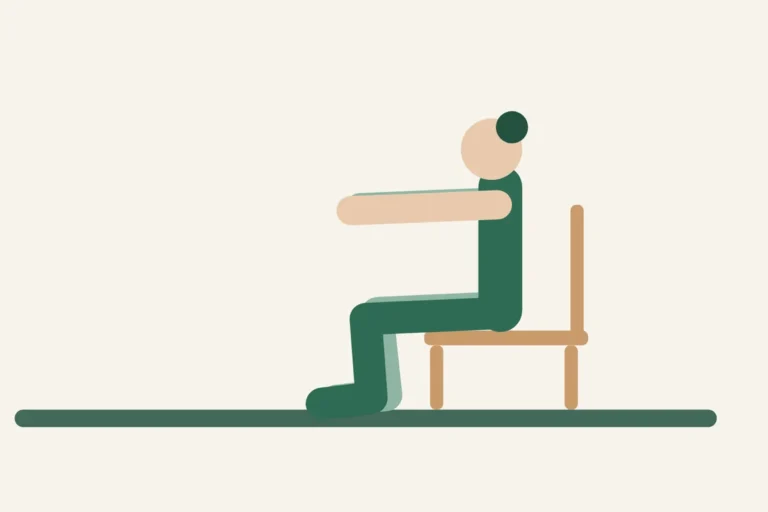
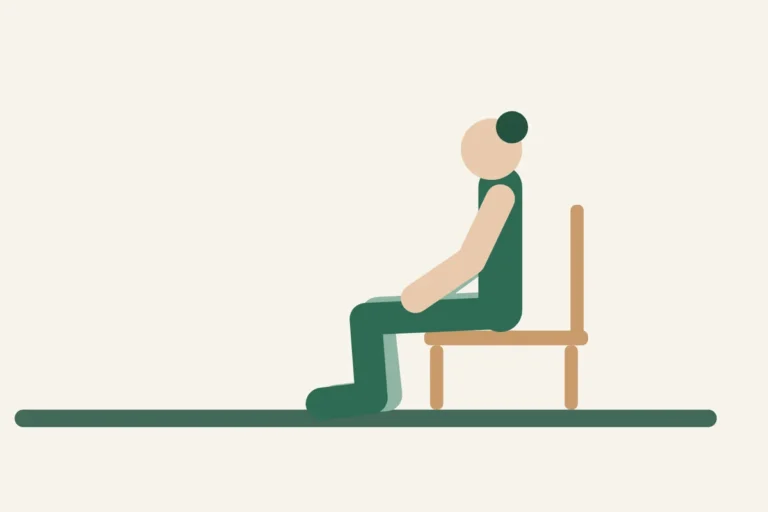
- Sit toward the front of the seat, both feet flat on the floor.
- Tip your pelvis a little forward and back until you feel both sitting bones under you.
- Grow tall through the crown of your head, soften your shoulders and rest your hands on your thighs.
- Take five slow breaths. Diaphragmatic breathing has a fuller guide.
Easier: a rolled towel behind your lower back helps if sitting tall tires you.
2. Seated Cat-Cow
Where you feel it: the whole spine, gently. The floor version is Cat-Cow.
- Put your hands on your thighs or knees.
- Breathe in: lift your breastbone, let your tailbone tip back and your belly move forward. Keep your chin level.
- Breathe out: round your back, tuck your tailbone and let your chin drift toward your chest.
- Match one breath to each movement and repeat about five times.
Watch out for: a chin that juts forward in the cow half, which Cleveland Clinic’s yoga-at-work poses warn against. Keep both halves small with low bone density.
3. Eagle arms
Where you feel it: between the shoulder blades and in the outer shoulders. This is only the arm part of Eagle Pose. Your legs stay uncrossed, feet flat.
- Sit tall and open both arms wide at shoulder height.
- Bring them forward and pass one elbow over the other, as if hugging yourself.
- Bend your elbows so your forearms point up and press your palms together. If they don’t meet, press the backs of your hands together, or rest each hand on the opposite shoulder.
- Lift your elbows to about shoulder height, keep your shoulders away from your ears and reach your fingertips forward.
- Stay three to five breaths, unwind, and switch which elbow is on top.
Watch out for: a pinch in the shoulder. Lower your elbows. Yoga International and YogaEasy teach these arm steps within the full pose, and we leave out the leg wrap.
4. Seated side bend
Where you feel it: along the ribs and waist.
- Place your left hand on the seat at your side.
- As you inhale, sweep your right arm overhead until it is next to your ear.
- As you exhale, tip toward the left. Keep both sitting bones on the seat and your chest pointing straight ahead.
- Hold for three breaths, rise as you inhale, then repeat on the other side.
5. Seated chest opener
Where you feel it: the front of the chest and shoulders. It’s a gentle backbend, so keep it small. The desk guide uses fingertips behind the head; this one uses your hands behind you.
- Move toward the seat’s front edge and sit upright.
- Reach both hands behind you and clasp them (Allina Health), or rest them on the seat behind you with fingertips pointing toward you (Harvard Health).
- Roll your shoulders back and down and lift your chest a little, chin level.
- Stay three breaths, then release.
Watch out for: a hard arch in the lower back or a head tipped back. Lift the chest, not the chin.
6. Seated twist
Where you feel it: the middle of the back.
- Sit sideways on an armless chair, backrest at your right side, feet flat, both sitting bones on the seat.
- Hold the backrest with both hands.
- Inhale and lengthen your spine. Exhale and rotate your ribcage toward the backrest, with your breastbone leading.
- Stay three to five breaths, return to center and turn the other way.
Watch out for: cranking the turn from your neck or pulling hard with your arms. If your neck pinches, line your chin up with the center of your chest, as Yoga International suggests. Harvard Health’s twist cue is to feel the stretch without straining or forcing.
Another way: sit facing forward, left hand to the outside of your right knee, right hand on the chair back, and turn right (Allina Health).
7. Chair forward fold
Where you feel it: the lower back and hips. On the floor, the matching pose is Seated Forward Fold.
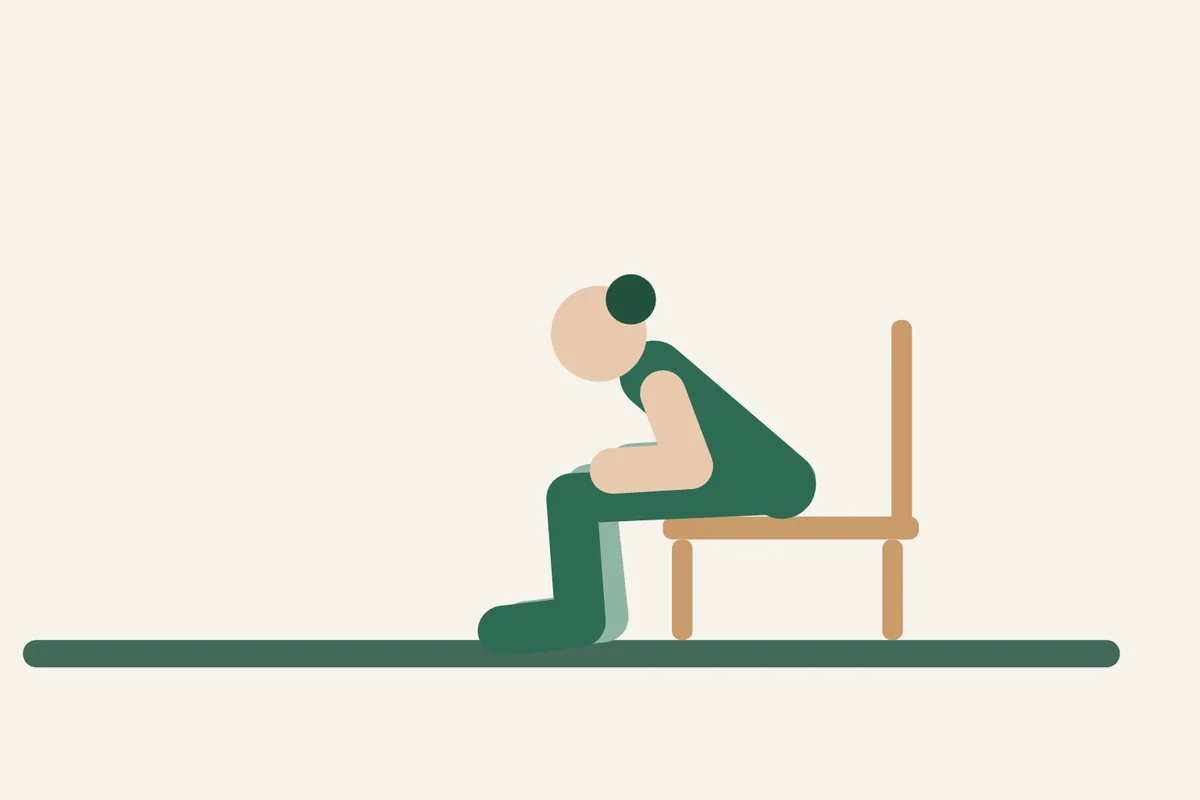
- Scoot forward until your back is off the backrest, feet hip-width or a little wider.
- Rest your hands on your thighs and lengthen your spine as you breathe in.
- Breathe out and hinge from the hips with a long back. Stay as high as is comfortable, or go until your forearms rest on your thighs.
- Stay three breaths, then press into your thighs and roll back up.
Watch out for: letting your head hang toward the floor. Some chair routines teach that, but head-down yoga poses pushed eye pressure up in a small study (Jasien et al., 2015), and ACE Fitness advises keeping the head above the heart in stretches, since many older adults get lightheaded easily. If you have glaucoma or get dizzy, stop while your hands still rest on your thighs and your head is higher than your heart; resting your forearms on your thighs is the deeper version.
8. Seated Warrior II
Where you feel it: the inner thigh of the straight leg, the hips and the shoulders. Use a stable chair with a wall behind it.
- Sit toward the front edge, facing forward. Bend your left knee over your left ankle, shin upright.
- Stretch your right leg out to the right and press the outer edge of that foot into the floor.
- Keep your hips centered on the seat and lift both arms to shoulder height in a T.
- Look over your left fingertips. Stay three slow breaths, then switch sides.
Easier: bend the straight leg a little, or rest your hands on your thighs. Warrior II has the standing pose.
9. Single-leg fold
Where you feel it: the back of the straight leg.
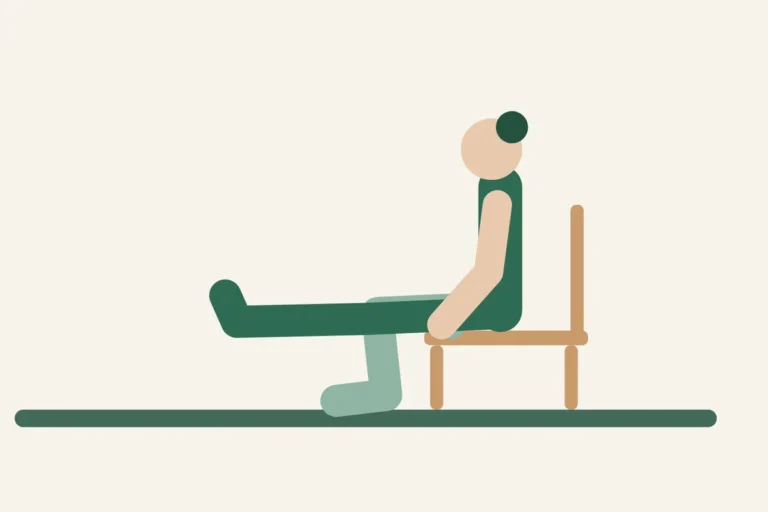
- Shift toward the front of the seat with your left foot flat on the floor.
- Extend your right leg ahead of you, heel on the floor and toes up, with a soft bend in the knee.
- Breathe in and lengthen. Breathe out and fold a little, sliding your hands down your thigh until you feel a mild pull behind it.
- Breathe three times, sit back up and change legs.
Easier: loop a strap around your foot, or stay upright. Keep your head above your heart, as in pose 7. See how to use a yoga strap and yoga for tight hamstrings.
10. Chair Pigeon
Where you feel it: deep in the outer hip and buttock. It’s the seated cousin of Pigeon Pose, also called a figure-4.
- Sit upright near the front of the seat, both feet flat.
- Lift your right foot and rest the ankle across your left thigh, just above the knee. Let the right knee fall open and flex that foot to protect the knee.
- If nothing stretches yet, lean forward a little from the hips, keeping your back long.
- Hold three to five breaths, then switch legs.
Easier: if the ankle won’t reach, cross it in front of the shin and rest the foot on a block. More hip poses: yoga for tight hips. Skip this pose after a hip replacement.
11. Seated quad stretch
Where you feel it: the front of the thigh and hip. Use a sturdy chair against a wall, and skip it if your balance is unsteady.
- Slide to the right side of the seat so your right thigh is half off the edge, left foot flat, left hand holding the chair.
- Let the right leg hang, then bend the knee and catch the foot with your right hand, or loop a strap around it.
- Draw the heel a little toward your buttock, sit tall and lean slightly left.
- Stay three breaths. If you feel it in the knee, let the foot go. Switch sides.
12. Seated rest
- Sit as in pose 1, hands on your thighs, eyes closed or gaze soft.
- Take five slow breaths and notice how you feel.
- Before you stand, pause for a few breaths and push up slowly with one hand on the chair. MedlinePlus notes that some people have low blood pressure symptoms if they get up too fast.
A 10-minute chair yoga routine
This order adds up to about 10 minutes, plus a little time between poses. These timings are our own plan, not a researched dose, and include both sides.
| Part | Poses | About how long |
|---|---|---|
| Settle | 1 Seated Mountain | 30 seconds |
| Spine | 2 Seated Cat-Cow | 50 seconds |
| Shoulders and chest | 3 Eagle arms, 5 Seated chest opener | 1 min 20 s |
| Sides and twist | 4 Seated side bend, 6 Seated twist | 1 min 50 s |
| Legs and hips | 7 Chair forward fold, 8 Seated Warrior II, 9 Single-leg fold | 2 min 40 s |
| Hips and thighs | 10 Chair Pigeon, 11 Seated quad stretch | 1 min 50 s |
| Finish | 12 Seated rest | 1 minute |
Short on time? Poses 1, 2, 6 and 12 fit into roughly three minutes.
Is chair yoga for beginners?
Yes, if you go slowly. For chair yoga for beginners we suggest poses 1, 2, 4, 6 and 12 for a week, then adding one or two poses each session until you’ve tried all 12. That’s our plan, not research. Read the safety box, check with your doctor if you have a health condition, and stop if anything hurts. When you want the floor, easy yoga poses lists beginner poses.
How long and how often, and is chair yoga enough exercise?
Research hasn’t settled on a dose. The trials we read used teacher-led classes: 45 minutes twice a week for 8 or 12 weeks, or 20 minutes twice a week for 12 weeks (see the research box). For home, Harvard Health says to do the moves in a sequence or pick a couple for a quick stretch. Treat a short session on most days as a starting point to adjust, not a prescription. More in how long to hold a yoga pose.
On its own, it may not be enough. The CDC says adults need 150 minutes of moderate-intensity activity a week and at least 2 days of muscle-strengthening, and that adults who sit less and do any amount of moderate or vigorous activity gain some benefits. We found no study that measured the intensity of a seated session, so we can’t say whether it counts toward those minutes. Think of it as a way to break up sitting, warm up, wind down or move on a low-energy day, alongside walking and strength work.
Make it easier (props)
You don’t need to buy anything.
- A sturdy chair without wheels, against a wall if you can.
- A block or thick book under your feet if they don’t reach the floor. See how to use yoga blocks.
- A strap or old belt for poses 9 and 11.
- A cushion or rolled towel behind your lower back, or under your hips in Warrior II.
Helpful gear for this
 Manduka begin yoga mat, 5 mm
5 mm TPE mat, 68 x 24 in, light to carry, with a center alignment stripe (maker's spec).
See it on Amazon Gaiam foam yoga blocks, pair
Two light foam blocks, 9 x 6 x 4 in each, to raise the floor under your hands (maker's spec).
See it on Amazon Hugger Mugger cotton D-ring yoga strap, 10 ft
Cotton webbing 1.5 in wide with a metal D-ring buckle, 10 ft long (maker's spec).
See it on Amazon
As an Amazon Associate we earn from qualifying purchases. How we choose gear
Who should skip it or ask a doctor first
- Talk to your doctor first if you have a health condition, take medicines that cause dizziness or haven’t been active lately. The NCCIH lists knee or hip injuries, lumbar spine disease, severe high blood pressure, balance problems and glaucoma as conditions that may call for changes, and says older adults and pregnant women may need them too. Harvard Health adds back, shoulder or hip problems and recent abdominal, shoulder or hip surgery.
- Hip replacement or a hip precaution: use a firm chair with armrests and hips higher than knees, and skip poses 7 to 11 unless your surgeon or physical therapist says they’re OK. MedlinePlus lists not bending the hip past 90 degrees, not crossing your legs or ankles, keeping your feet about 6 inches apart and keeping feet and knees pointed straight ahead, especially in the first few months. The folds, Pigeon and the wide stance of Warrior II run into those rules. Ask about poses 3 to 6 too.
- Pregnancy: check with your midwife or doctor. The NCCIH advises avoiding yoga poses with long periods of being still or lying on your back, and the NHS says to avoid lying flat on your back for more than a few minutes in later pregnancy. Everything here is seated. As our own precaution, skip or shrink any pose that squeezes your belly, such as the fold and the twist.
- Blood pressure: the NCCIH lists severe high blood pressure, so ask your doctor first. For low blood pressure, MedlinePlus says it is a problem when it causes dizziness or fainting. If you feel dizzy, sit still and tell your doctor if it happens more than once.
- Balance problems: stay seated with the chair against a wall, skip poses 8 and 11 or keep one hand on the chair, and don’t lean so far that the chair shifts.
- Osteoporosis or low bone density: Mayo Clinic doctors who reviewed the records of 89 patients injured by yoga found the poses most often blamed involved extreme bending of the spine forward or backward, and suggest people with low bone density avoid extreme forward flexion (Lee et al., 2019). Keep Cat-Cow and the chest opener small, hinge only a little in the folds and keep the twist gentle. The abstract names extreme bending, not twists, so ask your doctor how much turn is right.
- Glaucoma: keep your head above your heart. Eye pressure rose within a minute when 10 people with glaucoma and 10 without held four head-down yoga positions, and returned to baseline within two minutes of sitting up (Jasien et al., 2015). With glaucoma, keep the folds small: hands on your thighs, chest well above your knees and head clearly higher than your heart, or skip poses 7 and 9. Ask your eye doctor.
- Joint or neck pain: in Pigeon, flex your foot; in the quad stretch, let go if the knee complains; in Eagle arms, lower your elbows if a shoulder pinches; in the twist, keep your chin centered if your neck pinches.
- Chest pain, fainting, or sudden weakness or numbness: stop and call 911.
- Don’t use yoga to put off medical care. The NCCIH says not to use it to postpone seeing a provider about a medical problem.
What the research says
Evidence: limited
The evidence for chair yoga is limited. The trials are few and small, mostly in older adults or people with a health condition, and none tested this routine or individual poses. In the PubMed searches we ran on 21 November 2026 we found no randomized trial of chair yoga in healthy working-age adults, so we can’t say what it does for the average adult.
Trials in adults. In 75 adults with hypertension, split into three groups, twice-weekly 45-minute sessions for 12 weeks of chair yoga or of manual therapy, each added to patient education, were compared with education alone. Systolic blood pressure and heart rate fell within both treated groups, and the group-by-time results favored both over education alone. The chair yoga group also improved more on anxiety and mental well-being than the other two groups (Kaya Mutlu et al., 2026). The abstract gives p-values, not effect sizes, and it is one small trial, so we don’t suggest chair yoga lowers blood pressure. In 56 psychiatric inpatients (average age 55), 20-minute chair yoga sessions twice a week for 12 weeks, added to usual treatment, were followed by better flexibility, grip strength, leg endurance and confidence about falling in the chair yoga group, with no notable adverse effects. We read only the abstract, which doesn’t say whether these changes were compared with the usual-treatment group, so we treat them as changes within the group (Ikai et al., 2017).
Trials in older adults. A pilot randomized 131 older adults with lower-body osteoarthritis, who couldn’t do standing exercise, to chair yoga (66) or a health education program (65), both for 45 minutes twice a week over 8 weeks. Pain interference fell more with chair yoga, and the gap was still there at 3 months, while balance didn’t change (Park et al., 2017). A trial of 454 adults aged 65 and over with two or more long-term conditions offered a 12-week chair-based course on top of usual care. Quality of life over 12 months did not differ significantly (adjusted difference 0.020, 95% CI -0.006 to 0.045), and no serious related adverse events were reported (Tew et al., 2024). See chair yoga for seniors for more.
Yoga in general. For low back pain, the NCCIH describes a slight benefit and notes a 2022 review found the small difference over no exercise may not matter to patients. That is yoga overall, not chair yoga.
Overall: a few small trials, some positive within groups or on selected outcomes and one larger trial without a clear benefit on its main outcome. That is why we rate the evidence as limited.
Frequently asked questions
Is chair yoga a real workout?
It depends on how you do it. A slow stretching session is gentle, and no study we read measured its intensity. To reach the CDC’s activity targets, add walking and strength work. Chair yoga is a gentle option, not a replacement.
Is chair yoga only for seniors?
No. Harvard Health says anyone can try it. This page is for any adult, and chair yoga for seniors adds fall-aware notes for older adults. Your health conditions matter more than your age.
Sources
- National Center for Complementary and Integrative Health (NCCIH). Yoga: Effectiveness and Safety. Last updated August 2023., checked Nov 21, 2026
- Harvard Health Publishing (Klein S; reviewed by Shmerling RH). Chair yoga: Benefits of a mind-body practice without the risk of falling. February 11, 2025., checked Nov 21, 2026
- Kaya Mutlu E, Senel A, Atakan MB, et al. Integrating chair yoga and manual therapy into hypertension management: effects on autonomic regulation, muscle viscoelasticity, and mental well-being. J Clin Hypertens (Greenwich). 2026;28(7):e70329., checked Nov 21, 2026
- Ikai S, Uchida H, Mizuno Y, et al. Effects of chair yoga therapy on physical fitness in patients with psychiatric disorders: a 12-week single-blind randomized controlled trial. J Psychiatr Res. 2017;94:194-201., checked Nov 21, 2026
- Park J, McCaffrey R, Newman D, Liehr P, Ouslander JG. A pilot randomized controlled trial of the effects of chair yoga on pain and physical function among community-dwelling older adults with lower extremity osteoarthritis. J Am Geriatr Soc. 2017;65(3):592-597., checked Nov 21, 2026
- Tew GA, Wiley L, Ward L, et al. Chair-based yoga programme for older adults with multimorbidity: RCT with embedded economic and process evaluations. Health Technol Assess. 2024;28(53):1-152., checked Nov 21, 2026
- Centers for Disease Control and Prevention (CDC). Physical Activity Guidelines for Adults. Page dated December 20, 2023., checked Nov 21, 2026
- MedlinePlus (U.S. National Library of Medicine). Taking care of your new hip joint. Reviewed November 7, 2024., checked Nov 21, 2026
- MedlinePlus (U.S. National Library of Medicine). Low blood pressure. Last updated January 28, 2019., checked Nov 21, 2026
- NHS. Exercise in pregnancy. Page last reviewed September 24, 2026., checked Nov 21, 2026
- Lee M, Huntoon EA, Sinaki M. Soft tissue and bony injuries attributed to the practice of yoga: a biomechanical analysis and implications for management. Mayo Clin Proc. 2019;94(3):424-431., checked Nov 21, 2026
- Jasien JV, Jonas JB, de Moraes CG, Ritch R. Intraocular pressure rise in subjects with and without glaucoma during four common yoga positions. PLoS One. 2015;10(12):e0144505., checked Nov 21, 2026
- Karnes A. An accessible, fully seated chair yoga practice. Yoga International., checked Nov 21, 2026
- Jeraci AR. Chair yoga flow: a dynamic way to sit and practice. Yoga International., checked Nov 21, 2026
- Heagberg K. Eagle pose, step by step. Yoga International., checked Nov 21, 2026
- Savage J. Chair yoga sequence for hips and hamstrings. YogaEasy. Modified May 3, 2026., checked Nov 21, 2026
- YogaEasy Team. Eagle pose. YogaEasy. Modified July 29, 2026., checked Nov 21, 2026
- Cleveland Clinic. 12 yoga poses you can do wherever you’re working. November 24, 2020., checked Nov 21, 2026
- Dusek K. Five benefits of chair yoga and six poses to get started. Allina Health. June 2, 2017., checked Nov 21, 2026
- Antoian F. Chair exercises for older adults: 5 for strength, flexibility and balance. ACE Fitness. Last updated October 22, 2026., checked Nov 21, 2026
- Mansour S. 10 chair yoga poses you can do sitting down. TODAY. Accessed November 21, 2026., checked Nov 21, 2026
Image credits: Illustration: YogaForFitness (vector figure), drawn from the steps above