Chair Exercises for Seniors: 12 Strength Moves and a Printable Chart
Quick answer
Chair exercises for seniors are strength, mobility and light cardio moves done seated on a sturdy chair without wheels. Start with about 5 slow repetitions of each move, build toward 8 to 12 as it gets easier, and stop for pain, dizziness or chest discomfort. This page gives 12 moves, a one-page chart you can print and a 15-minute order. Seated work is a start, not the whole plan: health agencies also ask older adults for aerobic activity and balance practice.
We may earn a commission when you buy through links on this page. It never changes what we recommend. As an Amazon Associate we earn from qualifying purchases.
Chair exercises for seniors are strength, mobility and light cardio moves you do sitting on a sturdy chair, or standing while you hold one. This guide gives you 12 of them, a one-page chart to print and a 15-minute order to follow. Sit near the front edge with both feet flat, move slowly, and start with about 5 repetitions of each move. Health agencies ask older adults for strength work on at least 2 days a week, so this is a good place to begin. It is part of our Yoga For guides.
Nothing here is medical advice, and none of it promises better strength, balance or fewer falls. Read the safety box before you start.
In this guide
- What are chair exercises, and how are they different from chair yoga?
- How much exercise do older adults need?
- Set up your chair
- Printable chair exercises for seniors: the one-page chart
- The 12 moves, step by step
- Your 15 minute chair exercises for seniors routine
- How many repetitions, and how often?
- Make it easier (props)
- Who should skip it or ask a doctor first
- What the research says
- Frequently asked questions
- Sources
What are chair exercises, and how are they different from chair yoga?
Chair exercises are ordinary strength, mobility and cardio moves adapted so you can do them seated. Think of lifting a knee, straightening a leg, curling a light weight or standing up from the chair. Mobility here means moving your joints through a comfortable range (see mobility vs flexibility). The chair gives you support and takes the floor out of the picture, which helps if balance, joint pain or getting up and down is hard.
Chair yoga is a different thing. It is gentle yoga done seated, built around slow breathing, stretching and spine movement. This page is the strength-and-movement side. Pick chair yoga for a calm stretch or a warm-down, and this page for a strength session. You can use both in the same week. Neither is a complete plan on its own.
How much exercise do older adults need?
Seated moves are one piece of what agencies recommend for adults 65 and older:
- Aerobic: the CDC says 150 minutes a week of moderate effort (brisk walking, for example), or 75 minutes of vigorous effort, or a mix of the two.
- Strength: at least 2 days a week of muscle-strengthening that works all the major muscle groups (CDC). The NHS also lists strength, balance and flexibility activities on at least 2 days a week.
- Balance: the CDC includes activities that improve balance, and the National Institute on Aging (NIA) suggests about three balance sessions a week and lists practicing standing up from a seat as one example.
- Multicomponent: the World Health Organization recommends varied activity that emphasizes functional balance and strength training at moderate or greater intensity, on 3 or more days a week (Bull et al., 2020).
- Do what you can: the CDC says to be as active as your abilities and conditions allow.
Chair exercises can cover part of the strength requirement. This routine has no chest-strengthening move; a wall push-up (see the NHS strength exercises) fills that gap if you can stand. They don’t cover the aerobic minutes unless the session is hard enough to raise your breathing, and they touch balance only through the sit-to-stand. For balance and stretching, see balance exercises for seniors and stretching exercises for seniors.
Set up your chair
- Choose a firm, steady chair with a back and no wheels. The NHS advises a solid, stable chair that won’t slip on the floor and says to avoid chairs with arms because they restrict movement. Cleveland Clinic says dining chairs without armrests are usually a good choice and couches or soft chairs are not.
- Sit with your feet flat and your knees bent at right angles, as the NHS describes.
- After a hip replacement, follow your surgeon’s chair advice instead. MedlinePlus lists a firm, straight-backed chair with armrests, with your hips higher than your knees (sit on a cushion if the seat is low).
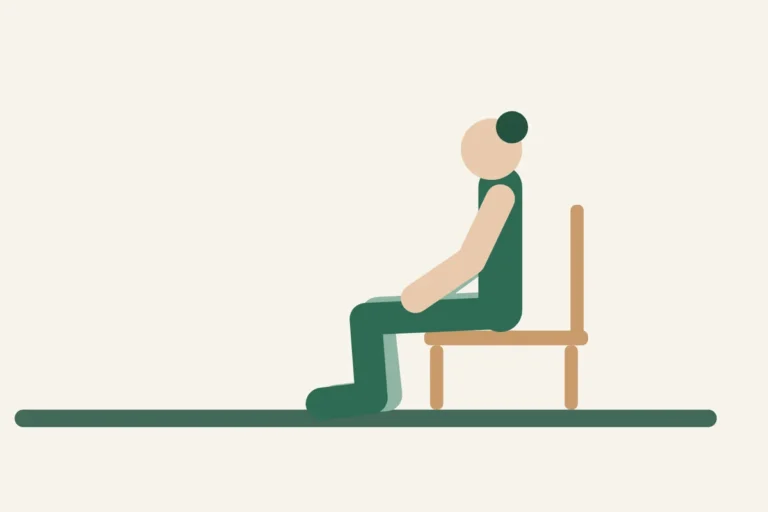
- Scoot toward the front of the seat for most moves, back tall. Sit back for the pelvic tilt.
- Keep support nearby for any move that involves standing. The NIA says to have a sturdy chair, a person or a wall within reach when you work on balance. A chair against a wall can’t slide, and Harvard Health suggests it for the chair stand.
- Wear comfortable clothes and keep water within reach, as the NHS suggests.
Printable chair exercises for seniors: the one-page chart
All 12 moves fit on this chart. There is no PDF to download. To print it, use your browser’s print command (Ctrl+P on Windows, Cmd+P on a Mac) and check the preview first, because the fit depends on your browser and paper. “Start” is where to begin, and “Build toward” is where to go over a few weeks if it feels easy. The counts follow the NHS, NIA, Harvard Health and Cleveland Clinic pages named below. They are general practice, not a prescription. The steps and easier or harder options follow the chart.
| # | Move | How | Start | Build toward |
|---|---|---|---|---|
| 1 | Seated march | Sit tall, lift one knee at a time | 20 seconds | 3 rounds of 15 to 20 seconds, 20 seconds’ rest between |
| 2 | Heel and toe raises | Lift heels, lower, then lift toes | 5 of each | 10 of each |
| 3 | Seated leg extension | Straighten one knee until the leg is level | 5 each leg | 8 to 12 each leg |
| 4 | Sit-to-stand | Stand up slowly from the chair, sit back slowly | 5 | 8 to 12 |
| 5 | Shoulder blade squeeze | Elbows bent, draw them back, squeeze | 5 | 10 |
| 6 | Arm raise | Thumbs up, lift both arms on a diagonal to shoulder height | 5 | 10 |
| 7 | Biceps curl | Bend the elbow to bring the weight to the shoulder | 5 each arm | 8 to 12 each arm |
| 8 | Knee squeeze | Pillow between knees, squeeze for 5 seconds | 5 | 10 |
| 9 | Knee press-out | Hands outside knees, press knees out for 5 seconds | 5 | 10 |
| 10 | Pelvic tilt | Press the lower back into the chair, tuck the tailbone | 5 | 10 |
| 11 | Upper-body twist | Arms crossed, turn from the ribs, hold 5 seconds | 3 each way | 5 each way |
| 12 | Chest stretch | Arms out wide, open the chest, hold 5 to 10 seconds | 3 | 5 |
If a move feels like too much, skip it or take the easier option. Pain, dizziness, nausea or chest pain or pressure means stop.
Before you start: after a hip replacement, ask your surgeon about moves 1, 4, 8 and 9. With osteoporosis, keep moves 10 and 11 small. With dizziness or low blood pressure, stand slowly in move 4 and have the chair against a wall. The safety box has the details.
The 12 moves, step by step
We wrote these steps in our own words after checking them against the teaching pages under Sources. Move slowly, breathe out on the effort and in as you relax, and don’t hold your breath, as the NIA advises.
1. Seated march
Works: the hips and thighs, and gets your heart rate up a little.
- Sit tall near the front of the seat, feet flat, hands holding the sides of the seat if you want support.
- Lift your right knee a comfortable height, then lower the foot with control.
- Do the left side, then keep alternating at an easy, steady pace. Breathe normally.
Easier: lift the knee only a couple of inches. Harder: pick up the pace, as in the Harvard Health seated march: 15 to 20 seconds, 20 seconds’ rest, three rounds.
2. Heel and toe raises
Works: the calves (heel raises) and the shins (toe raises).
- Sit with your feet about hip-width apart, flat on the floor.
- Press through the balls of your feet and lift both heels as high as is comfortable. Lower them slowly.
- Next, keep your heels down and lift your toes toward your shins. Lower slowly.
Harder: do the heel raise standing, hands on the chair back, as the NHS describes its calf raise.
3. Seated leg extension
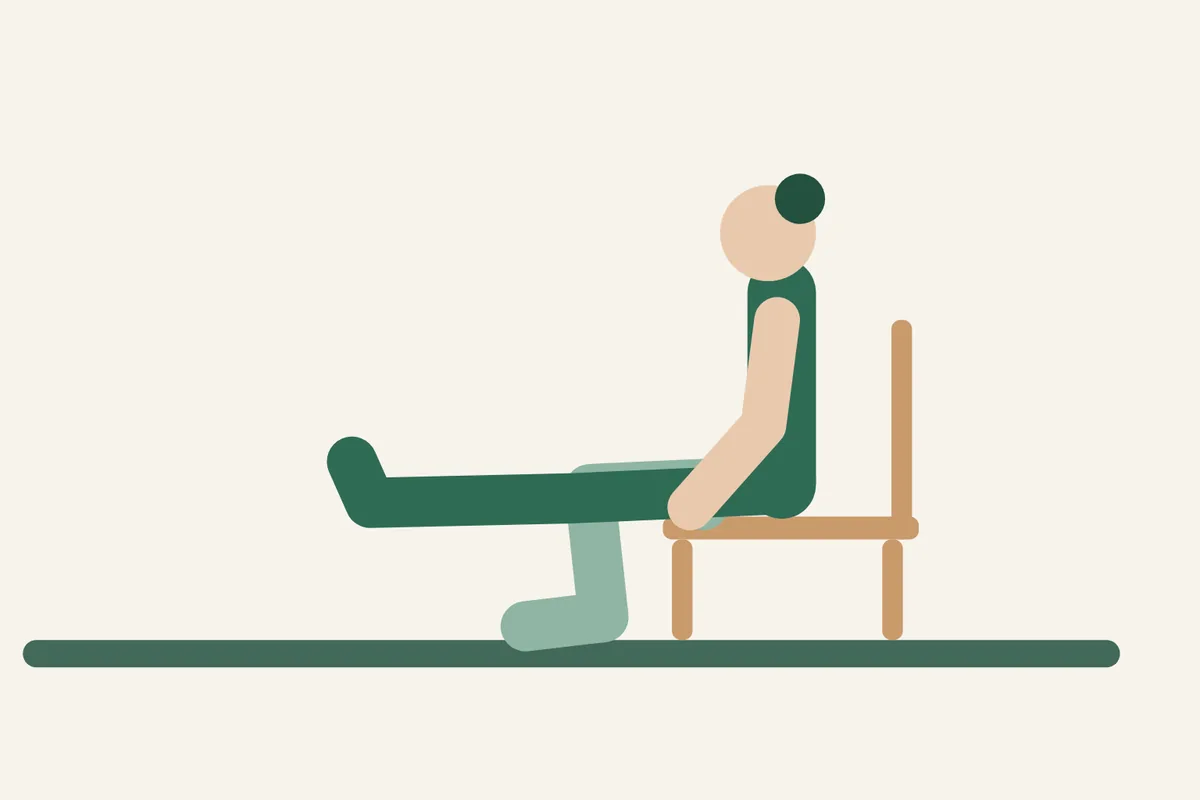
Works: the front of the thigh.
- Slide forward a little, sit tall and hold the sides of the seat.
- Breathe out and slowly straighten your right knee until the leg is about level with the floor.
- Pause a second, then lower the foot slowly. Do all your reps on one leg, then switch.
Stop just short of locking the knee; the NIA says to avoid locking your joints.
Easier: lift the foot only a few inches. Harder: add light ankle weights once 12 reps feel easy.
4. Sit-to-stand
Works: the thighs and buttocks, and the movement you use to get out of any chair. The NIA lists it as a balance practice, too.
- Put the chair against a wall and sit near the front edge, feet about hip-width apart. Cross your arms over your chest if you can, or rest your hands on your thighs.
- Lean your upper body forward a little, with your eyes ahead rather than on the floor.
- Push through your feet and stand up slowly, letting your legs do the work and your hands as little as possible.
- Pause upright for a breath, then lower yourself back down slowly. The slower, the better, says the NHS.
Easier: push off your thighs with both hands, or sit on a firm cushion to raise the seat (our own tip). Keep a person or a sturdy support within reach. Harder: slow the lowering down to a count of three, or add reps.
5. Shoulder blade squeeze
Works: the muscles between the shoulder blades.
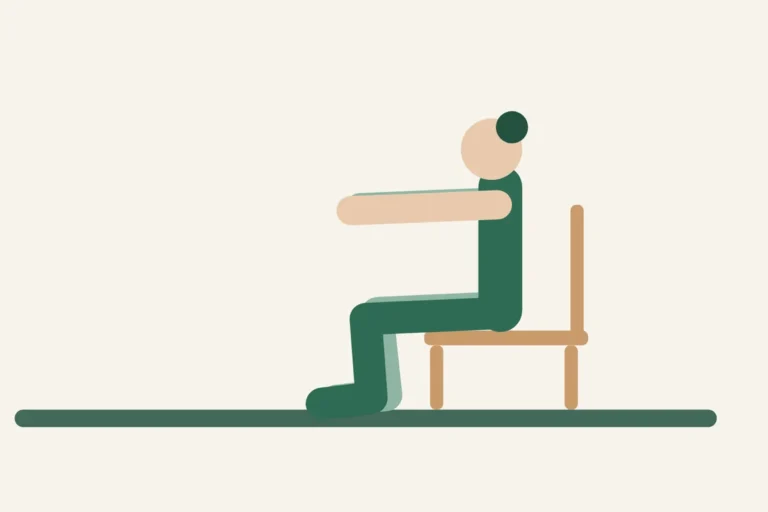
- Sit tall with your elbows bent and your forearms out in front of you, parallel to the floor.
- Draw your elbows back and down along your sides, and squeeze your shoulder blades toward each other as if holding a pencil between them.
- Hold for a second, then release slowly.
Easier: let your arms hang and just squeeze the shoulder blades.
6. Arm raise
Works: the shoulders and upper back. It is a strength move, not the stretch-style reach of chair yoga.
- Sit tall, gaze ahead, arms by your sides with your thumbs pointing up.
- Breathe out and lift both arms on a diagonal, halfway between straight ahead and out to the side, up to shoulder height and no higher.
- Lower them slowly.
Skip lifting overhead. ACE’s chair-exercise article advises skipping overhead presses with older clients.
Easier: lift one arm at a time. Harder: hold a light can, small water bottle or a wrist weight in each hand.
7. Biceps curl
Works: the front of the upper arm.
- Sit tall with your feet flat, holding a light weight in each hand, arms down by your sides and palms facing your thighs. A filled water bottle works, as the NHS notes.
- Keep your elbow tucked against your side. Breathe out and bend the elbow, turning your palm to face your shoulder as the weight rises.
- Pause, then lower slowly. Do your reps on one arm, then the other, or alternate.
Choose a weight that makes the last one or two reps feel hard but not impossible. Harvard Health suggests moving to a lighter weight if you can’t lift it 8 times and a heavier one once 12 reps feel comfortable.
Easier: no weight, as the NIA suggests for beginners.
8. Knee squeeze
Works: the inner thighs and hips.
- Sit near the front of the chair with a pillow or rolled towel between your knees and your feet about hip-width apart.
- Squeeze your knees together gently and hold for about 5 seconds, breathing normally.
- Release slowly.
Easier: squeeze softly, hold for 2 or 3 seconds. Skip it if you have had a hip replacement, unless your surgeon says it is fine (see the safety box).
9. Knee press-out
Works: the outer hips and buttocks.
- Sit as in move 8, without the pillow, and place your hands on the outsides of your knees.
- Press your knees out against your hands, with your hands resisting, and hold for about 5 seconds.
- Relax slowly.
Easier: press lightly. Harder: use a resistance band above the knees, as ACE does in its hip abduction move.
10. Pelvic tilt
Works: the deep abdominal muscles and lower back. The movement is small.
- Sit all the way back so your lower back touches the backrest, feet flat and a little wider than your hips.
- Breathe out and roll the bottom of your pelvis forward under you, so the small of your back flattens against the chair. Your chest and shoulders don’t move.
- Count to two or three, then ease back to a neutral, upright sit.
Easier: gentler squeezing, shorter holds.
11. Upper-body twist
Works: the middle back, with a small turn that keeps your hips still.
- Sit tall with your hips squarely on the seat and your arms folded across your chest, fingertips resting near your shoulders.
- Breathe out and turn your ribcage to the left, leading with your breastbone and keeping your hips facing forward. Go only as far as feels easy and stay for about 5 seconds.
- Return to the center of the seat, then turn the same way to the right.
Easier: turn only a little, hands on your thighs. Keep the turn gentle. With osteoporosis, keep it small.
12. Chest stretch
Works: the front of the chest and shoulders, a good way to finish.
- Slide forward so your back is off the backrest and your sitting bones are level.
- Open your arms wide at shoulder height, palms facing forward.
- Breathe in and let your breastbone rise as your shoulder blades draw gently toward each other, until you feel a mild stretch across the front of your chest. Stay for 5 to 10 seconds, breathing, then relax.
Easier: keep your hands on your thighs and just lift the chest. Stop at a mild stretch, never pain.
Your 15 minute chair exercises for seniors routine
This order takes about 15 minutes for one round. The timings are our plan, not a researched dose.
| Part | Moves | About how long |
|---|---|---|
| Warm-up | 1 Seated march, 2 Heel and toe raises | 3 min |
| Legs and hips | 3 Leg extension, 4 Sit-to-stand, 8 Knee squeeze, 9 Knee press-out | 5 min |
| Arms and upper back | 5 Shoulder blade squeeze, 6 Arm raise, 7 Biceps curl | 3 min |
| Core | 10 Pelvic tilt | 1 min |
| Stretch | 11 Upper-body twist, 12 Chest stretch | 2 min |
| Finish | Sit quietly and breathe, then stand slowly | 1 min |
Short on time? Moves 1, 4, 7 and 12 take about five minutes.
How many repetitions, and how often?
No study has set the right dose for these 12 moves. The ranges on the chart come from the guides we read:
- The NHS starts with 5 repetitions of its chair strength moves, says to build up slowly and suggests doing them at least twice a week.
- The NIA says one set of 8 to 12 repetitions works, with two or three sets possibly working better, and that beginners can skip weights until the movements feel comfortable.
- Harvard Health uses 8 to 12 repetitions for its chair stand and biceps curl.
- Cleveland Clinic starts with one set of 10, works toward two or three sets, and says most people can do its routine daily.
There is one disagreement worth knowing. The NIA advises not working the same muscle group on any two days in a row, so the muscles can recover, and says strength sets should be hard enough that one more repetition would be difficult. Cleveland Clinic says its gentler routine is safe to do every day for most people. A practical middle path: do the strength moves (3, 4, 7, 8 and 9) on alternate days, for example Monday, Wednesday and Friday, and use the gentler moves (1, 2, 11 and 12) on the days between. Some soreness is normal; joint pain is a reason to back off.
Make it easier (props)
You don’t need to buy anything.
- A sturdy chair without wheels, against a wall if you can.
- A small pillow or rolled towel for the knee squeeze and the sit-to-stand.
- Two light weights. Filled water bottles or soup cans work, as the NHS and Cleveland Clinic note.
- A firm cushion to raise the seat, or a box under your feet if they don’t reach the floor.
Helpful gear for this
 Manduka begin yoga mat, 5 mm
5 mm TPE mat, 68 x 24 in, light to carry, with a center alignment stripe (maker's spec).
See it on Amazon Gaiam foam yoga blocks, pair
Two light foam blocks, 9 x 6 x 4 in each, to raise the floor under your hands (maker's spec).
See it on Amazon Hugger Mugger cotton D-ring yoga strap, 10 ft
Cotton webbing 1.5 in wide with a metal D-ring buckle, 10 ft long (maker's spec).
See it on Amazon
As an Amazon Associate we earn from qualifying purchases. How we choose gear
Who should skip it or ask a doctor first
- Talk to your doctor first if you have a health condition, haven’t exercised for some time or have concerns. The NHS says to speak to a GP first in those cases. If you are unsure about a move, the NIA says to ask your doctor or physical therapist.
- Heart or lung conditions: ask your doctor how much effort is right for you. The NIA says aerobic activity shouldn’t bring on dizziness, chest pain or pressure, or nausea, and the seated march and sit-to-stand can raise your heart rate.
- Recent surgery: ask your surgeon or physical therapist before you start. This is our own precaution.
- Hip replacement: skip moves 1, 4, 8 and 9 unless your surgeon says they are OK. MedlinePlus lists rules for after surgery such as avoiding bending the hip past 90 degrees (a right angle), not crossing your legs or ankles, and, when sitting, keeping your feet about 6 inches apart rather than together. Lifting a knee, leaning forward to stand and squeezing your knees together can run into those rules. Rules depend on your surgery, so use a chair with armrests that keeps your hips above your knees if your surgeon advises it.
- High blood pressure: if yours is high or not under control, ask your doctor first. Keep the squeezes in moves 8 and 9 light and short, and breathe throughout; ACE advises against static isometric exercise for older clients (ACE).
- Knee or hip injury, or an arthritis flare: keep moves 3 and 4 small and skip ankle weights until your doctor or physical therapist says they are fine. NCCIH lists knee and hip injuries among conditions that may need changes to exercise (NCCIH).
- Dizziness or low blood pressure: stand slowly and pause before you walk. MedlinePlus says some people have symptoms of low blood pressure when they stand up too quickly, and that it becomes a problem when it causes dizziness or fainting. If you feel dizzy, sit still, and tell your doctor if it happens more than once.
- Balance problems: put the chair against a wall and hold something steady for move 4. Don’t lean far enough to shift the chair.
- Osteoporosis or low bone density: keep moves 10 and 11 small. A review of medical records of 89 patients with yoga-related injuries found that poses with extreme spinal bending, forward or backward, were most often involved, and advised avoiding extreme spinal flexion with osteopenia or osteoporosis (Lee et al., 2019). That was yoga, not these seated moves, and its abstract names extreme forward and backward bending, not twists, so ask your doctor how much turn is right for you.
- Joint pain or pain that doesn’t settle: stop and ease off (Cleveland Clinic). Effort is fine, pain is not.
- Chest pain, fainting, or sudden weakness or numbness: stop and call 911.
What the research says
Evidence: moderate
The evidence for chair-based exercise is moderate for strength tests, and weaker for balance and falls. No study tested this 12-move routine, so the label describes the research on chair-based and strength exercise in older adults in general.
Chair-based exercise. A 2021 review of chair-based exercise in adults aged 50 and over included 25 studies and 1,388 participants, and pooled 19 of them. Comparison groups were usual care, no intervention or non-seated exercise. Compared with those groups, chair-based programs improved grip strength (7 studies, 266 people), the 30-second arm curl test (3 studies, 97 people) and the 30-second chair stand test (3 studies, 97 people). The two 30-second tests varied a lot between studies. Berg balance score (5 studies, 359 people), timed up and go (7 studies, 394 people), gait speed (6 studies, 450 people) and falls efficacy (5 studies, 208 people) did not differ significantly. Seven of the 25 studies tested chair-based yoga, so the mix is wider than strength moves (Klempel et al., 2021). A review of 10 studies of 511 nursing home residents (average age 79) found seated exercise appeared feasible and safe, and said more high-quality trials were needed. It did not pool results (Cordes et al., 2021).
Strength training in general. A Cochrane review of 121 trials with 6,700 older participants found a large effect of progressive resistance training on muscle strength (73 trials, 3,059 people) and a smaller improvement in physical ability (33 trials, 2,172 people). Most trials used high-intensity training, harder than gentle seated moves. Muscle soreness and joint pain were reported in many of the trials that monitored them, and serious events were rare (Liu and Latham, 2009). That review is not about chairs.
Falls. A Cochrane review of 108 trials and 23,407 community-dwelling older adults found that balance and functional exercises reduced the rate of falls by 24% (39 studies, 7,920 people) and that combining several exercise types, usually balance and functional exercises plus resistance work, probably reduced it by 34% (11 studies, 1,374 people). It said the effect of programs that are mainly resistance training was uncertain (Sherrington et al., 2019). We found no trial showing that seated strength moves prevent falls, so pair them with balance practice.
Weight. Chair exercises alone aren’t a weight-loss plan. The CDC says that to lose weight and keep it off, you need a high amount of physical activity unless you also change what you eat (CDC). We make no claim about belly fat or weight loss.
Overall: reviews agree on gains in strength tests, but the chair-specific results come from small groups and varied programs, and balance and falls results are not clear.
Frequently asked questions
Are chair exercises for seniors good enough on their own?
They are a useful start, especially if standing or floor exercise is hard, but they aren’t enough alone. The CDC and WHO ask older adults for aerobic activity and balance practice as well as strength work (see the guidelines section above). Walking, if you can, and a balance routine fill the gaps.
Where can I get free printable chair exercises for seniors?
Right here. The chart above is free and on this page, and you can print it with your browser. It is a table rather than a downloadable file.
Is there a chair exercises for seniors PDF?
No. We don’t offer a PDF download. Print the chart above with Ctrl+P (Cmd+P on a Mac) and check the preview before you print.
Are chair exercises for over 60 safe?
They are a lower-risk way to start, and a nursing home review found seated exercise appeared feasible and safe, but no exercise is risk-free and your health matters more than your age. Soreness is common. Check with your doctor if you have any condition, and read the safety box above.
What are the best seated exercises for seniors?
There is no single best move. For the legs, the sit-to-stand and leg extension are the most useful here. The seated march adds light cardio, and the curl and arm raise work the arms and shoulders. The chart covers a bit of each.
Do senior chair exercises help with balance?
Only a little. Seated moves don’t train your balance reactions the way standing practice does, and the chair-based review found no significant difference in balance tests. The sit-to-stand is the one move here the NIA lists as balance practice. See balance exercises for seniors.
Are there sitting exercises for seniors that work the core?
Lightly: the pelvic tilt and the upper-body twist ask for a little core effort. For more, see core exercises for seniors.
Sources
- National Institute on Aging (NIA). Three Types of Exercise Can Improve Your Health and Physical Ability. Content reviewed January 14, 2025., checked Nov 20, 2026
- Centers for Disease Control and Prevention (CDC). Older Adult Activity: An Overview. Page dated December 4, 2025., checked Nov 20, 2026
- NHS. Physical activity guidelines for older adults. Page last reviewed August 15, 2024., checked Nov 20, 2026
- NHS. Strength exercises. Page last reviewed February 28, 2024., checked Nov 20, 2026
- NHS. Sitting exercises. Page last reviewed January 18, 2024., checked Nov 20, 2026
- Cleveland Clinic (Jevnikar T, PT). 11 chair exercises for seniors, older adults and people with limited mobility. April 18, 2024., checked Nov 20, 2026
- Harvard Health Publishing (Klein S; reviewed by Shmerling RH). Chair exercises for seniors: boosting strength, flexibility, and stamina. January 9, 2025., checked Nov 20, 2026
- Antoian F. Chair exercises for older adults: 5 for strength, flexibility and balance. ACE Fitness. Last updated October 22, 2026., checked Nov 20, 2026
- Klempel N, Blackburn NE, McMullan IL, et al. The effect of chair-based exercise on physical function in older adults: a systematic review and meta-analysis. Int J Environ Res Public Health. 2021;18(4):1902., checked Nov 20, 2026
- Cordes T, Schoene D, Kemmler W, Wollesen B. Chair-based exercise interventions for nursing home residents: a systematic review. J Am Med Dir Assoc. 2021;22(4):733-740., checked Nov 20, 2026
- Liu CJ, Latham NK. Progressive resistance strength training for improving physical function in older adults. Cochrane Database Syst Rev. 2009;(3):CD002759., checked Nov 20, 2026
- Sherrington C, Fairhall NJ, Wallbank GK, et al. Exercise for preventing falls in older people living in the community. Cochrane Database Syst Rev. 2019;1(1):CD012424., checked Nov 20, 2026
- Bull FC, Al-Ansari SS, Biddle S, et al. World Health Organization 2020 guidelines on physical activity and sedentary behaviour. Br J Sports Med. 2020;54(24):1451-1462., checked Nov 20, 2026
- Centers for Disease Control and Prevention (CDC). Physical Activity for a Healthy Weight. Page dated April 7, 2026., checked Nov 20, 2026
- Lee M, Huntoon EA, Sinaki M. Soft tissue and bony injuries attributed to the practice of yoga: a biomechanical analysis and implications for management. Mayo Clin Proc. 2019;94(3):424-431., checked Nov 20, 2026
- MedlinePlus (U.S. National Library of Medicine). Taking care of your new hip joint. Reviewed November 7, 2024., checked Nov 20, 2026
- MedlinePlus (U.S. National Library of Medicine). Low blood pressure. Last updated January 28, 2019., checked Nov 20, 2026
Image credits: Illustration: YogaForFitness (vector figure), drawn from the steps above