Yoga for Desk Workers: Desk Stretches for Neck, Back and Hips
Quick answer
Break up long stretches of sitting with a few minutes of gentle movement: breathe, round and lift your back, tilt your neck, roll your shoulders, open your chest, twist, and stretch your wrists and hips. Workplace guidance suggests a short break about once an hour, though no study has found the ideal timing. Stop if anything hurts, and see a doctor first if you have numbness, tingling or pain that doesn't settle.
We may earn a commission when you buy through links on this page. It never changes what we recommend. As an Amazon Associate we earn from qualifying purchases.
If you sit most of the day, your neck, shoulders, wrists and hips spend hours in the same position. This guide gives you gentle desk stretches, a yoga sequence you can do beside your desk, with a chair or standing, in a few minutes and without a mat or a change of clothes. It also answers the question behind it: how often should you stop sitting? And it says plainly what the research does and doesn’t show. It’s part of our Yoga For guides.
New to yoga? Start with yoga for beginners or how to start yoga at home. Nothing here is medical advice, and none of it promises pain relief.
In this guide
How often should you break up sitting?
No one has found a perfect interval, but the guidance points the same way: sit less, and move in short bursts.
- The World Health Organization recommends reducing sedentary behavior for every age group, but its 2020 guidelines say the evidence was too thin to name a time limit (Bull et al., 2020).
- The CDC pairs its adult activity targets, 150 minutes of moderate activity a week plus muscle-strengthening on at least 2 days, with a “move more, sit less” message (CDC).
- The American College of Sports Medicine found health benefits in cutting total sitting time and in breaking it up with frequent, short bouts of standing and activity, even in adults who exercise regularly (Garber et al., 2011).
- Canada’s federal workplace safety agency (CCOHS) advises a 5 to 10 minute break for every hour at a workstation, ideally standing and walking (CCOHS). A Cleveland Clinic chiropractor likewise suggests standing and moving around no less than hourly (Cleveland Clinic).
Reminders can help. A 2025 review of 18 trials in office workers pooled 8 of them (325 workers) and found that computer prompts, alone or combined with sit-stand desks, cut workday sitting by about 12 minutes. In 3 trials, workday steps rose by roughly 1,000. Only two trials measured aches and pains, with mixed results (one favored the prompts, one the control group). The certainty of the evidence for the sitting and step results was low to moderate (Leppe-Zamora et al., 2025).
A practical starting point, then: set a timer for every 30 to 60 minutes, stand up, and do one or two of the moves below. Treat that as a plan you can adjust, not a researched dose. Walking counts as a break too, and our sequence is simply one way to fill it.
Before you start
- Pick a stable chair. Harvard Health advises a chair that doesn’t tip, wobble or roll, and one without arms if you can, so you have room to move. If your office chair has wheels or swivels, use a sturdy chair without wheels for the twist and hip moves, and never step onto a wheeled chair for the standing lunge.
- Sit toward the front edge with your feet flat, so your back isn’t leaning on the backrest. If your feet don’t reach the floor, a box or stool helps (Cleveland Clinic).
- Aim for a mild stretch, never pain. CCOHS says to skip bouncing, forcing or locking your joints, to feel a stretch but not pain, and to stop if it hurts. Keep breathing slowly as you hold (CCOHS).
- Hold for 3 to 5 breaths, or about 10 to 20 seconds, the ranges used by Cleveland Clinic and CCOHS.
- Get your doctor’s OK first if your back, shoulders or hips give you trouble, or if you recently had abdominal, shoulder or hip surgery (Harvard Health). The caution box below has more.
A gentle desk sequence: nine moves
Each move names what it targets, gives short steps and offers an easier option. Do them in order for a full break, or pick two or three for a quick one. Everything is done sitting or standing; none of it needs you to lie down.
1. Settle and breathe (seated or standing Mountain Pose)
Targets: posture awareness and a calmer breath.
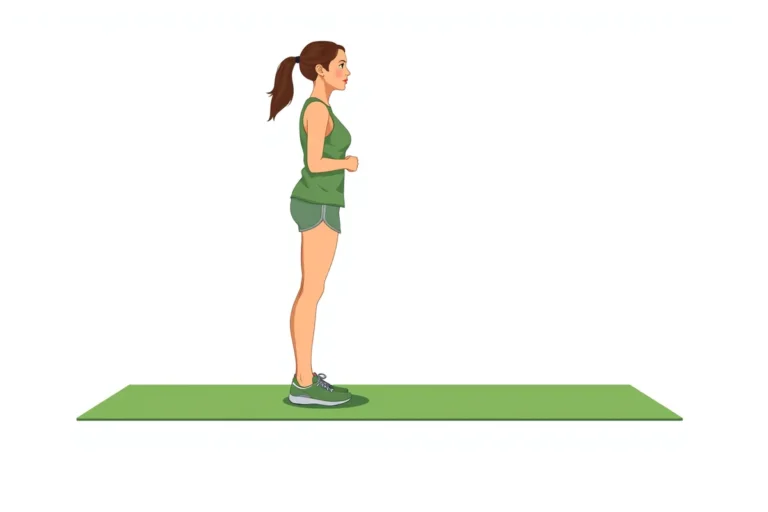
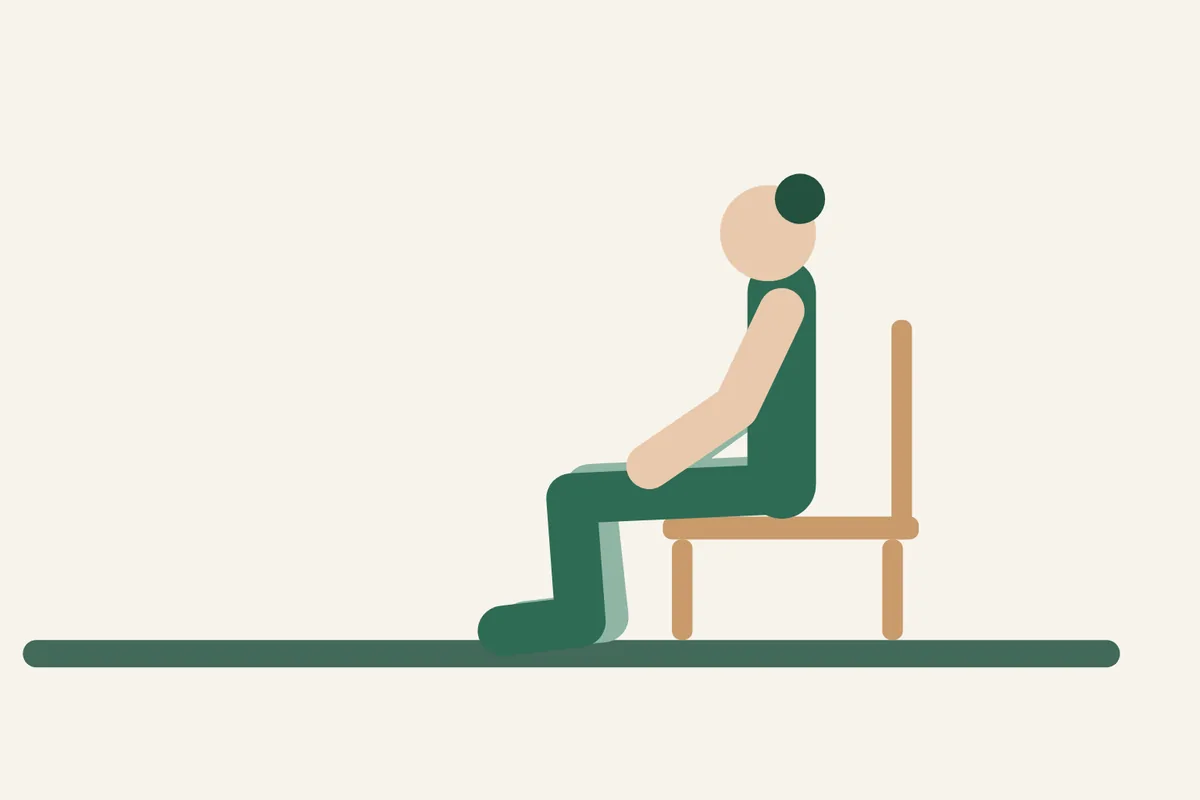
- Perch toward the front of the seat with your feet flat, about hip-width apart, and your knees stacked over your ankles. Or stand with your weight even on both feet, as in Mountain Pose.
- Grow tall through the crown of your head and let your shoulders drop away from your ears.
- Rest a hand on your belly and take five slow breaths through your nose, letting your belly rise as you breathe in. Diaphragmatic breathing has the full technique.
Easier: if five breaths feels long, take three.
2. Chair Cat-Cow
Targets: the whole spine, gently. Our Cat-Cow guide has the floor version and a standing version.
- Perch tall toward the front of the seat and rest your hands on your knees.
- Breathe in and let your chest lift and your belly move forward, keeping your chin level instead of tipping your head back.
- Breathe out and round your back, drawing your belly in and letting your head follow.
- Repeat for five slow rounds, one breath per movement.
Easier: make the movement smaller, or do only the lifting half.
3. Neck side tilt and turn
Targets: the sides and back of the neck.
- Sit tall with your shoulders soft and your hands resting in your lap or under your thighs.
- Slowly lower your right ear toward your right shoulder until you feel a mild stretch along the left side of your neck. Let the weight of your head do the work, with no pulling.
- Breathe for three to five breaths, then return to center and switch sides.
- Still sitting tall, turn your head slowly to look over one shoulder, then the other, only as far as is comfortable.
Keep the movements small and slow. This sequence leaves out neck circles and dropping your head back.
4. Shoulder shrugs and rolls
Targets: the shoulders and the base of the neck.
- Lift both shoulders toward your ears, hold for a few seconds, and let them drop. Do this two or three times.
- Roll your shoulders back in slow circles about five times, then forward about five times, breathing steadily.
Easier: move one shoulder at a time.
5. Open the chest
Targets: the chest and the front of the shoulders.
- Sit tall near the front edge of the chair.
- Rest your fingertips lightly behind your head, with your elbows wide.
- Draw your shoulder blades gently toward each other and lift your breastbone a little, keeping your ribs soft and your chin level.
- Hold for three to five breaths, then release your arms.
Easier: hold the sides of the chair seat and lift your chest, or rest your hands on your thighs and just squeeze your shoulder blades together. Don’t arch hard through your lower back or throw your head back.
6. Seated side bend
Targets: the sides of the ribs and waist.
- Sit tall and place your left hand on the chair seat beside you for support.
- Breathe in and reach your right arm up. Keep your shoulder relaxed.
- Breathe out and lean to the left, keeping both hips on the seat and your chest facing forward.
- Stay for three breaths, come back up with an inhale, and switch sides.
Easier: keep the reaching hand on your head or at your side.
7. Seated twist
Targets: the middle and upper back, with a gentle rotation.
- Sit sideways on a sturdy chair so the backrest is on your right. Keep your feet flat and your knees together.
- Hold the chair back with both hands.
- Breathe in and sit tall. Breathe out and turn your ribs toward the backrest, then look over your shoulder if your neck feels fine.
- Stay for three to five breaths and return to center. Then sit facing the other way, so the backrest is on your left, and twist toward it.
Watch out for: forcing the twist with your arms or from your neck. The turn should come from your mid-back, and Harvard Health says you shouldn’t strain or force it.
8. Wrist and forearm stretches
Targets: the muscles on the palm side and the back of your forearm.
- Hold one arm straight out in front of you with the palm up and your fingers straight. Use your other hand to ease your fingers gently down toward the floor until you feel a mild stretch in your forearm.
- Stay about 10 to 20 seconds and let go.
- Turn the palm down, bend the wrist so the fingers point toward the floor, and gently press on the back of your hand with the other hand. Stay about 10 to 20 seconds, let go and switch arms.
Cleveland Clinic says these are for wrists that move without much pain, and that pain above roughly 3 or 4 out of 10 is a reason to see a provider instead (Cleveland Clinic). Stop if you notice tingling or numbness.
Easier: bend the elbow so your forearm rests on the desk, and use less pressure.
9. Hips: seated figure-4 and a standing option
Targets: the outer hip and buttock (figure-4), and the front of the hip (standing option).
- Perch toward the front of the seat with your feet flat. Cross your right ankle over your left thigh, just above the knee.
- Sit tall. Already feeling it in the right hip? Stay upright. Otherwise, tip your torso forward a little from the hips, back long and chest open.
- Hold for three to five breaths, then switch sides.
- For a standing option, use the chair lunge from our Low Lunge guide: it keeps your weight off the knee, but use a sturdy chair without wheels, push it against a wall first, hold the backrest with both hands and go only as far as feels stable. Skip it if you’ve had a knee replacement, unless your physical therapist says it’s OK. Our yoga for tight hips guide has more hip poses for when you have a mat.
Easier: keep the crossed ankle lower on the shin, or skip the forward lean.
Finish: return to step 1 for a few slow breaths before you get back to work.
Three ready-made breaks
These timings are for planning, not research-based doses. Adjust them to your day.
| Break | What to do | About how long |
|---|---|---|
| Quick reset | 1 Settle and breathe, 2 Chair Cat-Cow, 4 Shoulder rolls, 7 Seated twist | 2 to 3 minutes |
| Mid-day break | The quick reset plus 3 Neck, 5 Open the chest and 8 Wrists | About 5 minutes |
| Full sequence | All nine moves, both sides, 3 to 5 breaths each | About 10 minutes |
The mid-day break fits the 5 to 10 minutes per hour that CCOHS suggests. If you can, also walk to get water or take a call on your feet, because standing and walking fit both the ACSM and CCOHS advice.
Make it easier (props)
You don’t need a mat. A few simple props help:
- A sturdy chair without wheels, pushed against a wall for the standing lunge and the hip move.
- A small block or folded towel behind your lower back if sitting tall is hard. Cleveland Clinic suggests a block behind the lower back to support a tall spine (Cleveland Clinic). See how to use yoga blocks.
- A towel or strap held between your hands, if lacing your fingers or touching your head is uncomfortable in the chest opener.
- A footrest, box or stool if your feet don’t reach the floor.
- A screen at eye level and elbows, hips and knees bent near 90 degrees, as a Cleveland Clinic chiropractor suggests (Cleveland Clinic). Setup and movement work together.
Helpful gear for this
 Manduka begin yoga mat, 5 mm
5 mm TPE mat, 68 x 24 in, light to carry, with a center alignment stripe (maker's spec).
See it on Amazon Gaiam foam yoga blocks, pair
Two light foam blocks, 9 x 6 x 4 in each, to raise the floor under your hands (maker's spec).
See it on Amazon Hugger Mugger cotton D-ring yoga strap, 10 ft
Cotton webbing 1.5 in wide with a metal D-ring buckle, 10 ft long (maker's spec).
See it on Amazon
As an Amazon Associate we earn from qualifying purchases. How we choose gear
Who should skip it or ask a doctor first
- Pain, numbness or tingling: stop. NHS advises seeing a doctor when neck pain or stiffness lasts beyond a few weeks, or comes with pins and needles or a cold arm. For hands, NHS lists aching, numbness and tingling in the fingers, hand or arm as symptoms that call for a visit if they keep getting worse or don’t go away. We can’t tell you what is causing yours.
- Back pain with warning signs: if back pain comes with bladder or bowel changes, a loss of feeling around the genitals or anus, or both legs feeling weak, numb or tingly, the NHS says to get emergency help right away.
- Existing conditions: the NCCIH says people with knee or hip injuries, lumbar spine disease, severe high blood pressure, balance problems or glaucoma, older adults and pregnant women may need to change or skip some poses and should talk with their health care provider. Keep a stable chair or the wall within reach if your balance is shaky.
- Osteoporosis or low bone density: a review of 89 Mayo Clinic patients’ records found that the poses most often behind yoga injuries involved extreme bending forward or backward of the spine, and advised avoiding extreme flexion with osteopenia or osteoporosis (Lee et al., 2019). Keep Chair Cat-Cow small, favor the lifting half, and skip any strongly rounded forward bend.
- Glaucoma: eye pressure rose within a minute in head-down yoga poses in a small study (Jasien et al., 2015). Nothing in this sequence puts your head below your heart. Keep it that way, and ask your eye doctor.
- Pregnancy: check with your provider first. The NCCIH advises avoiding poses with long periods of being still or lying on your back, and the NHS says to avoid lying flat on your back for more than a few minutes in later pregnancy. Everything here is seated or standing, and regular breaks from sitting help you avoid staying still for long. Keep the twist gentle and stop if anything feels uncomfortable.
- Don’t use yoga to put off medical care. The NCCIH says not to use it to postpone seeing a provider about a medical problem.
What the research says
Evidence: limited
What the research covers. Most trials tested supervised programs, not the short, self-guided desk breaks in this guide, and no study we found tested this sequence. We rate the evidence for yoga in desk workers as limited.
Moving more and sitting less. Official guidance says to reduce sitting and break it up, but it doesn’t set an interval (see above). In 8 trials with 325 office workers, computer prompts (some combined with sit-stand desks) cut workday sitting by about 12 minutes, while the two trials that measured aches and pains had mixed results (Leppe-Zamora et al., 2025).
Exercise for office workers (not yoga specifically). A 2022 review of 7 trials with 967 office workers who had musculoskeletal disorders found that all seven concluded workplace exercise reduced musculoskeletal disorders and pain compared with other interventions or no intervention. Six of the seven had a high risk of bias, so the authors drew no firm conclusions (Tersa-Miralles et al., 2022). A 2023 meta-analysis of 5 trials with 1,722 people without neck pain, 80% of them office workers, found moderate-certainty evidence that exercise probably lowers the chance of a new neck pain episode within 12 months (odds ratio 0.49), but the result did not hold up in sensitivity analyses and the authors called its clinical significance unclear (Teichert et al., 2023). An older review of 9 trials found strong evidence for strengthening and endurance exercise as treatment for office workers’ nonspecific neck pain, and no exercise type shown to prevent it (Sihawong et al., 2011). Its abstract highlights strengthening and endurance exercise, not stretching or yoga.
Yoga in office workers. In a trial of 150 sedentary office workers with mild or moderate neck or shoulder pain, people were assigned to a weekly 30-minute Hatha yoga class or to stretching for 4 weeks, with home practice. Of 150 enrolled, 130 were analyzed (59 yoga, 71 stretching). The authors tentatively found yoga non-inferior to stretching, and there was no group that did neither, so the study can’t show that either beats doing nothing (Kuptniratsaikul et al., 2023). In a trial of 37 university office workers, a 10-week lunchtime yoga program (three 50-minute sessions a week) improved sit-and-reach flexibility compared with a control group, but did not improve the main outcome, a heart rate variability measure called high-frequency power. Two other heart rate variability measures changed against the authors’ expectations, and no other adaptations were noted overall (Cheema et al., 2013).
Yoga for neck pain in general. A 2019 review of 10 trials with 686 people with chronic nonspecific neck pain, not specifically desk workers, found lower pain with yoga than with other therapies, but the authors called their conclusion “very cautious” because the programs and measures differed (Li et al., 2019).
That adds up to limited evidence: a few small or mixed trials of workplace yoga, plus broader exercise research with a high risk of bias. None tested a five-minute chair sequence.
Frequently asked questions
Is yoga better than plain stretching at my desk?
We can’t say. The one trial that compared them in office workers found yoga tentatively non-inferior to stretching, so neither clearly won (Kuptniratsaikul et al., 2023). Pick whichever you’ll actually do.
How long should I hold each stretch?
For desk stretches, 3 to 5 breaths or about 10 to 20 seconds is common (CCOHS, Cleveland Clinic). For maintaining range of motion more broadly, the ACSM recommends stretching each major muscle group for a total of 60 seconds on at least 2 days a week (Garber et al., 2011). More on that in our mobility vs flexibility guide.
Will this fix my posture or my neck?
We won’t promise that. The studies above measured pain, flexibility, fitness and sitting time, not posture. Neck pain has many possible causes: the NHS lists sleeping in an awkward position, bad posture at a desk, a pinched nerve and an injury among the most common (NHS). A nickname like “tech neck” doesn’t tell you which one applies to you, so see a clinician if your neck keeps hurting. The NHS also advises against holding your neck still for long stretches, such as during desk work, and says gentle movement is better than immobilizing it unless a doctor says otherwise.
Can I do this in work clothes?
Usually, yes. Most of it is small and done beside your chair. Skip the standing lunge if your clothes or shoes make stepping onto a chair awkward, and skip any other move that doesn’t suit your space. Stay within a comfortable range of motion.
What if I want a longer session?
Try 10-minute morning yoga or the yoga for tight hips routine after work, and see benefits of yoga for what the research says about regular practice more generally. Our chair yoga guide has more seated poses.
Sources
- National Center for Complementary and Integrative Health (NCCIH). Yoga: Effectiveness and Safety. Last updated August 2023., checked Nov 18, 2026
- Bull FC, Al-Ansari SS, Biddle S, et al. World Health Organization 2020 guidelines on physical activity and sedentary behaviour. Br J Sports Med. 2020;54(24):1451-1462., checked Nov 18, 2026
- Centers for Disease Control and Prevention (CDC). Physical Activity Guidelines for Adults. Page dated December 20, 2023., checked Nov 18, 2026
- Garber CE, Blissmer B, Deschenes MR, et al. American College of Sports Medicine position stand. Quantity and quality of exercise for developing and maintaining cardiorespiratory, musculoskeletal, and neuromotor fitness in apparently healthy adults: guidance for prescribing exercise. Med Sci Sports Exerc. 2011;43(7):1334-1359., checked Nov 18, 2026
- Canadian Centre for Occupational Health and Safety (CCOHS). Office Ergonomics: Stretching at the Workstation. Fact sheet confirmed current February 4, 2025., checked Nov 18, 2026
- Cleveland Clinic News Service. Simple Tips to Make Your Desk Job Less Painful. October 16, 2026., checked Nov 18, 2026
- Leppe-Zamora J, Ramos-Fuster S, Muñoz-Monari B, Roa-Alcaino S, Sarmiento OL. The effect of computer prompt in breaks of sedentary behaviour among office workers: a systematic review and meta-analysis. Int J Behav Nutr Phys Act. 2025;22(1):75., checked Nov 18, 2026
- Tersa-Miralles C, Bravo C, Bellon F, Pastells-Peiró R, Rubinat Arnaldo E, Rubí-Carnacea F. Effectiveness of workplace exercise interventions in the treatment of musculoskeletal disorders in office workers: a systematic review. BMJ Open. 2022;12(1):e054288., checked Nov 18, 2026
- Teichert F, Karner V, Döding R, Saueressig T, Owen PJ, Belavy DL. Effectiveness of exercise interventions for preventing neck pain: a systematic review with meta-analysis of randomized controlled trials. J Orthop Sports Phys Ther. 2023;53(10):594-609., checked Nov 18, 2026
- Sihawong R, Janwantanakul P, Sitthipornvorakul E, Pensri P. Exercise therapy for office workers with nonspecific neck pain: a systematic review. J Manipulative Physiol Ther. 2011;34(1):62-71., checked Nov 18, 2026
- Kuptniratsaikul V, Muaksorn C, Koedwan C, Suesuwan O, Srisomnuek A. Pain reduction, physical performance, and psychological status compared between Hatha yoga and stretching exercise to treat sedentary office workers with mild/moderate neck/shoulder pain: a randomized controlled non-inferiority trial. Complement Ther Med. 2023;79:102996., checked Nov 18, 2026
- Cheema BS, Houridis A, Busch L, et al. Effect of an office worksite-based yoga program on heart rate variability: outcomes of a randomized controlled trial. BMC Complement Altern Med. 2013;13:82., checked Nov 18, 2026
- Li Y, Li S, Jiang J, Yuan S. Effects of yoga on patients with chronic nonspecific neck pain: a PRISMA systematic review and meta-analysis. Medicine (Baltimore). 2019;98(8):e14649., checked Nov 18, 2026
- NHS. Neck pain. Page last reviewed April 27, 2023., checked Nov 18, 2026
- NHS. Carpal tunnel syndrome. Page last reviewed April 17, 2024., checked Nov 18, 2026
- NHS. Back pain. Page last reviewed March 5, 2026., checked Nov 18, 2026
- NHS. Exercise in pregnancy. Page last reviewed September 24, 2026., checked Nov 18, 2026
- Cleveland Clinic. 12 Yoga Poses You Can Do Wherever You’re Working. November 24, 2020., checked Nov 18, 2026
- Cleveland Clinic. 11 Exercises and Stretches for Wrist Pain. November 24, 2023., checked Nov 18, 2026
- Harvard Health Publishing. Chair yoga: Benefits of a mind-body practice without the risk of falling. February 11, 2025., checked Nov 18, 2026
- Lee M, Huntoon EA, Sinaki M. Soft tissue and bony injuries attributed to the practice of yoga: a biomechanical analysis and implications for management. Mayo Clin Proc. 2019;94(3):424-431., checked Nov 18, 2026
- Jasien JV, Jonas JB, de Moraes CG, Ritch R. Intraocular pressure rise in subjects with and without glaucoma during four common yoga positions. PLoS One. 2015;10(12):e0144505., checked Nov 18, 2026
Image credits: Illustration: YogaForFitness (vector figure), drawn from the steps above