How to Start Yoga at Home
Quick answer
Clear a patch of non-slip floor a little bigger than a mat, wear clothes you can bend in, and follow a beginner class or video for 10 to 20 minutes, two or three times a week. Skip headstands, shoulder stands and other advanced poses, and stop if a pose hurts. If you can, get feedback from a qualified teacher early on, because learning entirely on your own has been linked to higher risks.
We may earn a commission when you buy through links on this page. It never changes what we recommend. As an Amazon Associate we earn from qualifying purchases.
Yoga at home asks very little of you: a clear patch of floor, a surface your hands and feet won’t slide on, and a beginner class to follow. What you give up is a teacher in the room who notices when a pose starts to go wrong. So the main skill of home practice is choosing well and checking yourself.
This guide covers the home side of starting: setting up your space, what to wear, how to judge videos and online classes, a short first session, staying safe without a teacher and keeping the habit going. For a week-by-week plan and the 10 foundation poses, use our first-month guide, yoga for beginners. Both guides are part of our Start Here section.
In this guide
- Can you learn yoga at home on your own?
- How much space do you need for yoga at home?
- What should you wear for yoga at home?
- How do you choose a yoga video or online class?
- How do you do your first yoga session at home?
- How do you stay safe doing yoga without a teacher?
- Before you start, check with a doctor if…
- How do you make yoga at home a habit?
- Is doing yoga at home effective?
- Frequently asked questions
- Sources
Can you learn yoga at home on your own?
Yes, plenty of people do, but learning entirely on your own has been linked to more injuries and other harms than learning with a teacher. The NCCIH recommends practicing with a qualified instructor and notes that unsupervised self-learning has been linked to higher risks. In a survey of 1,702 yoga practitioners in Germany, people who practiced by self-study, doing yoga they had never been taught or supervised in, were more likely to report harms from yoga, mostly in muscles and joints (Cramer et al., 2019). Many of them also went to classes. A survey like this shows a link, not cause and effect, but it points the same way as the NCCIH advice.
The practical answer for most beginners is a mix: get some teacher input, then practice at home in between. Ways to get that input:
- An in-person beginner class or short series. The teacher can see you from every side.
- A private session, in person or by video, to check the handful of poses you plan to practice.
- A live online class with your camera on, so the teacher can see you and suggest changes.
A doctor and yoga teacher quoted by Cleveland Clinic recommends learning how each pose should be lined up in class first, to avoid injury, and points to free online videos for people who can’t get to a class. If classes aren’t possible for you right now, home practice can still work. The rest of this guide is about doing it carefully.
How much space do you need for yoga at home?
A spot a little longer and wider than a yoga mat covers most beginner classes. To test yours, lie down where you plan to practice and reach your arms overhead, then out to the sides. Stand up and step your feet wide apart. If you can do all of that without touching furniture, you have enough room.
The Physical Activity Guidelines for Americans count choosing a safe environment among the basics of being active safely. At home, that means a quick setup before each session:
- Clear the edges. Move whatever you could kick, trip on or fall against: table corners, cords, toys, a pet’s bowl.
- Practice near a wall. A bare stretch of wall within arm’s reach steadies you in balance poses, and many easier versions of poses use one.
- Keep a sturdy chair close. Pick one that doesn’t roll or fold. It helps with balance and with chair versions of poses.
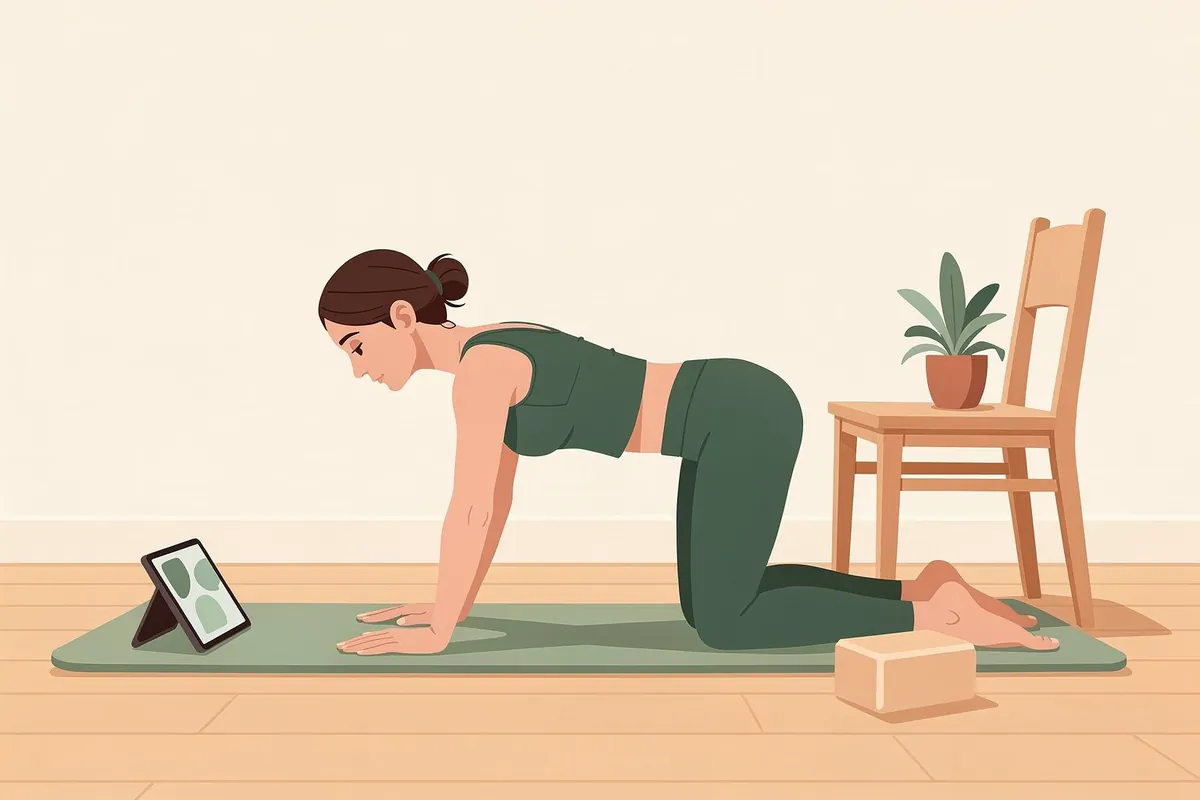
- Place the screen where you can see it from the floor and from standing. Turn the sound up so you can follow by ear instead of craning your neck mid-pose.
- Keep the room comfortable, not hot. Hot yoga carries special risks of overheating and dehydration (NCCIH), so there’s no need to turn up the heat.
- Head off interruptions. Silence notifications and let anyone you live with know you’re busy for the next 15 minutes.
Can you do yoga on carpet or a rug?
Yes, for most poses, though a firm, flat floor with a mat on top is the easiest setup.
| Floor | What to do |
|---|---|
| Wood, tile or laminate | Put a mat down. Bare feet on a smooth floor can slip in standing poses. |
| Low-pile carpet | A mat on top works for most people. |
| Thick, plush carpet | A mat can shift and sink, so balance poses feel wobbly. Do standing poses on a firmer spot. |
| Loose rug | Don’t stand on one that can slide. It’s fine under your knees for floor poses. |
No mat yet? Our guides to what you need to start yoga and yoga mats for beginners go through the options.
What should you wear for yoga at home?
Anything you can bend, twist and lie down in. At home, a few details matter more than they would in a studio:
- Bare feet. Socks slide on most mats and floors. If your feet get cold, keep socks on for floor poses and take them off to stand, or wear socks with grip soles.
- Clothes that stay put. A loose top that falls over your face when you fold forward is a distraction you don’t need.
- Nothing hard. Zippers, buttons, belts and studded pockets dig in when you lie down.
- No jewelry, hair tied back. Rings and long earrings can catch, and loose hair gets in your eyes in forward folds.
- A layer within reach. You’ll be still during the rest at the end, so a sweater or blanket helps.
How do you choose a yoga video or online class?
There are three main formats, and the big difference between them is whether anyone can see you.
| Format | Can the teacher see you? | Best use |
|---|---|---|
| Live online class, camera on | Yes | Learning the basics without traveling to a studio |
| Live online class, camera off | No, but you can usually ask questions | Easing in if you’re shy on camera |
| Recorded video or app class | No | Practicing poses you already know, at any hour |
Live online classes are a realistic option. In a small 2026 feasibility trial, 34 veterans with chronic muscle and joint pain (30 of them men) were assigned at random to live yoga classes over video or in person; the online group was given iPads and stands for class. Attendance was similar (about 72% and 77% of classes), more people in the online group finished the program (83% and 68%), and no serious side effects were reported (Mahoney et al., 2026).
Signs of a good beginner class or video
- It’s labeled beginner, gentle, basics or level 1, and the pace leaves time to get into each pose and breathe there.
- You can find out who the teacher is. The NCCIH suggests asking about a yoga teacher’s training and experience. For a video, look for that on the channel’s or app’s teacher page.
- The teacher explains the setup, not just the name of each pose, and shows or describes an easier version.
- Props or household stand-ins come up, such as books for blocks or a belt for a strap.
- Breathing is part of the instructions, not an afterthought.
- The camera shows the whole body, ideally from the side for some poses, so you can see where the hands, feet and hips go.
- It fits your time. Short is fine: a 10- to 20-minute class is plenty in your first weeks.
Skip these for now
- Classes with headstands, shoulder stands, the lotus position or forceful breathing. The NCCIH advises people who are new to yoga to avoid all four.
- Hot yoga routines.
- Advanced, power or fast flow classes, until you know the basic poses.
- Videos that promise to fix a health condition or melt fat fast. For what the research really shows, see benefits of yoga: what the research says.
A useful habit: watch a new video once before you follow along. You’ll know what’s coming, and you can note anything you’d rather skip.
How do you do your first yoga session at home?
Keep it to about 15 minutes. You can follow a beginner video, or use the outline below, which sticks to poses that have step-by-step guides on this site. The aim of a first session is to learn how a few poses feel, not to work up a sweat.
Before you start: clear your space, put water within reach and lay out anything you might use: two yoga blocks (or two sturdy books of the same size), a strap (or a belt or towel), a folded blanket for your knees and a chair.
| Minutes | What to do |
|---|---|
| 0–2 | Sit in any comfortable position and let your breathing slow down. Notice how your body feels today. |
| 2–5 | Stand in Mountain Pose for 5 to 10 slow breaths. Sway your weight forward and back, then side to side, and settle in the middle. Then breathe in as you sweep your arms overhead and breathe out as you lower them, about five times. |
| 5–8 | Come onto your hands and knees for slow rounds of Cat-Cow, moving with your breath. |
| 8–11 | Lift into Downward-Facing Dog with bent knees for a few breaths, lower your knees, and repeat once or twice. |
| 11–13 | Rest in Child’s Pose. |
| 13–15 | Lie on your back, or on your side if you’re pregnant, and let your breathing slow down. Roll onto your side before you sit up. |
Afterward, take a minute to write down what felt good, what felt awkward and anything that hurt. Those notes show you what to repeat, what to change and what to ask a teacher about. Once this session feels easy, move on to the 4-week starter plan in yoga for beginners, and see how long to hold a yoga pose for timing. To learn slow belly breathing for the first and last minutes, see diaphragmatic breathing.
How do you stay safe doing yoga without a teacher?
- Know your stop signs before you start. A stretch you can feel is fine. Sharp or pinching pain, or pain in a joint, means come out of the pose. Cleveland Clinic’s yoga expert calls joint pain a red flag (Cleveland Clinic). Stop and sit down if you feel dizzy or lightheaded, sick to your stomach, much more out of breath than the pose explains, or notice chest pain or an uneven heartbeat: MedlinePlus lists these as warning signs to stop and rest. Call 911 if you have sudden crushing, squeezing or tight pressure in your chest (MedlinePlus).
- Leave the risky practices for later. That means the four the NCCIH tells newcomers to avoid, listed under “Skip these for now” above. In the German survey, handstands, shoulder stands and headstands were the practices most often linked to sudden injuries and other problems (Cramer et al., 2019). The expert quoted by Cleveland Clinic also says to learn advanced poses, especially backbends and inversions, from an instructor before trying them alone.
- Follow your body, not the video. Hit pause, take fewer breaths in a pose than the teacher does, or rest in Child’s Pose whenever you want. The authors of the German survey suggest that people practicing alone may push too hard trying to keep up with the instructor on screen (Cramer et al., 2019).
- Keep breathing. If your breath turns choppy or you catch yourself holding it, back out of the pose a little. When you’re out of breath, Cleveland Clinic suggests taking a moment to tune back in to your breathing.
- Check your form. Cleveland Clinic’s expert suggests practicing in front of a mirror. You can also film yourself from the side and compare the clip with the steps in our pose guides.
- Use the wall and the chair. Do balance poses with a wall or the back of a sturdy chair within reach.
- Get up slowly. After lying down, roll to your side and sit for a breath or two before you stand, especially if you tend to feel lightheaded. MedlinePlus lists getting up slowly among the ways to prevent symptoms of low blood pressure.
- Take your questions to a teacher. If a pose keeps bothering you, or you’re not sure how it should feel, book a class or a private session before you keep repeating it.
- Watch for new symptoms. Tell a health care provider about any new symptom that shows up as you get more active (Physical Activity Guidelines).
Before you start, check with a doctor if…
- You’re pregnant. The NCCIH advises a check by your health care provider before you exercise. It also says to skip hot yoga and poses that involve lying on your back or staying still for long stretches. For rests, lie on your side with pillows for support, or sit in a chair. Stop if you feel too hot or unwell, don’t practice on an empty stomach, keep a wall or chair close in standing poses to lower the risk of a fall, and tell any teacher you’re pregnant (NHS).
- You’re 65 or older. Yoga injuries that end up in the emergency room happen at a higher rate in this age group than in younger adults (NCCIH). A teacher-led gentle or chair yoga class is a sensible first step.
- You have a health condition that may mean changing poses. The NCCIH names earlier injuries, such as knee or hip injuries, as well as disease of the lower (lumbar) spine, severe high blood pressure, balance problems and glaucoma. With any of these, a teacher’s eye matters more than usual.
- You have osteoporosis or low bone density, glaucoma, or severe high blood pressure. Two poses in the first session round your spine (Cat-Cow, Child’s Pose), and one puts your head below your heart (Downward-Facing Dog). Poses that strongly round the spine have been linked to spine fractures in people with weak bones (Lee 2019), and head-down poses briefly raise eye pressure (Jasien 2015). Ask your doctor or physical therapist which poses to change, and read the caution box on each pose guide first.
- You live with a chronic condition, for example diabetes, heart disease or osteoarthritis, or have symptoms such as chest pain or pressure, dizziness or joint pain. The Physical Activity Guidelines single these out as the situations where talking to a provider about activity makes sense.
Yoga is no substitute for medical care. If something seems wrong, see a provider instead of waiting to find out whether yoga helps (NCCIH).
How do you make yoga at home a habit?
Motivation comes and goes, so it helps to build a routine that doesn’t depend on it. Research on everyday health habits, such as healthy eating, exercise and flossing (not yoga specifically), offers some practical pointers. First, the pace: in your first two weeks, practice two or three times a week with a rest day in between, as in our 4-week plan. After that, short daily sessions are fine if you feel good.
- Tie it to a cue, either something you already do on your practice days, such as your morning coffee or your evening shower, or a set time. In a trial of 192 adults building a daily eating habit, tying it to an existing routine worked about as well as tying it to a set clock time. Repeating the behavior was a key predictor of how automatic it became (Keller et al., 2021).
- Expect it to take two months or more. In a 2024 review, the four studies that timed habit formation reported medians of 59 to 66 days and averages of 106 to 154 days, and individual people took anywhere from 4 to 335 days (Singh et al., 2024).
- Start small. In one well-known habit study, described by two of its authors in a 2012 article, simple actions became automatic faster than more demanding routines (Gardner et al., 2012). Cleveland Clinic quotes a yoga therapist who says even 10 minutes a day is better than practicing once every few weeks. And the Physical Activity Guidelines put it simply: some activity is better than none.
- Don’t give up after a missed day. In that same study, missing a single day didn’t seriously set back habit formation (Gardner et al., 2012). Just do your next session as planned.
- Make starting effortless. Leave your mat rolled out, or rolled up where you’ll see it, with your props on top. Choose tomorrow’s video tonight.
- Keep a simple log. A mark on a calendar for every session shows you how far you’ve come.
- Check in with a teacher now and then. A class every few weeks, in person or live online, gives you feedback and new ideas.
Is doing yoga at home effective?
Evidence: limited
Researchers have tested yoga programs done at home by video or live online class, but only a few, each in one specific group of people, with mixed results. None tested what most beginners actually do: pick free videos and follow them alone for general fitness.
- Recorded videos, no teacher: in a trial of 212 adults with knee osteoarthritis in Australia, 12 weeks of prerecorded yoga videos (three sessions a week) improved knee function a little more than online education alone, but not knee pain while walking. The average gain was smaller than the change patients usually notice, and it was gone by 24 weeks (Bennell et al., 2022).
- Live online first, then videos: in a trial of 86 working adults with signs of stress, an 8-week home program of moderate-intensity sun salutations (three 50-minute sessions a week) began with live video sessions led by a teacher and moved step by step to self-guided videos. Compared with a waiting-list group, the yoga group ended with lower stress and anxiety on most of the measures used (Phansikar et al., 2023).
- The wider picture: a 2022 review found 12 studies of yoga delivered through technology. They were of weak to moderate quality and too varied to say how well this kind of yoga works (James-Palmer et al., 2022).
- Home practice next to classes: in a 2012 survey of 1,045 people on the lists of 15 US Iyengar yoga studios, how often people practiced at home was more closely tied to measures such as well-being, sleep and fatigue than their years of practice or how often they went to class (Ross et al., 2012). It was a one-time survey, so it can’t show that home practice caused those differences.
- Safety: practicing by self-study, without a teacher’s current or past supervision, was linked to more reported harms (Cramer et al., 2019), as covered above.
Why “limited”: the trials are few and small to mid-sized, each studied a single group (people with knee arthritis, stressed working adults), and the results were mixed. The label covers home and online yoga programs as they were tested, not yoga in general. For that, see benefits of yoga: what the research says.
Frequently asked questions
Is it better to do yoga at home or in a studio?
Each has its strengths. A class gives you a teacher who can correct your form, which matters most while you’re learning, and the NCCIH advises learning under a qualified instructor. Home practice costs less, fits any schedule and makes it easier to practice often. Many people combine the two: classes to learn, home sessions in between.
Can you learn yoga from YouTube?
You can, if you choose carefully. Pick beginner videos from teachers who say where they trained, follow the safety rules above, and get feedback from a teacher when you can. Programs built on recorded videos have been tested in a few trials, with mixed results (see the research box above).
What’s the best time of day to do yoga at home?
The time you can keep. In habit research, tying a new habit to a set time and tying it to a daily routine worked about equally well (Keller et al., 2021). A 2024 review found that morning habits tended to be stronger, but that comes from studies of habits such as exercise, flossing and healthy eating, not yoga (Singh et al., 2024).
Sources
- National Center for Complementary and Integrative Health (NCCIH). Yoga: Effectiveness and Safety. Last updated August 2023., checked Nov 5, 2026
- Cramer H, Quinker D, Schumann D, Wardle J, Dobos G, Lauche R. Adverse effects of yoga: a national cross-sectional survey. BMC Complement Altern Med. 2019;19(1):190., checked Nov 5, 2026
- Bennell KL, Schwartz S, Teo PL, et al. Effectiveness of an Unsupervised Online Yoga Program on Pain and Function in People With Knee Osteoarthritis: A Randomized Clinical Trial. Ann Intern Med. 2022;175(10):1345-1355., checked Nov 5, 2026
- Phansikar M, Gothe N, Hernandez R, Lara-Cinisomo S, Mullen SP. Feasibility and impact of a remote moderate-intensity yoga intervention on stress and executive functioning in working adults: a randomized controlled trial. J Behav Med. 2023;46(5):720-731., checked Nov 5, 2026
- James-Palmer A, Anderson EZ, Daneault JF. Remote Delivery of Yoga Interventions Through Technology: Scoping Review. J Med Internet Res. 2022;24(6):e29092., checked Nov 5, 2026
- Mahoney L, Pahade S, Mahoney H, et al. Randomized feasibility trial of tele-yoga versus in-person yoga for treating chronic musculoskeletal pain in veterans. BMC Complement Med Ther. 2026;26(1):153., checked Nov 5, 2026
- Ross A, Friedmann E, Bevans M, Thomas S. Frequency of yoga practice predicts health: results of a national survey of yoga practitioners. Evid Based Complement Alternat Med. 2012;2012:983258., checked Nov 5, 2026
- Singh B, Murphy A, Maher C, Smith AE. Time to Form a Habit: A Systematic Review and Meta-Analysis of Health Behaviour Habit Formation and Its Determinants. Healthcare (Basel). 2024;12(23):2488., checked Nov 5, 2026
- Gardner B, Lally P, Wardle J. Making health habitual: the psychology of ‘habit-formation’ and general practice. Br J Gen Pract. 2012;62(605):664-666., checked Nov 5, 2026
- Keller J, Kwasnicka D, Klaiber P, Sichert L, Lally P, Fleig L. Habit formation following routine-based versus time-based cue planning: A randomized controlled trial. Br J Health Psychol. 2021;26(3):807-824., checked Nov 5, 2026
- U.S. Department of Health and Human Services. Physical Activity Guidelines for Americans, 2nd edition. Washington, DC: HHS; 2018., checked Nov 5, 2026
- MedlinePlus (U.S. National Library of Medicine). Low blood pressure. Reviewed January 1, 2025., checked Nov 5, 2026
- Cleveland Clinic. Tips for Practicing Yoga at Home. Health Essentials. June 11, 2026., checked Nov 5, 2026
- Cleveland Clinic. Yoga for Beginners: Get Started Today! Health Essentials. May 18, 2026., checked Nov 5, 2026
- MedlinePlus (U.S. National Library of Medicine). Being active when you have heart disease., checked Nov 5, 2026
- MedlinePlus (U.S. National Library of Medicine). Chest pain., checked Nov 5, 2026
- NHS. Exercise in pregnancy., checked Nov 5, 2026
- Lee M, Huntoon EA, Sinaki M. Soft tissue and bony injuries attributed to the practice of yoga: a biomechanical analysis and implications for management. Mayo Clin Proc. 2019;94(3):424-431., checked Nov 5, 2026
- Jasien JV, Jonas JB, de Moraes CG, Ritch R. Intraocular pressure rise in subjects with and without glaucoma during four common yoga positions. PLoS One. 2015;10(12):e0144505., checked Nov 5, 2026
Image credits: Illustration: AI-generated for YogaForFitness (FLUX.2 [pro]), checked for pose accuracy