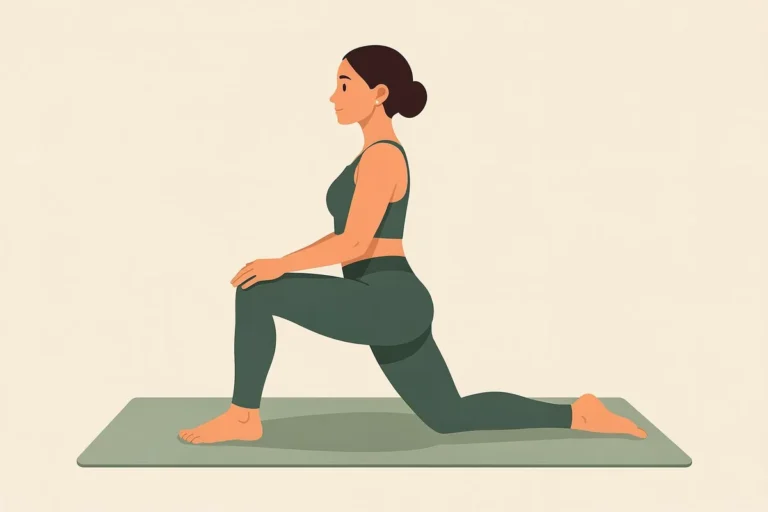
Yoga for Tight Hamstrings: 6 Poses and a 10-Minute Routine
Quick answer
Fold from your hips with a long back, bend your knees as much as you need to keep it long, and hold each pose for 30 seconds to a minute at a mild pull, never into pain. The six beginner poses and the 10-minute routine below do that standing, kneeling, sitting and lying down. In trials, flexibility improved over 4 to 8 weeks of stretching or yoga, most often 5 or 6 days a week. Do the routine at least twice a week, the minimum that exercise guidelines set, and more often if you can.
We may earn a commission when you buy through links on this page. It never changes what we recommend. As an Amazon Associate we earn from qualifying purchases.
Tight hamstrings show up when you try to touch your toes, sit with your legs straight out in front of you or fold forward in a yoga class. Sitting for long hours is one reason: Harvard Health says sitting in a chair all day can leave the hamstrings tight, making it harder to straighten your knee fully. Regular stretching helps. In controlled trials in healthy young adults, people who held hamstring stretches gained more flexibility than people who didn’t stretch (Medeiros et al., 2016).
This guide sticks to the backs of the thighs. For the front of the hips, the buttocks and the inner thighs, see yoga for tight hips. More guides like this one live in our Flexibility & Mobility section.
In this guide
- What are the hamstrings, and why do they feel tight?
- Six beginner poses for tight hamstrings
- A 10-minute routine for tight hamstrings
- Make it easier (props)
- How long should you hold a hamstring stretch, and how often?
- Who should skip it or ask a doctor first
- What the research says
- Frequently asked questions
- Sources
What are the hamstrings, and why do they feel tight?
Your hamstrings are three muscles at the back of each thigh: the biceps femoris on the outer side, and the semitendinosus and semimembranosus toward the inner side. They run from your pelvis to just below your knee. They bend your knee, and they extend your hip, which means they draw your thigh back behind you (Cleveland Clinic).
Because the hamstrings cross both the hip and the knee, two movements lengthen them at once: tipping forward at the hips and straightening the knees. That’s why every pose below asks you to fold from your hips with a long back, and why bending your knees is the quickest way to make any of them gentler. But not every pain at the back of the leg comes from the muscle.
Tight, or something else?
A hamstring stretch feels like a pull in the middle of the back of your thigh, and it fades when you ease off. Pain that burns, shoots or tingles down the back of the leg, numbness or a weak leg are different. They are typical symptoms of sciatica, an irritated nerve (MedlinePlus). Doctors also raise a straight leg during an exam to check for a herniated disk in the lower back (MedlinePlus), so leg pain that a straight-leg raise sets off isn’t always a tight muscle. So if a leg-raise or forward fold sets off that kind of pain, stop and read the caution box below.
Six beginner poses for tight hamstrings
For each pose you get the target, a few short steps and a gentler option. Three rules apply to all of them: hinge from your hips with a long back, bend your knees enough to keep it long, and stop at a mild pull in the middle of the back of your thigh. Pain behind the knee means you’ve gone too far.
1. Half Forward Fold at a chair
Targets: both hamstrings, gently, with your hands supported.
- Push the front edge of a sturdy chair’s seat against a wall, so the chair can’t move and its backrest faces you. Stand facing it with your feet hip-width apart.
- Rest your hands on top of the backrest.
- Walk your feet back as you tip forward from your hips, until your arms are straight and your back is roughly level with the floor. Your hips end up over your heels.
- Soften your knees. Reach your hips back, away from the chair, while the top of your head reaches toward it.
- Let your head line up with your back, ears level with your upper arms, and breathe.
- To come out, walk your feet in toward the chair and stand up slowly.
Easier: bend your knees more, or use a higher surface such as a kitchen counter. Deeper: once the chair version feels easy, put your hands on two blocks at their tallest height in front of your feet, knees bent as much as you need.
2. Pyramid Pose (Parsvottanasana), halfway
Targets: the back of the front thigh, and the calf of the back leg.
- Stand with your feet hip-width apart. Step your left foot back about one leg-length, or less if you feel wobbly, and turn the left toes out about 45 degrees, toward the front corner of your mat.
- Keep your feet hip-width apart from side to side, as if on two train tracks, not one behind the other.
- Set a block at its tallest height on each side of your right foot. Put your hands on your hips and square both hip bones toward the front.
- Grow tall, then breathe out and tip forward from your hips over your front leg. Keep a slight bend in the front knee.
- Stop when your back begins to round, and rest your fingertips on the blocks.
- Press both feet down and breathe. To come out, return your hands to your hips and rise with a long back. Switch sides.
Easier: shorten your stance, bend the front knee more, or put your hands on the seat of a chair. Stopping halfway with a flat back is a proper version of the pose in its own right.
3. Downward-Facing Dog, pedaling
Targets: the hamstrings and calves of both legs.
- On hands and knees, curl your toes under and send your hips up and back into an inverted V shape.
- Keep both knees bent at first, so your back stays long.
- Bend your right knee as you let your left heel sink toward the floor. Then switch. Keep pedaling slowly for several rounds.
- Finish by holding still with both knees softly bent and your hips lifting. Lower your knees to come out.
Easier: put your hands on a chair seat or a wall instead of the floor. Full steps and safety notes are in our Downward-Facing Dog guide.
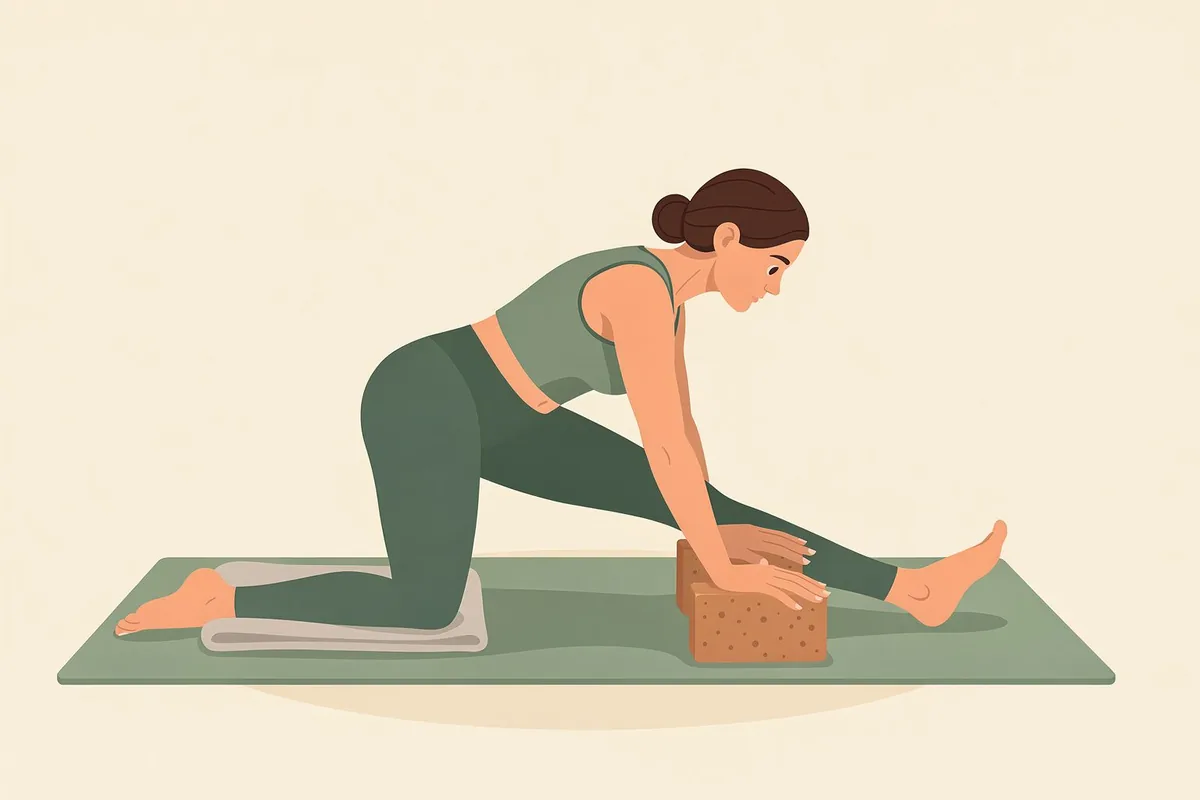
4. Half Splits (Ardha Hanumanasana)
Targets: the back of the front thigh.
- Begin in Low Lunge, right foot in front and left knee down on a folded blanket. Put a block on each side of your right foot.
- Bring your hands to the blocks and move your hips back until they are above your left knee.
- Straighten your right leg as far as it comfortably goes, heel on the floor and toes pointing up. Keep a small bend in the knee instead of locking it.
- Keep your hips square and lead with your chest, so your back stays long instead of rounding down over the leg.
- Breathe. To come out, bend your front knee and shift forward into Low Lunge. Switch sides.
Easier: use the blocks at their tallest height and keep the front knee bent. If kneeling hurts, push a sturdy chair against a wall, stand facing it, rest one heel on the seat with that knee straight or softly bent, and tip forward slightly from your hips. Hold the wall or the chair back for balance.
5. Seated Forward Fold with a strap
Targets: both hamstrings and the calves.
- Sit on a folded blanket with both legs reaching forward, feet about hip-width apart. Bend your knees as far as it takes to sit upright on your sitting bones.
- Wrap a strap, belt or towel around the balls of your feet, one end in each hand.
- Sit tall. As you breathe out, tip forward from your hips and walk your hands a little way along the strap.
- Stop as soon as your lower back starts to round. Keep your neck in line with your back and your shoulders away from your ears.
- Breathe slowly, then come back up as you breathe in.
Easier: bend your knees more, sit higher, or work one leg at a time: bend one knee and rest the sole of that foot against your inner thigh, then fold toward the straight leg. More in our Seated Forward Fold guide.
6. Reclined Hand-to-Big-Toe with a strap (Supta Padangusthasana)
Targets: one hamstring at a time, with the floor supporting your back.
- Lie face up, knees bent and feet flat. If your chin tips up, rest your head on a folded towel.
- Draw your right knee toward your chest and hook a strap over the ball of that foot.
- Straighten your right leg up toward the ceiling only as far as you can while the back of your pelvis stays on the floor. A bent knee is fine.
- Leave your left foot on the floor, or slide your left leg out along the mat if your lower back feels comfortable.
- Let your shoulders rest and hold the strap with your arms nearly straight. Breathe. Lower the leg slowly, then switch sides.
Easier: lie in a doorway and rest the raised leg against the door frame or a wall, so you don’t have to hold it up.
A 10-minute routine for tight hamstrings
The order goes from standing to hands and knees, then kneeling, sitting and lying down, so you change levels only a few times. The holds and the final rest add up to 9 minutes; moving between poses takes about one more. Do it after a short walk or at the end of a workout, when your muscles are warm.
| Pose | Time | Side |
|---|---|---|
| 1. Half Forward Fold at a chair | 1 min | Both legs |
| 2. Pyramid Pose, halfway | 30 s | Each side |
| 3. Downward-Facing Dog, pedaling | 1 min | Both legs |
| 4. Half Splits | 1 min | Each side |
| 5. Seated Forward Fold with a strap | 1 min | Both legs |
| 6. Reclined Hand-to-Big-Toe | 1 min | Each side |
| Rest, sitting or lying down | 1 min | — |
If a minute feels long, make it two 30-second holds. In Down Dog, lower your knees and rest halfway through if your wrists or shoulders tire. Short on time? Half Forward Fold, Half Splits and Reclined Hand-to-Big-Toe take about 5 minutes and stretch each leg standing, kneeling and lying down.
Make it easier (props)
You can do all six poses without equipment, but a few props make them friendlier for tight legs:
- A strap. Around your feet in Seated Forward Fold and around one foot in Reclined Hand-to-Big-Toe. A belt or towel works too. See how to use a yoga strap.
- Two blocks. Beside your front foot in Pyramid and Half Splits, or under your hands for a floor version of the Half Forward Fold. Thick books work too. See how to use yoga blocks.
- A folded blanket. Under your seat in Seated Forward Fold and under your back knee in Half Splits.
- A sturdy chair. For the Half Forward Fold, under your hands in Pyramid, and for the standing version of Half Splits.
- A wall or door frame. To rest your raised leg in the reclined stretch, and to steady yourself in the standing poses.
Helpful gear for this
 Manduka Align yoga strap, 8 ft
Cotton strap 1.75 in wide with a zinc-alloy buckle, 8 ft long (maker's spec).
See it on Amazon Manduka cork yoga block
Solid cork, 9 x 6 x 4 in and 2.2 lb, firmer and heavier than foam for steadier support (maker's spec).
See it on Amazon Gaiam foam yoga blocks, pair
Two light foam blocks, 9 x 6 x 4 in each, one for each hand (maker's spec).
See it on Amazon
As an Amazon Associate we earn from qualifying purchases. How we choose gear
How long should you hold a hamstring stretch, and how often?
For younger adults, about 30 seconds per stretch is enough, and once a day is plenty. In a trial of 57 adults aged 21 to 37 with tight hamstrings, who stretched 5 days a week for 6 weeks, 30-second and 60-second holds both improved flexibility more than 15-second holds or no stretching, and 60 seconds added nothing over 30 (Bandy & Irion, 1994). A follow-up trial in 93 adults aged 21 to 39, also with tight hamstrings, found that one 30-second stretch a day worked as well as 60-second holds or stretching three times a day (Bandy et al., 1997).
Older adults may need longer holds. In 62 people aged 65 to 97 (average age 85) with tight hamstrings who stretched 5 days a week for 6 weeks, 60-second holds improved knee extension nearly twice as fast as 30-second holds (2.4 vs 1.3 degrees a week), and the gains lasted longer after they stopped (Feland et al., 2001). If you’re 65 or older, hold each stretch for the full minute.
The American College of Sports Medicine’s position stand sets a floor rather than a ceiling: a series of stretches for the main muscle groups, about 60 seconds of total stretching per exercise, at least twice a week (Garber et al., 2011). Harvard Health adds two practical points: don’t bounce, and expect tension, not pain. The routine above gives each leg several minutes of stretching, more than these minimums. Our guide to how long to hold a yoga pose has more.
Who should skip it or ask a doctor first
- Pain, tingling or numbness down the leg. Stop if a stretch sends pain, burning or tingling down your leg, or leaves it numb or weak, and see a doctor before you stretch it again. These can be signs of an irritated nerve rather than a tight muscle. MedlinePlus advises contacting your provider right away for pain that travels down the leg below the knee, weakness or numbness in the buttocks or leg, or loss of control of urine or stool.
- A recent hamstring strain or tear. A sudden sharp pain at the back of the thigh, sometimes with a pop, swelling or bruising, can mean a hamstring injury. For the first 2 to 3 days the NHS advises rest, not exercise. Cleveland Clinic advises seeing a provider if symptoms last more than a few days and not stepping up your activity until your provider says it’s OK. Go to the emergency room if the pain is severe or you can’t move or use your leg, and get medical help soon if it hurts to walk or stand or the swelling or bruising is large or getting worse (NHS). Ask your provider when to start stretching.
- Disc problems or another lower-back condition. The NCCIH counts lumbar spine disease among the conditions that can mean adjusting or skipping some poses. Ask your doctor or physical therapist which stretches suit you before you start. Skip Seated Forward Fold, which teachers advise avoiding with a lower-back injury (YogaEasy). If you’re cleared for the reclined strap stretch, keep the knee bent and stop if it sends pain down your leg.
- Osteoporosis or low bone density. MedlinePlus lists bending forward from the waist, as in toe touches, among movements to avoid. In a review of 89 patients whose injuries were attributed to yoga, the poses most often involved bent the spine to extremes, forward or backward, and 13 patients had compression fractures in the spine. For people with osteopenia or osteoporosis, the authors’ advice is to stay away from extreme spinal flexion (Lee et al., 2019). Ask your doctor or physical therapist before you try any of the forward folds here (poses 1, 2, 4 and 5). Ask about the lying strap stretch first: your back rests on the floor, and you can keep the knee bent. Skip any pose where your back rounds.
- Hip replacement. MedlinePlus tells people with a new hip not to bend far forward from the waist and to keep hip flexion under 90 degrees, particularly during the first months. Most hamstring stretches do exactly that. Ask your surgeon or physical therapist which ones are safe for you, and when.
- Glaucoma or severe high blood pressure. The NCCIH names both as well. In a small study, eye pressure rose within a minute in Downward-Facing Dog and in a standing forward fold, in people with and without glaucoma (Jasien et al., 2015). Skip Down Dog and the floor version of the Half Forward Fold, keep your head above your heart in the other folds, and ask your doctor about head-down poses.
- Knee problems. The NCCIH names knee injuries too. Pad your back knee in Half Splits or use the standing chair version, and keep a slight bend in a straight leg instead of pushing the knee back.
- Pregnancy. Ask your health care provider whether exercise is safe for you before you start, as the NCCIH recommends. The NCCIH also says to avoid long spells lying on your back, and the NHS says that in later pregnancy you should try not to spend more than a few minutes lying flat. So replace the reclined stretch with a seated one: sit upright near the front edge of a sturdy chair, loop a strap around one foot and straighten that leg out in front of you. For the final rest, sit in a chair instead of lying down. Skip Down Dog if it makes you dizzy, widen your feet in forward folds to make room for your belly, keep a chair or wall close by in Pyramid, keep holds short, don’t practice on an empty stomach, and stop whenever you feel unwell, overheated or uncomfortable.
- Age 65 or older, or balance problems. The NCCIH says older adults may need extra caution, and it names balance issues among the conditions that can call for adjustments. Use the chair and wall versions, and hold each stretch for the full minute (see the hold-time section). If you’re new to yoga or have a health condition, a class with a qualified teacher is safer than learning alone, the NCCIH notes.
What the research says
Evidence: moderate
Hamstring stretching itself has good support. There are fewer studies of yoga for the hamstrings, and most of them measured flexibility with the sit-and-reach test, which depends on your lower back as well as your hamstrings. No study has tested this routine. That’s why we rate the evidence as moderate.
- Holding still stretches. A 2016 meta-analysis of controlled trials in healthy young adults (19 trials in all, pooled separately for each test) found that static stretching, holding a stretch still as you do in these poses, increased hamstring flexibility more than not stretching on all three standard tests: the straight-leg raise and two knee-extension tests (Medeiros et al., 2016). The two hold-time trials above point the same way.
- One yoga pose. In a 2026 trial at a university in North India, 150 healthy young adults aged 18 to 28 did 16 minutes of loosening exercises six days a week for four weeks, followed by either 4 minutes of Seated Forward Fold or 4 minutes of lying rest. Sit-and-reach scores improved more in the forward-fold group (Thapa et al., 2026). It’s the only randomized trial of a single hamstring pose we found, and we found no repeat of it.
- Yoga in older adults. In a 2019 review of trials in people whose average age was 60 or older, yoga beat no exercise for lower-body flexibility (7 trials, 431 people) and beat other exercise by a smaller margin (3 trials, 225 people). Flexibility there was measured with sit-and-reach tests (Sivaramakrishnan et al., 2019). In 118 inactive adults with an average age of 62, eight weeks of hatha yoga and eight weeks of stretching and strengthening exercises both improved sit-and-reach scores, with yoga doing as well as the exercise program (Gothe & McAuley, 2016).
- Yoga in young adults. 31 college-aged adults who took a 110-minute yoga class twice a week for 7 weeks gained about 4 degrees of hamstring flexibility within the group. There was no comparison group, so the study can’t rule out other causes (LaSala et al., 2021).
These studies looked at flexibility only. They didn’t test whether stretching prevents injuries or eases back pain; the questions below cover what other research shows.
Frequently asked questions
Why are my hamstrings so tight?
Sitting for long hours is one reason (see above). But a tight feeling isn’t always a short muscle. If it comes with tingling, numbness or pain running down the leg, the cause may be an irritated nerve, such as sciatica (MedlinePlus), and that needs a doctor, not a deeper stretch.
How long does it take to stretch out tight hamstrings?
Expect weeks, not days. In the hold-time trials above, people stretched 5 days a week for 6 weeks, and the single yoga trials in the research box ran from 4 to 8 weeks. Harvard Health puts it at weeks to months, and flexibility fades again if you stop.
Can tight hamstrings cause lower back pain?
It isn’t clear. Three long-term studies of 1,771 young people aged 10 to 26 linked less hamstring flexibility with a slightly higher chance of developing low back pain, but the effect was small and one study dominated the result (Sadler et al., 2017). A review of 17 studies that compared people with and without low back pain found tighter hamstrings in people with back pain on two tests, but the evidence was of such low quality that the authors couldn’t draw a conclusion (Hori et al., 2021). Back pain has many causes. If yours is severe or doesn’t settle, talk to your doctor.
Does stretching your hamstrings prevent injuries?
That hasn’t been shown. In a 2002 review, two studies of army recruits found that stretching before exercise didn’t lower their overall injury risk by a useful amount; they didn’t look at hamstring strains on their own (Herbert & Gabriel, 2002). Health sites such as Cleveland Clinic still advise stretching and warming up, but for hamstring strains in sports the stronger evidence is for strengthening: in 15 studies of athletes across several sports, injury-prevention programs that included the Nordic hamstring exercise, a strengthening move, had about half the rate of hamstring injuries (van Dyk et al., 2019). Stretch for flexibility, and ask a coach or physical therapist about strengthening if you play sports.
Is it OK to stretch your hamstrings every day?
Usually, yes, if it doesn’t hurt. Harvard Health suggests a daily habit, with three to four sessions a week as the fallback. In one of the trials above, stretching once a day worked as well as three times a day, so you don’t need extra sessions on the same day. If your legs feel sore the next day, take a day off.
Should you stretch a pulled hamstring?
Not right away. In the first 2 to 3 days, the NHS advises protecting and resting the leg. Once pain no longer stops you moving the leg, the NHS says gentle movement helps keep the hamstring from stiffening. A physical therapist can show you when and how to add stretches.
Sources
- Harvard Health Publishing. The importance of stretching. April 17, 2024., checked Nov 8, 2026
- Medeiros DM, Cini A, Sbruzzi G, Lima CS. Influence of static stretching on hamstring flexibility in healthy young adults: Systematic review and meta-analysis. Physiother Theory Pract. 2016;32(6):438-445., checked Nov 8, 2026
- Cleveland Clinic. Hamstring Muscles. Health Library., checked Nov 8, 2026
- MedlinePlus (U.S. National Library of Medicine). Sciatica. Reviewed August 27, 2024., checked Nov 8, 2026
- MedlinePlus (U.S. National Library of Medicine). Herniated disk. Reviewed August 27, 2024., checked Nov 8, 2026
- Bandy WD, Irion JM. The effect of time on static stretch on the flexibility of the hamstring muscles. Phys Ther. 1994;74(9):845-850., checked Nov 8, 2026
- Bandy WD, Irion JM, Briggler M. The effect of time and frequency of static stretching on flexibility of the hamstring muscles. Phys Ther. 1997;77(10):1090-1096., checked Nov 8, 2026
- Garber CE, Blissmer B, Deschenes MR, et al. American College of Sports Medicine position stand. Quantity and quality of exercise for developing and maintaining cardiorespiratory, musculoskeletal, and neuromotor fitness in apparently healthy adults: guidance for prescribing exercise. Med Sci Sports Exerc. 2011;43(7):1334-1359., checked Nov 8, 2026
- NHS. Hamstring injury. Page last reviewed July 28, 2025., checked Nov 8, 2026
- Cleveland Clinic. Hamstring Injury. Health Library., checked Nov 8, 2026
- National Center for Complementary and Integrative Health (NCCIH). Yoga: Effectiveness and Safety. Last updated August 2023., checked Nov 8, 2026
- MedlinePlus (U.S. National Library of Medicine). Osteoporosis. Last updated September 30, 2025., checked Nov 8, 2026
- Lee M, Huntoon EA, Sinaki M. Soft Tissue and Bony Injuries Attributed to the Practice of Yoga: A Biomechanical Analysis and Implications for Management. Mayo Clin Proc. 2019;94(3):424-431., checked Nov 8, 2026
- MedlinePlus (U.S. National Library of Medicine). Taking care of your new hip joint. Reviewed November 7, 2024., checked Nov 8, 2026
- NHS. Exercise in pregnancy. Page last reviewed September 24, 2026., checked Nov 8, 2026
- Thapa R, Chandrabanshi A, Singh A, Kumar R. Effect of 4 Weeks of Yogic-based Paschimottanasana Practice on Sit-and-Reach Test and Goniometer Measurements among Healthy Participants: A Randomized Controlled Trial. Adv Mind Body Med. 2026;40(2):22-27., checked Nov 8, 2026
- Sivaramakrishnan D, Fitzsimons C, Kelly P, et al. The effects of yoga compared to active and inactive controls on physical function and health related quality of life in older adults: systematic review and meta-analysis of randomised controlled trials. Int J Behav Nutr Phys Act. 2019;16(1):33., checked Nov 8, 2026
- Gothe NP, McAuley E. Yoga Is as Good as Stretching-Strengthening Exercises in Improving Functional Fitness Outcomes: Results From a Randomized Controlled Trial. J Gerontol A Biol Sci Med Sci. 2016;71(3):406-411., checked Nov 8, 2026
- LaSala TT, Run-Kowzun T, Figueroa M. The effect of a Hatha Yoga practice on hamstring flexibility. J Bodyw Mov Ther. 2021;28:439-449., checked Nov 8, 2026
- Sadler SG, Spink MJ, Ho A, De Jonge XJ, Chuter VH. Restriction in lateral bending range of motion, lumbar lordosis, and hamstring flexibility predicts the development of low back pain: a systematic review of prospective cohort studies. BMC Musculoskelet Disord. 2017;18(1):179., checked Nov 8, 2026
- Hori M, Hasegawa H, Takasaki H. Comparisons of hamstring flexibility between individuals with and without low back pain: systematic review with meta-analysis. Physiother Theory Pract. 2021;37(5):559-582., checked Nov 8, 2026
- Herbert RD, Gabriel M. Effects of stretching before and after exercising on muscle soreness and risk of injury: systematic review. BMJ. 2002;325(7362):468., checked Nov 8, 2026
- van Dyk N, Behan FP, Whiteley R. Including the Nordic hamstring exercise in injury prevention programmes halves the rate of hamstring injuries: a systematic review and meta-analysis of 8459 athletes. Br J Sports Med. 2019;53(21):1362-1370., checked Nov 8, 2026
- Feland JB, Myrer JW, Schulthies SS, Fellingham GW, Measom GW. The effect of duration of stretching of the hamstring muscle group for increasing range of motion in people aged 65 years or older. Phys Ther. 2001;81(5):1110-1117., checked Nov 8, 2026
- Jasien JV, Jonas JB, de Moraes CG, Ritch R. Intraocular pressure rise in subjects with and without glaucoma during four common yoga positions. PLoS One. 2015;10(12):e0144505., checked Nov 8, 2026
- YogaEasy. Seated Forward Bend (Paschimottanasana)., checked Nov 8, 2026
Image credits: Illustration: AI-generated for YogaForFitness (FLUX.2 [pro]), checked for pose accuracy