Yoga for Tight Hips: 8 Poses and a 15-Minute Routine
Quick answer
Tight hips usually means stiffness in one of three places: the hip flexors at the front, the glutes and outer hip, or the inner thighs. These eight beginner poses stretch all three, and the 15-minute routine below strings them together. Hold each pose for about a minute per side, at least two days a week. Stretch only to a mild pull, never into pain.
We may earn a commission when you buy through links on this page. It never changes what we recommend. As an Amazon Associate we earn from qualifying purchases.
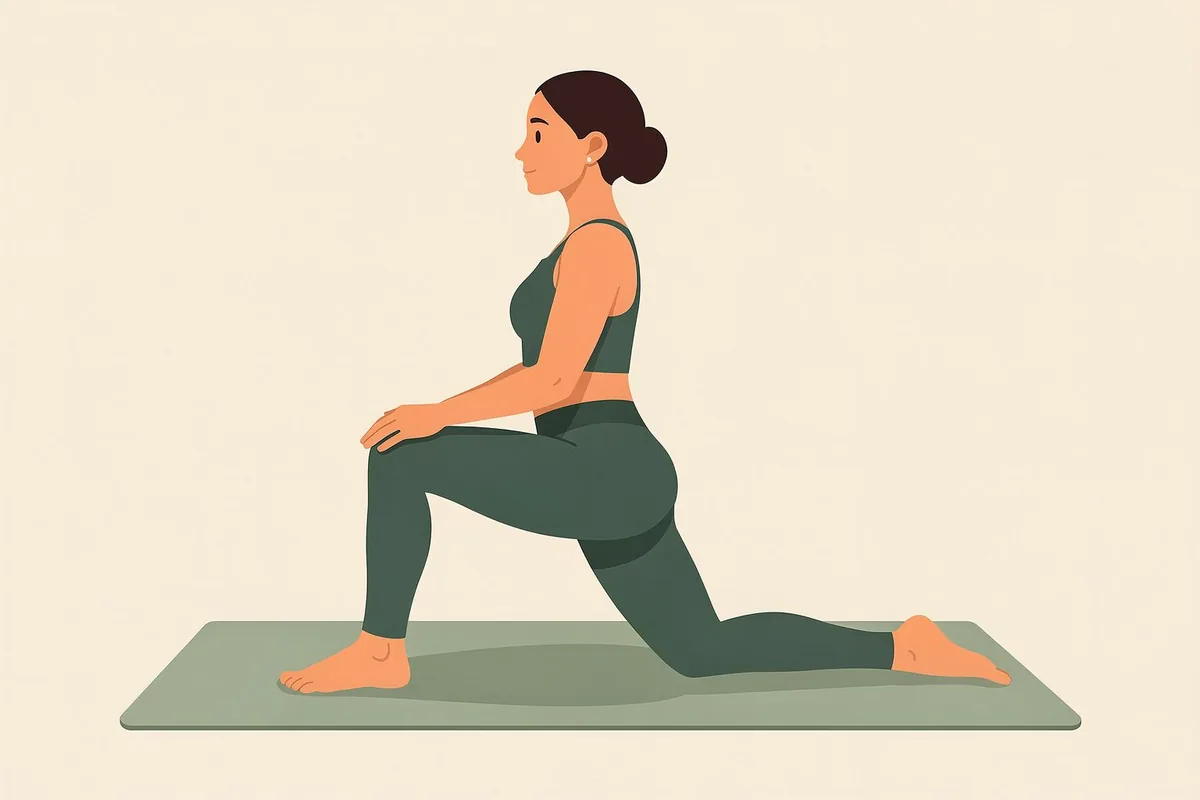
Stiff hips after a long day at a desk are common, and regular stretching can increase how far your hips move. This guide explains what “tight hips” means, walks you through eight beginner poses and combines them into a 15-minute routine. It’s part of our Flexibility & Mobility guides.
In this guide
What are tight hips, and why do they get tight?
“Tight hips” isn’t one muscle. It usually means stiffness in one or more of three areas:
| Area | Main muscles | Poses in this guide that target it |
|---|---|---|
| Front of the hip | Hip flexors (psoas, iliacus) | Low Lunge, Bridge Pose |
| Outer hip and buttocks | Glutes and other outer-hip muscles | Reclined Figure-4, Supine Twist |
| Inner thigh and groin | Adductors (inner-thigh muscles) | Child’s Pose, Garland, Bound Angle, Happy Baby |
The hip flexors lift your thigh and bend you at the hip; the main two, the psoas and the iliacus, run from the lower back and pelvis to the thigh bone. Long hours of sitting can leave them tight and short, which can make your hips feel stiff and achy, says Harvard Health. Cleveland Clinic adds that hips can become too tight when you’re inactive, limiting flexibility.
Tightness is not pain. A stretch should feel like mild pulling. Cleveland Clinic advises contacting a healthcare provider or physical therapist for sharp, pinpoint pain or pain that lasts more than a few hours.
Eight beginner poses for tight hips
Each pose lists what it targets, short steps and an easier version. Move slowly and stop where you first feel a clear stretch.
1. Wide-knee Child’s Pose
Targets: inner thighs and the hips, with a gentle stretch for the lower back.
- Kneel on your mat with your big toes touching and your knees about as wide as the mat.
- Breathe out and sit your hips back toward your heels.
- Walk your hands forward and rest your forehead on the mat.
- Let your belly settle between your thighs and breathe slowly.
Easier: put a cushion between your hips and heels and a block under your forehead. More in our Child’s Pose guide.
2. Low Lunge
Targets: the hip flexors and the front of the thigh of your back leg.
- From hands and knees, step your right foot forward between your hands, with the right knee above the ankle.
- Lower your left knee to the mat and untuck your left toes so the top of the foot rests down.
- Slide the left knee back a little, then gently shift your hips forward until you feel a stretch at the front of the left hip. Keep your front knee over your ankle.
- Rest your hands on your front thigh or on blocks, lift your chest and keep your hips level.
- Lengthen your tailbone toward the floor so your lower back doesn’t arch. Switch sides.
Easier: pad the back knee with a folded blanket, put your hands on blocks and take a shorter step. More in our Low Lunge guide.
Watch out for: a front knee that drifts inward. Keep it pointing the same way as your toes.
3. Garland (supported squat)
Targets: inner thighs and groin, plus the hips and ankles.
- Stand with your feet a little wider than your hips and your toes turned out.
- Bend your knees and lower your hips toward the floor only as far as feels comfortable.
- Bring your palms together at your chest, with your elbows inside your knees.
- Press your elbows gently against your knees and lift your chest.
- Keep your knees pointing the same way as your toes. If they drift inward, widen your feet or turn your toes out a little more.
Easier: sit on one or two blocks, put a rolled blanket under your heels if they lift, or hold a sturdy chair in front of you.
4. Bound Angle (Butterfly)
Targets: inner thighs and groin.
- Sit on the mat, bend your knees and bring the soles of your feet together.
- Let your knees fall out to the sides. They don’t need to touch the floor.
- Hold your feet or ankles and sit up tall on your sitting bones.
- If your back stays long, hinge forward a little from the hips. Don’t round down to go deeper.
Easier: sit on a folded blanket so your pelvis can tip forward, shift your hips back so your feet end up farther from your body, or rest each knee on a block or cushion.
5. Bridge Pose
Targets: the front of the hips, which open as your glutes and the backs of your legs work to lift you.
- Lie on your back with your knees bent and your feet flat, about hip-width apart.
- Rest your arms by your sides, palms down.
- Press into your feet and lift your hips only as high as you can without arching your lower back.
- Keep your knees pointing forward, not falling out, and don’t turn your head while your hips are up.
- Hold for five to eight breaths, lower slowly, and repeat two more times.
Easier: slide a block under the back of your pelvis and rest on it. More in our Bridge Pose guide.
6. Reclined Figure-4 (the knee-friendly Pigeon)
Targets: the outer hip and buttocks, the same area the classic Pigeon Pose works.
- Lie on your back with your knees bent and feet flat.
- Cross your right ankle over your left thigh, just above the knee, and flex your right foot.
- Stay here, or lift your left foot and hold the back of your left thigh, drawing it gently toward you.
- Keep your head and shoulders relaxed on the floor. Switch sides.
Easier: keep the bottom foot on the floor or on a wall, or loop a strap around the thigh. This lying version is a common alternative to Pigeon: none of your body weight rests on the bent leg, and you control how far the thigh comes in.
7. Happy Baby
Targets: inner thighs, groin and the back of the hips.
- Lie on your back and draw your knees toward your chest.
- Open your knees a little wider than your body, toward your armpits.
- Bring your ankles above your knees so your shins point up, and hold the outer edges of your feet.
- Gently pull down with your hands while pressing your feet up into them. Keep the back of your head on the floor.
Easier: hold your ankles, shins or the backs of your thighs instead of your feet, or loop a strap around each foot. You can also do one leg at a time.
8. Supine Twist
Targets: the outer hip and the side of the buttocks, with a twist through the back.
- Lie on your back with your knees bent, feet flat and arms out to the sides.
- Shift your hips slightly to the right.
- Breathe out and lower both knees to the left.
- Keep both shoulder blades on the floor and, if it feels fine for your neck, turn your head to the right. Switch sides.
Easier: put a pillow or block under your knees, or a pillow between them. If your top shoulder lifts, bend that elbow and rest the hand on your ribs.
A 15-minute routine for tight hips
The order goes from kneeling to standing, sitting and lying down, so there are no awkward jumps. The poses and the final rest add up to 14 minutes; moving between poses takes the last minute or so.
| Pose | Time | Side |
|---|---|---|
| 1. Wide-knee Child’s Pose | 1 min 30 s | Both together |
| 2. Low Lunge | 1 min | Each side |
| 3. Garland | 1 min | Both together |
| 4. Bound Angle | 1 min 30 s | Both together |
| 5. Bridge Pose | 1 min 30 s (3 lifts) | Both together |
| 6. Reclined Figure-4 | 1 min 15 s | Each side |
| 7. Happy Baby | 1 min | Both together |
| 8. Supine Twist | 1 min | Each side |
| Rest on your back | 1 min | — |
If a minute feels long, do two 30-second holds. Short on time? Low Lunge, Reclined Figure-4 and Bound Angle cover all three areas in about six minutes.
Make it easier (props)
You don’t need equipment, but a few props make these poses more comfortable:
- Two blocks. Under your hands in Low Lunge, under your seat in Garland, under your knees in Bound Angle, under your pelvis in Bridge, under your forehead in Child’s Pose. See how to use yoga blocks.
- A strap. Around your thigh in Reclined Figure-4 and around your feet in Happy Baby. See how to use a yoga strap.
- A folded blanket. Under the back knee in Low Lunge, under your heels in Garland and under your seat in Bound Angle.
- Pillows or cushions. Under your head for the lying poses, and under or between your knees in the twist.
- A wall or sturdy chair. For balance in Low Lunge and Garland, or as a place to rest your foot in Reclined Figure-4.
How long should you hold hip stretches, and how often?
Aim for about one minute per stretch, per side, at least two days a week. The American College of Sports Medicine recommends flexibility exercises for each major muscle group, adding up to 60 seconds per exercise, on two or more days a week (Garber et al., 2011). You can split the minute: Harvard Health suggests repeating a kneeling hip flexor stretch until the holds add up to 60 seconds. Cleveland Clinic suggests five to eight breaths per pose.
Longer or more frequent stretching hasn’t been shown to add much. A 2024 meta-analysis of 77 studies found that the amount, intensity and frequency of stretching made no clear difference to range-of-motion gains (Konrad et al., 2024), so pick a routine you can repeat. More in how long to hold a yoga pose.
The same ACSM guidance also points to health benefits from breaking up long sitting with frequent short bouts of standing and activity; see yoga for desk workers for ideas.
Who should skip it or ask a doctor first
- Sharp or lasting pain: stop. Cleveland Clinic advises seeing a healthcare provider or physical therapist for sharp, pinpoint pain, pain that lasts more than a few hours, or pain that makes daily activities hard.
- Hip replacement: MedlinePlus lists rules such as not bending the hip past 90 degrees, not crossing your legs and keeping knees and feet pointed straight ahead, especially in the first months after surgery. These rules protect the new joint from dislocating. Most poses here break at least one of them. Ask your surgeon or physical therapist which poses are safe for you, and when.
- Knee problems: Child’s Pose, Low Lunge and Garland bend or load the knees. Pad the knees, use the easier versions, or choose Bridge and Reclined Figure-4 instead. Skip any pose that hurts your knee.
- Pregnancy: check with your doctor or midwife before you start. In later pregnancy, skip the last 8 minutes of the routine (Bridge through the final rest, all done on your back), because the NHS and NCCIH advise against lying on your back for long. If you have pelvic pain, skip the wide-legged poses (Garland, Bound Angle, Happy Baby): the NHS notes that moving your legs apart can make it worse.
- Recent injury or surgery to the hip, knee or back: get your doctor’s or physical therapist’s OK first.
- Age 65 or older, balance problems, a back (lumbar spine) condition, severe high blood pressure or glaucoma: talk to your doctor first. NCCIH lists these among the reasons to change or skip poses. Hold a sturdy chair in Garland and Low Lunge if your balance is unsteady.
What the research says
Evidence: moderate
Stretching in general has good support: a 2024 meta-analysis of 77 studies found that regular stretching increased range of motion in healthy adults with a moderate effect, and static holds, like most poses here, produced bigger gains than bouncing (ballistic) or dynamic stretching (Konrad et al., 2024).
Hip studies are smaller. In 33 young patients (ages 18 to 25) with low back pain or leg injuries and tight hip flexors, both home stretching groups gained hip extension over six weeks, but no group skipped stretching for comparison (Winters et al., 2004). In a trial of 74 frail older adults, the 33 who stretched their hip flexors twice a day for 10 weeks gained passive hip extension, walking speed and stride length, but their hip extension while walking didn’t change. The published summary reports these changes within the stretching group only, not a comparison with the 41 people who stretched their shoulders instead (Watt et al., 2011).
For yoga, a 2019 review of trials in older adults (average age 60 or more) found better lower-body flexibility with yoga than with no exercise in 7 trials (431 people), and a smaller edge over other exercise in 3 trials (225 people) (Sivaramakrishnan et al., 2019). Flexibility was measured with the sit-and-reach test, which mostly reflects the backs of the legs and the lower back, not the hips, and no study has tested this routine. That is why we rate the evidence as moderate.
Frequently asked questions
Can tight hips cause lower back pain?
They may play a part. Harvard Health notes that the hip flexors connect to the pelvis and lower spine, so when they’re tight the pelvis can’t tilt and turn as freely, which may add to low back pain. Back pain has many possible causes, so talk to your doctor if your back pain is severe or doesn’t settle.
How long does it take to loosen tight hips?
It varies. In the two hip trials above, people stretched for six and 10 weeks. Expect gradual change, not a quick fix.
Is it OK to stretch my hips every day?
Yes, for most healthy adults, as long as it doesn’t hurt. The ACSM’s two days a week is a minimum, not a limit. In one trial, frail older adults stretched their hip flexors twice a day for 10 weeks, with a clinician checking in twice a week. A large review found that stretching more often didn’t clearly add to the gains (Konrad et al., 2024), so daily practice is optional. If your hips feel sore the next day, take a rest day. If the backs of your legs are tight too, see yoga for tight hamstrings.
Is Pigeon Pose good for tight hips?
It stretches the same outer-hip area as the Reclined Figure-4, but with your weight over the bent front leg, which is harder to control. Start with the reclined version.
Sources
- Harvard Health Publishing. Do you spend most of your day sitting? These hip flexor stretches are for you. December 18, 2024., checked Nov 4, 2026
- Cleveland Clinic. Tight hips? Try these 11 hip-opening stretches. December 4, 2025., checked Nov 4, 2026
- Garber CE, Blissmer B, Deschenes MR, et al. American College of Sports Medicine position stand. Quantity and quality of exercise for developing and maintaining cardiorespiratory, musculoskeletal, and neuromotor fitness in apparently healthy adults: guidance for prescribing exercise. Med Sci Sports Exerc. 2011;43(7):1334-1359., checked Nov 4, 2026
- Konrad A, Alizadeh S, Daneshjoo A, et al. Chronic effects of stretching on range of motion with consideration of potential moderating variables: a systematic review with meta-analysis. J Sport Health Sci. 2024;13(2):186-194., checked Nov 4, 2026
- Winters MV, Blake CG, Trost JS, et al. Passive versus active stretching of hip flexor muscles in subjects with limited hip extension: a randomized clinical trial. Phys Ther. 2004;84(9):800-807., checked Nov 4, 2026
- Watt JR, Jackson K, Franz JR, et al. Effect of a supervised hip flexor stretching program on gait in frail elderly patients. PM R. 2011;3(4):330-335., checked Nov 4, 2026
- Sivaramakrishnan D, Fitzsimons C, Kelly P, et al. The effects of yoga compared to active and inactive controls on physical function and health related quality of life in older adults: systematic review and meta-analysis of randomised controlled trials. Int J Behav Nutr Phys Act. 2019;16(1):33., checked Nov 4, 2026
- MedlinePlus (U.S. National Library of Medicine). Taking care of your new hip joint. Reviewed November 7, 2024., checked Nov 4, 2026
- NHS. Exercise in pregnancy. Reviewed September 24, 2026., checked Nov 4, 2026
- National Center for Complementary and Integrative Health (NCCIH). Yoga: Effectiveness and Safety. Last updated August 2023., checked Nov 4, 2026
- NHS. Pelvic pain in pregnancy., checked Nov 4, 2026
Image credits: Illustration: AI-generated for YogaForFitness (FLUX.2 [pro]), checked for pose accuracy
