- Level: Beginner
- Pose type: Kneeling
- Body area: Spine · Upper back · Lower back · Neck
- Props: blanket, block, chair
Cat-Cow (Marjaryasana-Bitilasana)
Pronounced mar-jar-ee-AHS-ah-nah bee-tee-LAHS-ah-nah
Quick answer
On your hands and knees, breathe in as you drop your belly and lift your chest and tailbone (Cow). Breathe out as you round your back toward the ceiling and let your head hang (Cat). Repeat slowly, one breath for each half.
We may earn a commission when you buy through links on this page. It never changes what we recommend. As an Amazon Associate we earn from qualifying purchases.
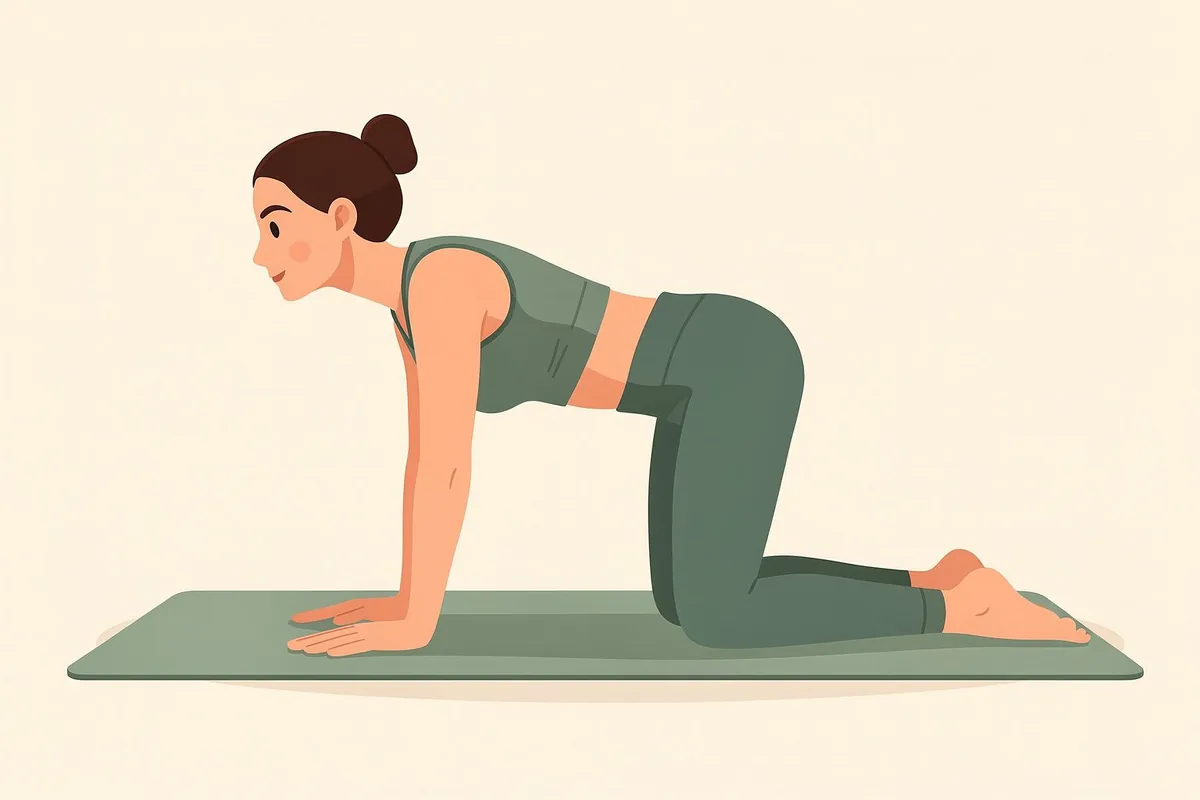
Cat-Cow is two poses joined into one smooth movement. On your hands and knees, you curve your spine down and then up in time with your breath: Cow as you breathe in, Cat as you breathe out. It is a common way to start a practice because it moves your whole spine gently, from your tailbone to your neck, before bigger poses.
The names describe the shapes. In Cat, your back arches up like a stretching cat. In Cow, your back dips while your chest and tailbone lift. In physical therapy and exercise research, a similar movement goes by the name cat-camel. This guide covers both halves, how to pace them with your breath, and chair and standing versions if kneeling isn’t for you. It is part of our pose library. New to yoga? Start with yoga for beginners.
In this guide
How to do Cat-Cow
Cat-Cow has a starting position and two halves. Learn each half on its own first, then link them with your breath.
Set up in tabletop
- Come onto your hands and knees on a yoga mat. Stack your shoulders over your wrists, or set your hands a little ahead of them, and line up your knees under your hips.
- Rest the tops of your feet on the mat.
- Open your hands wide and let your fingertips and the knuckles at the base of your fingers share the weight with your palms.
- Start with a flat, long back. Keep your neck long and look at the floor just ahead of your hands.
Cow: breathe in
- As you breathe in, let your belly sink toward the floor.
- Lift your tailbone and your chest at the same time, so your back curves gently down.
- Widen across your collarbones and draw your shoulders away from your ears.
- Lift your gaze forward or slightly up, keeping the back of your neck soft.
Cat: breathe out
- As you breathe out, draw your belly in toward your spine.
- Press the floor away and round your back up toward the ceiling.
- Tuck your tailbone under and let your head drop toward the floor, chin moving toward your chest.
Put the two halves together
- Flow from Cow to Cat and back again, letting each breath set the pace.
- Move slowly enough that your whole spine takes part, not just your lower back.
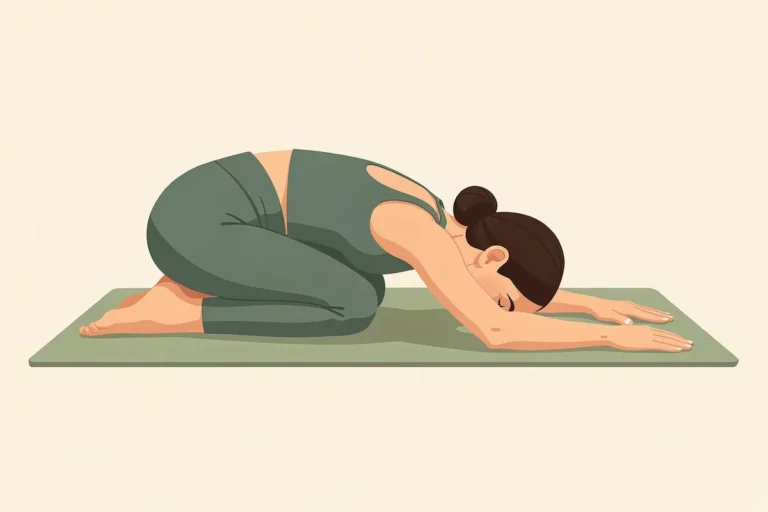
- Do 5 to 10 rounds. Then return to a flat back and sit back into Child’s Pose to rest.
Alignment cues
- Spread the curve. In Cow, aim for a long, even curve from your tailbone to your neck instead of a sharp bend in your lower back.
- Soft neck. Let your head follow your spine. In Cow, lift your chin only a little. In Cat, let your head hang.
- Steady arms. Keep your arms straight but not locked, and don’t let your shoulders creep up toward your ears.
- Lead with your pelvis. Let each half begin as a small tilt of your pelvis, then let the curve spread up your back until your head follows last.
- Let the breath lead. Start moving when the breath starts and finish when it finishes. If you run out of breath, slow down or make the movement smaller.
- Stay in your range. Move only as far as feels comfortable. Cat-Cow should feel easy, not forced.
Common mistakes
- Bending only in the lower back. If Cow happens mostly in your lower back, your upper back gets left out. Lift your chest forward as much as you lift your tailbone.
- Throwing your head back. Cranking your head up in Cow squeezes the back of your neck. Lift your gaze, not your whole head.
- Rushing. Fast, jerky rounds lose the link with your breath. One slow breath for each half is plenty.
- Shoulders up by your ears. Keep pushing the floor away in both halves.
- Breathing in reverse. The usual pairing is Cow on the in-breath and Cat on the out-breath. If you mix them up, pause and restart with a slow breath in.
- Locked elbows. If your elbows bend backward when straight, keep a soft bend in them.
Watch out for: sharp or pinching pain in your back, neck, wrists or knees. Stop, rest in Child’s Pose and try a smaller movement or the chair version.
Make it easier (props)
- Blanket under your knees. Fold a blanket, or fold over the end of your mat, to cushion your knees.
- Fists or forearms for your wrists. Make soft fists and rest on your knuckles, or lower onto your forearms resting on two yoga blocks at their lowest height. A rolled mat edge under the heels of your hands is another option.
- Chair Cat-Cow. Sit near the front of a sturdy chair with your feet flat and your hands on your knees. Breathe in to lift your chest (Cow). Breathe out to round your back (Cat). There are more ideas in our chair yoga guide.
- Standing Cat-Cow. With soft knees, lean forward a little and brace your hands just above your knees. Breathing in, lift your breastbone and let your back hollow; breathing out, curl your back and look toward your belly. It makes a handy break during a long day at a desk; see yoga for desk workers.
- A smaller movement. You don’t need the full range. A gentle tilt of your pelvis and a small change in the curve of your back still counts.
Variations
- Opposite arm and leg. Breathing in, float your right arm and left leg out level with your back. Breathing out, round your back and bring that elbow and knee toward each other under your belly. Switch sides after a few rounds. This adds balance and core work.
- Side bends. Between rounds, look over your right shoulder toward your right hip so your body curves into a C. Then switch sides.
Poses to do before and after
- First thing: Cat-Cow makes a gentle opening move. All it needs before it is a few calm breaths on your hands and knees.
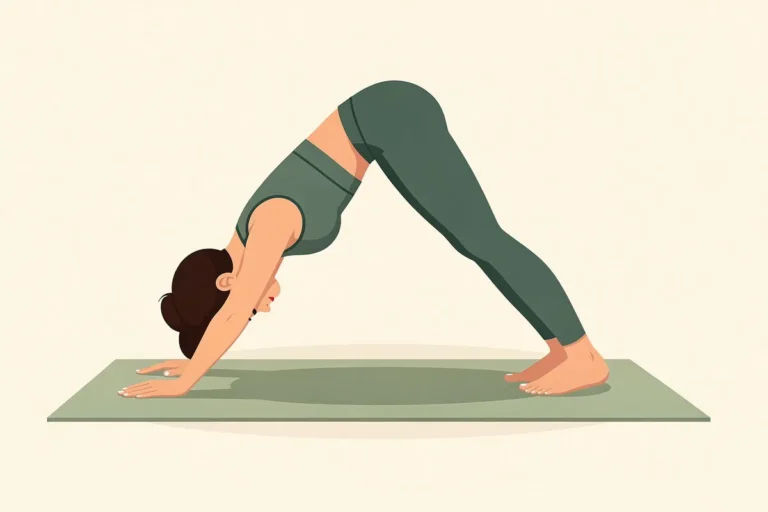
- After: move into Downward-Facing Dog from the same tabletop position, or rest in Child’s Pose.
- Later in a session: it pairs well with backbends such as Cobra Pose and Bridge Pose.
- In a routine: it fits easily into a short morning yoga routine.
Who should skip it or ask a doctor first
- Wrist or knee injuries. The NCCIH lists earlier injuries, such as knee injuries, among the conditions that may call for changes to your yoga practice. Pad your knees, use fists or forearms for your wrists, or do the chair version.
- Neck injuries. Keep your head in line with your spine in both halves instead of lifting or dropping it.
- Osteoporosis, low bone density or a past spine fracture. Cat rounds your spine forward. Doctors at Mayo Clinic have reported spine fractures, mostly in people with low bone mass, after yoga poses that bend the spine forward (Sfeir et al., 2018; Sinaki, 2013). They advise people with low bone density to avoid extreme forward bending of the spine (Lee et al., 2019). Ask your doctor or physical therapist whether rounding movements are OK for you, and how far.
- Back conditions or new back pain. The NCCIH lists lumbar spine disease among the conditions that may call for changes. Move in a small, pain-free range, and don’t use yoga to put off seeing a health care provider about a medical problem.
- Pregnancy. Get checked by your health care provider first, as the NCCIH advises. If you get the OK, pad your knees and keep Cow gentle: lift your chest without letting your lower back sag.
What the research says
Evidence: no good evidence
We found no trial that tested Cat-Cow on its own, so there is no good evidence for it by itself. Two kinds of studies still tell you something about it.
- What it asks of your muscles. In a lab study of 22 young adults trained in yoga, the cat-camel movement kept all four trunk and hip muscles measured below 20% of their maximum effort (Dewan et al., 2023). In other words, it is a gentle mobility move, not a strength exercise.
- Yoga programs for chronic low back pain. Cat-Cow has been part of yoga programs tested for back pain. In a trial of 320 adults, a 12-week class program that included Cat-Cow (study protocol) worked about as well as physical therapy, though not clearly better than an education book (Saper et al., 2017). A Cochrane review of 21 trials (2,223 people) found that, compared with no exercise, yoga gave small improvements in back function and pain, too small to count as a meaningful change for patients. It probably helped back function about as much as other back exercises. Yoga also led to more side effects than no exercise, mostly more back pain (about 4 in 100 people against 1 in 100), and about the same as other exercise (Wieland et al., 2022).
So Cat-Cow is a reasonable, gentle part of a practice. There is no evidence that Cat-Cow by itself treats back pain.
Frequently asked questions
When do you breathe in Cat-Cow?
Breathe in as you move into Cow (belly down, chest up). Breathe out as you move into Cat (back rounded, belly drawn in). Drawing your belly in goes naturally with breathing out, which makes the pairing easy to remember.
How many rounds of Cat-Cow should you do?
Five to 10 slow rounds make a good warm-up, with one full breath for each half. You can do more on a stiff morning or as a desk break, as long as it stays comfortable.
Is Cat-Cow good for lower back pain?
It may be a comfortable way to move, but it hasn’t been tested on its own. It has been part of yoga programs studied for chronic low back pain, and those programs helped a little (see the research box above). The NCCIH describes the overall evidence for yoga and low back pain as “a slight benefit.” Don’t use yoga to put off seeing a health care provider about back pain.
Is Cat-Cow safe during pregnancy?
Ask your doctor or midwife first; the NCCIH advises getting checked before you exercise in pregnancy. If you get the OK, put a folded blanket under your knees, move slowly, and keep Cow gentle so your lower back doesn’t sag.
Is Cat-Cow safe if you have osteoporosis?
Check with your doctor or physical therapist first. Cat rounds your spine forward, and doctors have reported spine fractures after forward-bending yoga poses, mostly in people with low bone mass. Your care team can tell you how much rounding, if any, suits your bones.
What is the difference between Cat-Cow and cat-camel?
They are very similar. Cat-camel is a name used in physical therapy and exercise research for rounding and arching your back on all fours. Yoga classes call it Cat-Cow and link each half to the breath.
Sources
- National Center for Complementary and Integrative Health (NCCIH). Yoga: Effectiveness and Safety. Last updated August 2023., checked Nov 4, 2026
- Wieland LS, Skoetz N, Pilkington K, Harbin S, Vempati R, Berman BM. Yoga for chronic non-specific low back pain. Cochrane Database Syst Rev. 2022;11(11):CD010671., checked Nov 4, 2026
- Saper RB, Lemaster C, Delitto A, et al. Yoga, Physical Therapy, or Education for Chronic Low Back Pain: A Randomized Noninferiority Trial. Ann Intern Med. 2017;167(2):85-94., checked Nov 4, 2026
- Saper RB, Sherman KJ, Delitto A, et al. Yoga vs. physical therapy vs. education for chronic low back pain in predominantly minority populations: study protocol for a randomized controlled trial. Trials. 2014;15:67., checked Nov 4, 2026
- Dewan M, Nijhawan M, Chhabra HS, Shandilya S, Kumar P, Phadke V. Electromyographic analysis of trunk and hip muscles during Yoga poses prescribed for treating chronic low back pain. J Bodyw Mov Ther. 2023;36:117-124., checked Nov 4, 2026
- Sfeir JG, Drake MT, Sonawane VJ, Sinaki M. Vertebral compression fractures associated with yoga: a case series. Eur J Phys Rehabil Med. 2018;54(6):947-951., checked Nov 4, 2026
- Sinaki M. Yoga spinal flexion positions and vertebral compression fracture in osteopenia or osteoporosis of spine: case series. Pain Pract. 2013;13(1):68-75., checked Nov 4, 2026
- Lee M, Huntoon EA, Sinaki M. Soft tissue and bony injuries attributed to the practice of yoga: a biomechanical analysis and implications for management. Mayo Clin Proc. 2019;94(3):424-431., checked Nov 4, 2026
Image credits: Illustration (the Cow half of the pose): AI-generated for YogaForFitness (FLUX.2 [pro]), checked for pose accuracy