How to Use Yoga Blocks: Three Heights and Seven Beginner Uses
Quick answer
A yoga block does three jobs: it raises the floor to meet your hands, it takes some of your weight under your hips, pelvis or forehead, and it gives your legs something to squeeze. Turn it to the height that lets you keep a long back and easy breathing. The lower and flatter it sits, the steadier it is: lie on it or lean your hands' weight on it only at its lowest, and never rest weight on a block standing on its small end. Blocks are a teaching convention: we found no study that tested them for any health result.
We may earn a commission when you buy through links on this page. It never changes what we recommend. As an Amazon Associate we earn from qualifying purchases.
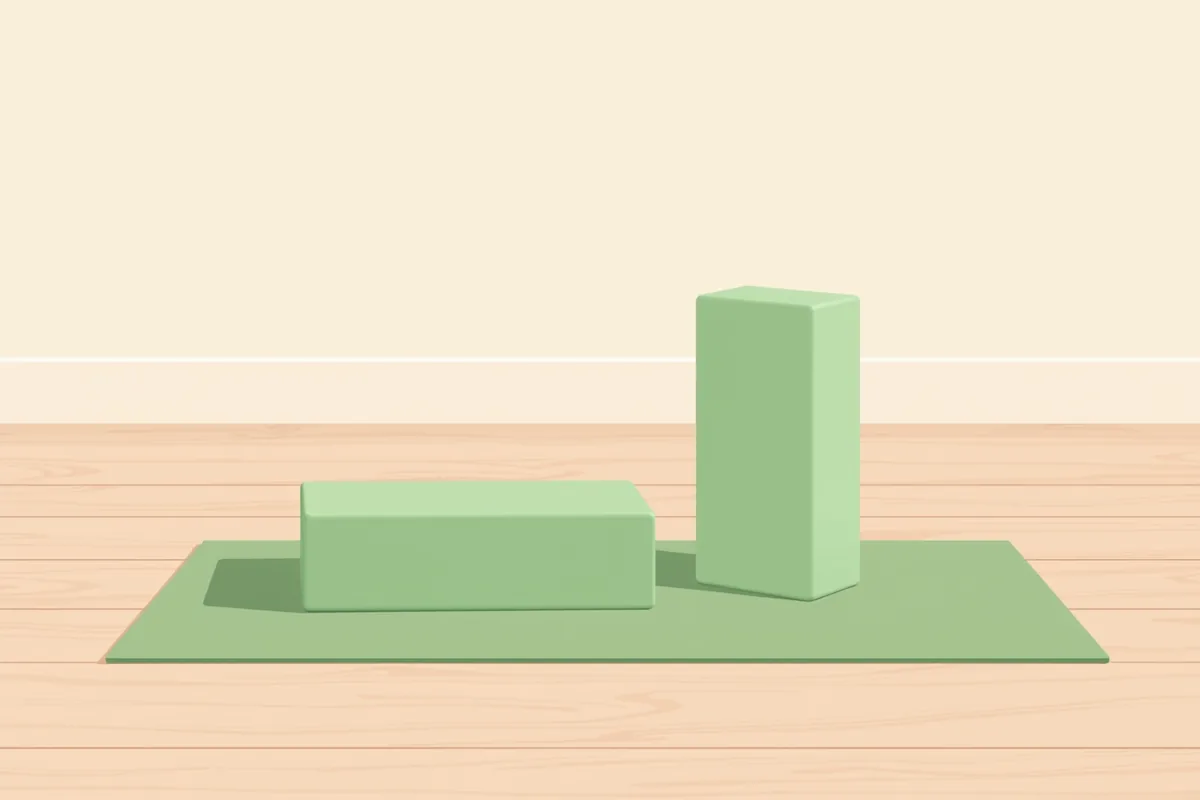
A yoga block is a firm brick, most often foam or cork (wood ones exist too), a little smaller than a shoebox. Our pose guides keep saying “put a block under it” without explaining the block. This guide does: what it is for, which way up to turn it, where it goes in the poses beginners meet first, and how to keep it from sliding or tipping.
It is a how-to, not a shopping list. For what a beginner needs in total, see the short list in yoga for beginners. This page is part of the gear section. We have not handled or tested any block: the product facts come from two makers’ own pages, and the placements from published teaching references.
In this guide
- What is a yoga block for?
- What are the three heights of a yoga block?
- Seven ways to use a yoga block as a beginner
- Foam or cork: what do the makers state?
- How many yoga blocks do you need: one or two?
- What can you use instead of a yoga block?
- How do you use yoga blocks safely?
- Who should ask a doctor before using these setups
- Do yoga blocks actually help?
- Frequently asked questions
- Sources
What is a yoga block for?
Three jobs cover nearly every use you will see in a class or a video:
- It raises the floor. With a block under your hand, you don’t have to round your back or strain to get your palm down. Cleveland Clinic’s yoga specialist describes this as shortening the gap from your hands to the mat in standing and bending poses (Cleveland Clinic).
- It carries part of your weight. A block under your seat, under the back of your pelvis or under your forehead lets that part of you rest. The American Council on Exercise notes that a block can support the back, head or hips as well as the hands (ACE).
- It gives you something to squeeze. Held between your thighs, a block gives your inner legs a clear task. Cleveland Clinic lists this for Bridge Pose.
Using one doesn’t mean you’re doing a lesser pose. The same Cleveland Clinic article says props exist so that people at any level of flexibility can practice. That is an expert’s view, not a trial result (see the research box).
What are the three heights of a yoga block?
A block has three different edge lengths, so it gives you three heights depending on which face is on the mat. Both blocks named in this guide measure 4 x 6 x 9 in on their makers’ pages (Gaiam; Manduka), which gives these numbers:
| Setting | Height | Face on the mat | Steady enough for |
|---|---|---|---|
| Low | 4 in | 9 x 6 in, the largest | Anything you lie on or lean your weight on: your pelvis in Supported Bridge, your hands or forearms in Downward-Facing Dog; also the first choice for a seat |
| Medium | 6 in | 9 x 4 in, the long narrow side | Hands in lunges and forward folds, your forehead, a higher seat |
| High | 9 in | 6 x 4 in, the small end | Light support only: fingertips or a flat hand on top, with your weight still in your legs |
Each step up makes the block taller and its footprint smaller, so it tips more easily. A teaching article on wrist-friendly poses makes the same point: with forearms on blocks in Downward-Facing Dog, use the lowest setting so the blocks don’t topple (Yoga International).
Two habits follow. Push straight down, never sideways: on the medium and high settings, set the block right under your shoulder so your arm is vertical. And start high for reach but low for weight. A block that only helps you reach can begin at its tallest and come down as you loosen up over the weeks. A block you lie on or lean your body weight on (Supported Bridge, hands or forearms in Downward-Facing Dog) begins at its lowest and stays there. A seat or a forehead rest may go to medium, because you press straight down on it. Other block sizes are sold, and the heights change with the block.
Seven ways to use a yoga block as a beginner
Each use names the height to begin with and links the page that teaches the pose. The steps cover only the block.
1. Under your hands in forward folds and lunges
Height: high to begin with, then medium.
- Stand a block on each side of your front foot in Low Lunge, or one in front of each foot for a standing half fold.
- Bend at the hips with soft knees and bring your hands down onto the blocks.
- Press lightly and lengthen your back, from tailbone to the top of your head.
- If your back still rounds, bend your knees more. Don’t stack two blocks under a hand: the top one can slide off.
The same setup works for Pyramid and Half Splits in our yoga for tight hamstrings routine.
2. Under your lower hand in side-reaching standing poses
Height: high, or medium if you can reach it without your waist collapsing.
Poses built on the wide stance of Warrior II, such as Triangle and Extended Side Angle, send your lower hand toward the floor beside your front foot. If the floor is too far, the underside of your waist crumples and your chest turns down.
- Set the block beside your front foot, on the inner or the outer side, whichever keeps both sides of your waist long (YogaEasy).
- Lower your hand to the block with your arm vertical.
- Keep most of your weight in your legs. The hand is a light touch.
If your balance is unsteady, a sturdy chair seat is a taller and steadier support than a block on its end.
3. Under your seat for cross-legged and seated poses
Height: low, or medium if your knees still sit above your hips.
- Place the block flat near the back of your mat.
- Sit on its front half, so your sitting bones are on the block and your thighs slope down off the edge.
- Cross your shins, or stretch your legs out for a Seated Forward Fold.
- If your lower back still slumps, go one height up or add a folded blanket on top.
The usual teaching reason is that a higher seat lets your lower back keep its natural curve instead of rounding (YogaEasy). Cleveland Clinic’s pose guides offer a block or rolled towel as a seat when the bare floor is hard to sit on (flexibility poses), and a block under the seat in a deep squat (hip stretches), the Garland pose in our yoga for tight hips routine.
4. Under your sacrum in Supported Bridge
Height: low.
- Set up for Bridge Pose: face up, knees bent, soles on the mat, block within reach.
- Push down through your feet until your hips come up.
- Slide the block, flat, under the back of your pelvis, with its long side running across your body from hip to hip. The spot is the broad bony plate called the sacrum, below the soft inward curve of your waist and above your tailbone.
- Lower your weight onto the block, keep both feet planted and your head still, and let your buttocks relax. A minute is plenty to begin with.
- To come out, lift your hips again, slide the block away and lower your back to the mat.
Teaching references agree on the landmark: under the sacrum, just above the tailbone (YogaEasy), and under the pelvis, never under the lower back, with the block on a wide side only (Yin Yoga). A bolster version is taught the same way: across the pelvis, not the lower back (YogaUOnline). If you feel the block’s edge in the curve of your lower back, it is too close to your ribs. Lift and move it toward your tailbone.
Watch out for: you are on your back with your hips above your head. Read the caution box first if you are pregnant or have glaucoma, a neck or back condition or severe high blood pressure. Keep your head still and face the ceiling while you are on the block.
5. Between your thighs
Height: none. Turn the block so its narrowest (4 in) width sits between your legs.
- In Bridge Pose, place the block between your thighs, a little above the knees, before you lift.
- Hold it with a light, steady squeeze as your hips rise and lower.
- Standing in Mountain Pose, hold it higher up, at the top of your inner thighs, and squeeze just enough that it stays put.
The block keeps your knees from drifting apart. When your legs stop working, it drops.
6. Under your forehead in Child’s Pose
Height: low or medium, whichever meets your forehead without lifting your hips.
- Come into Child’s Pose with the block on the mat ahead of your knees.
- Fold forward and slide the block under your forehead.
- Let your head rest fully, so the back of your neck stays long.
Cleveland Clinic recommends this when your forehead doesn’t reach the floor, to keep your neck straight.
7. Under your hands in Downward-Facing Dog (teachers differ)
Height: low. This is the one use here where your body weight pushes on the blocks at an angle. One tutorial and our own Downward-Facing Dog page also allow the middle height; start at low, where the blocks are least likely to skid.
Teaching references accept Downward-Facing Dog with hands on blocks. One lists it beside the chair and wall versions as a way to fit the pose to your body (Yoga International). They differ on what it does:
- A beginner tutorial says raised hands shift weight toward the legs and take some load off the wrists and upper body (YogaUOnline).
- A guide for people with wrist trouble doesn’t list hands on blocks. It moves the weight to the forearms, on blocks at their lowest setting, or puts a wedge under the hands (Yoga International).
Nobody has measured either, as far as we could find. If your wrists are the problem, the forearm version on our Downward-Facing Dog page is the more direct change.
- Lay two blocks flat at the front of your mat, shoulder-width apart, with the whole of each block on the mat.
- From hands and knees, put your palms flat on the blocks, fingers spread.
- Tuck your toes, lift your knees and move your hips up and back.
- If either block shifts, come down and reset. Skip this version on a worn or slick mat.
Our guides also put blocks under your forearms in Cat-Cow and under each knee in Bound Angle.
Foam or cork: what do the makers state?
We compare only what two makers publish, read on November 17, 2026.
| Foam: Gaiam Yoga Block 2-Pack | Cork: Manduka Cork Yoga Block | |
|---|---|---|
| Size | 4 x 6 x 9 in each | 4 x 6 x 9 in |
| Weight | Not stated | 2.2 lb (1 kg) |
| Material | “100% sturdy foam” | Solid cork |
| Maker’s description | Lightweight and portable | Dense, heavy enough to stay where you put it; textured surface; beveled, rounded edges |
| Firmness figure | None | None; the maker’s words are dense and firm |
| Care | Not stated | Wipe with a damp cloth and mild soap, air dry, don’t submerge |
Going by the makers’ own words, the choice is between a block that is easy to carry and one that is harder to nudge out of place. Neither page gives a density, and we found no weight limit on either. How each feels under load we can’t tell you, and we won’t guess. Sizes and pack counts can differ between sellers’ listings, so read both on the listing before you order.
How many yoga blocks do you need: one or two?
Count the uses above. One block covers sitting, Supported Bridge, the thigh squeeze, Child’s Pose and the side-reaching poses. Two are needed whenever both hands come down at once: forward folds, Low Lunge, Half Splits and Downward-Facing Dog, and for the forearm and knee supports mentioned above. One block under one hand in those poses tilts your shoulders.
That is why our beginner guides list two. If you have one, pair it with a book of the same height. When the gap is from your hands to your feet, not to the floor, a strap is the tool: see how to use a yoga strap.
What can you use instead of a yoga block?
The same references name household stand-ins:
- Under your hands: a stack of heavy books (Cleveland Clinic). Use two stacks of equal height, and tape or tie each one so the books can’t slide apart.
- Under your seat: a firm cushion, a folded blanket or a stack of books (YogaEasy).
- Between your thighs: a rolled towel, the same YogaEasy article says.
- Under your pelvis in Supported Bridge: a folded towel, which is lower and softer than a block (YogaEasy).
- Under your forehead: your stacked fists, as on our Child’s Pose page.
A stand-in has to pass the same test as a block: flat on top, flat underneath, and it doesn’t squash or slide when you load it.
How do you use yoga blocks safely?
- Keep the block on your mat. A mat is there to give a non-slip surface (Cleveland Clinic). A block on bare wood, tile or laminate can shoot out from under your hand. No mat yet? See yoga mats for beginners and the floor table in how to start yoga at home.
- Test it first. The whole face is down, no corner hangs off the mat, and it doesn’t rock when you press on it. Use the lowest setting when you lie on a block or lean your weight on it.
- Don’t stand or balance on a block. Some teaching pages show standing on blocks as an added challenge (YogaEasy). We leave those uses out: a beginner’s prop should lower the chance of a fall, not raise it.
- A block doesn’t change which way up you are. With your hands on blocks in a forward fold, your head is still below your heart and your spine can still round. The limits on a pose apply to its block version too.
- Pain is a stop sign. If a supported position pinches or aches, come out.
Who should ask a doctor before using these setups
- Pregnancy. Before you exercise, a health care provider should rule out any medical reason not to, the NCCIH says. Skip Supported Bridge and the Bridge thigh squeeze. Both keep you on your back, which the NCCIH says to avoid for long periods; the NHS puts the limit in later pregnancy at a few minutes. The NCCIH also says to avoid long periods of being still, so keep any rested position on a block short. The NHS also warns against activities where a fall is likely, so stand near a wall or chair, whatever is under your hand.
- Glaucoma. In one small study (Jasien et al., 2015), twenty people, ten of whom had glaucoma, held four head-down poses, Downward-Facing Dog and the standing forward fold among them. Pressure inside the eye climbed within the first minute and had returned to where it began two minutes after they sat up. Blocks under your hands don’t lift your head above your heart, so ask your eye doctor before uses 1 and 7. Supported Bridge and Child’s Pose also put your head lower than your hips. Neither was in that study, so ask about them as well.
- Osteoporosis or low bone density. A Mayo Clinic review of 89 patients hurt in yoga (Lee et al., 2019) concluded that anyone with thinning bones would do well to keep the spine out of extreme forward bends. Blocks under the hands are taught as a way to fold with a longer back, but no study shows that they protect the spine. The same doctors urge care with extreme backbends; ask about Supported Bridge too. Ask your doctor which forward bends suit you.
- Hip replacement. MedlinePlus says to keep the hip from bending beyond a right angle and not to cross your legs, and its rule for sitting is to avoid low seats, so your hips stay higher than your knees. A block on the floor is a very low seat. Forward folds, Low Lunge, Child’s Pose and Downward-Facing Dog bend the hip past a right angle with or without a block. The Hospital for Special Surgery says a few of its surgeons advise patients to avoid yoga after a hip replacement (HSS). Follow your own surgeon’s rules.
- Knee or shoulder replacement. HSS advises waiting for your surgeon’s go-ahead, expecting modified poses, and telling your yoga teacher about the new joint.
- Unsteady balance, or 65 and over. Balance issues are on the NCCIH’s list of reasons to change poses, and it reports a higher rate of emergency-room yoga injuries from 65 up. Use a sturdy chair in place of a tall block in standing poses, with two or more of its legs on your mat so it can’t slide, as the Arthritis Foundation suggests.
- Lower-back (lumbar spine) disease, knee or hip injuries, severe high blood pressure. The NCCIH names these too. Supported Bridge holds your lower back in a gentle arch, forward folds put your head down, and Child’s Pose and Low Lunge load or deeply bend the knees. Get your doctor’s advice before trying them.
- Neck problems or a past neck injury. Supported Bridge bends your neck forward while your shoulders carry weight. Ask your doctor or physical therapist first, and never turn your head while your hips are up (see Bridge Pose).
- Wrist, elbow or shoulder injuries; heart conditions, dizziness or fainting. Hands on blocks is still Downward-Facing Dog: your arms carry weight and your head is below your heart. The cautions on our Downward-Facing Dog page apply; use its wall or chair version, or ask your doctor first.
Do yoga blocks actually help?
Evidence: no good evidence
We found no study that has tested it. We searched PubMed for studies of yoga blocks and of yoga props and found none that measured what a block does to injuries, flexibility, pain or any other health result.
The closest study is about props in general, and about opinion. Over two semesters, 220 undergraduates in physical education courses did three yoga poses with and without props. They reported that props helped with moderately difficult and more difficult poses, and reported no significant difference for a less demanding pose (Jahani et al., 2025). The published summary doesn’t say which props or which poses, the result is the students’ own rating, and we could read only the summary.
Why “none”: no study tested blocks themselves, and the one study of props measured satisfaction, not health. Where a block goes is a convention among teachers. It is widely shared, but it is not tested evidence. For what trials of yoga itself show, see benefits of yoga.
Frequently asked questions
Are yoga blocks necessary?
No. Every use above has a household stand-in, and many poses need nothing. Blocks earn their place when the floor is out of comfortable reach or when sitting on it makes you slump.
Can a yoga block help with back pain?
We can’t say that it does: no study we found has tested a block for back pain. A block is a support, not a treatment. If your back pain is severe, keeps returning or travels down a leg, get it checked by a doctor before trying supported positions such as Bridge on a block.
Helpful gear for this
 Manduka begin yoga mat, 5 mm
5 mm TPE mat, 68 x 24 in, light to carry, with a center alignment stripe (maker's spec).
See it on Amazon Gaiam foam yoga blocks, pair
Two light foam blocks, 9 x 6 x 4 in each, to raise the floor under your hands (maker's spec).
See it on Amazon Hugger Mugger cotton D-ring yoga strap, 10 ft
Cotton webbing 1.5 in wide with a metal D-ring buckle, 10 ft long (maker's spec).
See it on Amazon
As an Amazon Associate we earn from qualifying purchases. How we choose gear
Sources
- Cleveland Clinic. Essential Yoga Props for Every Yoga Practice. Health Essentials. February 20, 2026., checked Nov 17, 2026
- Thielen S. How to Use Blocks to Enhance Your Yoga Poses. American Council on Exercise (ACE). September 5, 2018., checked Nov 17, 2026
- Cleveland Clinic. Tight hips? Try these 11 hip-opening stretches. Health Essentials. December 4, 2025., checked Nov 17, 2026
- Cleveland Clinic. Try These Yoga Poses To Improve Your Flexibility. Health Essentials. September 26, 2022., checked Nov 17, 2026
- Arthritis Foundation. Get Support From Yoga Gear., checked Nov 17, 2026
- National Center for Complementary and Integrative Health (NCCIH). Yoga: Effectiveness and Safety. Last updated August 2023., checked Nov 17, 2026
- Lee M, Huntoon EA, Sinaki M. Soft tissue and bony injuries attributed to the practice of yoga: a biomechanical analysis and implications for management. Mayo Clin Proc. 2019;94(3):424-431., checked Nov 17, 2026
- Jasien JV, Jonas JB, de Moraes CG, Ritch R. Intraocular pressure rise in subjects with and without glaucoma during four common yoga positions. PLoS One. 2015;10(12):e0144505., checked Nov 17, 2026
- NHS. Exercise in pregnancy. Page last reviewed September 24, 2026., checked Nov 17, 2026
- MedlinePlus (U.S. National Library of Medicine). Taking care of your new hip joint. Reviewed November 7, 2024., checked Nov 17, 2026
- Hospital for Special Surgery (HSS). Is Yoga Safe to Do After Joint Replacement Surgery?, checked Nov 17, 2026
- Jahani S, Haberlin S, Roig Ralls Y, Bradshaw T. Examining the use of props to assist undergraduates in developing a sustainable yoga practice. J Bodyw Mov Ther. 2025;45:147-152. Abstract only., checked Nov 17, 2026
- Gaiam. Yoga Block 2-Pack (product page: measurements and materials)., checked Nov 17, 2026
- Manduka. Cork Yoga Block (product page: specs, use and care)., checked Nov 17, 2026
- Heagberg K. 7 Common Misconceptions About Down Dog. Yoga International. Teaching reference., checked Nov 17, 2026
- Moonaz S. Pose Modifications for Wrist Challenges. Yoga International. Teaching reference., checked Nov 17, 2026
- Sugerman L. Downward Facing Dog for Beginners: 5 Ways to Practice. YogaUOnline. November 6, 2023. Teaching reference., checked Nov 17, 2026
- Bell C. Decompress in Supported Bridge Pose. YogaUOnline. September 13, 2024. Teaching reference., checked Nov 17, 2026
- Yin Yoga. Bridge Pose. Teaching reference., checked Nov 17, 2026
- YogaEasy. Bridge Pose. Teaching reference., checked Nov 17, 2026
- YogaEasy. Triangle Pose. Teaching reference., checked Nov 17, 2026
- Savage J. What if you don’t have any yoga props? YogaEasy. Teaching reference., checked Nov 17, 2026
- Bové L. 12 ways to use yoga blocks. YogaEasy. Teaching reference., checked Nov 17, 2026
Image credits: Illustration: AI-generated for YogaForFitness (FLUX.1-schnell), checked for accuracy