Easy Yoga Poses: 20 Beginner Poses to Start With
Quick answer
Easy yoga poses are the ones you can do with a long, comfortable breath: standing poses like Mountain Pose, kneeling poses like Child's Pose and Cat-Cow, easy seats and folds, gentle floor poses, and resting poses at the end. This library gives 20 of them, each with a short how-to and a note on when to skip or change it. Start with 3 to 5 slow breaths in each and stop at any sharp pain.
We may earn a commission when you buy through links on this page. It never changes what we recommend. As an Amazon Associate we earn from qualifying purchases.
Easy yoga poses are the ones you can do while breathing slowly and smoothly, without strain. This page is a library of 20 of them, grouped by type. Each has a short how-to and a “skip or change if” note, and many link to a full guide. Pick three or four, hold each for about 3 to 5 slow breaths, the range Cleveland Clinic gives in its beginner sequence (Cleveland Clinic), and add more over time.
If you’re brand new, begin with yoga for beginners, which gives a four-week plan and a starter set of ten poses. This page is the bigger library: ten more poses, plus how to choose and order them. More single-pose guides are in our pose library.
In this guide
- How do you choose yoga poses for beginners?
- How do you put basic yoga poses in order?
- Standing yoga poses
- Hands-and-knees and kneeling poses
- Seated poses
- Lying-down poses
- Restful poses
- A sample 15-minute order
- How long should you hold each pose?
- Which props help with beginner poses?
- Who should change these poses or ask a doctor first
- Sources
How do you choose yoga poses for beginners?
Choose poses that pass three simple tests:
- You can breathe smoothly in them. If your breath turns choppy or you hold it, you’ve gone past what’s easy today.
- They don’t hurt. A stretch or a working muscle is normal. Sharp, pinching or joint pain isn’t. Cleveland Clinic says you should never feel pain in yoga and should stop and reassess if you do (Cleveland Clinic).
- You can reach the floor, or the floor can reach you. If a pose feels far away, blocks, a folded blanket or a wall bring the floor closer.
Also pick a mix: something standing, something on hands and knees, a fold, a gentle floor pose and a rest. The sections below follow that order, so you can take one or two yoga positions from each group.
How do you put basic yoga poses in order?
There is no official rule, only habits most classes share: small moves first, quiet ones last.
- Settle: start seated or standing and breathe for a minute.
- Warm up: slow, small movements such as Cat-Cow.
- Stand: standing poses, then fold forward or rest.
- Work the floor: kneeling, seated and lying poses, with the more active ones first.
- Rest: finish lying down with a calm, supported pose.
Do both sides of any one-sided pose with the same number of breaths, and rest in Child’s Pose whenever you need to.
Standing yoga poses
Standing poses work your legs and let you practice balance. Keep your knees soft rather than locked, and do the balance poses next to a wall.
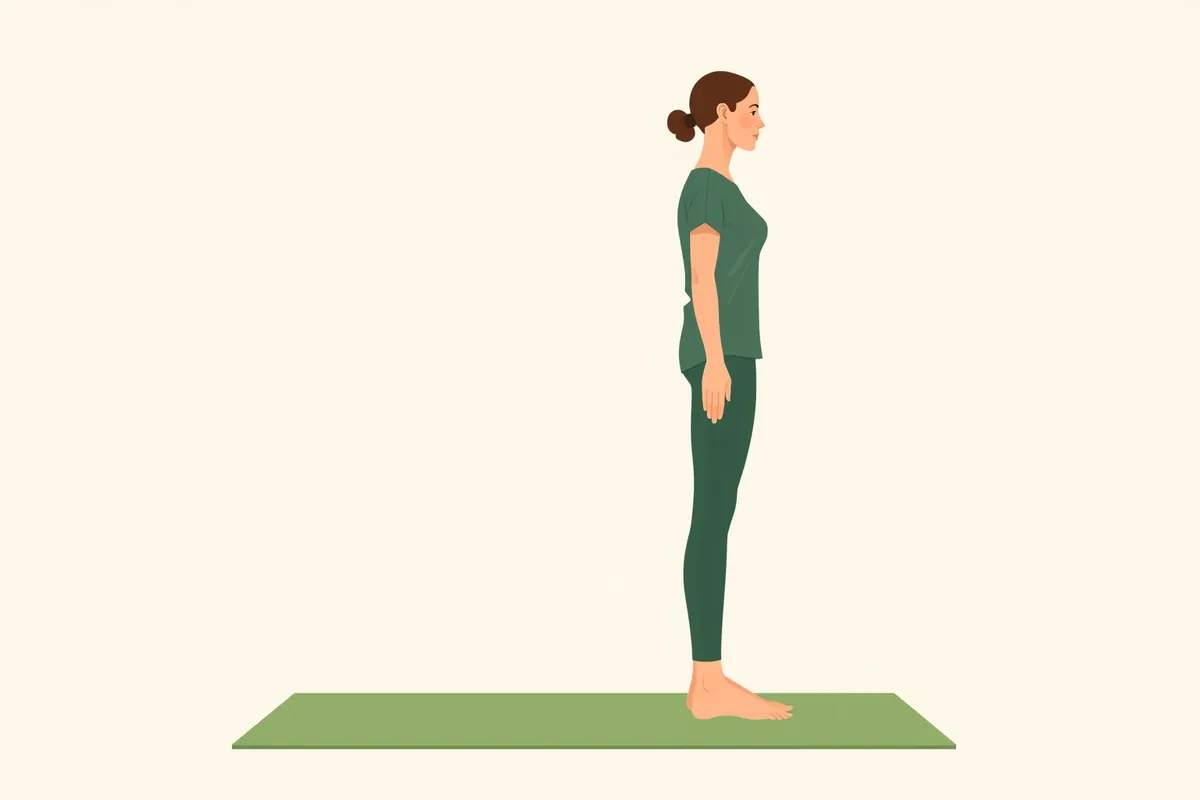
1. Mountain Pose
Mountain Pose is standing with care. Set your feet parallel and hip-width apart, spread your toes, and share your weight evenly between the feet. Stack your head over your shoulders and let your arms hang. Most other standing poses start from it.
Skip or change if: you can’t stand for long. Do it seated instead, with your feet flat and your back tall.
2. Standing Forward Fold
Stand with your feet about hip-width apart. Soften your knees, then hinge forward from your hip creases, keeping your back long for as long as you can. Let your hands rest on your thighs, shins, a pair of blocks or the floor, and let your head and neck hang loose. Bending your knees as much as you like helps keep length in the spine, and length matters more than depth (YogaEasy). Hold for 3 to 5 breaths (Cleveland Clinic).
Skip or change if: you have a back injury (check with a health professional first, per YogaEasy), glaucoma (head-down, see the caution box) or osteoporosis (ask which folds are safe for you).
3. Chair Pose
Stand with your feet hip-width apart and bend your knees, sending your hips back as if you were lowering onto a chair. Send your weight back far enough that you can still see your toes, and keep your lower belly gently drawn in so your lower back doesn’t arch. Reach your arms forward or overhead if your shoulders are comfortable. Teachers describe about 5 to 10 breaths (YogaEasy; Yoga International), but a few is plenty at first.
Skip or change if: your knees or ankles are injured or painful. Bend your knees only a little, keep your hands on the back of a sturdy chair, or skip the pose. Ask your provider or physical therapist which standing poses suit you.
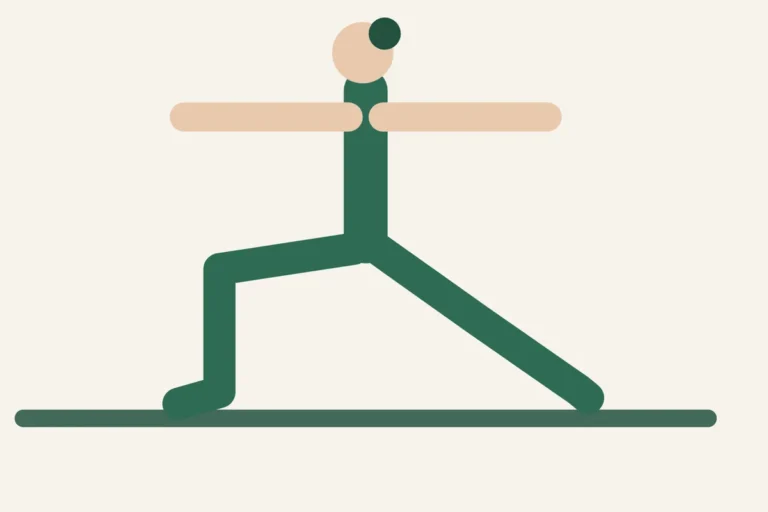
4. Warrior II
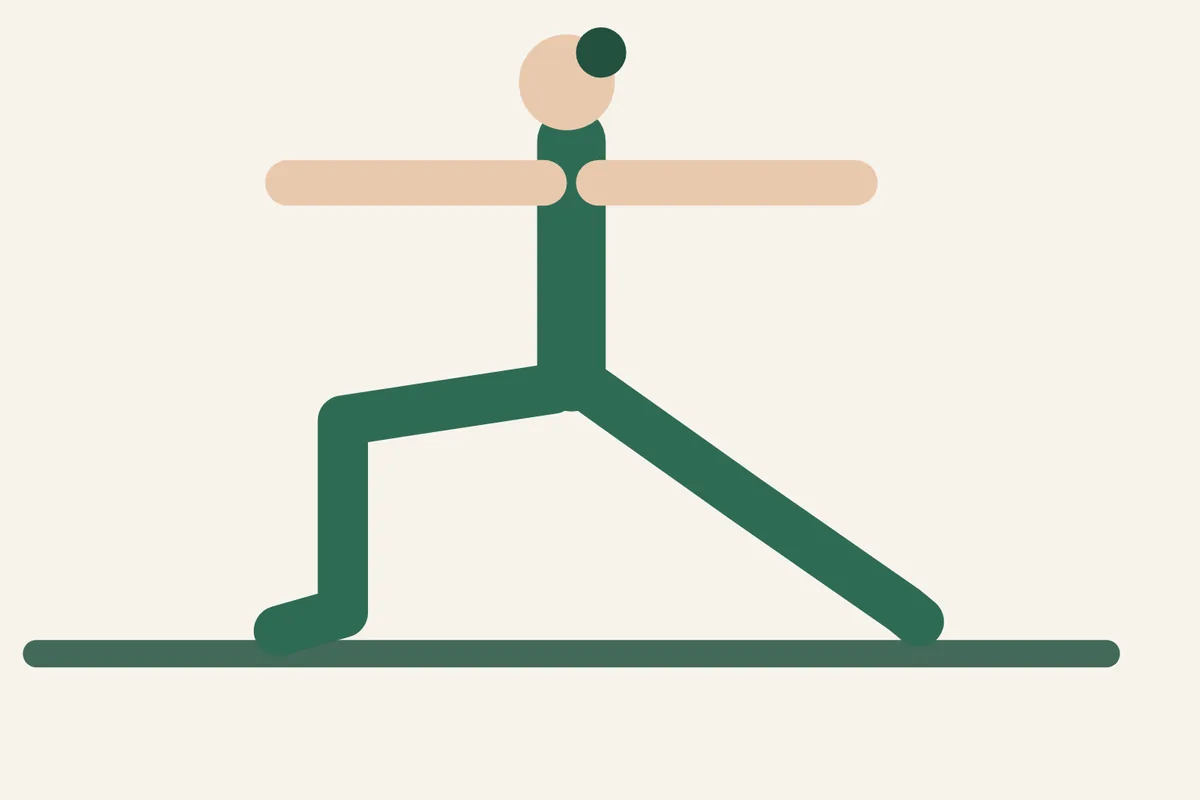
Warrior II is a wide-legged stance that gives your legs a steady workout. Bend the front knee over the ankle, keep the back leg straight and your trunk upright between your legs, and reach both arms out level with your shoulders. A shorter stance and a smaller bend make it easier, and you can rest your hands on your hips.
Skip or change if: you have knee pain, or tire fast. Bend less, or hold fewer breaths.
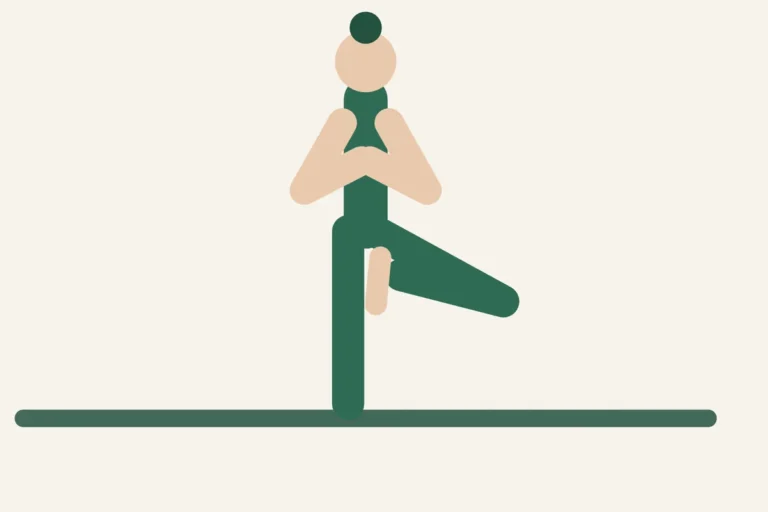
5. Tree Pose
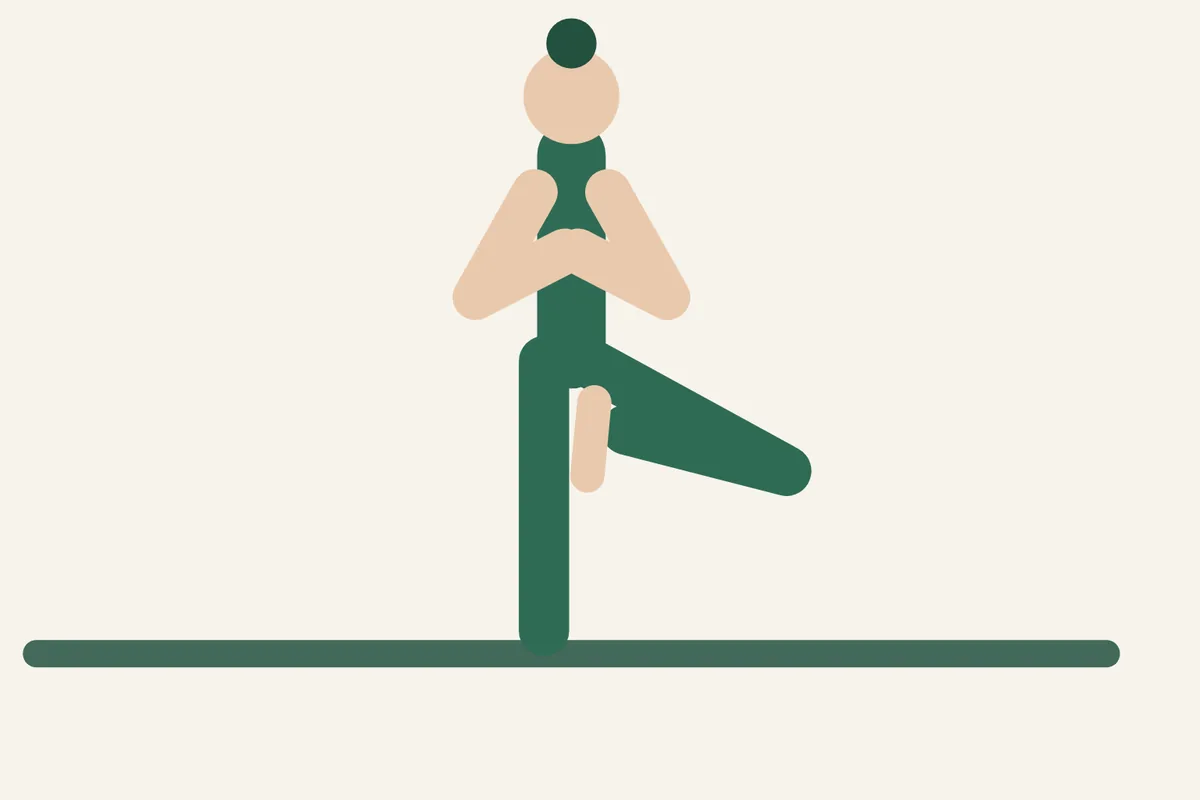
Tree Pose is a one-leg balance. Rest the foot on the opposite ankle, calf or inner thigh, below the knee or above it, never on the knee itself. Stand near a wall you can touch, and fix your eyes on a still spot.
Skip or change if: you have balance problems. Keep your toes on the floor in the “kickstand” version, and keep a hand on the wall.
Hands-and-knees and kneeling poses
These poses keep you close to the floor. Fold a blanket under your knees if the floor is hard.
6. Cat-Cow
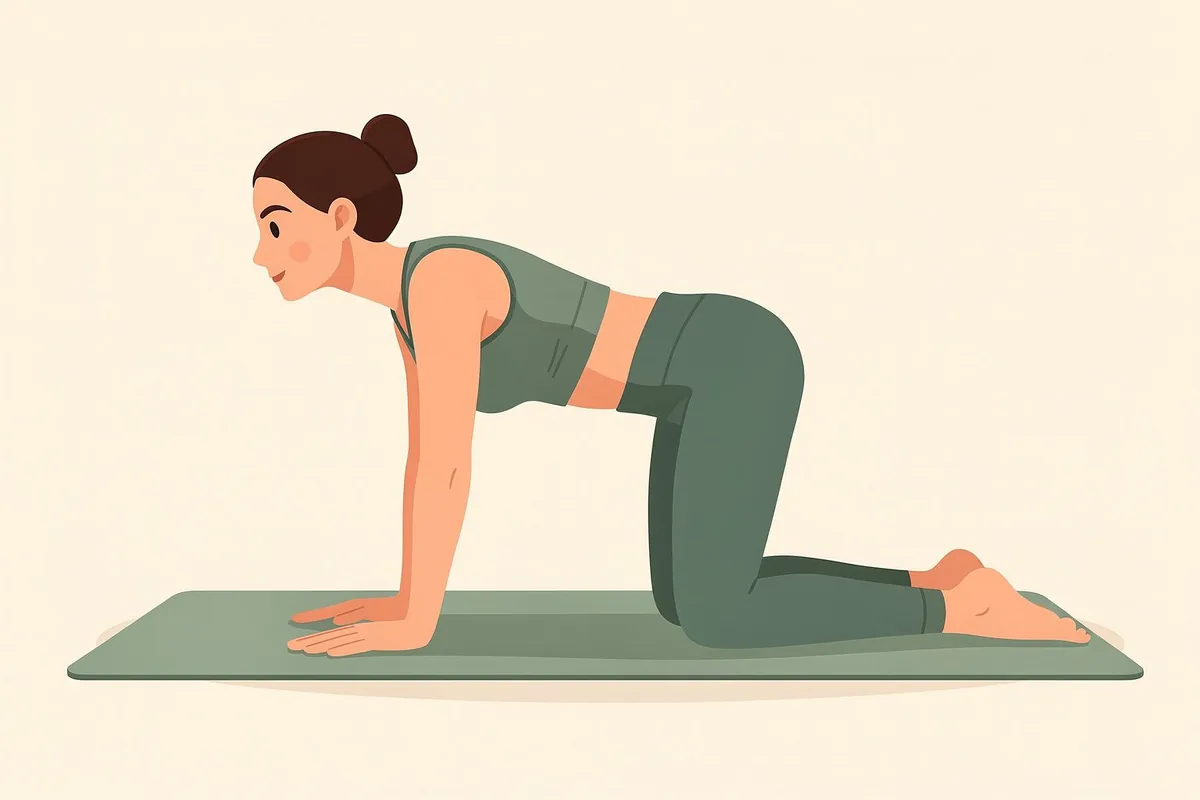
Cat-Cow is a slow rocking of the spine in time with your breath. On an inhale, lower your belly and lift your chest a little (Cow, shown here). On an exhale, round your back and let your head hang (Cat).
Skip or change if: your wrists hurt. Make fists, rest on your forearms, or do it seated with your hands on your knees.
7. Child’s Pose
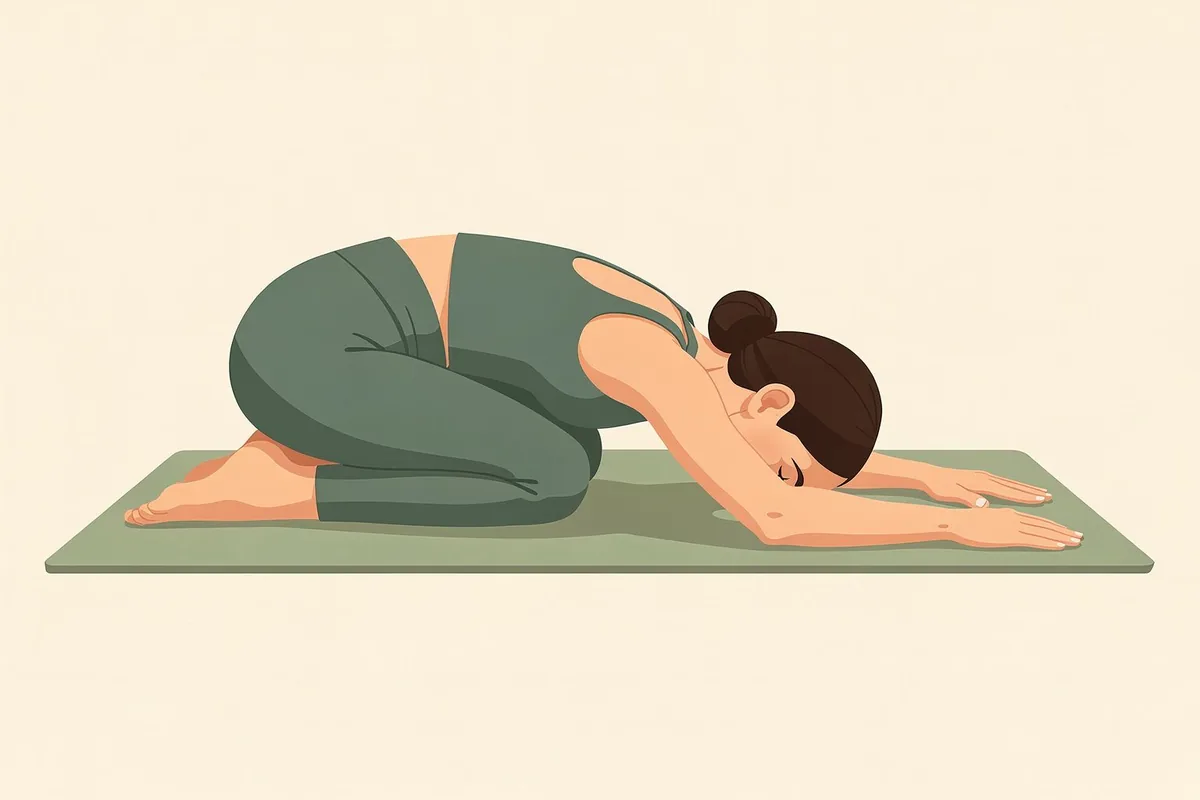
Child’s Pose is the place to rest between harder poses. Sit your hips back toward your heels, fold forward and let your forehead rest on the mat or a block, with your arms forward or beside your legs. Open your knees wider if your belly feels squeezed.
Skip or change if: your knees object to deep bending. Slide a folded blanket under your hips or knees, or rest in another pose instead.
8. Downward-Facing Dog
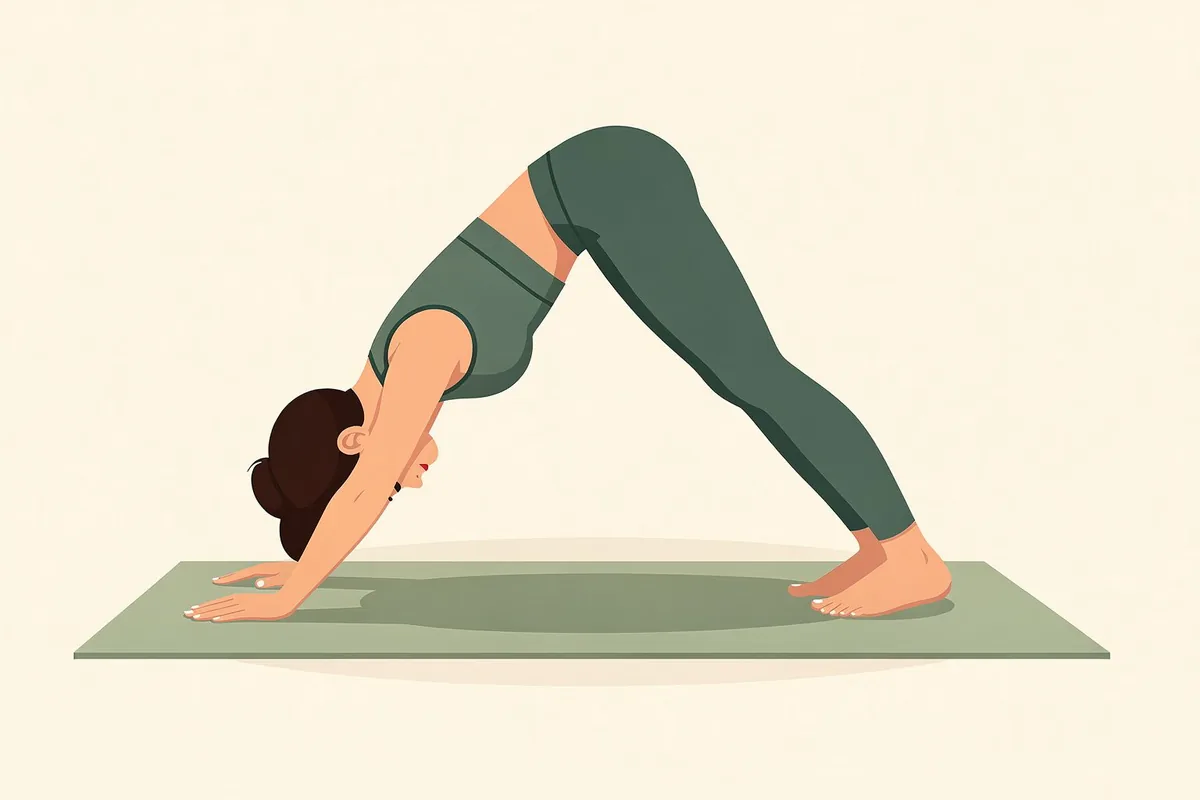
In Downward-Facing Dog your hands and feet are on the floor and your hips lift into an upside-down V. Keep your knees as bent as you need so your back stays long, and let your heels hover.
Skip or change if: you have wrist or shoulder pain, or glaucoma (the head sits low, see the caution box). Rest in Child’s Pose instead.
9. Low Lunge
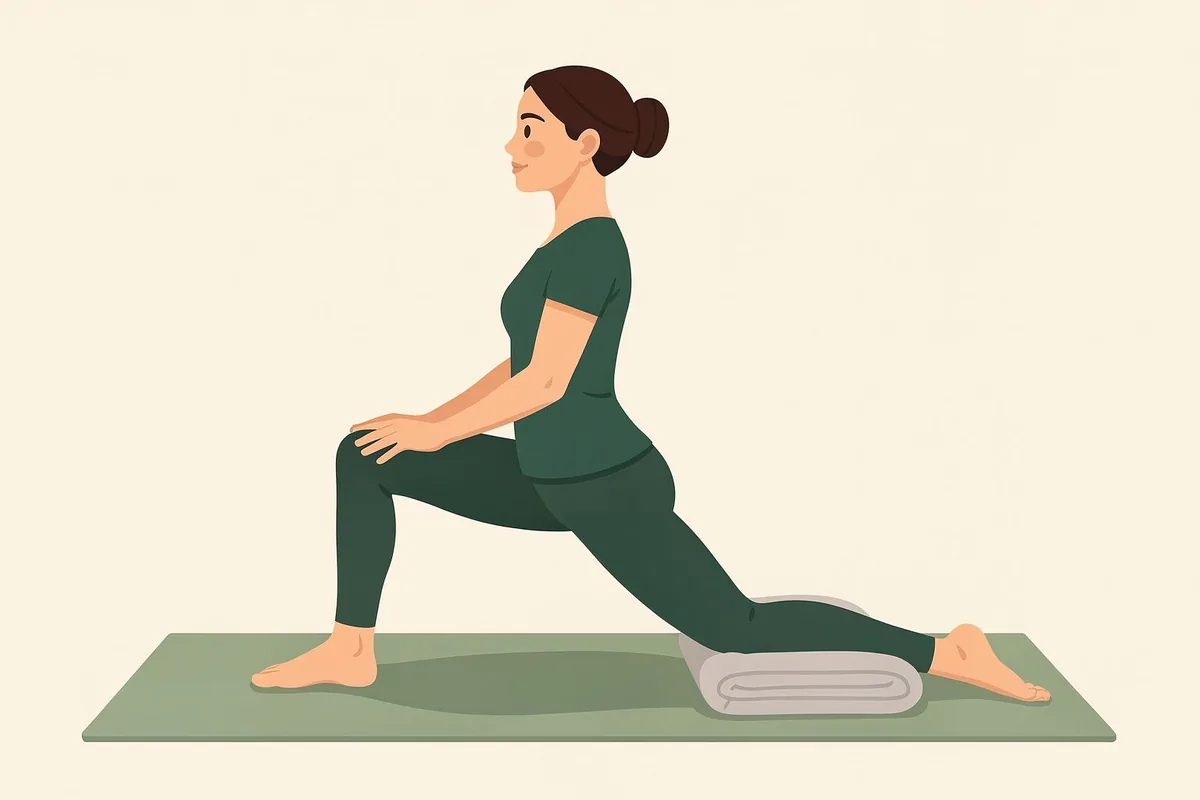
Low Lunge stretches the front of the back hip. Step one foot forward between your hands, lower the back knee onto padding and let your hips move forward until you feel a mild pull. Keep your chest lifted and do both sides.
Skip or change if: your knees are painful. Add more padding under the knee, or skip it.
Seated poses
Seated poses are a calm way to begin or finish. Sit on a folded blanket if your back rounds on the floor.
10. Easy Pose
Sit on the front edge of a folded blanket or firm cushion, so your hips sit higher than your knees. Cross your shins, each foot more or less under the opposite knee, or rest one shin in front of the other if crossing is uncomfortable, rest your hands on your knees and grow tall from your sitting bones. Raising your hips so your knees sit lower than your hip bones makes the pose more comfortable, and a blanket under your knees can add support (Yoga International). Switch which shin is in front each time you sit (YogaEasy).
Skip or change if: you feel any strain in your knees. Yoga International advises against full and half lotus for most people because they twist the knee joint (Yoga International). Sit on a chair or with your legs straight instead.
11. Butterfly
Sit tall, press the soles of your feet against each other and let your knees drop open. Hold your ankles or feet, lengthen your spine and, if you like, hinge forward slowly from the hips until you feel a stretch along the inner thighs (ACE; Cleveland Clinic). ACE suggests going only to the point of tension, never to pain, and not bouncing. Sit on a folded blanket or a block, with blocks under your knees, if your hips are tight (ACE). Stay for 5 to 10 breaths (ACE, same source).
Skip or change if: your knees or hips hurt. Let your knees fall open on their own; if you press them, keep it gentle and stop well short of any knee or hip pain. Lean back against a wall or choose Easy Pose instead.
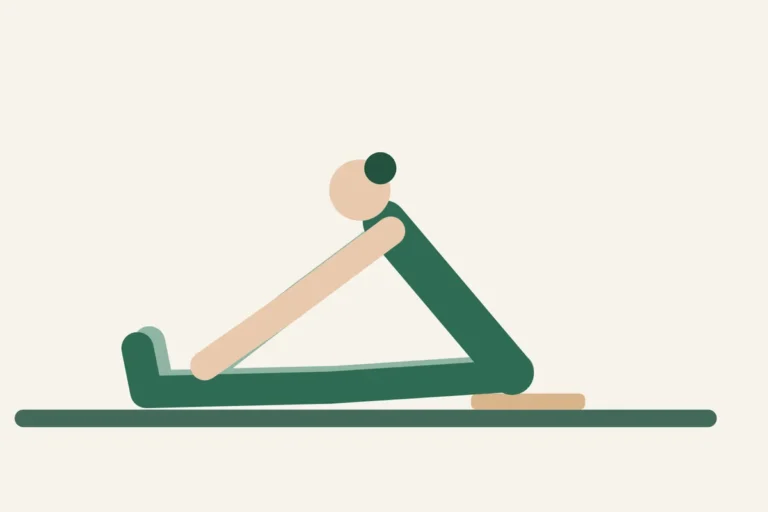
12. Seated Forward Fold
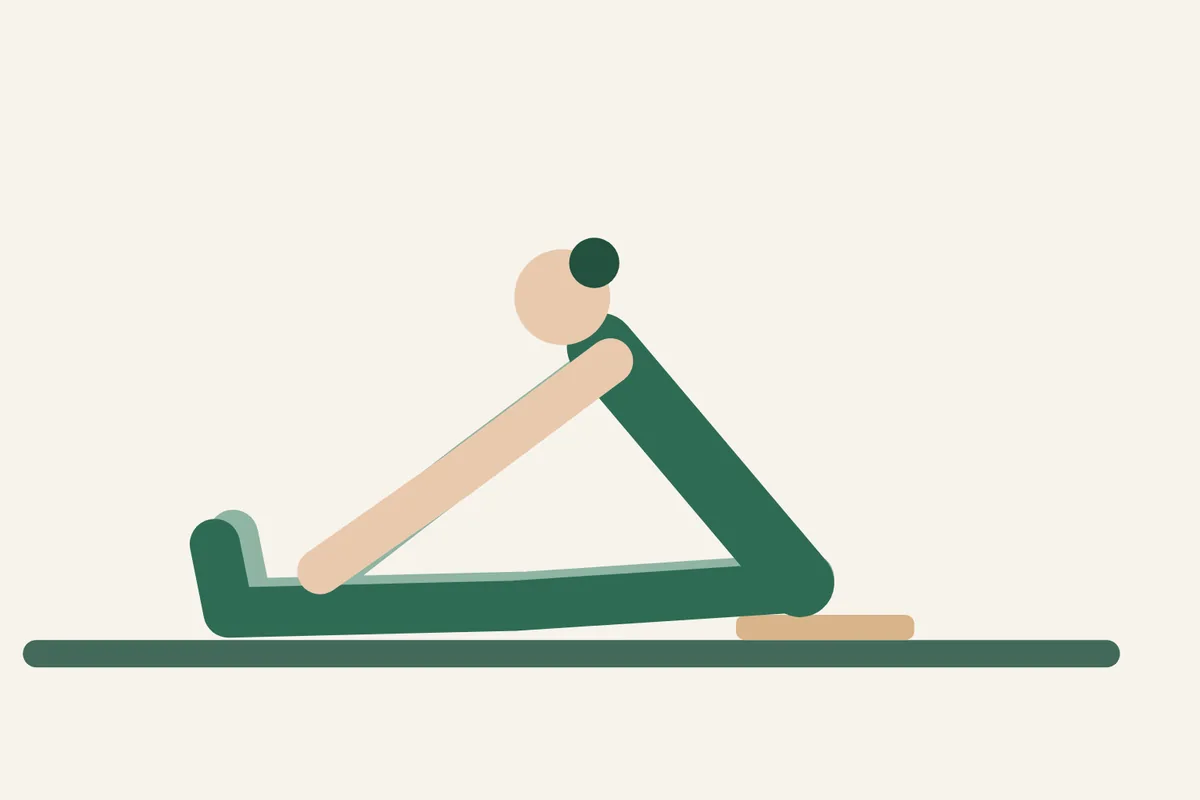
Seated Forward Fold stretches the backs of the legs and lower back. Sit on a blanket, bend your knees if your back rounds, and tip forward from your hips with a long spine. Let your hands rest on your shins, or use a strap around your feet. A small lean is a full pose for many beginners.
Skip or change if: you have osteoporosis or a back injury. Ask your provider before folding forward (see the caution box).
13. Seated Twist
Sit on a folded blanket with your legs straight. Bend your right knee and step your right foot over your left thigh, planting it flat. If your hip lifts off the floor, keep the bottom leg straight instead (ACE). Place your right hand on the floor behind you, reach your left arm up to lengthen your spine, then breathe out and turn toward your right knee, hooking your left elbow outside it or hugging the knee (ACE). Hold for 3 to 5 breaths, then switch sides.
Skip or change if: you have a spine condition, or twisting is uncomfortable. ACE shows a chair version: sit tall with your feet flat, one hand behind you on the seat edge, and turn gently.
Lying-down poses
Floor poses on the belly and back are easy on the legs. If you’re pregnant, skip the poses that have you lying on your back, and ask your provider about lying face down in Cobra Pose (see the caution box).
14. Cobra Pose
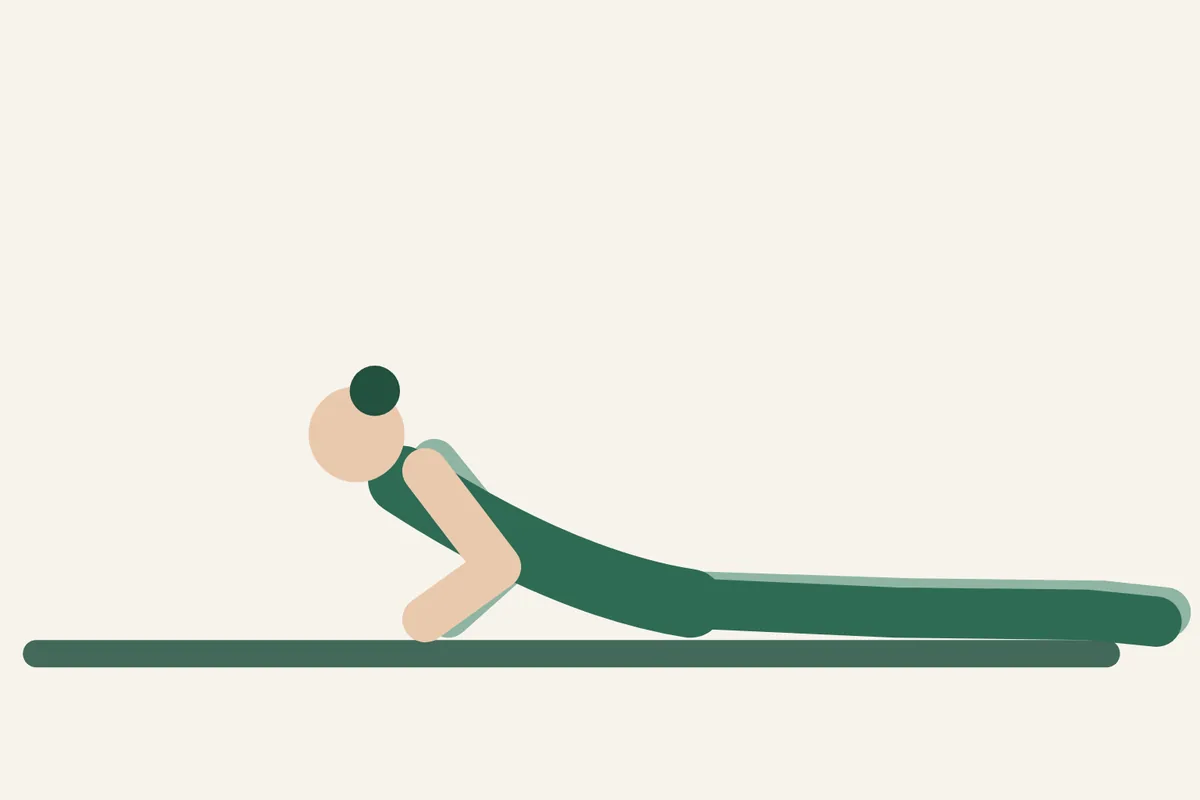
Cobra Pose is a gentle backbend. Lie face down with your hands under your shoulders and elbows bent against your ribs. Press the tops of your feet and the front of your pelvis into the mat, and lift your chest only a few inches, keeping your neck long.
Skip or change if: your lower back pinches. Lower down and rest your forehead on your hands.
15. Bridge Pose
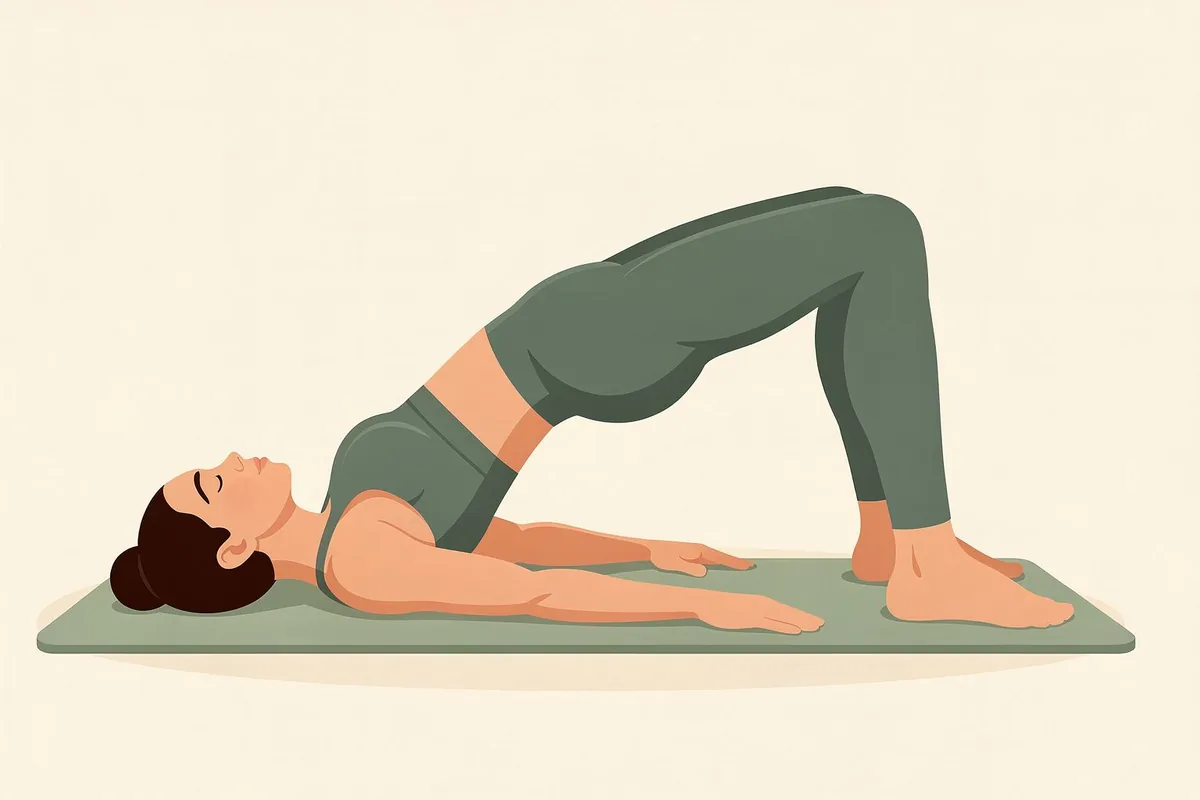
Bridge Pose lifts your hips from the floor while you lie on your back. Bend your knees, set your feet flat and hip-width apart, then press into your feet to raise your hips. Keep your knees pointing forward and your head still, and lower slowly.
Skip or change if: your neck feels strained, or you’re pregnant (it has you lying on your back). Lift only a few inches, or skip it.
16. Knees to Chest
Lie face up and draw both knees in toward your chest. Wrap your hands around your shins or thighs and sway softly side to side for a few deep breaths (Cleveland Clinic). Let your lower back rest flat on the floor, without forcing it (Yoga International).
Skip or change if: you’re pregnant or have a back condition. Hug one knee at a time with the other foot flat on the floor, or skip it.
17. Supine Twist
Lie face up and spread your arms wide, level with your shoulders. Hug your knees in, then lower them together toward one side, keeping both shoulders on the floor. Your gaze can stay up or turn the other way (ACE). Put a block or pillow under your knees if they don’t reach the floor (Cleveland Clinic). Stay for a few breaths, then switch sides.
Skip or change if: you’re pregnant or have a spine condition, or if twisting hurts. Keep your knees higher and your range small.
Restful poses
End with one of these. Cleveland Clinic and ACE describe restorative holds of 2 to 10 minutes, but a minute or two is enough at first.
18. Reclined Butterfly
Lie back on a pillow or folded blanket that supports your head and spine. Press the soles of your feet together, let your knees open out, and set pillows or blankets under your thighs for support. ACE suggests at least 2 to 3 minutes (ACE); Cleveland Clinic describes 5 to 10 (Cleveland Clinic).
Skip or change if: your hips or knees ache, or you’re pregnant. Add more support under your knees, or use the seated butterfly.
19. Legs Up the Wall
Sit sideways next to a wall, with a folded blanket under your hips. Lower onto your back and swing your legs up the wall, with your hips as close as is comfortable and a slight bend in your knees if that feels better (ACE; Cleveland Clinic). ACE suggests one minute and offers a chair version, with your lower legs resting on the seat. Cleveland Clinic describes holds of 5 to 10 minutes. To come out, bend your knees and roll to one side.
Skip or change if: you have glaucoma (Jasien measured a rise in eye pressure in this pose, see the caution box), or you’re pregnant.
20. Savasana (Corpse Pose)
Savasana is the final rest. Lie on your back with your legs long and your feet falling open to about hip width, arms by your sides with palms up. Breathe deeply and evenly (Harvard Health). Put a small cushion under your head and a folded blanket or bolster under your knees if your lower back feels strained (Yoga International). Harvard Health describes 5 to 10 minutes. If you may fall asleep, set a soft timer (Cleveland Clinic).
Skip or change if: lying on your back is uncomfortable or not advised for you, for example in pregnancy. Yoga International describes a side-lying version, with a blanket under your head. After about 20 weeks of pregnancy it says to lie on your left side (Yoga International).
A sample 15-minute order
This is our own suggestion, built loosely from the order above, not a tested program. Leave out any pose you don’t like.
| Minutes | Pose | Notes |
|---|---|---|
| 1 | Easy Pose | Breathe slowly and settle |
| 2 | Cat-Cow | Small, slow rounds |
| 1 | Downward-Facing Dog | Knees bent |
| 2 | Low Lunge | Both sides |
| 1 | Mountain Pose | Stand tall and steady |
| 2 | Warrior II | Both sides |
| 1 | Standing Forward Fold | Knees soft |
| 1 | Bridge Pose | A few lifts |
| 1 | Knees to Chest | Rock gently |
| 1 | Supine Twist | Both sides, short |
| 2 | Savasana | Final rest |
If you’re pregnant, leave out Bridge Pose, Knees to Chest and Supine Twist, and end with a side-lying rest instead of Savasana on your back. A more detailed morning routine is in 10-minute morning yoga.
How long should you hold each pose?
Start with 3 to 5 slow breaths in each pose and add more as the pose gets steadier (Cleveland Clinic). Resting poses can be held for several minutes. Our guide to how long to hold a yoga pose explains the ranges and the signs that mean it’s time to come out.
Which props help with beginner poses?
A few props cover most of the poses above:
- A non-slip mat: keeps your hands and feet in place. See yoga mats for beginners.
- Two blocks: raise the floor under your hands in folds and lunges, and support your knees in Butterfly. See how to use yoga blocks.
- A folded blanket: pads your knees, lifts your hips in seated poses and supports your head in Savasana.
- A strap, belt or towel: a loop around your feet for Seated Forward Fold.
- A wall or sturdy chair: for Tree Pose, Warrior II and Chair Pose, and for Legs Up the Wall.
If getting to the floor is hard, a chair routine is a good place to begin. See chair yoga for seniors. If tight hips or hamstrings limit your seated poses, see yoga for tight hips and yoga for tight hamstrings.
Who should change these poses or ask a doctor first
- Injuries and conditions: the National Center for Complementary and Integrative Health says people with knee or hip injuries, lower-spine (lumbar) disease, severe high blood pressure, balance problems or glaucoma may need to change or avoid some poses (NCCIH). Ask your provider which poses are right for you.
- Pregnancy: get a checkup first, and avoid poses that have you lying on your back or still for a long time (NCCIH). That rules out Bridge Pose, Knees to Chest, Supine Twist, Reclined Butterfly, Legs Up the Wall and a back-lying Savasana. Choose standing, seated or hands-and-knees poses, and the side-lying rest in Savasana. Cobra Pose has you lie on your belly, which gets uncomfortable as pregnancy goes on, so ask your provider about it too.
- Glaucoma: in a small study of 10 people with glaucoma and 10 without, eye pressure rose within a minute in Downward-Facing Dog, Standing Forward Fold, Plow and Legs Up the Wall, each held for two minutes, and returned to baseline within two minutes of sitting up (Jasien 2015). Whether this raises the risk of glaucoma getting worse isn’t known. Ask your eye doctor before doing head-down poses.
- Osteoporosis or low bone density: a Mayo Clinic review of 89 patients with yoga-related injuries found that the poses most often blamed involved extreme bending of the spine forward or back, and advised people with osteopenia or osteoporosis to avoid extreme spinal flexion (Lee 2019). Ask your doctor about poses that round your spine strongly, such as Standing and Seated Forward Fold, Knees to Chest, the Cat half of Cat-Cow and leaning forward in Butterfly, and about deep backbends.
- Age 65 and over: emergency departments treat yoga injuries at a higher rate in this age group than in younger adults (NCCIH). Start with gentle and chair-based practice.
- Always: if you can, learn with a qualified teacher: NCCIH notes that practicing alone without supervision has been linked to more injuries (NCCIH). Avoid hot yoga if you are pregnant. Arthritis, sciatica or high blood pressure can also mean changing poses (MedlinePlus). Skip or change any pose that causes sharp pain, pinching, tingling or dizziness. NCCIH also advises beginners to leave out headstands, shoulder stands, the lotus position and forceful breathing (NCCIH). Yoga doesn’t replace medical care.
Helpful gear for this pose
 Manduka begin yoga mat, 5 mm
5 mm TPE mat, 68 x 24 in, light to carry, with a center alignment stripe (maker's spec).
See it on Amazon Gaiam foam yoga blocks, pair
Two light foam blocks, 9 x 6 x 4 in each, to raise the floor under your hands (maker's spec).
See it on Amazon Hugger Mugger cotton D-ring yoga strap, 10 ft
Cotton webbing 1.5 in wide with a metal D-ring buckle, 10 ft long (maker's spec).
See it on Amazon
As an Amazon Associate we earn from qualifying purchases. How we choose gear
Sources
- MedlinePlus. Yoga. National Library of Medicine., checked Nov 20, 2026
- National Center for Complementary and Integrative Health (NCCIH). Yoga: Effectiveness and Safety. National Institutes of Health. Last updated August 2023., checked Nov 20, 2026
- Jasien JV, Jonas JB, de Moraes CG, Ritch R. Intraocular pressure rise in subjects with and without glaucoma during four common yoga positions. PLoS One. 2015;10(12):e0144505., checked Nov 20, 2026
- Lee M, Huntoon EA, Sinaki M. Soft tissue and bony injuries attributed to the practice of yoga: a biomechanical analysis and implications for management. Mayo Clin Proc. 2019;94(3):424-431., checked Nov 20, 2026
- Cleveland Clinic. Yoga for Beginners: Get Started Today! Health Essentials., checked Nov 20, 2026
- Cleveland Clinic. Restorative Yoga: Benefits and Poses To Try. Health Essentials., checked Nov 20, 2026
- Cleveland Clinic. 11 Hip-Opener Stretches To Help Flex Your Muscles. Health Essentials., checked Nov 20, 2026
- Cleveland Clinic. Bedtime Yoga for Better Sleep: A 10-Pose Routine to Try. Health Essentials., checked Nov 20, 2026
- American Council on Exercise (ACE). Exercise Library: Seated Butterfly Stretch., checked Nov 20, 2026
- American Council on Exercise (ACE). Post-run Yoga Routine. ACE expert articles., checked Nov 20, 2026
- American Council on Exercise (ACE). Yoga For Active Older Adults: 6 Accessible Poses to Enhance Functional Capacity. ACE expert articles., checked Nov 20, 2026
- American Council on Exercise (ACE). Relaxation-promoting Restorative Yoga Routine. ACE expert articles., checked Nov 20, 2026
- American Council on Exercise (ACE). 7 Yoga Poses to Counteract the Effects of Prolonged Sitting., checked Nov 20, 2026
- YogaEasy. Standing Forward Bend., checked Nov 20, 2026
- YogaEasy. Chair Pose / Powerful Pose., checked Nov 20, 2026
- YogaEasy. Easy Pose (Sukhasana)., checked Nov 20, 2026
- Yoga International. The Mythology Behind Utkatasana (Chair Pose/Fierce Pose)., checked Nov 20, 2026
- Yoga International. Pain-Free Meditation Seat., checked Nov 20, 2026
- Yoga International. 2 Guided Relaxations in Savasana (Corpse Pose)., checked Nov 20, 2026
- Yoga International. 3 Corpse Pose (Savasana) Variations to Try., checked Nov 20, 2026
- Yoga International. A Gentle Knees-to-Chest Twist., checked Nov 20, 2026
- Harvard Health Publishing. Try this: Play dead. Healthy Aging and Longevity., checked Nov 20, 2026
Image credits: Illustration: AI-generated for YogaForFitness (FLUX.1 [schnell], run locally), checked for pose accuracy; Illustration: YogaForFitness (vector figure), drawn from the steps above; Illustration: YogaForFitness (vector figure), drawn from the steps above; Illustration (the Cow half of the pose): AI-generated for YogaForFitness (FLUX.2 [pro]), checked for pose accuracy; Illustration: AI-generated for YogaForFitness (FLUX.2 [pro]), checked for pose accuracy; Illustration: AI-generated for YogaForFitness (FLUX.2 [pro]), checked for pose accuracy; Illustration: AI-generated for YogaForFitness (FLUX.2 [pro]), checked for pose accuracy; Illustration: YogaForFitness (vector figure), drawn from the steps above; Illustration: YogaForFitness (vector figure), drawn from the steps above; Illustration: AI-generated for YogaForFitness (FLUX.2 [pro]), checked for pose accuracy