How Long Should You Hold a Yoga Pose?
Quick answer
A common teaching rule for beginners is 3 to 5 slow breaths per pose, building toward 5 to 10 breaths as the pose gets steadier; flowing classes hold each pose only briefly, and restorative or yin poses are held for several minutes. We found no study that tested how long to hold yoga poses, and the closest research, on stretching, found 30-second holds worked about as well as 60-second holds in younger adults. Come out early if you feel sharp pain, tingling or dizziness.
We may earn a commission when you buy through links on this page. It never changes what we recommend. As an Amazon Associate we earn from qualifying purchases.
There is no single right answer to how long to hold a yoga pose. It depends on the style of class, the pose, how steady you feel and your body that day. What follows is a practical way to choose: typical holds by style and by pose type, whether to count breaths or seconds, what stretching research does and doesn’t say, and the signs that mean it’s time to come out. For a gentle way into practice, see yoga for beginners in our Start Here section.
In this guide
- How long should a beginner hold a yoga pose?
- How long do you hold poses in different yoga styles?
- Should you count breaths or seconds?
- How long to hold different types of poses
- Do longer holds make you more flexible?
- Is there a downside to holding a stretch for a long time?
- How long is too long in restorative or yin poses?
- When should you come out of a pose early?
- Who may need shorter holds or changes
- What does the research say about how long to hold a yoga pose?
- Frequently asked questions
- Sources
How long should a beginner hold a yoga pose?
Start with 3 to 5 slow breaths per pose. That is the range Cleveland Clinic gives for several poses in its beginner sequence, which also says that once you feel comfortable you can stay for a few deep breaths and add time bit by bit (Cleveland Clinic). As a pose gets steadier, you can stay longer: several of our own pose guides build to 5 to 10 breaths (see the table below).
Two checks tell you the length is right. First, you can keep breathing smoothly. Second, your alignment still matches the steps in the pose guide. If either one slips, you’ve held long enough: come out, rest, and try again with fewer breaths. Fewer breaths than a video asks for is fine, and so is skipping ahead to the next pose (how to start yoga at home covers following videos safely).
These numbers are teaching conventions. As the research section explains, we found no study that tested them.
How long do you hold poses in different yoga styles?
Hold times are one of the main ways styles differ. The figures below come from popular teaching and health sources, and they don’t agree on the edges, so treat them as ranges and follow your teacher’s cues first.
| Style | Typical hold | What the sources say |
|---|---|---|
| Flow or vinyasa | Brief | Poses are linked by the breath and each is held only briefly (Cleveland Clinic) |
| Hatha | Several breaths | You hold each pose for several breaths, and it’s a common starting style (Cleveland Clinic) |
| Iyengar | Longer holds | Standing and seated poses are held for longer periods, with props such as chairs, blocks and straps (Cleveland Clinic) |
| Yin | 1 to 5 minutes or more | One teaching site says up to five minutes or more (YogaEasy); Yoga International says from one minute to well over five (Yoga International); Cleveland Clinic says anywhere from 3 to nearly 10 minutes (Cleveland Clinic) |
| Restorative | Several minutes | Cleveland Clinic describes 5 to 10 minutes per pose with props (Cleveland Clinic) and, in another guide, 10 minutes or longer (Cleveland Clinic); the American Council on Exercise suggests at least 2 to 3 minutes (ACE) |
If you’re new to yin, YogaEasy suggests starting at 1 to 3 minutes and working up to 5 or more (YogaEasy). A timer helps with the long holds, and the section on restorative and yin poses below explains why.
Should you count breaths or seconds?
Count breaths in active poses and seconds in long passive ones.
Breaths keep your hold tied to how you feel. If your breathing turns choppy or you catch yourself holding your breath, you’re past your edge for today. Cleveland Clinic advises that when you get out of breath in practice, you take a moment to reconnect with your breathing (Cleveland Clinic). Count one breath as a full in-and-out, and give both sides the same count. Slow belly breathing makes the count easier to keep; see diaphragmatic breathing.
Seconds matter when you want a known amount of time, as in a stretching routine or a restorative pose. To convert, note that a healthy adult at rest breathes about 12 to 18 times a minute (MedlinePlus). At those rates, 5 breaths take roughly 17 to 25 seconds, and 10 breaths take roughly 33 to 50 seconds. If you breathe more slowly in a pose, the same count takes longer. Time yourself once with a clock to learn what 5 of your own breaths come to.
How long to hold different types of poses
The table gives the starting holds from our pose guides, so you can see how the ranges differ by type. Each guide has the steps, the caution list and its own hold-time section.
| Type of pose | Example | Starting hold in our guide |
|---|---|---|
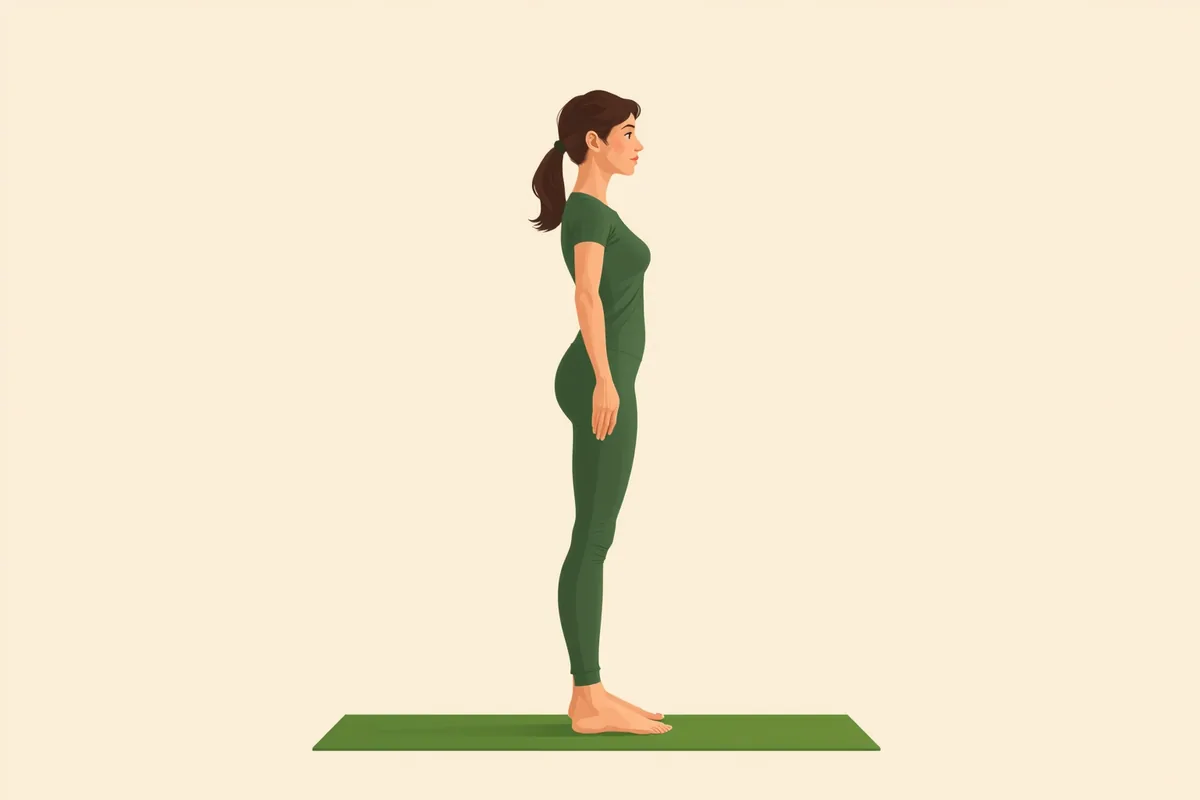
| Standing | Mountain Pose | 5 to 10 slow breaths |
| Standing, wide stance | Warrior II | 3 to 5 slow breaths per side |
| Balance | Tree Pose | 3 to 5 slow breaths per side |
| Forward fold | Seated Forward Fold | 3 to 5 slow breaths, then 30 seconds to a minute |
| Hip stretch | Low Lunge | 5 to 8 slow breaths per side |
| Backbend | Cobra Pose and Bridge Pose | 2 to 5 breaths for Cobra, 3 to 8 for Bridge |
| Head below heart | Downward-Facing Dog | 3 to 5 slow breaths, building toward a minute |
| Rest | Child’s Pose | A few breaths, or several minutes at the end |
For stretches aimed at tight muscles, see the hold-time sections in yoga for tight hamstrings and yoga for tight hips. Both explain the research for their muscle groups, and both build to holds of about 30 seconds to a minute (tight hips: about a minute per side).
The pattern is simple. Poses that take muscle effort, such as Warrior II, balances and backbends, tire you sooner, so the holds are shorter. Easy standing poses like Mountain Pose and supported floor poses can be held longer. Moving between poses, such as Cat-Cow, isn’t held at all: you move with the breath.
Do longer holds make you more flexible?
Not necessarily, and the research on this comes from stretching exercises rather than yoga poses. The best-known trials used the hamstrings (the muscles at the back of your thigh).
- Younger adults. In a trial of 57 adults aged 21 to 37 with tight hamstrings, people stretched 5 days a week for 6
weeks. Holds of 30 seconds and 60 seconds both increased knee range of motion more than 15 seconds or no stretching, and 60 seconds did no better than 30 (Bandy & Irion, 1994). In a second trial of 93 adults aged 21 to 39, every stretching group beat the control group, with no difference between 30 and 60 seconds, or between stretching once and three times a day (Bandy et al., 1997).
- Adults 65 and older. In 62 people aged 65 to 97 with tight hamstrings, 60-second stretches improved range of
motion faster than 30-second or 15-second ones, at 2.4, 1.3 and 0.6 degrees per week, and the gain lasted longer after they stopped (Feland et al., 2001).
- The wider reviews. A review of 28 hamstring-stretching studies in 1,338 healthy people found that range of motion
improved with a variety of techniques, positions and durations, but only 6 of the 28 studies scored well on quality, so it couldn’t name one best method (Decoster et al., 2005). A 2024 meta-analysis of 77 studies found that stretch training increases range of motion, with no significant link between total stretching time and the size of the gain (Konrad et al., 2024). A 2018 review of 23 articles disagreed on one point: it found that time per session didn’t seem to matter, but time per week and number of days per week did (Thomas et al., 2018).
Two sources give simple targets. The American College of Sports Medicine recommends a series of flexibility exercises for each major muscle-tendon group, totaling 60 seconds per exercise, on at least 2 days a week (Garber et al., 2011). Harvard Health suggests 30 seconds per stretch, without bouncing (Harvard Health). You can reach the ACSM’s 60 seconds with one long hold or two or more shorter ones.
Why might holding longer not add much? Reviews of stretching programs lasting a few weeks suggest the gains come mostly from being able to tolerate a stronger stretch, not from the muscle itself getting longer (Weppler & Magnusson, 2010; Freitas et al., 2018). That fits the usual advice to stretch to a mild pull and stay there, not to force the range. For more on the difference between stretching and moving well, see mobility vs flexibility.
Is there a downside to holding a stretch for a long time?
Possibly, if you’re about to do something that needs your muscles at full power. A systematic review of 106 studies found that short static stretches, under 30 seconds, had no harmful effect on maximal muscle performance, and that holds of 60 seconds or more were likely to reduce it (Kay & Blazevich, 2012). A later review put the drop at about 4.6% for 60 seconds or more per muscle group, against 1.1% for less, measured within minutes of stretching. It added that gains in range of motion typically last under 30 minutes, and that static stretching had no clear effect on injury rates (Behm et al., 2016).
Those studies tested stretches of single muscle groups followed by force or power tests, not yoga classes. Still, they suggest two habits. If you’re warming up for a run or a lifting session, keep stretches short and finish with movement. Save the long holds for after you’re done, or for a separate session.
How long is too long in restorative or yin poses?
Long, passive holds bring a different risk: you can drift off or lose circulation to a limb without noticing.
- Use a timer. Cleveland Clinic suggests a soft timer of 5 or 10 minutes per restorative pose, so you don’t get so
comfortable that you fall asleep (Cleveland Clinic).
- Don’t doze in a forward fold. A case report describes a woman who developed severe leg weakness and abnormal
sensation after falling asleep in Seated Forward Fold. The report is about sciatic nerve compression (Walker et al., 2005). It is a single, rare case, but it’s a good reason to prop yourself comfortably and set an alarm.
- Move when your limbs go to sleep. Pins and needles usually come from cutting off the blood supply to a nerve,
such as when you sit on part of your body, and they ease when you take the weight off (NHS). Come out, shift position, and use a prop next time.
- Use props to take effort out. A bolster, blanket or block lets you relax into a pose, which is the point of
these styles (Cleveland Clinic).
When should you come out of a pose early?
Come out, rest, and decide whether to try again with a shorter hold or an easier version if you notice any of these.
- Sharp, pinching or joint pain. A gentle stretch is fine, but a Cleveland Clinic yoga expert calls pain in a joint
a red flag (Cleveland Clinic). Harvard Health puts the line the same way: expect tension in a stretch, not pain, and stop and talk to your doctor if you feel pain (Harvard Health).
- Tingling, numbness or pins and needles that doesn’t ease when you shift position. See a doctor if you have it constantly or it
keeps coming back (NHS).
- Dizziness or lightheadedness. MedlinePlus lists this among warning signs to stop and rest, in its advice on being active with heart disease
(MedlinePlus). Come up slowly: rising slowly from a chair or the floor is one way MedlinePlus suggests to prevent low-blood-pressure symptoms (MedlinePlus).
- Chest pain, pressure or tightness. Stop right away. Call 911 if it is sudden and crushing, squeezing or tight, if it spreads to your jaw, left arm or back, or if it comes with shortness of breath, nausea, sweating, dizziness or a racing heart (MedlinePlus). Any chest pain during exercise that doesn’t go away when you stop needs a call to your provider right away (MedlinePlus).
- Breath that turns choppy or held. Back out of the pose until the breath steadies.
- Your shape falls apart. If your knee caves, your lower back sags or your shoulders creep up, the hold has outrun
your strength. Compare yourself with the steps in the pose guide.
Bouncing to get deeper is a bad idea too. Harvard Health says not to bounce in a stretch, which can cause injury (Harvard Health).
Who may need shorter holds or changes
- Pregnancy. The NCCIH says to have your health
care provider check that exercise is safe for you, to skip hot yoga, and to avoid yoga poses where you stay motionless for long stretches or lie on your back. In later pregnancy the NHS says to avoid spending more than a few minutes flat on your back. So keep holds short, and for longer rests sit up or lie on your side with pillows. Ask a prenatal-trained teacher before joining a restorative class.
- Age 65 or older. The NCCIH says yoga injuries seen in emergency departments are more frequent in people 65 and
older. The older-adult trial above (60-second holds worked best) tested one hamstring stretch, not yoga poses. Use a chair or wall for balance in standing poses, and ask a teacher before holding longer.
- Glaucoma. In a small study of 10 people with glaucoma and 10 without, eye pressure rose within a minute in four
head-down poses, each held for two minutes, and fell back within two minutes of sitting up (Jasien et al., 2015). Ask your eye doctor before holding Downward-Facing Dog, standing folds or other head-down poses.
- Osteoporosis or low bone density. A Mayo Clinic review of yoga injuries advises people with osteopenia or osteoporosis to avoid extreme
spinal flexion (Lee et al., 2019). So skip deep, rounded folds at any hold length: fold from the hips with a long back, keep your knees bent and use a block. Ask your doctor which poses to change.
- An injured knee or hip, disease of the lower spine, severe high blood pressure or balance problems. The NCCIH lists these
among the conditions that may call for changes. Ask your provider first, use props, and keep holds short.
- Low blood pressure or lightheadedness when you stand. Come up slowly after any long hold or rest
(MedlinePlus), and check with your provider if it keeps happening.
Yoga can’t replace medical care. If something seems wrong, see a provider.
What does the research say about how long to hold a yoga pose?
Evidence: no good evidence
We found no study that tested how long to hold yoga poses, so we rate the evidence for yoga hold times as no good evidence. On November 18, 2026 we searched PubMed for yoga trials that compared hold lengths, pose durations or holding times and found none; the few single-pose yoga trials we know of (Seated Forward Fold, Tree Pose) used one fixed practice time and did not compare hold lengths. The research that does exist tested stretching exercises, mostly of the hamstrings, so it cannot tell you how long to hold Tree Pose, Warrior II or any other pose. “No good evidence” describes that gap. It doesn’t mean holds don’t matter.
- Hamstring hold trials. Two trials in adults aged 21 to 39 (57 and 93 people) found 30-second holds were as
effective as 60-second holds, and one trial in 62 people aged 65 to 97 found 60-second holds worked faster than 30-second ones (Bandy & Irion, 1994; Bandy et al., 1997; Feland et al., 2001). Each used a stretch of one muscle group, 5 days a week for 6 weeks, and measured knee range of motion.
- Reviews disagree. The 2024 meta-analysis (77 studies) found no significant link between total stretching time and
range-of-motion gains (Konrad et al., 2024); the 2018 review (23 articles) linked weekly time and number of days to gains but found no effect of time per session (Thomas et al., 2018). Hamstring studies were mostly of poor quality (Decoster et al., 2005).
- One yoga pose. A 2026 randomized trial of 150 healthy 18-to-28-year-olds compared 4 minutes a day of Seated
Forward Fold with 4 minutes of lying rest, after the same 16 minutes of loosening exercises, six days a week for four weeks. Sit-and-reach scores improved more in the pose group. It did not compare different hold lengths, and we could read only the abstract (Thapa et al., 2026).
- Why gains happen. Short stretching programs mostly appear to change how much stretch you tolerate, not the
muscle itself (Weppler & Magnusson, 2010; Freitas et al., 2018).
- Long holds and performance. Holds of 60 seconds or more were linked to short-term drops in maximal muscle performance
(Kay & Blazevich, 2012; Behm et al., 2016).
The hold times for yin, restorative, hatha and flow classes in this guide are teaching practice from health and teaching sites, not research results.
Frequently asked questions
How many breaths should you hold a yoga pose?
For most beginners, 3 to 5 slow breaths is a sensible start, working toward 5 to 10 in poses that feel steady. Active poses such as backbends and balances usually stay at the low end. See the table above and each pose guide for details.
How long should you hold a yoga pose for flexibility?
The studies that tested hold length used stretches held for 15, 30 and 60 seconds, usually 5 days a week for 6 weeks. In younger adults, 30 seconds worked about as well as 60 seconds, and in one trial of people 65 and older, 60 seconds did better. The American College of Sports Medicine’s floor is 60 seconds per exercise on at least 2 days a week (Garber et al., 2011). Those numbers come from stretching, not yoga. Those trials ran for 6 weeks, so expect weeks, not days, and stay at a mild pull.
Can you hold a yoga pose too long?
Yes. Holds that run past your strength cost you your alignment, and long passive holds can leave a limb numb or put you to sleep. Use a timer for restorative poses, and come out for pain, numbness or dizziness. See the signs above.
Is it okay to hold a pose for fewer breaths than the teacher says?
Yes. Taking fewer breaths or resting in Child’s Pose is a normal way to follow along, especially when you practice alone. The NCCIH also recommends learning under a qualified instructor, who can tell you how long is right for you.
Helpful gear for this
 Manduka begin yoga mat, 5 mm
5 mm TPE mat, 68 x 24 in, light to carry, with a center alignment stripe (maker's spec).
See it on Amazon Gaiam foam yoga blocks, pair
Two light foam blocks, 9 x 6 x 4 in each, to raise the floor under your hands (maker's spec).
See it on Amazon Hugger Mugger cotton D-ring yoga strap, 10 ft
Cotton webbing 1.5 in wide with a metal D-ring buckle, 10 ft long (maker's spec).
See it on Amazon
As an Amazon Associate we earn from qualifying purchases. How we choose gear
Sources
- National Center for Complementary and Integrative Health (NCCIH). Yoga: Effectiveness and Safety. Last updated August 2023., checked Nov 18, 2026
- Bandy WD, Irion JM. The effect of time on static stretch on the flexibility of the hamstring muscles. Phys Ther. 1994;74(9):845-850., checked Nov 18, 2026
- Bandy WD, Irion JM, Briggler M. The effect of time and frequency of static stretching on flexibility of the hamstring muscles. Phys Ther. 1997;77(10):1090-1096., checked Nov 18, 2026
- Feland JB, Myrer JW, Schulthies SS, Fellingham GW, Measom GW. The effect of duration of stretching of the hamstring muscle group for increasing range of motion in people aged 65 years or older. Phys Ther. 2001;81(5):1110-1117., checked Nov 18, 2026
- Decoster LC, Cleland J, Altieri C, Russell P. The effects of hamstring stretching on range of motion: a systematic literature review. J Orthop Sports Phys Ther. 2005;35(6):377-387., checked Nov 18, 2026
- Konrad A, Alizadeh S, Daneshjoo A, et al. Chronic effects of stretching on range of motion with consideration of potential moderating variables: a systematic review with meta-analysis. J Sport Health Sci. 2024;13(2):186-194., checked Nov 18, 2026
- Thomas E, Bianco A, Paoli A, Palma A. The relation between stretching typology and stretching duration: the effects on range of motion. Int J Sports Med. 2018;39(4):243-254., checked Nov 18, 2026
- Weppler CH, Magnusson SP. Increasing muscle extensibility: a matter of increasing length or modifying sensation? Phys Ther. 2010;90(3):438-449., checked Nov 18, 2026
- Freitas SR, Mendes B, Le Sant G, Andrade RJ, Nordez A, Milanovic Z. Can chronic stretching change the muscle-tendon mechanical properties? A review. Scand J Med Sci Sports. 2018;28(3):794-806., checked Nov 18, 2026
- Kay AD, Blazevich AJ. Effect of acute static stretch on maximal muscle performance: a systematic review. Med Sci Sports Exerc. 2012;44(1):154-164., checked Nov 18, 2026
- Behm DG, Blazevich AJ, Kay AD, McHugh M. Acute effects of muscle stretching on physical performance, range of motion, and injury incidence in healthy active individuals: a systematic review. Appl Physiol Nutr Metab. 2016;41(1):1-11., checked Nov 18, 2026
- Garber CE, Blissmer B, Deschenes MR, et al. American College of Sports Medicine position stand. Quantity and quality of exercise for developing and maintaining cardiorespiratory, musculoskeletal, and neuromotor fitness in apparently healthy adults. Med Sci Sports Exerc. 2011;43(7):1334-1359., checked Nov 18, 2026
- Thapa R, Chandrabanshi A, Singh A, Kumar R. Effect of 4 weeks of yogic-based Paschimottanasana practice on sit-and-reach test and goniometer measurements among healthy participants: a randomized controlled trial. Adv Mind Body Med. 2026;40(2):22-27., checked Nov 18, 2026
- Harvard Health Publishing. The importance of stretching. April 17, 2024., checked Nov 18, 2026
- Jasien JV, Jonas JB, de Moraes CG, Ritch R. Intraocular pressure rise in subjects with and without glaucoma during four common yoga positions. PLoS One. 2015;10(12):e0144505., checked Nov 18, 2026
- Lee M, Huntoon EA, Sinaki M. Soft tissue and bony injuries attributed to the practice of yoga: a biomechanical analysis and implications for management. Mayo Clin Proc. 2019;94(3):424-431., checked Nov 18, 2026
- Walker M, Meekins G, Hu SC. Yoga neuropathy. A snoozer. Neurologist. 2005;11(3):176-178., checked Nov 18, 2026
- Cleveland Clinic. Yoga for Beginners: Get Started Today! Health Essentials. May 18, 2026., checked Nov 18, 2026
- Cleveland Clinic. 7 Different Kinds of Yoga and How To Find the Right Practice. Health Essentials. June 2, 2022., checked Nov 18, 2026
- Cleveland Clinic. How Restorative Yoga Can Nurture Your Mind, Body and Spirit. Health Essentials. January 4, 2024., checked Nov 18, 2026
- Cleveland Clinic. Tips for Practicing Yoga at Home. Health Essentials. June 11, 2026., checked Nov 18, 2026
- Morris N. Yin Yoga: Tips for Developing Your Practice. Yoga International., checked Nov 18, 2026
- YogaEasy. Yin Yoga., checked Nov 18, 2026
- Kovar E. Relaxation-promoting Restorative Yoga Routine. ACE Fitness. December 15, 2015., checked Nov 18, 2026
- MedlinePlus (U.S. National Library of Medicine). Vital signs., checked Nov 18, 2026
- MedlinePlus (U.S. National Library of Medicine). Low blood pressure., checked Nov 18, 2026
- MedlinePlus (U.S. National Library of Medicine). Being active when you have heart disease., checked Nov 18, 2026
- MedlinePlus (U.S. National Library of Medicine). Chest pain., checked Nov 18, 2026
- NHS. Pins and needles. Page last reviewed January 4, 2024., checked Nov 18, 2026
- NHS. Exercise in pregnancy. Page last reviewed September 24, 2026., checked Nov 18, 2026
Image credits: Illustration: AI-generated for YogaForFitness (FLUX.1-schnell), checked for pose accuracy