Stretching Exercises for Seniors: Seated, Standing and Lying
Quick answer
Stretching exercises for seniors work best when they are slow, supported and held for about 15 to 30 seconds, with a mild pull and never pain. This page gives five stretches you can do seated, at a wall or counter, or lying on a bed or mat, plus hold times, a 15-minute order, safety notes and what the research shows. Studies suggest stretching can widen joint range of motion in older adults, but whether it improves daily function is unproven.
We may earn a commission when you buy through links on this page. It never changes what we recommend. As an Amazon Associate we earn from qualifying purchases.
Stretching exercises for seniors work best when they are slow, supported and held for about 15 to 30 seconds at a mild pull, never into pain. This guide groups the stretches by where you do them: seated, standing at a wall or counter, or lying on a bed or mat. It also covers hold times, stiff mornings, a hip-replacement exception and what the research really shows. It’s part of our Yoga For guides, and nothing here is medical advice.
This page doesn’t repeat moves we already teach in full; yoga for seniors shows how the senior pages fit together. Many of the stretches older adults are usually shown are seated ones, and chair yoga for seniors teaches 12 seated moves, most of them stretches. The table further down says which stretch lives where, so you can pick from all the pages.
In this guide
- What counts as a stretch, and what doesn’t?
- Stretching for seniors: how long to hold and how often
- Warm up first, and what to do about stiff mornings
- Getting down to a bed or mat, and back up
- Seated: one stretch for the arms
- Standing at a wall or counter
- Lying down on a bed or mat
- Stretches we cover on other pages
- A 15-minute order for the five stretches
- Make it easier (props)
- Who should skip it or ask a doctor first
- What the research says
- Frequently asked questions
- Sources
What counts as a stretch, and what doesn’t?
Cleveland Clinic describes two kinds. Static stretches are held still, and its sports medicine doctor suggests them for the cool-down after exercise. Dynamic stretches, such as arm circles, move a joint slowly through its range and suit a warm-up. Everything in this guide is static, because a held, supported stretch is the easiest kind to do safely at home.
Stretching builds flexibility, meaning how far a joint can move. The NIA says moving more freely can make daily tasks like tying shoes easier. It isn’t strength, balance or heart-and-lung exercise, and we say below why it can’t stand in for them. Mobility vs flexibility explains the difference.
Stretching for seniors: how long to hold and how often
Guidance varies, and no study has found the one right dose for older adults. Here is what the sources we read say.
| Source | Hold | How often or how much |
|---|---|---|
| ACSM position stand (abstract) | A total of 60 seconds per exercise for each major muscle group | At least 2 days a week |
| Harvard Health on ACSM | 10 to 30 seconds per static stretch; older adults might strive for 60 | Most days, even for a few minutes |
| Mayo Clinic | About 30 seconds; about 60 for problem areas | At least 2 to 3 times a week; 5 to 10 minutes helps |
| ACE exercise library | 15 to 30 seconds | 2 to 4 repetitions per side |
| NHS after-exercise stretches | 15 to 20 seconds | About 5 minutes |
| NHS flexibility exercises | 2 to 5 seconds for its neck and side-bend moves | 3 repetitions per side, at least twice a week |
The NHS asks adults 65 and over to fit in strength, balance and flexibility work on at least 2 days each week.
Our plan, not a researched prescription. Hold each stretch for 20 to 30 seconds, twice on each side, which adds up to roughly the 60 seconds per muscle group the ACSM abstract gives. If 20 seconds feels long, start at 15 and add time over several weeks. Aim for at least 2 days a week, and more days if it feels good and you aren’t sore. One small trial in people 65 and older (see the research box) found 60-second holds gained range faster than 15 or 30 seconds, for one muscle group. For breath-count versions, see how long to hold a yoga pose.
The rules that every source repeats:
- Mild tension, never pain. Mayo says to expect tension rather than pain, and to ease off to a pain-free point if it hurts. The NIA says not to stretch so far that it hurts.
- Don’t bounce. Mayo says bouncing can injure the muscle and make it tighter, and ACE’s leg-crossover page also says to avoid bouncing.
- Keep breathing. The NIA and Mayo both say to breathe as you stretch. Don’t hold your breath.
- Stretch both sides, and notice if one side is much tighter than the other.
Warm up first, and what to do about stiff mornings
Mayo says not to treat stretching as a warm-up: stretching cold muscles may hurt you, and it suggests 5 to 10 minutes of light walking, jogging or biking first, or stretching after exercise when your muscles are warm. The NIA also says to stretch when your muscles are warm and after endurance or strength exercise. Harvard Health suggests a few minutes of gentle, dynamic movement before a workout. The NHS warm-up takes at least 6 minutes and starts with 3 minutes of marching in place.
For stiff mornings, this order is our own suggestion built on that advice: move first, stretch second.
- In bed, point and flex your feet a few times and wiggle your fingers.
- Sit on the edge of the bed for a few breaths before you stand.
- Walk around the house or march in place for a few minutes.
- Then do two or three stretches from this page, holding a counter or wall.
The NHS describes morning stiffness from osteoarthritis as usually gone within half an hour of rising, and stiffness from rheumatoid arthritis as often lasting longer. We can’t tell which, if either, you have. Tell your doctor if you are stiff for more than half an hour most mornings, or if joints are swollen or hot.
Getting down to a bed or mat, and back up
Lying stretches are gentle on balance, but getting to the floor is its own skill. The way that is safe depends on your knees, hips, strength and balance. An article from the National Council on Aging by a physical therapist says there are techniques anyone can learn, but the right one depends on what you can do, and it recommends a physical therapist to teach you (NCOA). So we don’t give a step-by-step floor transfer here.
What we suggest instead:
- Use the bed. It is higher than the floor and easier to get on and off. Sit on the edge, lie back and bring your legs up. Do the lying stretches there, with a pillow under your head.
- Use a mat only if you can get down and up on your own. Keep a sturdy chair or the bed edge within reach, and ask a physical therapist to show you a method that suits you.
- Getting up: roll onto your side, push up with your hands as your legs come down, and sit for a few breaths. MedlinePlus says some people get low-blood-pressure symptoms when they stand up too quickly, so pause before you stand, then hold something stable.
- After a hip replacement, MedlinePlus says not to cross your legs or ankles while sitting, standing or lying, and not to sleep on the side of the new hip or on your stomach. For these stretches, stay on your back; MedlinePlus says to put a pillow between your thighs if you lie on your other side.
Seated: one stretch for the arms
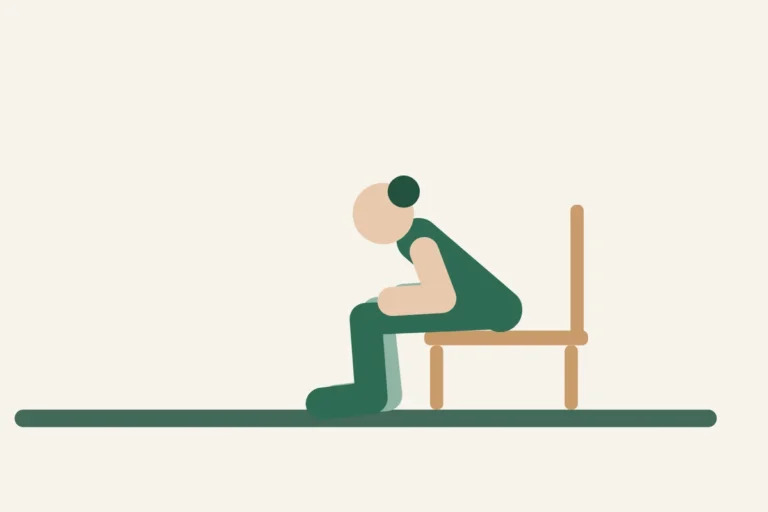
Most seated stretches for seniors are already on our chair pages (see the table below), so this section adds one that isn’t. Use a sturdy chair without wheels. Scoot toward the front of the seat and plant both feet. Chair yoga for seniors covers chair choice. If you’ve had a hip replacement, use the MedlinePlus chair: firm, straight-backed, with armrests and with your hips higher than your knees. The NHS says to avoid chairs with arms for its sitting exercises because they restrict movement, so ask your surgeon or physical therapist which advice applies to you.
1. Overhead triceps stretch
Works: the back of the upper arm, and a little of the shoulder.
- Sit tall, shoulders relaxed and low.
- Lift your right arm up, bend the elbow and let your right hand drop behind your head toward your upper back.
- Use your left hand to give the right elbow a light press, with your fingers resting just above the joint. Cleveland Clinic and ACE both teach it this way.
- Hold for 20 to 30 seconds, breathing slowly. Lower the arm, rest and repeat once, then switch sides.
Easier: lift the elbow only as high as is comfortable and leave your hand resting on your shoulder.
Watch out for: a pinch at the top of the shoulder, or an arched lower back. Ease off if either shows up. Feeling woozy with your arm up means lowering it and breathing for a moment.
Standing at a wall or counter
Stay within arm’s reach of a kitchen counter, wall or sturdy chair. The NIA advises having a sturdy chair, a person or a wall nearby for balance work, and the same logic applies here. Wear shoes or grippy socks with non-slip soles. If you feel unsteady, switch to the seated or lying stretches.
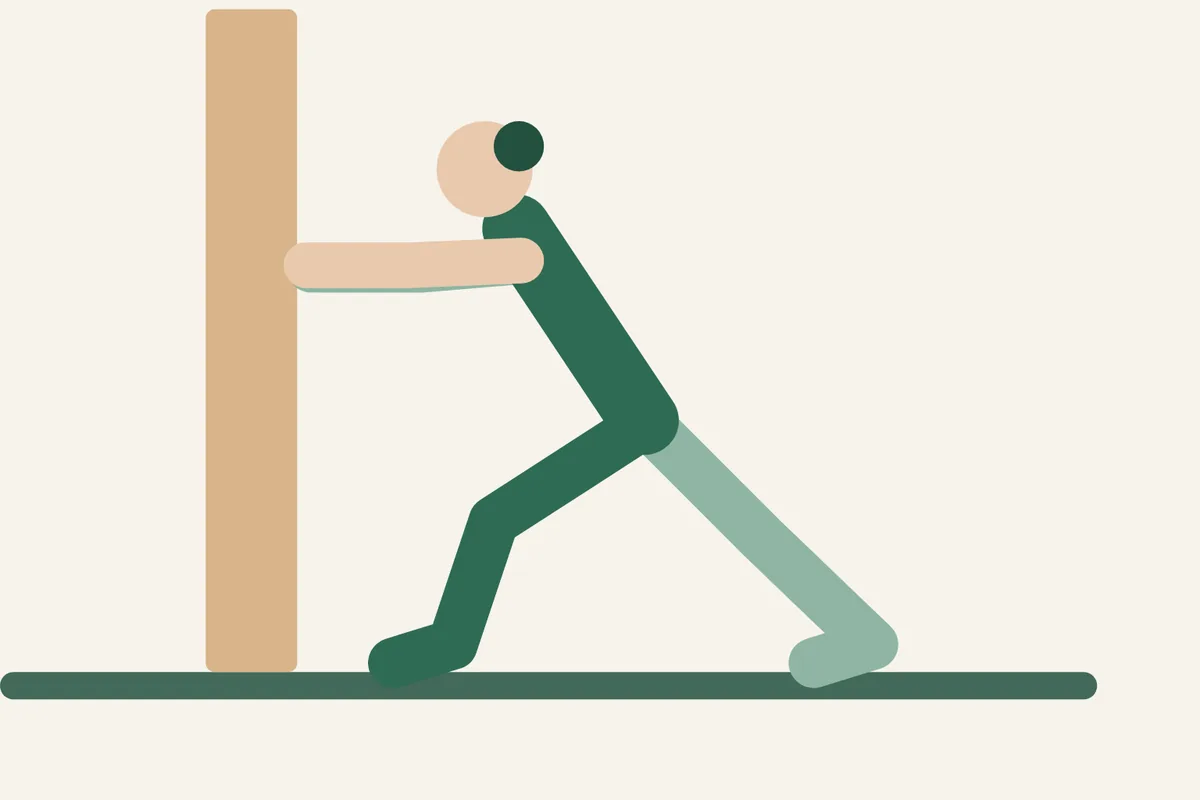
2. Wall calf stretch
Works: the calf, the back of the lower leg.
- Stand facing a wall, about an arm’s length away, with your hands on it a little above shoulder height. Both feet point forward.
- Step your right foot back, a half step to start. Keep that heel on the floor.
- Bend your left (front) knee and lean toward the wall until you feel a pull in the right calf. Keep your back leg straight. ACE says to keep the heel down and your head in line with your spine.
- Hold 20 to 30 seconds. Switch legs and repeat each side once more.
Easier: take a shorter step and stand closer to the wall, or use a counter. Harvard Health also shows a version holding a chair back.
Variation: keep the heel down and let the back knee soften a little. ACE uses this to shift the stretch to the soleus, lower in the calf.
3. Wall chest and shoulder stretch
Works: the chest and the front of the shoulder, the muscles that tighten when we sit rounded forward.
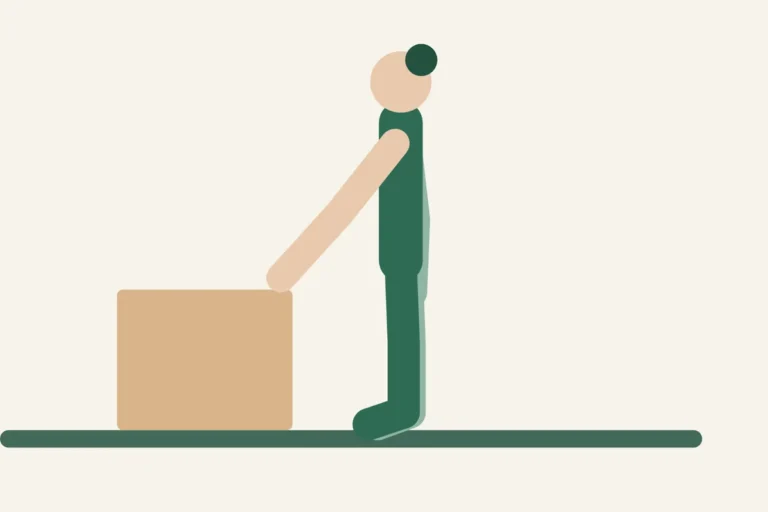
- Stand side-on to a wall or an open door frame, an arm’s length away.
- Place the hand nearest the wall flat on it, at about shoulder height or a little lower, elbow nearly straight.
- Keep your feet where they are and slowly turn your chest away from the wall until you feel a stretch across the chest and the front of the shoulder. Harvard Health describes a similar stretch, and Cleveland Clinic lists a door frame as a way to stretch the chest and shoulders.
- Stay for 20 to 30 seconds, then change sides.
Easier: step closer and bend the elbow a little, or turn less.
Watch out for: a pinching feeling at the front of the shoulder. Stop and lower your hand, since that is not a stretch. If you have had shoulder surgery or a rotator cuff problem, ask your doctor first.
Standing thigh stretch
The standing quad stretch (hold a counter, bring your heel toward your buttock, keep your knees together) is taught by Cleveland Clinic with a 20-second hold. It needs one-leg standing, so use the counter with a firm hand, and skip it if that feels shaky. Hip flexor stretches has the full steps and a wall version, and balance exercises for seniors builds the one-leg skill.
Lying down on a bed or mat
Lying down takes balance out of the picture, so these suit you if standing feels unsteady. Do them on your back, with a pillow under your head if your neck wants it. Check the hip-replacement note in the caution box first: after a hip replacement, skip both stretches here unless your surgeon or physical therapist says they’re OK.
4. Lying hamstring stretch with a towel
Works: the hamstrings, along the back of your thigh.
- Lie on your back, with your left knee bent and foot flat on the bed or mat.
- Loop a bath towel or belt around the arch of your right foot, holding an end in each hand.
- Lift your right leg and let your knee stay slightly soft, until you feel a mild pull behind the thigh. Cleveland Clinic and the NHS both teach a lying version, with the hands behind the thigh or below the knee, and Cleveland Clinic offers a towel if you can’t clasp your hands.
- Hold 20 to 30 seconds, breathing. Lower slowly, rest, and do each side twice.
Easier: keep the knee more bent, or hold behind the thigh instead of the foot.
Watch out for: pain that travels down the leg, or pulling the leg higher than the pull behind your thigh allows. Yoga for tight hamstrings has a strap version of this and a full routine for the hamstrings.
5. Lying outer-hip stretch (ankle over knee)
Works: the buttock and outer hip.
- Lie on your back with both knees bent and both feet flat.
- Rest your right ankle on your left knee, and keep your left foot where it is.
- Let your right knee fall gently outward until a mild stretch appears in the outer right hip. The ACE leg crossover stretch pushes the knee away until the point of tension, keeping the hips and trunk still. We stop there.
- Hold 20 to 30 seconds, uncross the leg and switch sides.
Skip it after a hip replacement. MedlinePlus says not to cross your legs or ankles in any position, and this stretch crosses the legs, so skip it. Ask your surgeon before you try any version. The seated version is in chair yoga for seniors and has the same limit.
Stretches we cover on other pages
Many of the stretches older adults are usually shown are seated ones, and we already cover most of them. We’d rather link than copy the steps.
| Stretch | Where the full steps are | What to know |
|---|---|---|
| Neck tilt and turn, shoulder rolls, side bend, gentle twist | Chair yoga for seniors | Seated, small movements. Keep the twist gentle with osteoporosis |
| Seated hamstring stretch, seated figure-4, ankle circles | Chair yoga for seniors | After a hip replacement, skip the seated hamstring stretch and the figure-4 unless your surgeon says they’re OK |
| Seated chest stretch, upper-body twist | Chair exercises for seniors | Also has strength moves, which stretching does not replace |
| Seated forward fold | Seated Forward Fold | A forward bend: see the osteoporosis and glaucoma notes below |
| Cat-Cow | Cat-Cow | Keep the rounding small with low bone density |
| Hip flexors: kneeling, standing, reclined knee hug | Hip flexor stretches | Kneeling needs knees that tolerate it |
| Hips and outer hips | Yoga for tight hips | Many poses need floor work |
| Child’s Pose, Low Lunge | Child’s Pose, Low Lunge | Floor poses, with a difficult get-up for some people |
A 15-minute order for the five stretches
This plan is ours and not researched. The times add up: 3 minutes of warm-up, 2 minutes each for four stretches (two 20-second holds per side, with rests), 3 minutes for the lying hamstring stretch and 1 minute to rest, which makes 15.
| Part | Stretch | About how long |
|---|---|---|
| Warm-up | March in place or walk around the house, holding a counter if needed | 3 min |
| Seated | 1 Overhead triceps stretch | 2 min |
| Standing | 2 Wall calf stretch | 2 min |
| Standing | 3 Wall chest and shoulder stretch | 2 min |
| Lying | 4 Lying hamstring stretch with a towel (skip after a hip replacement unless cleared) | 3 min |
| Lying | 5 Lying outer-hip stretch (skip after a hip replacement) | 2 min |
| Finish | Rest on your back, breathing slowly, then roll to your side and sit up slowly | 1 min |
Short on time? Do stretches 2, 3 and 4 for about 7 minutes after a walk. Add a neck or side-bend stretch from chair yoga for seniors if you want to fill the gaps.
Make it easier (props)
Everything here is already in most homes.
- A bath towel or an old belt to reach your foot in the lying hamstring stretch. A strap is the next step up.
- A kitchen counter, a sturdy table or a wall for balance.
- A pillow under your head when you lie down.
- A firm mat or the bed. Don’t use a slippery or squishy surface.
Helpful gear for this
 Manduka Align yoga strap, 8 ft
Cotton strap 1.75 in wide with a zinc-alloy buckle, 8 ft long (maker's spec).
See it on Amazon Manduka cork yoga block
Solid cork, 9 x 6 x 4 in and 2.2 lb, firmer and heavier than foam for steadier support (maker's spec).
See it on Amazon Gaiam foam yoga blocks, pair
Two light foam blocks, 9 x 6 x 4 in each, one for each hand (maker's spec).
See it on Amazon
As an Amazon Associate we earn from qualifying purchases. How we choose gear
Who should skip it or ask a doctor first
- Check with your doctor first if you have a medical condition, have been inactive for a while or have worries about your health. That is the NHS advice for people 65 and over. The NCCIH lists knee or hip injuries, lumbar spine disease, severe high blood pressure, balance issues and glaucoma as conditions that may call for changes, and says yoga-related injuries treated in emergency departments are more common in people 65 and older.
- Hip replacement: MedlinePlus lists its rules by position, and they can differ from your surgeon’s. For any activity: don’t cross your legs or ankles, don’t bend at the waist or pull the leg past your waist (hip flexion of more than 90 degrees). Sitting: a firm, straight-backed chair with armrests, hips higher than knees, feet and knees pointing straight ahead. Lying: no sleeping on the side of the new hip or on your stomach. That rules out the lying outer-hip stretch here. Skip the lying hamstring stretch too, unless your surgeon or physical therapist says it’s OK: a leg pointing straight up is already at the 90-degree limit. If you are cleared, keep the leg well below straight up and don’t pull on the towel. Rules depend on your surgery and how long ago it was.
- Osteoporosis or low bone density: avoid strongly rounded spine bends, such as deep forward folds and big rounding. In a review of 89 patients with yoga-related injuries, the poses most often involved bent the spine to extremes forward or backward, and the authors advise people with osteopenia or osteoporosis to avoid extreme spinal flexion (Lee et al., 2019). The stretches here keep your spine long, but ask your doctor how much movement is right for you.
- Glaucoma: avoid head-down positions. Researchers measured eye pressure in 10 people with glaucoma and 10 without during four head-down yoga positions. Pressure rose within a minute in both groups, in all four positions, and returned to baseline within two minutes of sitting back up (Jasien et al., 2015). Skip forward folds below heart level and ask your eye doctor.
- Blood pressure and dizziness: MedlinePlus notes that some people feel symptoms of low blood pressure when they stand up too quickly. So stand up slowly, and as our own precaution, raise and lower your arms slowly and sit for a few breaths before you stand. Stop if you feel light-headed, and tell your doctor if it happens again. Ask your doctor about severe high blood pressure.
- Balance: use a counter or wall within reach, or stay seated or lying down. Our balance guide has supported practice.
- Joint replacements, recent surgery, shoulder or knee problems, or a muscle strain: ask your surgeon or physical therapist which stretches are OK. Mayo notes that stretching a strained muscle may cause more harm.
- Pain, a pinch or tingling: stop. Expect tension, not pain. Don’t bounce.
- Emergencies: stop and call 911 for chest pain, fainting, or sudden weakness or numbness.
What the research says
Evidence: limited
The evidence is limited. Studies in older adults suggest stretching can widen how far joints move, but results on daily function are mixed, the studies don’t agree on a best dose, and none tested the five stretches on this page.
Flexibility training review. A 2012 systematic review looked at 22 studies of flexibility-specific training in healthy adults over 65. It concluded flexibility training may affect range of motion, but information on daily function was conflicting. In the full text, the authors count 7 studies with mostly positive function results, 6 with mostly negative ones and 10 that measured only flexibility or range of motion (one study appears in two groups). The studies averaged 14.2 weeks. The authors say the studies were too varied to recommend a specific type, frequency, duration or program length (Stathokostas et al., 2012).
Hold time in one muscle group. In a trial of 62 independent-living older adults (average age 84.7, range 65 to 97) with tight hamstrings, groups stretched one leg 5 times a week for 6 weeks for 15, 30 or 60 seconds, and a control group did not stretch. Range of motion rose fastest with 60 seconds (2.4 degrees a week, against 1.3 for 30 seconds and 0.6 for 15 seconds). Four weeks after stopping, the 60-second group still had 5.4 degrees more motion than at the start, against 0.7 and 0.8 degrees for the others (Feland et al., 2001). The groups were small (13 to 17 people) and the trial tested one hamstring stretch, not these stretches.
A single session. A 2024 review and meta-analysis of 6 studies found that static stretching lowered passive muscle-tendon stiffness in older adults to a small degree (effect size 0.55, 95% CI 0.27 to 0.84), and in the 3 studies that compared age groups the effect was not significantly different from that in young adults (Nakamura et al., 2024). This looks at the effect of acute stretching, not at lasting gains or daily function.
Yoga and flexibility. A 2023 meta-analysis of randomized trials of yoga in adults 60 and over (15 studies in the review, community-dwelling adults) found improved flexibility after a sensitivity analysis (SMD 0.38, 95% CI 0.07 to 0.68); the authors call heterogeneity across the studies relatively high. We read only its abstract, so we can’t give the number of trials behind the flexibility result or the type of yoga (Ko et al., 2023). Yoga includes much more than stretching.
Overall: stretching can help older adults move joints through more range, and the effect on everyday function is unproven.
Frequently asked questions
Is stretching enough exercise for seniors?
No. The NHS guideline for adults 65 and over pairs strength, balance and flexibility work on at least 2 days a week with 150 minutes of moderate-intensity activity (or 75 vigorous minutes if you’re already active). Stretching covers only the flexibility part. For strength see chair exercises for seniors, and for balance see balance exercises for seniors.
Should seniors stretch before or after exercise?
Mayo, the NIA and Cleveland Clinic all point to stretching when muscles are warm, usually after exercise, and Cleveland Clinic and Harvard Health suggest dynamic moves before a workout. Hold static stretches after you’ve walked or moved for a few minutes.
Is it OK to stretch every day?
Harvard Health suggests stretching most days, even briefly, and Mayo says at least 2 to 3 times a week. We found no study that tested daily stretching in older adults. Stop for a day if a joint or muscle feels sore.
Does stretching help balance or fall risk?
No trial we found tested whether these stretches improve balance or reduce falls. The 2012 review above found mixed results for function, and it didn’t cover falls. Balance practice itself is the better-supported route (see our balance page).
How do I stretch when I can’t get on the floor?
Stay seated, stand at a counter or use the bed. The five stretches here work that way, and the chair pages linked above have many more seated options. A physical therapist can show you a floor transfer that suits you, if you want one.
What if my joints are stiff first thing in the morning?
Move first and stretch second: ankle pumps in bed, a short walk, then a few gentle stretches. If morning stiffness lasts longer than half an hour most days, or joints are swollen or hot, tell your doctor.
Sources
- National Center for Complementary and Integrative Health (NCCIH). Yoga: Effectiveness and Safety. Last updated August 2023., checked Nov 23, 2026
- Garber CE, Blissmer B, Deschenes MR, et al. American College of Sports Medicine position stand. Quantity and quality of exercise for developing and maintaining cardiorespiratory, musculoskeletal, and neuromotor fitness in apparently healthy adults: guidance for prescribing exercise. Med Sci Sports Exerc. 2011;43(7):1334-1359., checked Nov 23, 2026
- Harvard Health Publishing (Corliss J; reviewed by Cannon CP). Take time to stretch. August 1, 2024., checked Nov 23, 2026
- Mayo Clinic Staff. Stretching: Focus on flexibility. November 18, 2023., checked Nov 23, 2026
- National Institute on Aging (NIA). Three Types of Exercise Can Improve Your Health and Physical Ability. Content reviewed January 14, 2025., checked Nov 23, 2026
- NHS. Physical activity guidelines for older adults., checked Nov 23, 2026
- NHS. Flexibility exercises. Page last reviewed November 20, 2023., checked Nov 23, 2026
- NHS. How to stretch after exercising. Page last reviewed March 16, 2026., checked Nov 23, 2026
- NHS. How to warm up before exercising. Page last reviewed June 24, 2026., checked Nov 23, 2026
- NHS. Sitting exercises. Page last reviewed January 18, 2024., checked Nov 23, 2026
- NHS. Rheumatoid arthritis: symptoms. Page last reviewed March 8, 2023., checked Nov 23, 2026
- Cleveland Clinic (Wichman L, MD). Stretching 101: exercises and benefits. November 4, 2025., checked Nov 23, 2026
- ACE (American Council on Exercise). Exercise library: Overhead Triceps Stretch., checked Nov 23, 2026
- ACE (American Council on Exercise). Exercise library: Standing Dorsi-Flexion (Calf Stretch)., checked Nov 23, 2026
- ACE (American Council on Exercise). Exercise library: Leg Crossover Stretch., checked Nov 23, 2026
- Stathokostas L, Little RM, Vandervoort AA, Paterson DH. Flexibility training and functional ability in older adults: a systematic review. J Aging Res. 2012;2012:306818., checked Nov 23, 2026
- Feland JB, Myrer JW, Schulthies SS, Fellingham GW, Measom GW. The effect of duration of stretching of the hamstring muscle group for increasing range of motion in people aged 65 years or older. Phys Ther. 2001;81(5):1110-1117., checked Nov 23, 2026
- Nakamura M, Takeuchi K, Fukaya T, Nakao G, Konrad A, Mizuno T. Acute effects of static stretching on passive stiffness in older adults: a systematic review and meta-analysis. Arch Gerontol Geriatr. 2024;117:105256., checked Nov 23, 2026
- Ko KY, Kwok ZCM, Chan HY. Effects of yoga on physical and psychological health among community-dwelling older adults: a systematic review and meta-analysis. Int J Older People Nurs. 2023;18(5):e12562., checked Nov 23, 2026
- Lee M, Huntoon EA, Sinaki M. Soft tissue and bony injuries attributed to the practice of yoga: a biomechanical analysis and implications for management. Mayo Clin Proc. 2019;94(3):424-431., checked Nov 23, 2026
- Jasien JV, Jonas JB, de Moraes CG, Ritch R. Intraocular pressure rise in subjects with and without glaucoma during four common yoga positions. PLoS One. 2015;10(12):e0144505., checked Nov 23, 2026
- MedlinePlus (U.S. National Library of Medicine). Taking care of your new hip joint. Reviewed November 7, 2024., checked Nov 23, 2026
- MedlinePlus (U.S. National Library of Medicine). Low blood pressure. Last updated January 28, 2019., checked Nov 23, 2026
- Schrodt L. Getting to and from the floor. National Council on Aging (NCOA). June 18, 2025., checked Nov 23, 2026
Image credits: Illustration: YogaForFitness (vector figure), drawn from the steps above