Balance Exercises for Seniors: 10 Supported Moves
Quick answer
Balance exercises for seniors are simple standing moves, done with a counter, wall or sturdy chair within reach, that ask your legs and feet to steady you a little more over time. This page gives 10, from Mountain Pose at a counter to a low Tree Pose and a sit-to-stand, each with a counter, wall or chair for support. Research is strong for balance and functional exercise programs in general and limited for yoga-based moves, so check with your doctor first if you have fallen or feel unsteady.
We may earn a commission when you buy through links on this page. It never changes what we recommend. As an Amazon Associate we earn from qualifying purchases.
Balance exercises for seniors are simple standing moves, done with a counter, wall or sturdy chair within reach, that ask your legs and feet to steady you a little more over time. This guide gives 10 of them, from Mountain Pose at a counter to a low Tree Pose and a sit-to-stand, plus a ladder for moving up one step at a time. Use support for every move, stop for dizziness or pain, and check with your doctor first if you have fallen or feel unsteady. You’ll find more like this in our Yoga For guides.
Two of the ten moves are yoga poses, Mountain Pose and Tree Pose. The other eight are standard balance drills taught by health agencies and medical centers. Nothing here is medical advice, and no study has shown that these ten moves, or yoga in general, prevent falls; the research box explains what has been tested. New to yoga? Start with yoga for beginners and how to start yoga at home.
In this guide
- Who should check with a doctor first?
- Set up before you start
- The 10 moves at a glance
- How to do the 10 moves
- The progression ladder
- How to improve balance for seniors: how often and how long
- Make it easier (props)
- Poses to pair with these moves
- Who should skip it or ask a doctor first
- What the research says
- Frequently asked questions
- Sources
Who should check with a doctor first?
Falling is the main risk of balance practice, so a short check first is worth it. Ask your doctor, nurse or physical therapist before you start if any of these fit you:
- You have fallen, worry about falling or feel unsteady. The CDC’s fall-prevention brochure says to tell a provider right away, and to ask which exercise program is best for you (CDC STEADI). The National Institute on Aging (NIA) says to report any fall since your last checkup, even one that didn’t hurt.
- You get dizzy, lightheaded or faint when you stand up. The NIA lists blood pressure that drops when you rise from sitting or lying as a risk factor for falls.
- A medicine makes you sleepy or dizzy. The CDC advises a doctor or pharmacist review of everything you take (CDC).
- You have numb or sore feet, nerve problems, diabetes, heart disease or thyroid trouble. The NIA says these can affect balance.
- Your vision has changed. The CDC advises an eye exam at least once a year, and the NIA links even small changes in sight to more falls.
- You have a serious balance problem, or a bone, joint or muscle condition. Mayo Clinic says to get a healthcare professional’s OK before balance exercises (Mayo Clinic).
The caution box below covers hip replacement, osteoporosis and joint pain.
Set up before you start
- Something sturdy to hold. A kitchen counter or heavy table, or a chair with its back against a wall so it can’t slide (the wall tip is ours). Mayo Clinic suggests a table or counter, and the NIA says to keep a sturdy chair, a person or a wall nearby.
- Firm floor, right footwear. The NIA says comfortable, stable shoes or bare feet give grip on a floor or mat. Its falls page recommends nonskid, rubber-soled, low-heeled shoes and warns against socks and smooth-soled slippers.
- Clear space, good light (CDC brochure), someone nearby for the first tries and a charged phone within reach (NIA).
- Glasses on if your eye doctor says so (NIA), and loose clothing and water close by (NHS).
The 10 moves at a glance
This table is the whole routine on one screen. There’s no PDF to download; use your browser’s print command (Ctrl+P on Windows, Cmd+P on a Mac) for a paper copy and check the preview first.
| # | Move | Support | Time or repetitions the sources give |
|---|---|---|---|
| 1 | Mountain Pose with weight shifts | Both hands on a counter | Mountain Pose 30 to 60 seconds (Cleveland Clinic) |
| 2 | Semi-tandem stand | Counter | 10 seconds (CDC clinic test, not a training dose) |
| 3 | Tandem stand | Counter | 10 seconds (same test) |
| 4 | Sideways walking | Counter or wall | 10 steps each way (NHS) |
| 5 | Heel-to-toe walk | Fingertips on a wall | At least 5 steps (NHS); 5 or more per foot (Cleveland Clinic) |
| 6 | Heel raises | Counter | 3-second hold, 5 to 20 times (Cleveland Clinic); 10 to 15 times (MedlinePlus) |
| 7 | One-leg stand | Fingertips on a wall | 5 to 10 seconds, 3 per side (NHS); up to 30 seconds (Mayo Clinic) |
| 8 | Low Tree Pose | Fingertips on a wall | 3 to 5 breaths per side (ACE) |
| 9 | Standing knee bend | Counter | 10 seconds (Cleveland Clinic); 10 to 15 times (MedlinePlus) |
| 10 | Sit-to-stand | Chair, back to a wall | 3 to 5 times (Cleveland Clinic) |
Moves 1 and 8 are yoga poses, moves 2 and 3 follow the stances in the CDC’s balance test, and the rest come from the NHS, NIA, Mayo Clinic, MedlinePlus and Cleveland Clinic pages under Sources. Move 10 is the only one that uses a seat; every other move is done standing, unlike chair yoga for seniors and chair exercises for seniors. Our chair exercises guide teaches the same sit-to-stand.
How to do the 10 moves
We wrote the steps in our own words after checking them against the sources named in each move. Where no source gives a time, stop when your form slips.
1. Mountain Pose with weight shifts
Works: the steady base the other moves build on. The full pose is on the Mountain Pose page.
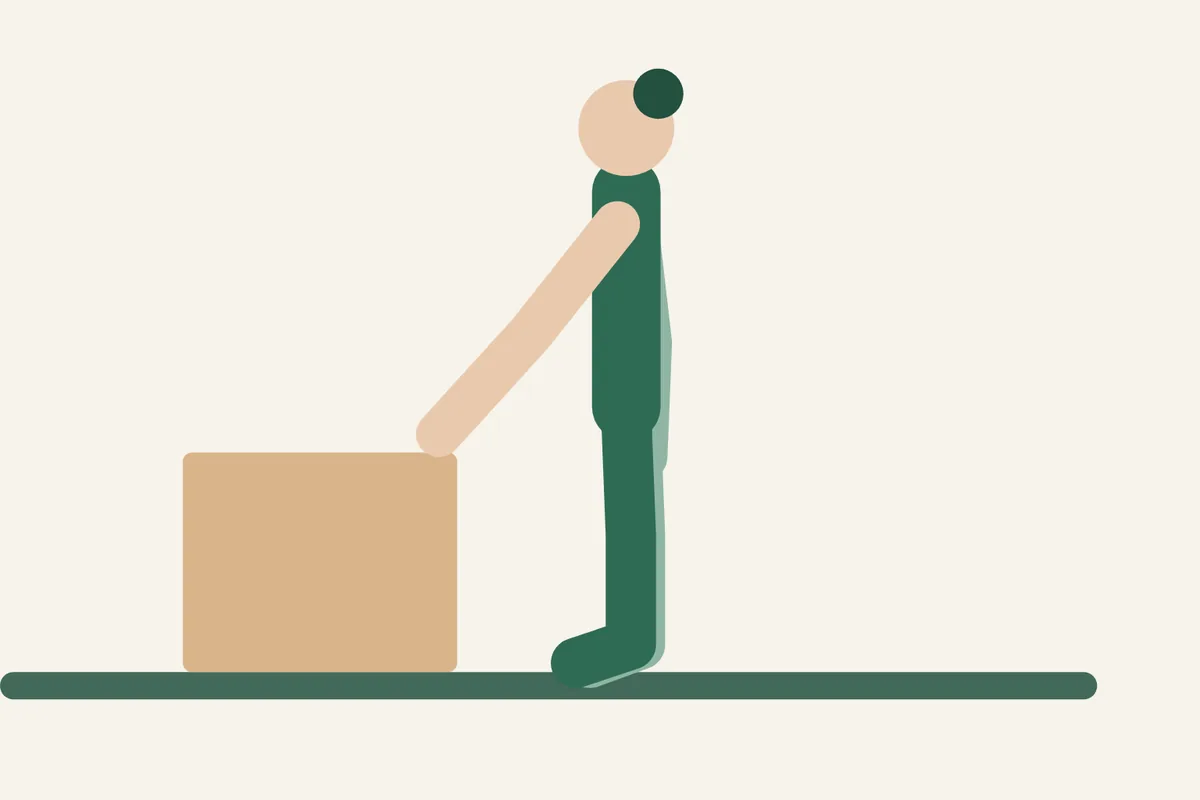
- Stand an arm’s length from a counter, feet about hip-width apart, toes forward, both hands resting on it.
- Press evenly through both feet, keep your knees soft and let the top of your head float up. Fix your eyes on a spot straight ahead.
- Slowly slide your weight toward your right foot, pause for a breath, return to the middle, then slide left. Keep both feet down.
Time: Cleveland Clinic suggests holding Mountain Pose for about 30 to 60 seconds. Mayo Clinic’s weight shift lifts the other foot for up to 30 seconds; that is move 7 here, so begin with both feet down.
Easier: stand with your back an inch or two from a wall, as Yoga International suggests.
2. Semi-tandem stand
- Stand at the counter in Mountain Pose, both hands on it.
- Slide one foot forward until its instep touches the big toe of the other, the foot position of the second stage in the CDC’s 4-stage balance test.
- Share your weight between both feet, look ahead and breathe. Stay up to 10 seconds, the time the test uses, then switch feet.
Harder: fingertips only.
3. Tandem stand
- From the semi-tandem stand, set one foot straight ahead of the other, heel touching toes, the test’s third stage.
- Keep your fingertips on the counter and your eyes ahead. Stay up to 10 seconds, then switch.
Easier: go back to move 2.
4. Sideways walking
- Stand beside a counter or wall, feet together, knees slightly bent.
- Step sideways with one foot and bring the other to meet it. Go slowly and don’t sink into your hips, as the NHS advises.
- Take 10 steps one way and 10 back, sliding a hand along the counter.
The NIA also lists walking backward as a balance exercise. Our advice is to leave it out of home practice until a physical therapist says yes, because you can’t see where you’re going.
5. Heel-to-toe walk
- Stand tall beside a wall with your fingertips on it.
- Put your right heel directly in front of your left toes, then your left heel in front of your right toes. Look straight ahead the whole time, not down (NHS).
- Take at least 5 steps (NHS). Cleveland Clinic pauses one to two seconds on each step.
- As you steady, stand a little farther from the wall (NHS).
6. Heel raises
- Stand holding a counter or chair back, feet together or hip-width apart.
- Rise slowly onto your toes, as if peeking over a fence, hold about 3 seconds and lower slowly.
- Repeat 5 to 20 times (Cleveland Clinic), or 10 to 15 times with a sturdy support and slightly bent knees (MedlinePlus).
7. One-leg stand with fingertips
- Face a wall with arms out and fingertips on it, as the NHS describes, or hold a counter.
- Keep the standing knee slightly bent and your hips level. Raise one foot just clear of the floor (a small lift is enough; that detail is ours).
- Hold 5 to 10 seconds, 3 times per side (NHS). Mayo Clinic says to hold as long as your form stays good, up to 30 seconds, and Cleveland Clinic uses 10 seconds for up to three sets.
Easier: hold the counter with a whole hand, as Mayo Clinic suggests with a table or desk.
8. Low Tree Pose
The Tree Pose page has the full pose and higher foot positions. Here the foot stays low.
- Put the fingertips of one hand on a wall beside you, standing about an arm’s length from it.
- Shift onto the foot farther from the wall. Bend the other knee and set that heel against the inside of your standing ankle, at or just above the ankle bone, toes on the floor.
- Keep your hips level and facing forward, and look at one point ahead. Stay 3 to 5 breaths, the hold the American Council on Exercise (ACE) uses for older adults, then switch sides.
Watch out for: a foot against the side of the standing knee. Yoga International places the foot below or above the knee, never against it, and ACE’s version for older adults keeps it at the ankle or the lower leg, so keep it low. In a lab study of 20 healthy adults about 70 years old, this toes-on-the-floor version with hands lightly on a wall put less load on the standing hip than the versions with the whole foot lifted off the floor (resting just above the ankle). Holding the wall in those one-leg versions did not reduce the sideways load on the knee (Yu et al., 2012).
9. Standing knee bend
- Stand holding a counter or chair back, feet shoulder-width apart, back straight, knees slightly bent.
- Bend one knee and bring that heel back toward your buttock, a few inches or as far as is comfortable, then lower slowly.
- Hold up to 10 seconds (Cleveland Clinic’s backward single-leg stance) or repeat 10 to 15 times per leg (MedlinePlus). Mayo Clinic’s version holds up to 30 seconds.
Easier: lift the heel only a little, with both hands on the counter.
10. Sit-to-stand
Works: the leg strength and control you use to get out of any chair. The NIA lists practicing standing up from a seat as a balance exercise.
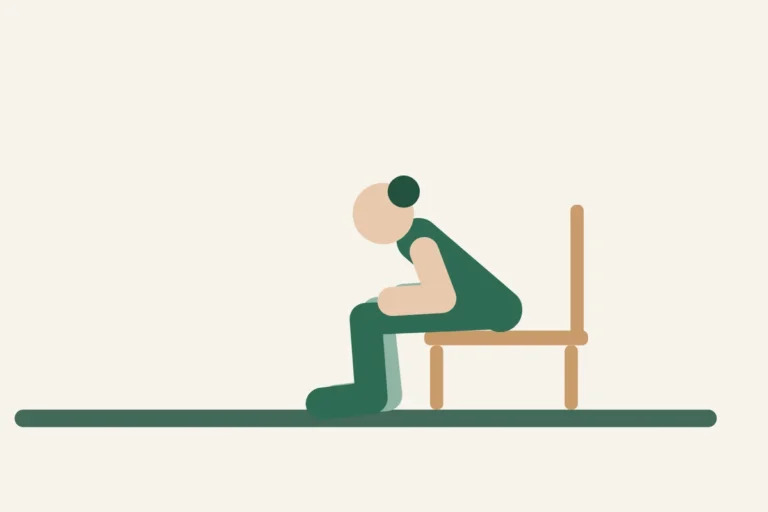
- Stand in front of a firm chair without wheels, its back against a wall, knees shoulder-width apart, feet and knees pointing straight ahead. A chair without a cushion is best (Cleveland Clinic).
- Bend your knees and hips and sit slowly. Stay seated a few seconds.
- Push through your heels and stand tall. Try not to push or pull with your arms, but use the armrests or your knees if you need to.
- Stand up slowly and pause for a breath with a hand on the chair back or a counter before the next repetition or before walking away. If you feel dizzy or lightheaded, sit down and stop (NIA; MedlinePlus).
- Repeat 3 to 5 times (Cleveland Clinic).
After a hip replacement, follow your surgeon’s rules first. MedlinePlus says to use a firm, straight-backed chair with armrests, high enough that your hips stay above your knees; to keep your feet and knees pointing straight ahead, not turned out; to slide to the front edge and push up with the armrests rather than rocking; and not to bend forward past 90 degrees at the hip. In that case skip the “try not to use your arms” cue above.
The progression ladder
Balance practice should feel a little challenging, not scary. The NHS says to build up slowly, and MedlinePlus says to hold positions longer as you get stronger. This ladder follows the order of the CDC’s balance test, with support added so you can practice at home.
| Rung | Position | Support | Hold range from the sources |
|---|---|---|---|
| 0 | Feet hip-width apart (move 1) | Both hands | Mountain Pose 30 to 60 seconds (Cleveland Clinic) |
| 1 | Feet together | Both hands, then fingertips | The CDC test’s first stage, 10 seconds |
| 2 | Semi-tandem (move 2) | Fingertips | 10 seconds |
| 3 | Tandem (move 3) | Fingertips | 10 seconds |
| 4 | One-leg stand (move 7) | Fingertips | 5 to 10 seconds, 3 per side (NHS); up to 30 seconds (Mayo Clinic) |
Our rule of thumb, not a researched one: move up a rung only when the one below feels calm for the full time with your fingertips barely touching, and drop back a rung on a tired or wobbly day. Beyond rung 4, ask a physical therapist.
About the CDC test. A clinician gives this test: they stand beside you, help you into each position, and time you without a cane or walker. The CDC says that failing to hold the tandem stance for 10 seconds marks a higher risk of falling, and suggests physical therapy or an evidence-based program such as Tai Chi. Don’t test yourself unsupported at home. If you can’t hold tandem for 10 seconds even with fingertips on a counter, tell your doctor or physical therapist.
How to improve balance for seniors: how often and how long
- How often. The NIA says about three balance sessions a week (NIA). The NHS says at least twice a week, and Cleveland Clinic says a few minutes a day builds steadiness. These ranges come from different sources and aren’t a prescription for you.
- How long a session lasts. No source we read gives a length for a routine like this. Pick a few moves at your rung, stop while you still feel steady and add moves over weeks. That advice is ours.
- A sample order (ours, not researched). Mountain Pose with weight shifts, one stance rung, one walking move (4 or 5), heel raises, one one-leg move (7, 8 or 9), sit-to-stand, then a few quiet breaths before you walk away.
- One part of a plan. The NIA says older adults need a mix of aerobic, muscle-strengthening and balance activity. Seated strength work is in chair exercises for seniors.
- Classes. The CDC names Tai Chi as an example of a strength and balance exercise. The NCCIH advises yoga under a qualified instructor and links learning it alone to more risk.
Make it easier (props)
Nothing to buy:
- A sturdy counter or heavy table for moves 1 to 4, 6 and 9.
- A chair against a wall for hand support in moves 6 and 9, and for move 10.
- A wall for your fingertips in moves 5, 7 and 8, as the NHS does for its heel-to-toe walk and one-leg stand.
- A hard floor and nonskid shoes, or bare feet. A mat is optional; a non-slip one is fine if it lies flat. Mayo Clinic lists a pillow or other unstable surface as the harder version, so skip thick rugs for now.
- Blocks: none of the sources we read puts a block under the hand for these moves, so we left them out.
Helpful gear for this
 Manduka begin yoga mat, 5 mm
5 mm TPE mat, 68 x 24 in, light to carry, with a center alignment stripe (maker's spec).
See it on Amazon Gaiam foam yoga blocks, pair
Two light foam blocks, 9 x 6 x 4 in each, to raise the floor under your hands (maker's spec).
See it on Amazon Hugger Mugger cotton D-ring yoga strap, 10 ft
Cotton webbing 1.5 in wide with a metal D-ring buckle, 10 ft long (maker's spec).
See it on Amazon
As an Amazon Associate we earn from qualifying purchases. How we choose gear
Poses to pair with these moves
- The standing base: Mountain Pose is move 1 and the start of every other move.
- One-leg balance: Tree Pose has calf and thigh versions once the ankle version feels easy.
- Not included: Warrior II, a wide-stance pose with its own chair and wall versions.
- Seated days: chair yoga.
- Read next: how long to hold a yoga pose and benefits of yoga.
Who should skip it or ask a doctor first
- Talk to your doctor first if you have fallen, feel unsteady, get dizzy, take medicines that cause dizziness, or have any condition in the checklist above. The NCCIH says past knee or hip injuries, lower-back spine disease, severe high blood pressure, balance problems and glaucoma may call for changes to yoga, and that the rate of yoga injuries treated in emergency departments is higher at 65 and older than in younger adults.
- Support for every move. Keep a counter, wall or sturdy chair within reach. If you feel unsteady, steady yourself and stop, and stand up slowly afterward (NIA).
- Dizziness, lightheadedness or fainting. Stop and sit. MedlinePlus lists these as symptoms of low blood pressure, says to call a provider right away, and says to get emergency help if someone passes out.
- A recent fall. Don’t start on your own. Tell your doctor first, even if you weren’t hurt (NIA).
- Hip replacement. MedlinePlus says to take the most care in the first few months, not to cross your legs or ankles, and not to bend the hip past 90 degrees or lift the leg above the waist. Rules depend on your operation. Leave out moves 7, 8 and 9 until your surgeon or therapist approves them, and ask about the rest.
- Osteoporosis or low bone density. A fall can break a bone, so don’t skimp on support. Keep your back upright rather than bending forward to watch your feet (our cue). A review of 89 patients with yoga-related injuries advised people with osteopenia or osteoporosis to avoid extreme forward bending of the spine (Lee et al., 2019).
- Numb feet, nerve problems or foot pain. The NIA lists nerve and foot problems among causes of poor balance, and the CDC advises a yearly foot check. Use support throughout and ask your doctor before starting.
- Vision changes. Have your eyes checked yearly (CDC), and after new glasses give yourself time to adjust (NIA) before standing balance practice.
- Knee, hip or ankle pain. Skip the one-leg moves (7, 8, 9). In the lab study of healthy adults about 70, the single-leg Tree versions loaded the standing hip more than the toes-on-the-floor version, and the authors warned they could aggravate existing joint problems (Yu et al., 2012). Pain, dizziness or trouble breathing means stop and talk with your provider (MedlinePlus).
- If you fall, stay calm, breathe, stay still a moment and decide whether you’re hurt before you move. If you can get up safely, roll to your side and crawl to a sturdy chair. Otherwise call for help or 911 (NIA). Tell your doctor afterward.
What the research says
Evidence: limited
The evidence for this exact routine is limited. No study tested these 10 moves. Supervised balance and functional exercise programs have strong evidence for fewer falls, but those programs ran for months and were usually led by trainers. Yoga-based moves have only small to moderate gains on balance tests. We label the page limited because it is a home routine built from both.
Balance and functional exercise in general. The Cochrane review of exercise to prevent falls included 108 trials and 23,407 community-dwelling adults aged 60 and over (average age 76; trials of particular conditions such as stroke were left out). Exercise of all types reduced the rate of falls by 23% (59 studies, 12,981 people, high certainty). Balance and functional exercises reduced it by 24% (39 studies, 7,920 people, high certainty). Tai Chi reduced the number of people who fell by 20% (8 studies, 2,677 people, high certainty). The abstract doesn’t list yoga as a category. Only 27 of the 108 trials reported side effects, and only one monitored them closely; most reported ones were minor and in the muscles and joints, with two serious ones (a pelvic stress fracture and a hernia operation) (Sherrington et al., 2019).
Yoga and balance tests. A review of 6 trials with 307 participants aged 60 and over found a small improvement in balance performance (effect size 0.40, 95% CI 0.15 to 0.65). Its authors wrote that more research is needed to learn whether this carries over to preventing falls (Youkhana et al., 2016). A 2019 review of 22 trials in older adults with an average age of 60 or more, not chosen for a disease, found better balance than inactive comparison groups (7 studies, 265 people; effect size 0.70, 95% CI 0.19 to 1.22, with results that varied widely). Against active comparison groups, such as walking or chair aerobics, the balance difference was not statistically significant (5 studies, 264 people). Adverse events in yoga groups, reported by four studies, included a groin strain, a fall during a session and muscle or joint pain (Sivaramakrishnan et al., 2019). The NCCIH says research suggests yoga may improve balance.
What this means. Yoga-based moves are not a proven fall-prevention program. Reviews show small to moderate gains on balance tests, mixed against other exercise, and neither yoga review gives a pooled result for falls. The strong falls result belongs to balance and functional exercise programs and, with different certainty, Tai Chi, and those trials tested whole programs, not this list. The NIA still lists yoga among balance activities and says balance exercises help prevent falls and fall-related injuries.
Frequently asked questions
Can balance exercises for older adults prevent falls?
Balance and functional exercise programs do: the Cochrane review found a 24% lower rate of falls with them (high-certainty evidence). Programs that add strength work probably help too (moderate certainty), and strength training alone has an uncertain effect. Whether these ten moves do the same hasn’t been tested, and the yoga reviews we read give no pooled result for falls. Ask your doctor about a program that suits you.
Is there a balance exercises for seniors PDF?
Not a PDF download. The chart near the top of this page is a plain table. Use your browser’s print command for a paper copy and check the preview first.
What are the safest exercises for balance for seniors to start with?
Start with move 1 and both hands on a counter, then the feet-together stance. Leave the one-leg moves until the stances feel calm.
What should I do if I fall while practicing?
Stay calm and still for a moment, check whether you’re hurt and don’t rush to get up. The NIA’s steps are in the caution box. Call 911 if you’re hurt or can’t get up, and tell your doctor about any fall.
Sources
- National Institute on Aging (NIA). Three Types of Exercise Can Improve Your Health and Physical Ability. Content reviewed January 14, 2025., checked Nov 22, 2026
- National Institute on Aging (NIA). Falls and Fractures in Older Adults: Causes and Prevention. Reviewed September 12, 2022., checked Nov 22, 2026
- Centers for Disease Control and Prevention (CDC). Preventing Falls and Hip Fractures. Page dated January 27, 2026., checked Nov 22, 2026
- CDC STEADI (Stopping Elderly Accidents, Deaths and Injuries). Assessment: The 4-Stage Balance Test. 2017., checked Nov 22, 2026
- CDC STEADI. What YOU Can Do to Prevent Falls (patient brochure). 2017., checked Nov 22, 2026
- National Health Service (NHS), UK. Balance exercises. Last reviewed 7 November 2023., checked Nov 22, 2026
- Mayo Clinic Staff. Balance exercises. August 20, 2024., checked Nov 22, 2026
- MedlinePlus (U.S. National Library of Medicine). Exercises to help prevent falls. Review date June 4, 2026., checked Nov 22, 2026
- Cleveland Clinic. Keeping Steady: Balance Exercises To Improve Stability. Health Essentials, July 29, 2025., checked Nov 22, 2026
- Sherrington C, Fairhall NJ, Wallbank GK, et al. Exercise for preventing falls in older people living in the community. Cochrane Database Syst Rev. 2019;1(1):CD012424., checked Nov 22, 2026
- Youkhana S, Dean CM, Wolff M, Sherrington C, Tiedemann A. Yoga-based exercise improves balance and mobility in people aged 60 and over: a systematic review and meta-analysis. Age Ageing. 2016;45(1):21-29., checked Nov 22, 2026
- Sivaramakrishnan D, Fitzsimons C, Kelly P, et al. The effects of yoga compared to active and inactive controls on physical function and health related quality of life in older adults: systematic review and meta-analysis of randomised controlled trials. Int J Behav Nutr Phys Act. 2019;16(1):33., checked Nov 22, 2026
- National Center for Complementary and Integrative Health (NCCIH). Yoga: Effectiveness and Safety. Last updated August 2023., checked Nov 22, 2026
- Yu SS, Wang MY, Samarawickrame S, et al. The physical demands of the tree (vriksasana) and one-leg balance (utthita hasta padangusthasana) poses performed by seniors: a biomechanical examination. Evid Based Complement Alternat Med. 2012;2012:971896., checked Nov 22, 2026
- MedlinePlus (U.S. National Library of Medicine). Taking care of your new hip joint. Reviewed November 7, 2024., checked Nov 22, 2026
- MedlinePlus (U.S. National Library of Medicine). Low blood pressure. Reviewed January 1, 2025., checked Nov 22, 2026
- Lee M, Huntoon EA, Sinaki M. Soft tissue and bony injuries attributed to the practice of yoga: a biomechanical analysis and implications for management. Mayo Clin Proc. 2019;94(3):424-431., checked Nov 22, 2026
- Matthews J. Yoga For Active Older Adults: 6 Accessible Poses to Enhance Functional Capacity. American Council on Exercise (ACE). September 28, 2015., checked Nov 22, 2026
- Cleveland Clinic. Mountain Pose (Tadasana). Health Essentials, October 27, 2025., checked Nov 22, 2026
- Yoga International. Mountain Pose. Pose library., checked Nov 22, 2026
- Yoga International. Tree Pose. Pose library., checked Nov 22, 2026
Image credits: Illustration: YogaForFitness (vector figure), drawn from the steps above