Sciatica Stretches: 6 Gentle Moves and When to See a Doctor
Quick answer
The gentlest stretches for sciatica are slow moves on your back, on your hands and knees, or in a chair, done only to a mild pull and stopped if leg pain, tingling or numbness grows. Get emergency care for sciatica in both legs, numbness around your genitals or bottom, or new trouble with bladder or bowel control, and see a doctor first for leg weakness or numbness or pain below the knee. No trial has tested these six moves for sciatica, so treat them as careful movement, not a fix.
We may earn a commission when you buy through links on this page. It never changes what we recommend. As an Amazon Associate we earn from qualifying purchases.
Sciatica stretches should feel like a mild, easy pull and never bring on more pain, tingling or numbness down your leg. This guide gives six gentle, yoga-based moves for people whose leg pain has been checked and has no warning signs. Most sciatica improves within a few weeks to a few months (NHS), and the NHS advises against long spells of sitting or lying still. The warning signs come first, because some leg symptoms need a doctor, not a stretch. It’s part of our Yoga For guides.
In this guide
- See a doctor first: the warning signs
- What is sciatica, in plain words?
- Ground rules for stretching with sciatica
- Six gentle moves
- Which sciatic nerve stretches and yoga poses should you skip?
- Sciatica exercises for seniors: what changes
- Make it easier (props)
- Who should skip it or ask a doctor first
- What the research says
- Frequently asked questions
- Sources
See a doctor first: the warning signs
MedlinePlus describes sciatica as a symptom of another problem, not a condition by itself. Leg pain, tingling or weakness can have several causes, so read these lists before you stretch.
Get emergency care now
The NHS says to go to A&E or call 999 (in the US, an emergency room or 911), and not to drive yourself, if you have:
- Sciatica on both sides, or severe or worsening weakness or numbness in both legs.
- Numbness around or under your genitals, or around your bottom.
- New trouble starting to pee, being unable to pee, or losing control of your bladder.
- Not noticing when you need to poop, or losing control of your bowels.
The NHS warns these can mean a serious spine problem that needs urgent hospital treatment. A physical therapist at the Hospital for Special Surgery names a rare condition, cauda equina syndrome, that can cause permanent damage if it isn’t treated right away (HSS). Don’t stretch your way through these signs.
Contact your doctor right away
MedlinePlus advises contacting your provider right away for back pain after a hard blow or fall, unexplained fever with back pain, redness or swelling on the spine, pain that travels down the leg below the knee, weakness or numbness in the buttocks, thigh, leg or pelvis, pain that is worse lying down or wakes you at night, severe pain that won’t let you get comfortable, burning when you pee or blood in your urine, or loss of control of urine or stool. It also advises contacting your provider, though not necessarily right away, for unplanned weight loss, steroid use or injecting drugs, an episode that feels different from and worse than earlier back pain, or an episode lasting longer than 4 weeks.
That list is long on purpose. A first episode of leg pain with numbness or weakness deserves an exam before you start stretching on your own.
Get checked if it isn’t improving
The NHS says to see a GP (a primary care doctor) if the pain hasn’t improved after a few weeks of home care, is getting worse, or is stopping your normal activities. Cleveland Clinic says moderate to severe pain, numbness, tingling or weakness needs medical care. The HSS physical therapist suggests getting checked if symptoms last more than a week or two, and getting urgent care for fever, chills or night sweats (HSS). The NCCIH advises against using yoga to put off seeing a provider about a medical problem.
What is sciatica, in plain words?
“Sciatica” names a set of symptoms, not a diagnosis. Harvard Health explains that it arises when the sciatic nerve, or the nerve roots feeding it, is irritated or squeezed. It starts in your lower back and travels through the buttock and down the back of each leg to the foot. You may feel burning or sharp pain down the back of one leg, tingling, numbness or weakness. With back pain alone, the NHS says you probably don’t have sciatica.
The NHS names a slipped (herniated) disc as the most common cause, then spinal stenosis (a narrowed spinal canal), spondylolisthesis (a vertebra slipping out of place) and back injury. MedlinePlus also lists piriformis syndrome, a pain problem involving a small buttock muscle. A 2010 systematic review called that label controversial (Hopayian et al., 2010), and a 2018 update found its prevalence and test accuracy still unsettled (Hopayian and Danielyan, 2018). We can’t tell you which cause you have, and it matters: MedlinePlus says bending backward and walking bring on pain especially with stenosis.
Sciatica usually gets better in a few weeks to a few months, though it can return (NHS); Cleveland Clinic reports that improvement within four to six weeks is common. MedlinePlus says bed rest isn’t recommended, but suggests cutting back for about the first two days, then gradually returning to usual activity, and avoiding heavy lifting and twisting for the first six weeks. On timing the sources differ: MedlinePlus suggests starting exercise again after 2 to 3 weeks, while the NHS says to start gentle exercise as soon as you can. Ask your doctor or physical therapist when to begin.
Ground rules for stretching with sciatica
- Aim for a mild pull, never pain. The HSS physical therapist says moves like these shouldn’t cause more pain, and to stop right away if they do (HSS). Harvard Health warns against deep stretches past your current range, and the NHS exercise page says to stop at once if you feel pain.
- Stop if your leg symptoms start or grow. MedlinePlus describes sciatica as pain, weakness, numbness or tingling in the leg, and Cleveland Clinic says numbness, tingling or weakness needs medical care. So stop if a move brings on or increases any of these, not just pain, and tell your clinician which move did it.
- Go slowly and keep breathing. Stretch only to the point of tension, don’t bounce (ACE), and don’t hold your breath (HSS).
- We give no hold times or counts. The sources we read disagree and none tested them in sciatica. A physical therapist who has examined you can set yours.
Six gentle moves
Moves 1, 2, 4 and 6 appear in at least two medical sources on sciatica or the closely related piriformis problem. Move 3 comes from Cleveland Clinic and move 5 from HSS. Being listed isn’t the same as being shown to work. Pick two or three, not all six.
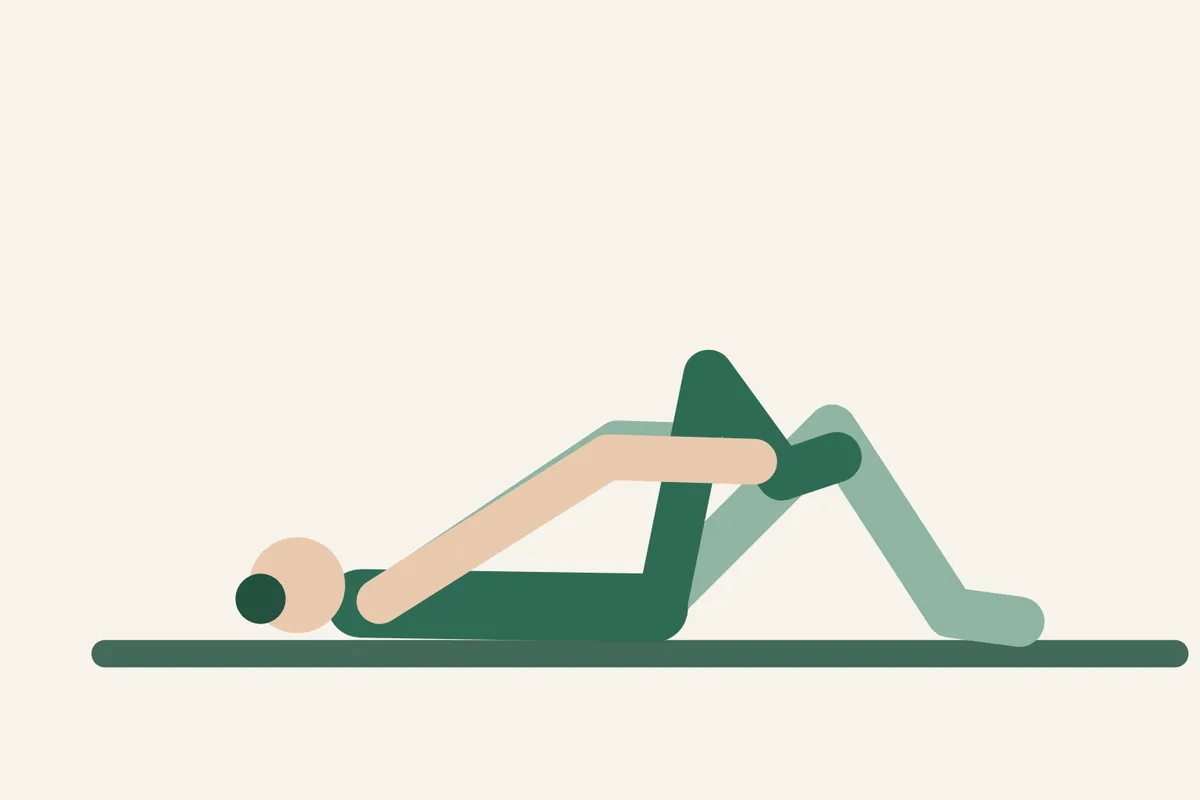
1. Lying knee-to-chest, one leg at a time
Felt mostly in: lower back, hip and buttock.
- Lie face up with your knees bent and your soles on the floor. Use a thin pillow under your head if your chin tips up.
- Breathe out and draw one knee toward your chest, holding behind the thigh or over the shin.
- Stop at a gentle stretch. Keep the other foot down and your lower back resting, not arched.
- Lower slowly and switch.
Stop if: leg pain, tingling or numbness starts or grows, or your lower back pinches.
Easier: loop a strap or towel behind the thigh if your hands don’t reach. Harvard Health, HSS and Cleveland Clinic all list this move for sciatica.
2. Reclined figure-4
Felt mostly in: the outer hip and buttock. It’s the lying version of Pigeon Pose, with no weight on the bent leg, and it also appears in yoga for tight hips.
- Lie face up, knees bent, soles on the floor.
- Bring your right ankle over to the left thigh, resting just above the knee, with the foot flexed.
- Reach behind the left thigh and draw it gently toward you until you feel a stretch in the outer right hip or buttock.
- Let your head and shoulders rest. Release, then switch.
Stop if: your knee hurts, or leg symptoms start or grow.
Easier: leave the lower foot planted, and use a strap around the thigh if you can’t reach. Skip it after a hip replacement unless your surgeon says it’s fine. Cleveland Clinic teaches this for piriformis-type pain; Harvard Health gives a similar version.
3. Seated figure-4 in a chair
Felt mostly in: the outer hip and buttock, without getting down to the floor.
- Sit toward the front of a sturdy chair without wheels, both feet flat.
- Cross your right ankle over your left knee and let the right knee drop open.
- Sit tall. For more, hinge forward from your hips with your back long. If leaning forward sets off leg symptoms, stay upright.
- Come up, uncross and switch.
Stop if: leg symptoms start or grow, or your knee pinches.
Easier: stay upright and let the knee fall without pressing. Skip it after a hip replacement unless your surgeon says it’s fine.
4. Cat-Cow in a small range
Felt mostly in: the whole spine, as a gentle wave.
- Come onto all fours, with your hands below your shoulders and your knees below your hips.
- Breathe out and round your back softly toward the ceiling.
- Breathe in and let your belly soften and your chest lift a little. Keep this half small.
- Move with your breath for a few rounds. Don’t hold either position.
Stop if: leg symptoms start or grow. If bending backward bothers your leg, skip the Cow half and ask your clinician: MedlinePlus lists bending backward among the things that can worsen sciatica, especially with stenosis.
Easier: pad your knees. Our Cat-Cow guide has a chair version. Harvard Health and Cleveland Clinic both list this move.
5. Supported Child’s Pose
Felt mostly in: hips, lower back and the backs of the buttocks.
- From hands and knees, take your knees about as wide as the mat.
- Sit your hips back toward your heels. They needn’t reach them.
- Rest your forehead on a block, pillow or stacked fists, arms forward or by your sides.
- Let your upper body soften and breathe slowly.
Stop if: folding forward sets off leg symptoms, or your knees ache. We found no source that ranks forward against backward bending for sciatica, so your own response is the guide.
Easier: stack pillows or a bolster under your chest. HSS lists this pose; see Child’s Pose.
6. Small bridge
This one strengthens the buttocks and back of the legs rather than stretching them. Harvard Health, HSS and Cleveland Clinic all list it for sciatica.
- Lie face up with bent knees and your feet planted about hip-width apart, arms resting at your sides.
- Tighten your belly gently, press into your feet and lift your hips until your shoulders, hips and knees make one line.
- Keep the lift small so your lower back doesn’t arch. Squeeze your buttocks, then lower slowly.
Stop if: your lower back pinches or leg symptoms start or grow. A bridge extends your hips and can arch your back, and bending backward can worsen sciatica with stenosis (MedlinePlus). Our Bridge Pose guide has its own sciatica answer.
Easier: lift only a few inches, or skip it for now.
Which sciatic nerve stretches and yoga poses should you skip?
We left these out on purpose, because no sciatica source we read recommends them or one warns against them.
- Deep forward folds, such as Seated Forward Fold. That guide says to ask your doctor or physical therapist first with disc problems or sciatica.
- Twists. Harvard Health says to avoid yoga poses with sharp spinal rotation until sciatica pain settles, and MedlinePlus advises no heavy lifting or twisting for the first six weeks. So no supine twist here.
- Pigeon Pose. It puts your weight over the bent front leg, and we found no sciatica source for it. Our Pigeon Pose guide says to come out if you feel tingling or numbness in the leg and to use the reclined figure-4 instead.
- Cobra and other backbends. Sources disagree. HSS and Cleveland Clinic each list a gentle press-up, while MedlinePlus says bending backward can worsen sciatica, especially with stenosis. Which direction suits you depends on the cause, so ask first. See our Cobra Pose guide.
- Lying or standing hamstring stretches. We found no sciatica source for them, and lifting a straight leg is how doctors test for an irritated nerve (MedlinePlus).
Sciatica exercises for seniors: what changes
We found no trial of stretching or yoga for sciatica in older adults. The largest exercise trial we found enrolled adults aged 18 to 60 (Fritz et al., 2021), so none of this is tested on older bodies. What sources do say:
- Age and causes. A slipped disc is more likely as you get older (NHS), and worn discs and joints can pinch nerves (Cleveland Clinic), so ask which movements suit your cause.
- Extra care. The NCCIH says older adults may need to be particularly careful with yoga, and that emergency-department visits for yoga injuries are more common at 65 and older.
- A seated option. Move 3 keeps you off the floor. Getting down and up is part of the lying moves, so take your time or ask a physical therapist about another way.
- After a hip replacement, MedlinePlus says not to cross your legs or ankles, so skip move 3 unless your surgeon says it’s OK. If a seated move is cleared, MedlinePlus advises a firm, straight-backed chair with armrests and your hips higher than your knees, and no soft chairs, stools or sofas.
More options: chair yoga for seniors, stretching exercises for seniors and balance exercises for seniors.
Make it easier (props)
- A thin pillow or folded towel under your head for the lying moves.
- A strap, belt or towel for moves 1 and 2. See how to use a yoga strap.
- A folded blanket under your knees for moves 4 and 5.
- A block, pillows or a bolster under your forehead or chest in move 5. See how to use yoga blocks.
- A sturdy chair without wheels for move 3.
Helpful gear for this
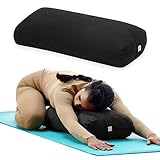 Gaiam rectangular yoga bolster
Rectangular bolster, 25 x 12 x 5 in, with a removable, machine-washable cover (maker's spec).
See it on Amazon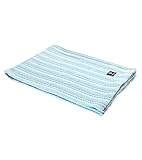 Hugger Mugger cotton yoga blanket
Woven cotton blanket to fold, roll or stack under your hips or knees (maker's description).
See it on Amazon Gaiam foam yoga blocks, pair
Two light foam blocks, 9 x 6 x 4 in each, to prop a bolster or rest under your forehead (maker's spec).
See it on Amazon
As an Amazon Associate we earn from qualifying purchases. How we choose gear
Who should skip it or ask a doctor first
- Any warning sign above. Bladder or bowel changes, numbness around the genitals or bottom, or weakness or numbness in both legs need emergency care now. For numbness or weakness in one leg or pain below the knee, see your doctor before you stretch.
- A first episode, or a known disc problem, stenosis or spondylolisthesis. The NCCIH lists lumbar spine disease among the conditions that may call for changes to yoga. Ask your doctor or physical therapist which movement directions suit your cause.
- Hip replacement. MedlinePlus lists not crossing your legs or ankles and not bending the hip past a right angle, especially in the first months. Most of these moves cross the legs or bend the hip a lot, so skip them unless your surgeon or physical therapist says they’re OK.
- Pregnancy. Check with your doctor or midwife first: Harvard Health notes pregnancy can itself cause sciatica, and the NHS exercise page says to get advice before trying its exercises when pregnant. The NCCIH advises avoiding long periods lying on your back, and the NHS says to avoid lying flat for more than a few minutes in later pregnancy. Skip moves 1, 2 and 6, which are done on your back, and ask your doctor or midwife what suits you instead.
- Osteoporosis or low bone density. Mayo Clinic doctors who reviewed 89 patients with yoga injuries advise avoiding extreme forward bending of the spine with osteopenia or osteoporosis (Lee et al., 2019). Moves 1, 4 and 5 bend the spine forward a little, so keep them small and ask which positions suit your bones.
- Glaucoma. In move 5 your head sits below hip level. The NCCIH lists glaucoma among conditions that may call for changes, and a small study found eye pressure rose within a minute in four other head-down yoga poses; Child’s Pose wasn’t tested (Jasien et al., 2015). Ask your eye doctor, or skip move 5.
- Knee injuries, balance problems, severe high blood pressure or age 65 and older. The NCCIH lists these too. Pad your knees in moves 4 and 5, and prefer the chair version.
- Pain that lingers or worsens after you stretch. Stop and see your doctor or physical therapist.
What the research says
Evidence: no good evidence
We found no study that tested these six moves for sciatica, so there is no good evidence for them. A few studies of whole exercise or yoga programs in people with sciatica exist, but they are small, mixed or rated very uncertain.
- Back pain guidance isn’t sciatica guidance. The American College of Physicians lists yoga among the non-drug options to try first for chronic low back pain, graded as low-quality evidence (Qaseem et al., 2017). A Cochrane review of 21 trials (2,223 people) of yoga for chronic non-specific low back pain found gains in function (11 trials) and pain (9 trials) versus no exercise at three months that were too small to be clinically important (Wieland et al., 2022). Its abstract doesn’t mention sciatica.
- One small yoga trial includes sciatica. In 61 adults aged 20 to 45 with disc bulges or extrusions and back pain or sciatica (62% had sciatica), a three-month yoga course built to be safe for disc problems scored 3.29 points better than usual medical care on a disability questionnaire. No other outcome, including worst pain, differed significantly, and no adverse effects of yoga were reported. It was an exploratory trial of a whole program, not of these moves (Monro et al., 2015).
- Physical therapy. In 220 adults aged 18 to 60 with sciatica for under 90 days, those referred to four weeks of physical therapy (exercise and manual therapy) did better on a disability score at six months (5.4 points) and more often reported treatment success at one year (45.2% vs 27.6%) than those given one education session. The trial wasn’t blinded and can’t say which part helped (Fritz et al., 2021). A review of five trials found a small short-term edge for supervised exercise over advice to stay active for leg pain (low-quality evidence) and no difference in disability or later outcomes (Fernandez et al., 2015).
- Null and uncertain results. In 66 people with sciatica from an MRI-confirmed disc herniation, McKenzie back exercises and a single self-management session didn’t differ significantly at 24 months; both groups improved, and the authors note the study was small (Kilpikoski et al., 2024). A review of 50 trials (4,920 adults with sciatica for 3 months or more) found the evidence for non-surgical options very uncertain, with no high-quality evidence that any one is better (Zhu et al., 2025).
- Harms. In the Cochrane back-pain review, yoga raised the risk of adverse events at 6 to 12 months, mostly more back pain (low-certainty evidence, 8 trials, 1,037 people): about 43 in 1,000 with yoga versus 9 in 1,000 with no exercise. Of 89 Mayo Clinic patients injured by yoga, 5 had radiculopathy (Lee et al., 2019).
Harvard Health’s stretching article says gentle stretches may help (Harvard Health, 2025), while its Q&A says no specific exercise is known to reliably fix sciatica (Harvard Health, 2024). The trials fit the second statement better. We rate the evidence for these moves as none: no study tested them, and the program studies are small or mixed.
Frequently asked questions
Is yoga good for sciatica?
We can’t say. The one yoga trial that included people with sciatica was small and tested a course built for disc safety (see the research box), and guidance on yoga for back pain isn’t about sciatica. If you try yoga, tell your teacher and doctor about your leg symptoms first, and avoid deep folds, twists and strong backbends until you’ve been cleared.
Do sciatica exercises work?
A review found a small short-term edge for supervised exercise over advice for leg pain, but the evidence is thin and mixed, and the larger trial we found tested supervised physical therapy, not home stretching (see the research box). A physical therapist can match exercises to your cause.
Is it sciatica, or just tight hamstrings or hips?
We can’t tell you which it is. Burning or shooting pain down the back of the leg, tingling, numbness or weakness are symptoms of sciatica (MedlinePlus), and moderate to severe symptoms like these need medical care (Cleveland Clinic). See yoga for tight hamstrings for that distinction, and our lower back stretches guide for back pain without leg symptoms.
Sources
- NHS. Sciatica. Page last reviewed 3 December 2024., checked Nov 24, 2026
- NHS. Exercises for sciatica problems. Page last reviewed 2 March 2026., checked Nov 24, 2026
- MedlinePlus (U.S. National Library of Medicine). Sciatica. Reviewed August 27, 2024., checked Nov 24, 2026
- Harvard Health Publishing. Sciatica: Gentle stretches to help relieve pain and improve mobility. January 13, 2025., checked Nov 24, 2026
- Harvard Health Publishing. Are there exercises to cure sciatica? January 20, 2024., checked Nov 24, 2026
- Cleveland Clinic. Sciatica. Last updated February 10, 2026., checked Nov 24, 2026
- Cleveland Clinic Health Essentials. 7 Best Stretches and Exercises for Piriformis Syndrome. July 1, 2022., checked Nov 24, 2026
- Hospital for Special Surgery (HSS). Stretches and Exercises to Ease Sciatica Pain, from a PT. September 28, 2022., checked Nov 24, 2026
- ACE (American Council on Exercise). Supine Hamstrings Stretch. Exercise library., checked Nov 24, 2026
- Qaseem A, Wilt TJ, McLean RM, Forciea MA; Clinical Guidelines Committee of the American College of Physicians. Noninvasive treatments for acute, subacute, and chronic low back pain: a clinical practice guideline from the American College of Physicians. Ann Intern Med. 2017;166(7):514-530., checked Nov 24, 2026
- Wieland LS, Skoetz N, Pilkington K, Harbin S, Vempati R, Berman BM. Yoga for chronic non-specific low back pain. Cochrane Database Syst Rev. 2022;11(11):CD010671., checked Nov 24, 2026
- Monro R, Bhardwaj AK, Gupta RK, Telles S, Allen B, Little P. Disc extrusions and bulges in nonspecific low back pain and sciatica: exploratory randomised controlled trial comparing yoga therapy and normal medical treatment. J Back Musculoskelet Rehabil. 2015;28(2):383-392., checked Nov 24, 2026
- Fritz JM, Lane E, McFadden M, et al. Physical therapy referral from primary care for acute back pain with sciatica: a randomized controlled trial. Ann Intern Med. 2021;174(1):8-17., checked Nov 24, 2026
- Fernandez M, Hartvigsen J, Ferreira ML, et al. Advice to stay active or structured exercise in the management of sciatica: a systematic review and meta-analysis. Spine (Phila Pa 1976). 2015;40(18):1457-1466., checked Nov 24, 2026
- Kilpikoski S, Hakkinen AH, Repo JP, et al. The McKenzie Method versus guideline-based advice in the treatment of sciatica: 24-month outcomes of a randomised clinical trial. Clin Rehabil. 2024;38(1):72-84., checked Nov 24, 2026
- Zhu Z, Schouten T, Strijkers R, Koes B, Gerger H, Chiarotto A. Effectiveness of non-surgical interventions for patients with chronic sciatica: a systematic review with network meta-analysis. J Pain. 2025;33:105431., checked Nov 24, 2026
- Hopayian K, Song F, Riera R, Sambandan S. The clinical features of the piriformis syndrome: a systematic review. Eur Spine J. 2010;19(12):2095-2109., checked Nov 24, 2026
- Hopayian K, Danielyan A. Four symptoms define the piriformis syndrome: an updated systematic review of its clinical features. Eur J Orthop Surg Traumatol. 2018;28(2):155-164., checked Nov 24, 2026
- Lee M, Huntoon EA, Sinaki M. Soft tissue and bony injuries attributed to the practice of yoga: a biomechanical analysis and implications for management. Mayo Clin Proc. 2019;94(3):424-431., checked Nov 24, 2026
- Jasien JV, Jonas JB, de Moraes CG, Ritch R. Intraocular pressure rise in subjects with and without glaucoma during four common yoga positions. PLoS One. 2015;10(12):e0144505., checked Nov 24, 2026
- National Center for Complementary and Integrative Health (NCCIH). Yoga: Effectiveness and Safety. Last updated August 2023., checked Nov 24, 2026
- MedlinePlus (U.S. National Library of Medicine). Taking care of your new hip joint. Reviewed November 7, 2024., checked Nov 24, 2026
- NHS. Exercise in pregnancy. Reviewed September 24, 2026., checked Nov 24, 2026
Image credits: Illustration: YogaForFitness (vector figure), drawn from the steps above