Hatha Yoga: What It Is and How to Start
Quick answer
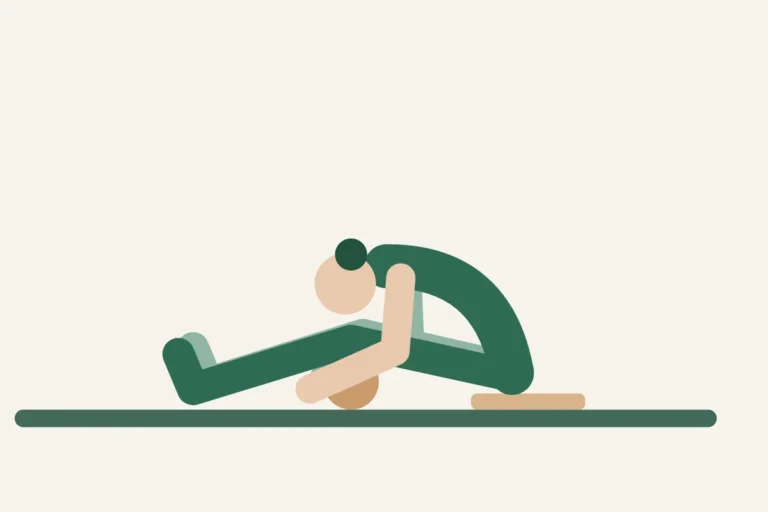
Hatha yoga today usually means a general, unhurried class that mixes standing and seated poses, each held for several breaths, with attention to breathing. The name is much older and wider than the class label: it began as a medieval Indian method built mainly on physical practices. A basic class is a sensible first choice, but talk to a health care provider first if you're pregnant, an older adult or living with a health condition.
We may earn a commission when you buy through links on this page. It never changes what we recommend. As an Amazon Associate we earn from qualifying purchases.
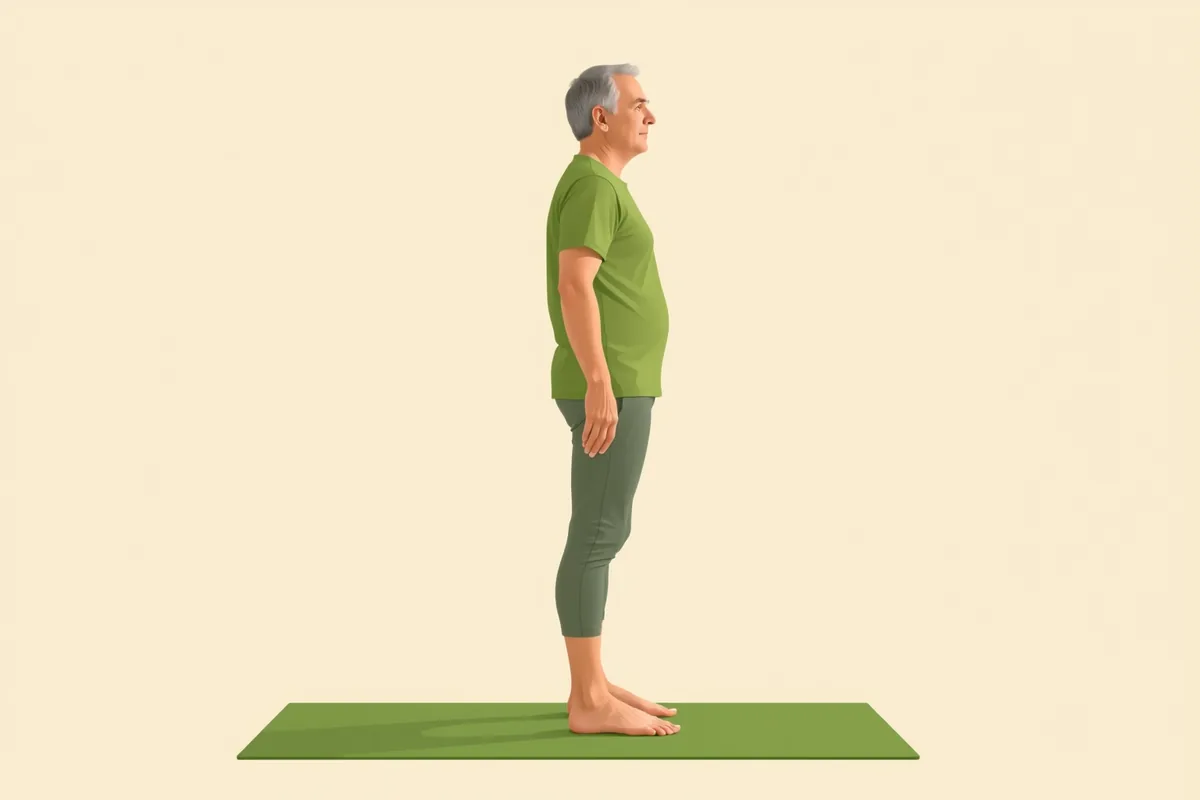
Two classes with this name can feel quite different, so it helps to know what the word covers before you book one. Below you’ll find the old and new meanings, a typical class, a comparison with other styles, a short home routine and an honest look at the trials. It’s part of our Start Here section; for a week-by-week plan, use yoga for beginners.
In this guide
- What is hatha yoga?
- What happens in a Hatha class?
- How is it different from vinyasa, yin, restorative and other classes?
- Who is a hatha class good for?
- How do you try hatha at home? A short beginner sequence
- Make it easier (props)
- How do you choose a class or teacher?
- Who should skip it or ask a doctor first
- What the research says
- Frequently asked questions
- Sources
What is hatha yoga?
In a Western studio, “Hatha” on a timetable usually signals a general class. Cleveland Clinic describes a mix of standing and seated poses, each held for several breaths while the teacher gives detailed instructions, and the aim is to build strength, flexibility and relaxation.
The same guide notes that the term is also a technical catchall for body-based yoga with poses and breath practice. So the word works at two levels: a broad family of body-based yoga, and one slower style within it.
What did the name mean historically?
It named something much bigger than an easy class. According to the Hatha Yoga Project at SOAS University of London, a five-year research project, the name belonged in medieval India to a kind of yoga that relied mainly on physical methods. The project dates its origins to around 1000 CE, among several ascetic traditions, and says much of today’s yoga worldwide descends from it.
A YogaEasy teaching article translates the Sanskrit word *hatha* as “force.” It adds a second common reading, with *ha* for the sun and *tha* for the moon, as a picture of balance between opposites. It lists breathing techniques, chanting, hand gestures, cleansing techniques and visualization alongside postures, and describes the earliest practitioners as ascetics who had given up family and working life.
Here is how the two uses compare.
| Question | The historical term | The class label today |
|---|---|---|
| What it covers | A whole method, led by physical practices | One general, slower-paced style |
| Who it was or is for | Developed in ascetic traditions | Often suggested for beginners |
| What you can expect | Much more than postures | Mostly poses and breathing |
The gentle class of today has roots far from a studio timetable, so don’t expect it to teach the medieval practices.
What happens in a Hatha class?
No single sequence defines it. These are the features you’re likely to meet:
- Poses held, then changed. You move from one pose to the next and stay in each for several breaths (Cleveland Clinic). One teaching site puts most holds at about 3 to 8 breaths (YogaEasy).
- Standing and seated work. Expect both. If getting down to the floor and up again is hard for you, ask how much of the class happens there.
- Breathing. Breathing techniques usually sit alongside the poses (YogaEasy). Diaphragmatic breathing is a gentle one to learn at home.
- Time to learn. A yoga therapist quoted by Cleveland Clinic likes it for newcomers because longer holds let you notice how a pose feels and which muscles are working before you move on.
Our guide on how long to hold a yoga pose shows how to adjust holds to your breath.
Is it a workout?
Expect light exercise from a beginner session. In a 2007 laboratory study, 20 intermediate and advanced practitioners followed a 56-minute beginner video inside a chamber that measured energy use. The session averaged 2.5 METs (multiples of resting energy use), which the authors rated as low-intensity activity, similar to slow treadmill walking at about 2 miles per hour. They concluded that this didn’t meet exercise recommendations for health or heart fitness, although sun salutation sequences lasting more than 10 minutes might contribute for unfit or inactive people. Harder classes may differ. Keep some brisker activity in your week.
How is it different from vinyasa, yin, restorative and other classes?
The clearest differences are pace, hold length and how much support you use. Studios name classes loosely, so treat this table as a starting point. Unless a row links elsewhere, it follows Cleveland Clinic’s guide to styles.
| Class | Pace and holds | What sets it apart from a hatha class |
|---|---|---|
| Hatha | Steady; several breaths per pose | The general reference point here |
| Vinyasa or flow | Quick transitions, brief holds | Repeated loops of poses moved with the breath |
| Iyengar | Slow and strong; longer holds | Heavy use of chairs, blocks and straps for alignment |
| Restorative | Very slow; often 10 minutes or longer per pose | Props carry your body so you can rest completely |
| Yin | Floor stretches held for minutes | Long, still holds; see what yin yoga is |
| Power | Athletic, flowing | No set pose order; some studios heat the room |
Some terms overlap. The team behind one trial cited below calls Iyengar a form of hatha yoga, so “Hatha versus Iyengar” is partly a matter of labels. Heat is a separate choice: the NCCIH (the NIH’s center for complementary health) warns that hot yoga carries special risks of overheating and dehydration. If supported rest is what you’re after, read about restorative yoga.
Is one style better than another?
Research hasn’t crowned a winner. A 2016 review sorted 306 randomized trials using 52 yoga styles, with hatha the most common (36 trials). The share of trials concluding that yoga helped didn’t differ between styles. That counts authors’ conclusions up to early 2014, not the size of any benefit, so it can’t show that all styles work equally well. The reviewers suggested picking by preference and availability.
Who is a hatha class good for?
It suits many people who want to learn poses at a pace that leaves room to adjust. Cleveland Clinic’s style guide rates it a very good starting style for new students. A teaching source also suggests it for people returning after a break and for older adults. It may suit you, too, if you’d rather not race from pose to pose.
It’s less of a match if you want continuous, sweaty movement. And “slow” isn’t the same as “easy”: holding a standing pose for several breaths can be hard work.
Check with a health care provider before you start if you’re pregnant, an older adult or living with a health condition or past injury. The caution box further down lists the main ones. If getting to the floor is the obstacle, our chair yoga for seniors routine is a better entry point.
How do you try hatha at home? A short beginner sequence
Learn each pose on its own page first, then link them. This order, about 15 minutes with pauses, is our own arrangement and no study has tested it. The pose pages have the steps, easier versions and cautions, so they aren’t repeated here.
Read the caution box before you begin. This sequence isn’t designed for pregnancy, since it includes lying on your back. After a hip replacement, wait for your surgeon’s clearance before trying any of it. With osteoporosis, low bone density or glaucoma, see the notes under the table first.
| Order | Pose or part | How long | Getting there |
|---|---|---|---|
| 1 | Sit on a cushion or chair and watch your breath | 2 minutes | Settle in |
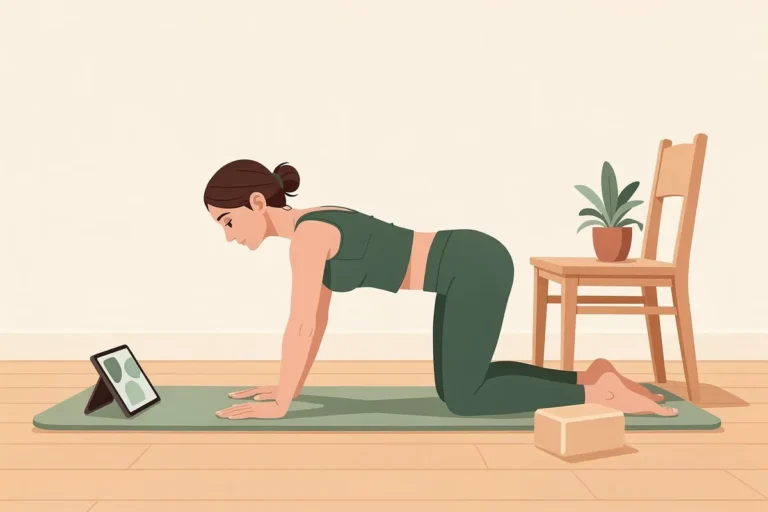
| 2 | Cat-Cow | 5 slow rounds | Come to hands and knees |
| 3 | Child’s Pose | 3 to 5 breaths | Ease your hips back |
| 4 | Downward-Facing Dog, knees bent | 3 to 5 breaths | From hands and knees |
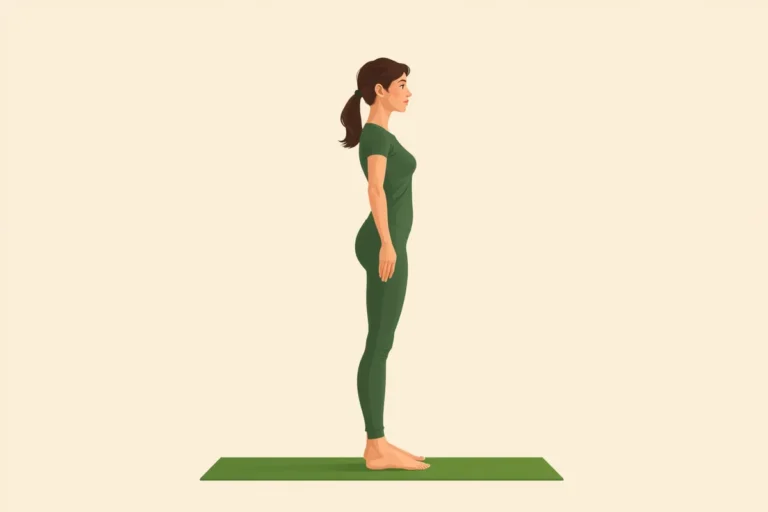
| 5 | Mountain Pose | 5 to 10 breaths | Lower your knees, then stand up in stages |
| 6 | Warrior II | 3 to 5 breaths per side | Step your feet wide |
| 7 | Tree Pose beside a wall | 3 to 5 breaths per side | Bring your feet back together |
| 8 | Cobra Pose | 2 to 5 breaths, twice | Get down to the floor and lie on your front |
| 9 | Bridge Pose | 3 to 8 breaths, twice | Roll onto your back |
| 10 | Seated Forward Fold | 3 to 5 breaths | Roll to one side and sit up |
| 11 | Rest on your back, or sit | 3 minutes | Lie down; finish by rolling to your side |
Changes to ask about first:
- Osteoporosis or low bone density: Cat, Child’s Pose, the forward fold and rolling up into Bridge round your spine. Mayo Clinic authors advise people with low bone density to avoid extreme forward bending of the spine. Ask your doctor or physical therapist which of these suit you before you try them.
- Glaucoma: Downward-Facing Dog, Child’s Pose, Bridge and a deep forward fold put your head low. In a small study, eye pressure rose quickly in Downward-Facing Dog and a standing forward fold, among other head-down poses. Ask your eye doctor before you try them.
- Wobbly balance: YogaEasy suggests a chair for standing balances or seated versions of poses; stay next to a wall or sturdy chair for steps 5 to 7, or stay seated.
Move slowly and keep breathing. Some effort is normal, but pain isn’t: Cleveland Clinic advises that if you feel it, stop and reassess. Our home practice guide covers clearing a spot and picking videos.
Make it easier (props)
- Under your hands: yoga blocks or two sturdy books bring the ground closer in Downward-Facing Dog.
- Under your knees or seat: fold a blanket for Cat-Cow, or perch on its edge for the seated parts.
- A strap, belt or towel around your feet lets you keep your back longer in the fold.
- A chair or wall steadies you in standing poses and can replace floor sitting.
- Fewer breaths are always allowed. Rest whenever your breathing turns ragged.
Helpful gear for this
 Manduka begin yoga mat, 5 mm
5 mm TPE mat, 68 x 24 in, light to carry, with a center alignment stripe (maker's spec).
See it on Amazon Gaiam foam yoga blocks, pair
Two light foam blocks, 9 x 6 x 4 in each, to raise the floor under your hands (maker's spec).
See it on Amazon Hugger Mugger cotton D-ring yoga strap, 10 ft
Cotton webbing 1.5 in wide with a metal D-ring buckle, 10 ft long (maker's spec).
See it on Amazon
As an Amazon Associate we earn from qualifying purchases. How we choose gear
How do you choose a class or teacher?
The label alone tells you little, so read the description and ask questions.
- Look for “beginner,” “basics” or “gentle.” Those words are our suggested filter. Expect a written class description, and ask to sit in once before joining, two things Cleveland Clinic says a studio should offer.
- Ask about training and experience, as the NCCIH advises. Cleveland Clinic’s expert suggests a teacher certified by Yoga Alliance or a similar major body.
- Ask how poses are changed. A good teacher helps you modify them, with props or a chair if needed, and encourages you to stay within your limits.
- Ask about heat, pace and floor work. Our questions: Is the room heated? Do you flow between poses? How often do students get up and down?
- Mention health issues before class so the teacher can plan for them.
- Judge the first visit. You should feel welcome, not pushed to compete, and free to pause.
Who should skip it or ask a doctor first
- Everyone: with a qualified teacher and proper technique, yoga is generally safe for healthy people, says the NCCIH. Serious injuries are rare; sprains and strains, often of the knee or lower leg, are the usual ones.
- Health conditions: knee or hip injuries, lumbar (lower) spine disease, severe high blood pressure, balance problems and glaucoma may call for changed or skipped poses. Ask your provider and tell the teacher (NCCIH).
- Pregnancy: have your provider evaluate you before exercising. Avoid hot yoga, long periods of stillness and poses on your back (NCCIH). The NHS adds that in later pregnancy, lying flat on your back can make you dizzy and isn’t good for your baby.
- Older adults: extra caution is sensible, since yoga injuries treated in emergency departments occur at a higher rate from age 65 (NCCIH).
- Osteoporosis or low bone density: Mayo Clinic authors advise avoiding extreme forward bending of the spine.
- Glaucoma: eye pressure rose in four head-down yoga positions in a study of 10 people with glaucoma and 10 without. Ask your eye doctor.
- Hip replacement: while you recover, the NHS says not to bend your hip past a right angle, sit with your legs crossed or reach down to your feet. Ask your surgeon or physiotherapist before you start yoga.
- First-timers: the NCCIH rates headstands, shoulder stands, lotus and forceful breathing as extreme practices to avoid while you’re new.
- Yoga doesn’t replace medical care. Don’t postpone seeing a provider about a problem.
What the research says
Evidence: limited
The evidence is limited. Some trials show gains over a waiting list or no program. Several found no clear advantage over another active program on their main measures. None tested the sequence above. Unless a bullet says otherwise, the studies below described the practice as hatha, though what each taught varied.
Chronic low back pain
- Against a waiting list: in 140 adults, 12 weekly live online classes lowered pain by 1.5 points more on a 0 to 10 scale at 12 weeks and improved function. Three of the 71 people assigned to yoga had a passing back pain flare possibly related to it.
- Against a book: in 120 US veterans, mostly men, 12 weekly classes did not beat a back pain book for disability or pain, though more of the yoga group felt much improved. Neither group had a serious adverse event.
- Against exercise: in 70 adults, six weekly 35-minute sessions plus home practice showed no significant difference from therapeutic exercises.
- All styles together: a Cochrane review found gains over no exercise in function (11 trials) and pain (9 trials) too small to count as clinically important.
Mood, anxiety and stress
- A review in people with mood or anxiety disorders included 18 mostly low-quality trials. Depression scores weren’t significantly better than with usual care (5 trials) or active comparisons (11 trials), though yoga did beat education programs (6 trials). Anxiety didn’t differ from active comparisons (5 trials). Reviews of all yoga styles are somewhat more positive about depression; see benefits of yoga.
- In 122 adults still depressed on medication, weekly classes did not differ significantly from health education at 10 weeks, the main measure. Across the whole study, including six months of follow-up, symptoms were lower with yoga.
- An anxiety meta-analysis of 17 studies (501 people doing hatha) found lower anxiety. Its only controlled comparison was against a waiting list (11 trials), the authors called the effect relatively small, and study quality was relatively low.
- Among 98 healthy beginners, eight weeks reduced self-reported stress compared with a waiting list, but anxiety did not change significantly.
- An online trial in adults aged 65 to 80 reported better distress and sleep scores than no program. Only 160 of 200 finished, 65 in the yoga group and 95 in the control group, and the groups already differed in sleep scores before it started, so treat it cautiously.
Sleep
- In a secondary analysis of the urine-leak trial below (240 women), three months of yoga was not better for sleep than general physical conditioning.
- In 410 cancer survivors with poor sleep, four weeks of a program blending gentle hatha and restorative poses, breathing and meditation improved sleep quality more than standard care alone. It can’t isolate the hatha part.
Fitness and joints
- In 118 inactive adults, average age 62, eight weeks of hatha classes and a stretching and strengthening program both improved balance, strength, flexibility and walking tests. The authors judged yoga as effective as that program. There was no inactive group.
- In 75 inactive adults with rheumatoid arthritis or knee osteoarthritis, physical health scores, walking and mood did better than on a waiting list, but balance, grip strength and flexibility did not differ. None of seven adverse events was linked to yoga.
Cancer fatigue and bladder leaks
- In 200 breast cancer survivors, fatigue was no lower than on a waiting list right after 12 weeks of classes, although vitality was higher; fatigue was lower three months later. Depression did not differ.
- A review of 11 studies (777 adults with cancer) of hatha or Iyengar yoga found no improvement in fatigue, depression or quality of life, with low to very low certainty. Reviews that pool all yoga styles, summarized in benefits of yoga, found small short-term gains for breast cancer survivors; this review looked only at hatha and Iyengar programs.
- In 240 women with daily urine leaks, a pelvic-floor yoga program was not superior to general stretching and strengthening.
Harms
In the urine-leak trial, 26 women in the yoga group and 35 in the conditioning group had an adverse event, and the one serious event was in the conditioning group. That comparison doesn’t show yoga is risk-free. A review of case reports gathered 84 adverse events and listed Bikram, Ashtanga and hatha as the styles most often involved; headstand and forceful breathing were the practices named most. Case reports can’t tell how often harm happens.
Why “limited”: trials are mostly small or short, rely on self-ratings, can’t hide who is doing yoga and teach different things under one name. For results across all styles, see benefits of yoga.
Frequently asked questions
Do you need to be flexible to start?
No. Flexibility is something you can work on in class, and bent knees, blocks and a strap make poses reachable (YogaEasy).
How often should you practice?
No agreed dose exists. The trials above differed: some back pain studies held one class a week, and the fitness trial held three. Our beginner plan starts with two or three short sessions a week and shows how to build up.
Is it the same as gentle yoga?
Not always. Many classes are calm, but the name also covers physical yoga in general, so difficulty varies. Read the description or ask before you go.
Can you learn it from videos?
Videos help you practice, but they can’t watch you. The NCCIH recommends a qualified teacher, since teaching yourself without supervision has been tied to more risk. A few lessons first, live in person or online, is a sensible mix.
Sources
- Cleveland Clinic. 7 Different Kinds of Yoga and How To Find the Right Practice. Health Essentials. June 2, 2022., checked Nov 27, 2026
- SOAS University of London. The Hatha Yoga Project: Ancient practices for modern wellbeing., checked Nov 27, 2026
- Newlyn E. What is Hatha yoga? Meaning, benefits and how it differs from Vinyasa. YogaEasy. Teaching reference., checked Nov 27, 2026
- Cleveland Clinic. Yoga for Beginners: Get Started Today! Health Essentials. May 18, 2026., checked Nov 27, 2026
- Hagins M, Moore W, Rundle A. Does practicing hatha yoga satisfy recommendations for intensity of physical activity which improves and maintains health and cardiovascular fitness? BMC Complement Altern Med. 2007;7:40., checked Nov 27, 2026
- Cramer H, Lauche R, Langhorst J, Dobos G. Is one yoga style better than another? A systematic review of associations of yoga style and conclusions in randomized yoga trials. Complement Ther Med. 2016;25:178-187., checked Nov 27, 2026
- National Center for Complementary and Integrative Health (NCCIH). Yoga: Effectiveness and Safety. Last updated August 2023., checked Nov 27, 2026
- NHS. Exercise in pregnancy. Page last reviewed September 24, 2026., checked Nov 27, 2026
- Lee M, Huntoon EA, Sinaki M. Soft tissue and bony injuries attributed to the practice of yoga: a biomechanical analysis and implications for management. Mayo Clin Proc. 2019;94(3):424-431., checked Nov 27, 2026
- Jasien JV, Jonas JB, de Moraes CG, Ritch R. Intraocular pressure rise in subjects with and without glaucoma during four common yoga positions. PLoS One. 2015;10(12):e0144505., checked Nov 27, 2026
- NHS. Recovering from a hip replacement. Page last reviewed March 6, 2024., checked Nov 27, 2026
- Tankha H, Gaskins D, Shallcross A, et al. Effectiveness of virtual yoga for chronic low back pain: a randomized clinical trial. JAMA Netw Open. 2024;7(11):e2442339., checked Nov 27, 2026
- Roseen EJ, Pinheiro A, Lemaster CM, et al. Yoga versus education for veterans with chronic low back pain: a randomized controlled trial. J Gen Intern Med. 2023;38(9):2113-2122., checked Nov 27, 2026
- Neyaz O, Sumila L, Nanda S, Wadhwa S. Effectiveness of Hatha yoga versus conventional therapeutic exercises for chronic nonspecific low-back pain. J Altern Complement Med. 2019;25(9):938-945., checked Nov 27, 2026
- Wieland LS, Skoetz N, Pilkington K, Harbin S, Vempati R, Berman BM. Yoga for chronic non-specific low back pain. Cochrane Database Syst Rev. 2022;11(11):CD010671., checked Nov 27, 2026
- Vollbehr NK, Bartels-Velthuis AA, Nauta MH, et al. Hatha yoga for acute, chronic and/or treatment-resistant mood and anxiety disorders: a systematic review and meta-analysis. PLoS One. 2018;13(10):e0204925. (A 2019 correction replaced one figure.), checked Nov 27, 2026
- Uebelacker LA, Tremont G, Gillette LT, et al. Adjunctive yoga v. health education for persistent major depression: a randomized controlled trial. Psychol Med. 2017;47(12):2130-2142., checked Nov 27, 2026
- Hofmann SG, Andreoli G, Carpenter JK, Curtiss J. Effect of Hatha yoga on anxiety: a meta-analysis. J Evid Based Med. 2016;9(3):116-124., checked Nov 27, 2026
- Szaszkó B, Schmid RR, Pomper U, et al. The influence of hatha yoga on stress, anxiety, and suppression: a randomized controlled trial. Acta Psychol (Amst). 2023;241:104075., checked Nov 27, 2026
- Baklouti S, Fekih-Romdhane F, Guelmami N, et al. The effect of web-based Hatha yoga on psychological distress and sleep quality in older adults: a randomized controlled trial. Complement Ther Clin Pract. 2023;50:101715., checked Nov 27, 2026
- Hough E, Goldstein LA, Subak LL, et al. Effects of Hatha yoga vs physical conditioning on sleep in women with urinary incontinence: a secondary analysis of a randomized clinical trial. JAMA Netw Open. 2025;8(12):e2546499., checked Nov 27, 2026
- Mustian KM, Sprod LK, Janelsins M, et al. Multicenter, randomized controlled trial of yoga for sleep quality among cancer survivors. J Clin Oncol. 2013;31(26):3233-3241., checked Nov 27, 2026
- Gothe NP, McAuley E. Yoga is as good as stretching-strengthening exercises in improving functional fitness outcomes: results from a randomized controlled trial. J Gerontol A Biol Sci Med Sci. 2016;71(3):406-411., checked Nov 27, 2026
- Moonaz SH, Bingham CO, Wissow L, Bartlett SJ. Yoga in sedentary adults with arthritis: effects of a randomized controlled pragmatic trial. J Rheumatol. 2015;42(7):1194-1202., checked Nov 27, 2026
- Kiecolt-Glaser JK, Bennett JM, Andridge R, et al. Yoga’s impact on inflammation, mood, and fatigue in breast cancer survivors: a randomized controlled trial. J Clin Oncol. 2014;32(10):1040-1049., checked Nov 27, 2026
- García-Muñoz C, Villar-Alises O, Rodríguez-Sánchez-Laulhé P, Matias-Soto J, Martinez-Calderon J. No effects were found in favor of Hatha or Iyengar yoga exercises for improving cancer-related fatigue, depression symptoms, or quality of life: a systematic review with meta-analysis and metaregression. Support Care Cancer. 2023;32(1):3., checked Nov 27, 2026
- Huang AJ, Chesney M, Schembri M, et al. Efficacy of a therapeutic pelvic yoga program versus a physical conditioning program on urinary incontinence in women: a randomized trial. Ann Intern Med. 2024;177(10):1339-1349., checked Nov 27, 2026
- Sharma S, Bhandari SS, Malhotra V, Kuppusamy M, Kumar S, Dhakal M. Yoga and its risks: a systematic review of adverse events reported in case reports and case series. J Integr Med. 2026;24(5):667-682., checked Nov 27, 2026
Image credits: Illustration: AI-generated for YogaForFitness (FLUX.1-schnell), checked for pose accuracy