Lower Back Stretches: Gentle Yoga Routine, What Trials Show
Quick answer
For everyday low back pain without leg symptoms, six slow moves are a gentle place to start: pelvic tilts, knee-to-chest, knee rolls, a small bridge, Cat-Cow and Child's Pose, all stopped if pain gets worse. With back pain, call 911 or go to an emergency room for pain, tingling, weakness or numbness affecting both legs, lost feeling around the genitals or anus, bladder, bowel or sexual changes, chest pain, or if it began with a serious accident. No trial has tested this routine.
We may earn a commission when you buy through links on this page. It never changes what we recommend. As an Amazon Associate we earn from qualifying purchases.
Gentle lower back stretches for everyday pain are slow, comfortable moves, mostly on your back or on hands and knees, that you stop if the pain gets worse. This guide has six, in a routine that fits in about 10 minutes. It’s meant for “non-specific” low back pain without leg symptoms: pain with no specific cause found, such as infection, cancer, trauma or inflammatory disease (NICE). If pain, tingling or numbness runs down your leg, use our sciatica stretches guide, which has its own warning signs. Read the warning lists first. You’ll find related guides under Yoga For.
In this guide
- When is back pain an emergency?
- Who shouldn’t start stretching on their own?
- Stretches for lower back pain: ground rules
- A short lower back stretch routine
- Make it easier (props)
- Do you need back strengthening exercises too?
- Does yoga for lower back pain help? What trials show
- What the research says
- Who should skip it or ask a doctor first
- Frequently asked questions
- Sources
When is back pain an emergency?
Call 911 or go to the emergency room now
The NHS treats these as emergencies (its wording is “call 999 or go to A&E”). Go if you have back pain with any of them:
- Weakness, numbness, tingling or pain affecting both of your legs.
- Lost feeling around your genitals or anus.
- Bladder or bowel changes, such as trouble peeing, or wetting or soiling yourself.
- Sexual changes: your penis or vagina feels different during sex, you can’t get or keep an erection, or you can’t orgasm.
- Chest pain.
- Pain that began after a serious accident, for example a car crash.
Don’t drive yourself. Have someone take you, or call 911 for an ambulance, and bring any medicines you take.
Get urgent medical advice
The NHS says to ask for an urgent doctor’s appointment, or use its 111 advice line, if you feel hot, cold, shivery or unwell in general, or if severe pain starts suddenly or is quickly getting worse. In the US, call your doctor and ask to be seen urgently.
Contact your doctor right away
Cleveland Clinic says to see a provider right away for back pain with any of these:
- Numbness, or weakness in one or both legs.
- Trouble peeing or pooping (if you’ve lost control, follow the emergency list above).
- Fever.
- Feeling light-headed or fainting.
- Severe pain in your belly.
The NIAMS also says to see a doctor for back pain that starts after a fall or injury.
Book a visit
See your doctor soon, though not necessarily the same day, if any of these fit (NHS, Cleveland Clinic):
- Home care hasn’t helped after a few weeks.
- Pain stops your daily activities, or you’re worried or struggling to cope.
- You’re losing weight without trying.
- Your back has a lump or swelling, or has changed shape.
- Rest doesn’t ease it, it’s worse at night, or sneezing, coughing or pooping makes it worse.
- It comes from your upper back, between your shoulders.
- You have a history of cancer.
- You’re 55 or older and there’s no clear reason for the pain.
- Your immune system is weakened, so infections are more likely.
Where two lists overlap, follow the more urgent one.
Who shouldn’t start stretching on their own?
- A diagnosed back problem. Harvard Health advises against starting on your own if you’ve been diagnosed with a problem such as worn or leaking discs, bad arthritis of the lower back, or severe spinal stenosis (narrowing around the nerves). A physical therapist should assess you first.
- Pain after trauma, or with illness. If a fall or accident caused it, or you’re also coughing, vomiting or otherwise unwell, Cleveland Clinic says to talk with a provider before stretching.
- Leg pain, or pain that isn’t settling. Cleveland Clinic advises an appointment for pain that goes down a leg, persists or worsens.
- Brand-new pain. Timing advice differs. The NHS encourages staying active and trying exercises, and stopping to see a doctor if pain worsens. Harvard Health says it may be wise to consult your doctor before exercising with back pain, and describes starting gentle daily exercises gradually once the pain is no longer severe. Harvard Health says to go easy for a few days after sudden new pain and call your doctor if it stays.
- Pregnancy, hip replacement, osteoporosis or recent surgery. Read the caution box below first.
Stretches for lower back pain: ground rules
- Go gently. Ease into a mild stretch without bouncing. A physical therapist quoted by Harvard Health suggests holds of no more than 30 seconds at first, lengthened gradually.
- Back off if it hurts more. The NHS says to stop exercises that make your pain worse and to see a doctor for advice.
- Watch your legs. New pain, tingling, numbness or weakness in a leg ends the session. Go back to the warning lists.
- Breathe slowly throughout.
A short lower back stretch routine
Medical or hospital sources list each of these six moves for the back, at least two sources per move. The order and the number of repeats are our own cautious arrangement, with hold times drawn from their ranges, and nobody has tested them as a set. Do the four moves on your back first, then turn over.
| No. | Move | Position | How much |
|---|---|---|---|
| 1 | Pelvic tilt | On your back | 3 to 5 tilts, 5 to 10 seconds each |
| 2 | Knee-to-chest | On your back | 3 to 5 per leg, 5 to 10 seconds each |
| 3 | Knee rolls | On your back | 3 to 5 per side, 5 to 10 seconds each |
| 4 | Small bridge | On your back | About 5 lifts, 3 to 5 seconds each |
| 5 | Cat-Cow | Hands and knees | 3 to 5 slow rounds |
| 6 | Child’s Pose | Kneeling | Up to 3 holds, 10 to 30 seconds each |
Start at the low end. One Harvard article suggests a few times a week or daily for recurring back pain, and a Sussex Community NHS page says once or twice a day as you’re able, only as pain allows.
1. Pelvic tilt
A tiny movement that rocks your pelvis. Listed by Harvard Health and Cambridge University Hospitals.
- Lie face up on a mat, with knees bent, soles down and arms relaxed.
- As you exhale, firm your belly a little so your lower back presses softly into the floor. Your hips stay down.
- Stay for a few easy breaths.
- Let go and return to where you began.
The Cambridge sheet continues into a gentle arch the other way. Leave that half out if arching bothers your back.
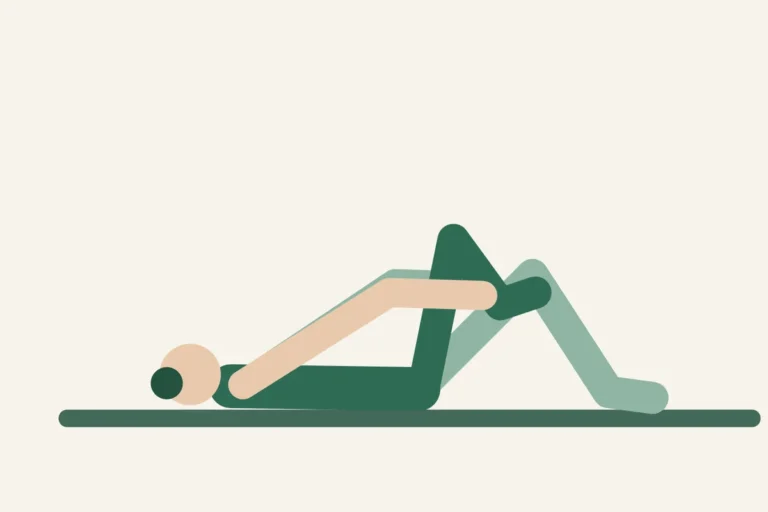
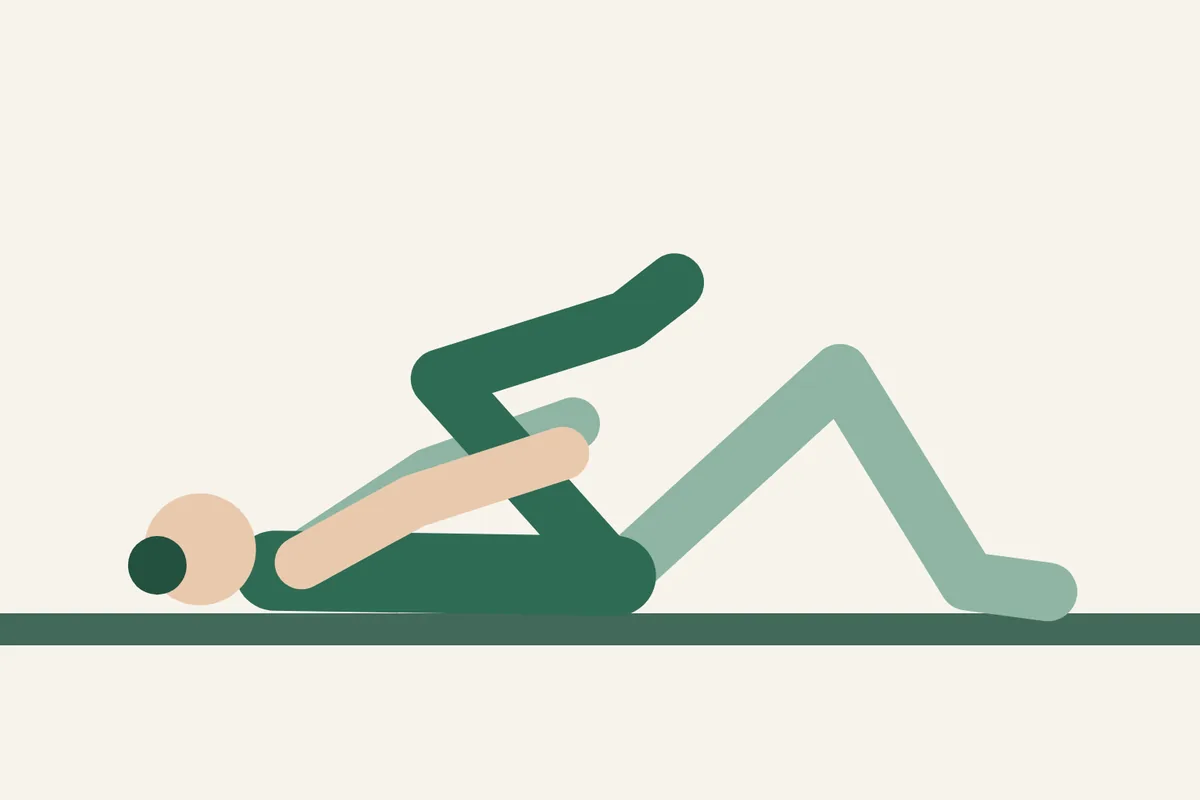
2. Knee-to-chest
Two Harvard articles (2024, 2022) list it, as do the Cambridge and Sussex NHS pages, which show both knees together.
- Begin on your back, both knees bent.
- Clasp one leg, under the thigh or around the shin.
- Breathe out and guide that knee toward your chest until the stretch feels comfortable.
- Hold, set the foot back down, then change legs.
Easier: wrap a towel behind the thigh so your shoulders can stay down.
3. Knee rolls
A mild rotation for the lower back, also called a lying trunk rotation. Cleveland Clinic, Cambridge and Sussex list it, and a Harvard Health article includes it as a double knee rotation.
- On your back, bend your knees and bring them together. Spread your arms out wide for balance.
- Let both knees tip slowly to the right, only as far as feels controlled.
- Keep your shoulders heavy on the floor and pause.
- Draw the knees back to the middle and go left.
Easier: make the tip very small, or set a pillow on each side to catch your knees. Skip this move if twisting brings on pain.
4. Small bridge
This one is a strength move for the buttocks and the backs of the legs. Harvard Health, Cleveland Clinic, Cambridge and Sussex all list it.
- Stay on your back, feet planted about as wide as your hips.
- Tighten your buttocks and raise your hips a short way. Harvard Health suggests only 4 to 6 inches.
- Hold briefly, lower with control and rest before the next lift.
Lower at once if you feel pinching in your lower back. The full pose, with alignment cues and a block-supported version, is in our Bridge Pose guide.
5. Cat-Cow
A slow wave through your spine on all fours. Cleveland Clinic and Sussex list it.
- Get on all fours, stacking shoulders over wrists and hips over knees.
- Round your back as you breathe out, then let your chest lift and your belly drop as you breathe in.
- Keep both halves small at first.
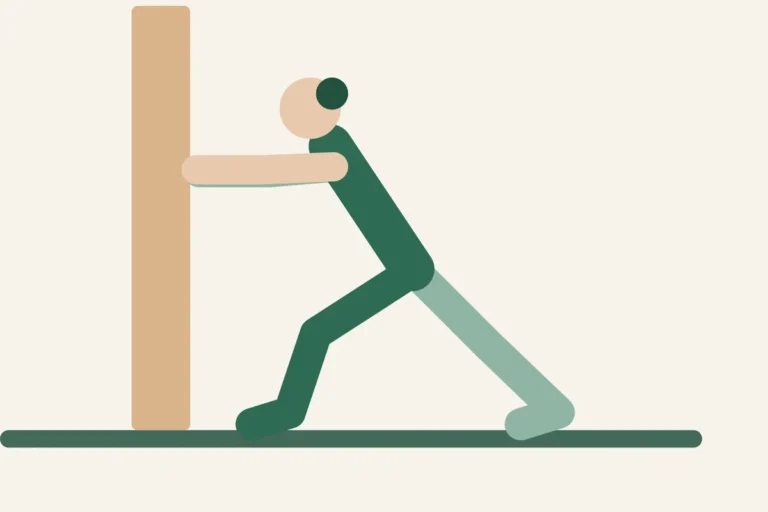
Easier: Cleveland Clinic starts sore backs standing, with straight arms and hands on a counter or table. See the full Cat-Cow steps.
6. Child’s Pose
A resting fold, listed by Cleveland Clinic, Harvard Health and Sussex.
- Starting on hands and knees, ease your hips back toward your heels. They don’t have to touch.
- Let your arms stretch out ahead and lower your head to the floor or a cushion.
- Breathe slowly, then press up with your hands.
Easier: Cleveland Clinic’s counter version has you walk your feet back, hands on the counter, and send your hips backward with a flat back. Knee and prop options are in the Child’s Pose guide.
What we left out
Some handouts add back extensions done lying on your front (Cambridge), standing forward bends and side bends (Sussex). We left them out to keep the routine short. Harvard Health notes that, depending on the cause, some exercises can make back pain worse, so ask first. See Cobra Pose for backbends and yoga for tight hamstrings for the backs of the legs.
Make it easier (props)
- A small cushion under your head for moves 1 to 4.
- A towel or strap behind the thigh in knee-to-chest (more in our yoga strap guide).
- Knee padding, such as a folded blanket, for the kneeling moves.
- A bolster, pillows or a block to hold up your chest or head in Child’s Pose (our guide to blocks shows heights).
- A bed or counter if the floor is hard to reach (a bed for move 2, a counter for moves 5 and 6).
Helpful gear for this
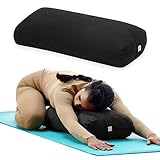 Gaiam rectangular yoga bolster
Rectangular bolster, 25 x 12 x 5 in, with a removable, machine-washable cover (maker's spec).
See it on Amazon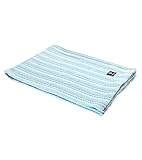 Hugger Mugger cotton yoga blanket
Woven cotton blanket to fold, roll or stack under your hips or knees (maker's description).
See it on Amazon Gaiam foam yoga blocks, pair
Two light foam blocks, 9 x 6 x 4 in each, to prop a bolster or rest under your forehead (maker's spec).
See it on Amazon
As an Amazon Associate we earn from qualifying purchases. How we choose gear
Do you need back strengthening exercises too?
Stretching is one part. Harvard Health says a stretching and strengthening routine should work the back, belly, buttock and upper leg muscles, since core muscles help support the spine, and warns that pushing too far too fast can lead to injury. A physical therapist can help with timing and technique. The NHS adds that walking, swimming, yoga and Pilates may help ease back pain. Related: yoga for desk workers and yoga for tight hips.
Does yoga for lower back pain help? What trials show
For pain that has lasted 3 months or more, yoga programs have shown small average gains over no exercise, and not every trial found any.
What guidelines say. The American College of Physicians (ACP) notes that most new or recent back pain improves with time. For that stage it recommends surface heat, massage, acupuncture or spinal manipulation as non-drug choices, and its recommendation doesn’t name exercise or yoga. For chronic pain it advises starting with non-drug options, including exercise (moderate-quality evidence) and yoga (low-quality evidence), as a strong recommendation (Qaseem et al., 2017). England’s health guidance body, in NICE guideline NG59, encourages normal activities and says to consider a group exercise program, which may be mind-body, aerobic, biomechanical or mixed, for an episode or flare-up, with or without sciatica.
The Cochrane review. The latest version we found covers 21 trials with 2,223 people, mostly women in their 40s or 50s, with chronic non-specific low back pain (Wieland et al., 2022). Yoga compared with no exercise:
| Outcome | Trials (people) | Result | Certainty |
|---|---|---|---|
| Function, 3 months | 11 (1,155) | 1.7 points better on a 24-point scale; 5 counts as meaningful | Low |
| Pain, 3 months | 9 (946) | 4.5 points lower out of 100; 15 counts as meaningful | Moderate |
| Self-rated better or resolved | 4 (353) | More often with yoga; may be a meaningful gain | Low |
| Side effects, 6 to 12 months | 8 (1,037) | 43 vs 9 per 1,000, mostly more back pain | Low |
So the average gains in function and pain were too small to be clinically important. Yoga and back-focused exercise, such as physical therapy, probably differ little or not at all for function (4 trials, 575 people). For pain that comparison is very uncertain (2 trials, 326 people), and side effects may occur about equally often (5 trials, 640 people; low certainty). In these trials, people knew which treatment they got and rated their own results. The NCCIH calls the benefit for low back pain slight.
Single trials show the spread:
- Yoga vs usual care. Among 313 UK adults with chronic or recurring pain, a 12-class program beat usual care on function by 2.2 points (24-point scale) at 3 months and 1.6 at 12 months. Back pain scores were similar. Adverse events, mostly more pain, were reported by 12 of 156 yoga participants and 2 of 157 others (Tilbrook et al., 2011).
- Yoga vs stretching vs a book. In 228 adults, yoga classes weren’t better than stretching classes led by physical therapists. At 12 weeks, function beat a self-care book by 2.5 points with yoga and 2.2 with stretching (23-point scale); for how bothersome pain felt, stretching didn’t differ significantly from the book. Mild or moderate side effects possibly tied to the classes, mostly more back pain, were reported by 13 of 87 yoga and 13 of 75 stretching attendees, and one yoga participant had a herniated disc (Sherman et al., 2011).
- Yoga vs physical therapy vs education. In 320 adults, mostly on low incomes, yoga was not worse than physical therapy for pain and function, but not better than an education book either (Saper et al., 2017).
- No clear edge. In an analysis of 274 people, yoga, physical therapy exercises and eurythmy (a movement therapy) didn’t differ significantly after 8 weeks, and function gains weren’t clinically meaningful (Michalsen et al., 2021). In 120 veterans, mostly men, 12 weeks of classes didn’t beat an education book for disability or pain, although more of the yoga group rated themselves very much or extremely improved (39% vs 19%) (Roseen et al., 2023).
- Online classes. In 140 adults aged 18 to 64, live virtual classes led to less pain (by 1.5 points out of 10) and better function than a waiting list at 12 weeks (Tankha et al., 2024).
New pain is a different question. A Cochrane review of exercise therapy (not yoga as such) for pain lasting 6 weeks or less found it may make no clinically relevant difference to pain or function compared with sham treatment (1 study, 299 people) or no treatment (2 studies, 157 people). That evidence is very uncertain (IJzelenberg et al., 2023).
What the research says
Evidence: no good evidence
We found no trial of this six-move routine, so our label for it is “No good evidence.” The yoga and stretching trials above mostly followed people with long-lasting pain through class programs that ran for weeks. Don’t read their results as results for a short home routine or for any single stretch. A place on a medical list is weaker than proof that a move works. For yoga’s wider research record, see benefits of yoga.
Who should skip it or ask a doctor first
- Any warning sign above. Get medical care before you stretch.
- A back condition or recent surgery. Disease of the lumbar (lower) spine is one reason the NCCIH gives for adapting yoga. Find out from your doctor or physical therapist which directions of movement suit you, and get your surgeon’s OK after an operation.
- Hip replacement. The NHS says that while you recover you shouldn’t bend the hip past a right angle or sit with your legs crossed, and Cleveland Clinic adds not pulling your knees past your waist. Knee-to-chest and Child’s Pose bend the hip deeply. Skip this routine unless your surgeon or physical therapist has cleared the moves.
- Osteoporosis or low bone density. A Mayo Clinic team looked back at 89 people hurt doing yoga and concluded that those with weak bones would do well to steer clear of extreme spinal flexion, meaning strong forward rounding (Lee et al., 2019). Knee-to-chest, the Cat half of Cat-Cow and Child’s Pose can round your back, so ask first. Osteoporosis can also lead to painful fractures of the bones in the spine (NIAMS), so have new back pain checked.
- Pregnancy: get your doctor’s or midwife’s OK before you begin. Skip moves 1 to 4, which are on your back; the NCCIH advises against long periods lying that way, and for the later months the NHS limits any flat-on-your-back activity to a few minutes at most. On all fours, the NHS back exercise for pregnancy rounds the back and returns to flat without letting it hollow, so leave out the Cow dip. For Child’s Pose, widen your knees, support your forehead and keep holds short.
- Back pain in pregnancy that needs a call. The NHS says to contact your doctor or midwife urgently in the second or third trimester (it can signal early labor), with fever, vaginal bleeding or pain when peeing, or with pain under the ribs on one or both sides. Call 911 or go to an emergency room if you lose feeling in one or both legs, your bottom or your genitals.
- Glaucoma. Your head sits below your hips in Child’s Pose and Bridge, and glaucoma is on the NCCIH list. Neither pose was in the small study that measured higher eye pressure during four head-down positions (Jasien et al., 2015). Check with your eye specialist, or leave both out.
- Joints, balance, blood pressure or age. The NCCIH also flags knee or hip injuries, balance issues and severe high blood pressure, and says older adults may need particular care. Ask your provider, and take your time getting down and up.
- Practicing on your own. The NCCIH notes that learning yoga alone, without supervision, has been linked to increased risks. If these moves are new to you, consider learning them first from a physical therapist or a qualified teacher.
- Pain that lingers or builds. End the routine and get it looked at.
Frequently asked questions
What are the best stretches for lower back pain?
No trial we found ranks them. The six above are reasonable ones to try, and a physical therapist can fit a plan to you.
Should you rest or keep moving?
Keep moving as you’re able. The NHS says not to stay in bed for long and to carry on with daily activities. A physical therapist quoted by Cleveland Clinic favors gentle movement over resting still, without pushing through increased pain.
Is yoga for back pain safe?
It can make pain worse for some people. In the Cochrane figures above, side effects, mostly more back pain, were more common with yoga than with no exercise. Yoga shouldn’t delay a medical visit you need, the NCCIH cautions. Tell your teacher about your back and skip anything that hurts.
Sources
- NHS. Back pain. Page last reviewed 5 March 2026., checked Nov 25, 2026
- Cleveland Clinic. Lower back pain. Last updated August 13, 2024., checked Nov 25, 2026
- National Institute of Arthritis and Musculoskeletal and Skin Diseases (NIAMS). Back pain., checked Nov 25, 2026
- Harvard Health Publishing. Stretching and strengthening exercises to relieve and prevent lower back pain. June 21, 2024., checked Nov 25, 2026
- Harvard Health Publishing. Relieve low back pain with stretching. October 1, 2022., checked Nov 25, 2026
- Cleveland Clinic Health Essentials. These lower back stretches and exercises can help relieve pain. February 12, 2025., checked Nov 25, 2026
- Cambridge University Hospitals NHS Foundation Trust. Back mobility exercises. Approved 16 July 2024., checked Nov 25, 2026
- Sussex Community NHS Foundation Trust. Mechanical low back pain: rehabilitation exercises., checked Nov 25, 2026
- Qaseem A, Wilt TJ, McLean RM, Forciea MA; Clinical Guidelines Committee of the American College of Physicians. Noninvasive treatments for acute, subacute, and chronic low back pain: a clinical practice guideline from the American College of Physicians. Ann Intern Med. 2017;166(7):514-530., checked Nov 25, 2026
- National Institute for Health and Care Excellence (NICE). Low back pain and sciatica in over 16s: assessment and management. NICE guideline NG59. Last updated 29 July 2026., checked Nov 25, 2026
- Wieland LS, Skoetz N, Pilkington K, Harbin S, Vempati R, Berman BM. Yoga for chronic non-specific low back pain. Cochrane Database Syst Rev. 2022;11(11):CD010671., checked Nov 25, 2026
- IJzelenberg W, Oosterhuis T, Hayden JA, et al. Exercise therapy for treatment of acute non-specific low back pain. Cochrane Database Syst Rev. 2023;8(8):CD009365., checked Nov 25, 2026
- Sherman KJ, Cherkin DC, Wellman RD, et al. A randomized trial comparing yoga, stretching, and a self-care book for chronic low back pain. Arch Intern Med. 2011;171(22):2019-2026., checked Nov 25, 2026
- Tilbrook HE, Cox H, Hewitt CE, et al. Yoga for chronic low back pain: a randomized trial. Ann Intern Med. 2011;155(9):569-578., checked Nov 25, 2026
- Saper RB, Lemaster C, Delitto A, et al. Yoga, physical therapy, or education for chronic low back pain: a randomized noninferiority trial. Ann Intern Med. 2017;167(2):85-94., checked Nov 25, 2026
- Michalsen A, Jeitler M, Kessler CS, et al. Yoga, eurythmy therapy and standard physiotherapy (YES-Trial) for patients with chronic non-specific low back pain: a three-armed randomized controlled trial. J Pain. 2021;22(10):1233-1245., checked Nov 25, 2026
- Roseen EJ, Pinheiro A, Lemaster CM, et al. Yoga versus education for veterans with chronic low back pain: a randomized controlled trial. J Gen Intern Med. 2023;38(9):2113-2122., checked Nov 25, 2026
- Tankha H, Gaskins D, Shallcross A, et al. Effectiveness of virtual yoga for chronic low back pain: a randomized clinical trial. JAMA Netw Open. 2024;7(11):e2442339., checked Nov 25, 2026
- National Center for Complementary and Integrative Health (NCCIH). Yoga: Effectiveness and Safety. Last updated August 2023., checked Nov 25, 2026
- Lee M, Huntoon EA, Sinaki M. Soft tissue and bony injuries attributed to the practice of yoga: a biomechanical analysis and implications for management. Mayo Clin Proc. 2019;94(3):424-431., checked Nov 25, 2026
- Jasien JV, Jonas JB, de Moraes CG, Ritch R. Intraocular pressure rise in subjects with and without glaucoma during four common yoga positions. PLoS One. 2015;10(12):e0144505., checked Nov 25, 2026
- NHS. Recovering from a hip replacement. Page last reviewed 6 March 2024., checked Nov 25, 2026
- Cleveland Clinic. Hip replacement surgery. Last updated July 24, 2025., checked Nov 25, 2026
- NHS. Back pain in pregnancy. Page last reviewed 10 January 2024., checked Nov 25, 2026
- NHS. Exercise in pregnancy. Page last reviewed 24 September 2026., checked Nov 25, 2026
Image credits: Illustration: YogaForFitness (vector figure), drawn from the steps above