Hip Flexor Stretches: 7 Yoga Moves for the Front of the Hips
Quick answer
Hip flexor stretches reach the muscles at the front of your hip. Tuck your tailbone slightly, shift forward only until you feel a mild pull at the front of the hip, and stop there. The seven moves below cover kneeling, standing, lying and wall-supported versions, plus a short routine. Stretching research on this muscle group is small and limited.
We may earn a commission when you buy through links on this page. It never changes what we recommend. As an Amazon Associate we earn from qualifying purchases.
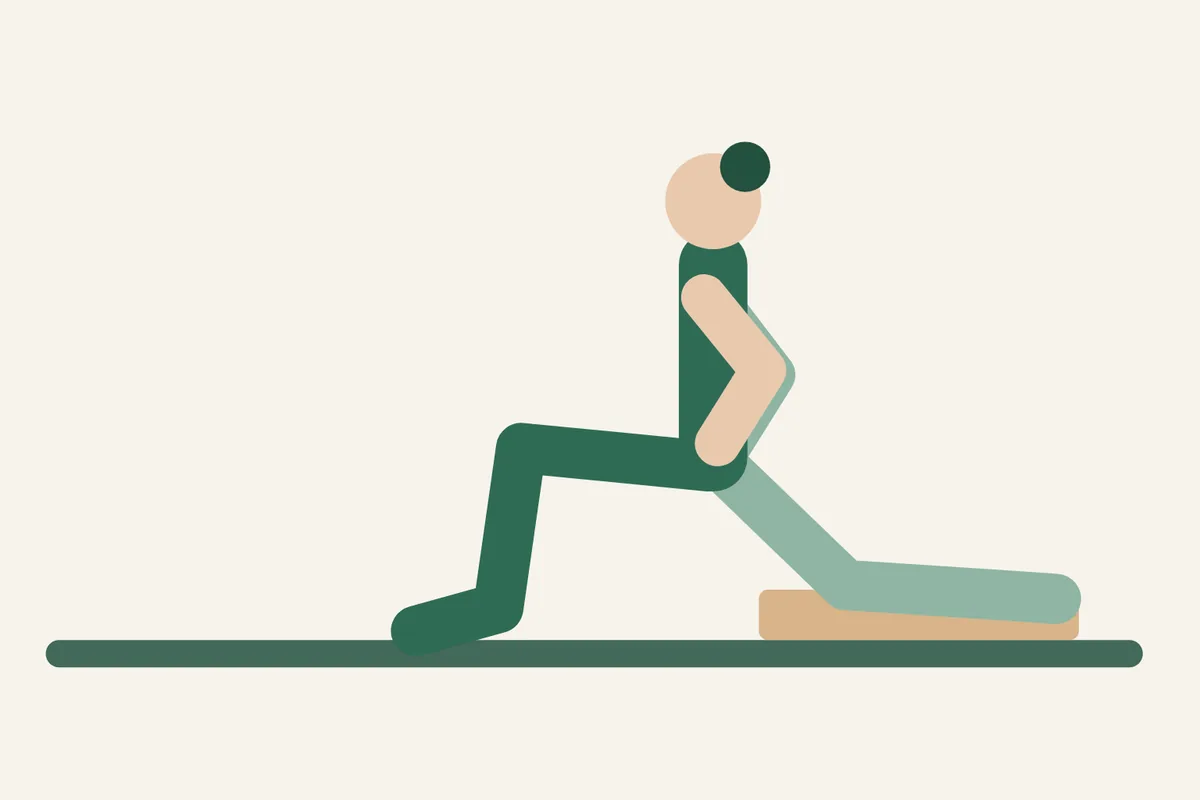
Hip flexor stretches target the muscles at the front of your hips, the ones that lift your thigh. The seven moves below run from kneeling to standing, lying down and leaning on a wall, and they share one cue: tuck your tailbone a little, so the pull lands at the front of the hip and not in your lower back. Go only until you feel a mild stretch. Sitting is the usual reason these muscles feel stiff, but the research on stretching them is small, and this page says what it does and doesn’t show. It is part of our Flexibility & Mobility guides.
In this guide
- What are the hip flexor muscles, and why do they feel tight after sitting?
- How to stretch hip flexors without arching your lower back
- Seven hip flexor stretches
- Make it easier (props)
- How long should you hold a hip flexor stretch?
- A short hip flexor routine
- Who should skip it or ask a doctor first
- What the research says
- Frequently asked questions
- Sources
What are the hip flexor muscles, and why do they feel tight after sitting?
The hip flexors are the group of muscles that bend your hip and lift your leg when you walk, climb stairs or sit. Harvard Health names two main ones: the psoas, which runs from the lower spine down to the upper thigh bone, and the iliacus, which lines the inside of the pelvis and joins the psoas at the thigh. It also lists the rectus femoris, a muscle down the front of your thigh that helps bend the hip and also straightens the knee. That double job matters in the standing quad-linked stretch below.
Why do they feel tight after a day in a chair? Harvard’s explanation is that long spells of sitting leave the hip flexors tighter and shorter, which can show up as stiffness and discomfort. A Cleveland Clinic physical therapist puts it simply: the psoas gets stiff because it has been held short for a long time (Cleveland Clinic). Harvard also notes that these muscles connect to the pelvis and lower back, so when they are tight the pelvis turns less freely, and that this may play a part in low back pain.
Two honest notes. “May contribute” is not “causes”: in a one-year study of 62 first-year students, iliopsoas length fell and back pain became more common, but the only independent predictor of later pain was earlier pain (Abbas et al., 2026). And stiffness is not pain, and the caution box says when to get pain checked. If your sitting day is the main issue, our yoga for desk workers guide has short breaks you can do in a chair.
How to stretch hip flexors without arching your lower back
The usual mistake is driving the hips forward with a soft belly. The pelvis tips, the lower back sinks into a curve and the stretch drifts away from the front of the hip. The ACE Exercise Library warns against both in its kneeling stretch for these muscles: don’t arch the low back, and don’t let the pelvis rotate forward (ACE).
Use the tuck in every move below:
- Find it first. Stand with one hand low on your belly and one on your lower back. Rock your pelvis forward and back a few times, like tipping a bowl. The tuck is the “back” end of that rock: your pubic bone rises toward your navel and your tailbone points down.
- Add the glute squeeze. Squeeze the buttock on the side you are stretching. The Cleveland Clinic therapist tightens the buttock muscles so the back can’t arch, and ACE uses the same squeeze to deepen the stretch (Cleveland Clinic; ACE).
- Then move forward a little. Keep the tuck and shift your weight by an inch or two. The same therapist says you may need to lunge less far than you expect: more is not better, and good form is.
How to tell you have lost it: you feel the pull in your lower back instead of the front of the hip, your ribs flare, or your belly pushes forward. Shift back an inch and tuck again. In a small crossover trial, a half-kneeling stretch with a backward pelvic tilt lowered a force test of the hip flexors more than the usual forward-shift version, though the test was done only right after stretching (González-de-la-Flor et al., 2024). It fits the cue; it doesn’t prove it matters over weeks.
Seven hip flexor stretches
Stretch when you are warm, after a workout or, as ACE suggests, after a hot bath or shower (ACE). Breathe slowly, don’t bounce, and stop at a mild pull.
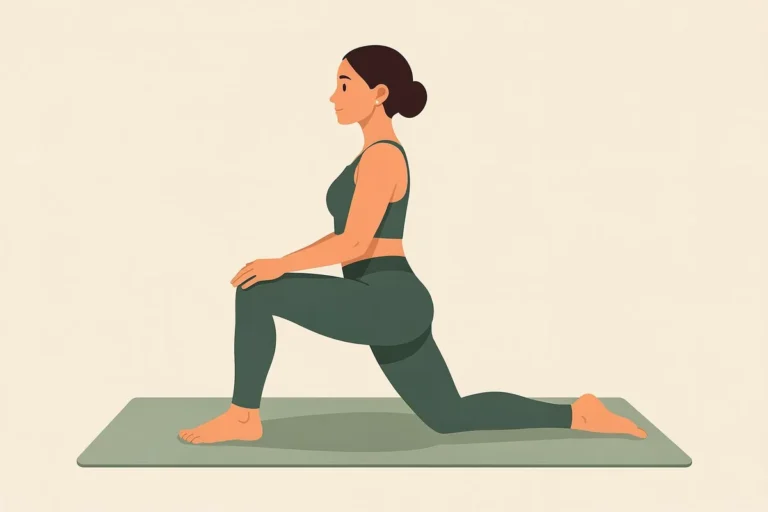
1. Half-kneeling stretch with a tuck
Targets: the front of the hip and the top of the thigh on the side of the back leg.
- Kneel on a folded blanket with one knee down and the other foot flat in front of you, shin close to upright.
- Rest your hands on your front thigh and stack your ribs over your hips.
- Tuck your tailbone and squeeze the back-leg glute before you move anywhere.
- Keeping the tuck, glide forward a little, only until the front of the back hip feels a gentle tug.
- Breathe slowly for 5 to 8 breaths (the range Cleveland Clinic uses for its hip stretches), then step back and switch sides.
This is the same shape as our Low Lunge pose with different cues. That guide has the full setup, knee padding and common mistakes, so read it if the kneeling position is new to you.
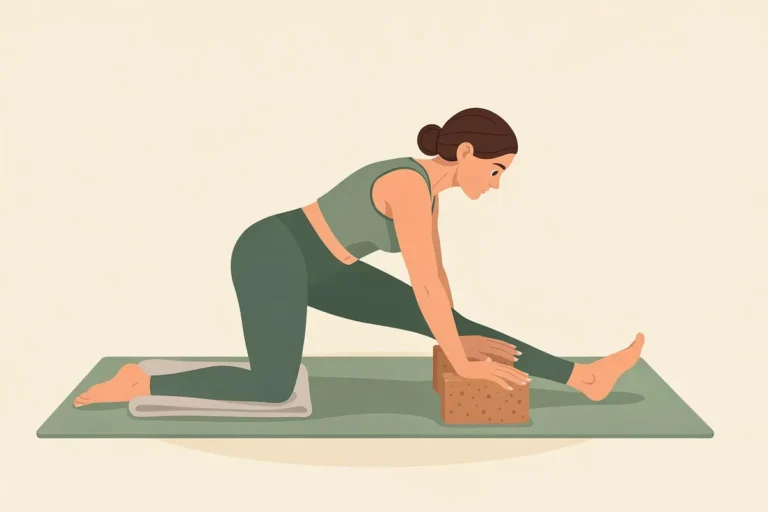
Easier: pad the knee more, shorten the step, or put your hands on blocks.
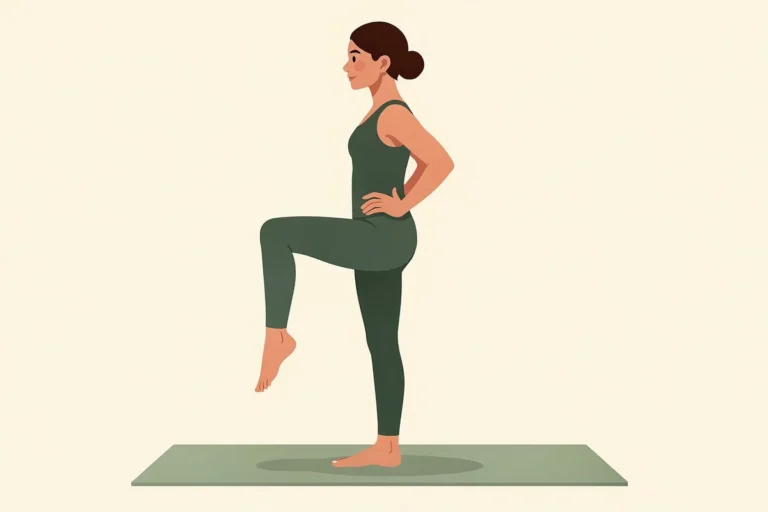
2. Standing hip flexor stretch with a split stance
Targets: the front of the hip of the back leg, with nothing pressing on your knee.
- Stand tall, then step one foot back about as far as a long walking stride. Keep both feet pointing forward.
- Bend both knees slightly and let your tailbone sink a little as you tuck. ACE teaches the same small drop with a neutral spine (ACE). ACE also suggests doing its half-kneeling stretch, pelvis tucked, in a standing lunge if kneeling is uncomfortable (ACE).
- Rest your hands on your hips and keep your ribs stacked over your pelvis.
- Let your front knee bend a bit more and shift forward slightly, until you feel the front of the back hip.
- Breathe, then switch sides.
Easier: hold the back of a sturdy chair, or use the wall version (move 6).
3. Reclined knee hug
Targets: the front of the hip of the straight leg, lying down.
- Lie on your back on the floor. Bend one knee and hug it toward your chest with both hands behind the thigh.
- Let the other leg lie long on the floor, foot flexed.
- Gently press the back of the long thigh and calf toward the floor. Harvard describes this floor stretch the same way: hug one knee, flex the other foot and press the calf and thigh down.
- Keep your lower back resting on the floor. If it lifts into an arch, ease off the hug until it settles.
- Breathe, then switch sides.
ACE’s Thomas stretch is the edge-of-a-table version, and the Cleveland Clinic therapist shows a bed version where the other leg dangles (ACE; Cleveland Clinic). We start on the floor: no furniture, nothing to fall from. ACE’s lying version also stops the long leg wherever the lower back starts to lift (ACE).
Easier: keep the long leg bent with the foot on the floor, or fold a towel under your head.
4. Bridge, with a small lift
Targets: a mild stretch at the front of the hips while the backs of your legs and your buttocks do the lifting.
- Lie on your back, knees bent, feet flat and parallel.
- Tuck your tailbone first, so your lower back presses toward the floor.
- Press through your feet and lift your hips a few inches. Stop while your lower back still feels long, not pinched.
- Hold for a few slow breaths, then lower. Repeat two or three times.
Cleveland Clinic lists the bridge among its beginner hip openers, with five to eight breaths per hold (Cleveland Clinic). Treat it as the gentle, active one here. Foot placement and neck safety are in our Bridge Pose guide.
Easier: lift only an inch or two, or rest on a block under your pelvis (see the props section).
5. Standing quad-linked stretch
Targets: the front of the thigh and the front of the hip, together.
- Stand next to a wall and rest one hand on it. Put your weight on the leg closest to the wall.
- Bend the other knee and catch that foot with your free hand, or loop a strap or towel around the ankle. ACE teaches this stretch with the heel drawn toward the buttock and the two knees kept close together (ACE).
- Now add the tuck: tailbone down, and don’t let the bent knee swing behind you.
- Hold the stretch, then switch sides.
Bending the knee adds pull on the rectus femoris, the thigh muscle that crosses both the hip and the knee. If bending the knee feels sore, use the strap, bend less, or choose another move.
6. Wall-supported tuck-and-step
Targets: the same front-of-hip area as move 2, with balance taken care of.
- Learn the tuck. Stand with your back to a wall, heels a few inches away. Tuck your pelvis so your lower back moves toward the wall, and breathe for three slow breaths.
- Turn side-on. Stand with one hand on the wall at shoulder height, feet hip-width.
- Step the outside leg back into a split stance and keep the tuck, bending both knees a little.
- Shift forward slightly until you feel the front of the back hip. Hold, breathe, switch sides.
This is our own adaptation of the standing stance, using a wall for balance, as ACE does in its standing quad stretch. It suits you if balance is a worry.
7. Low Lunge or Lizard, a deeper floor stretch
When the first six feel easy, try Low Lunge; its guide covers every step and the easier versions. Lizard is a Low Lunge with your hands inside the front foot; Yoga International keeps the front knee stacked over the ankle and lets you lessen the intensity by keeping your hands on blocks. Both load the back knee, so skip them if kneeling hurts. For the outer hip and inner thighs, see yoga for tight hips and Pigeon Pose.
Make it easier (props)
You don’t need equipment. A few household items help:
- A folded blanket or towel under the back knee in move 1. ACE suggests a pad or rolled mat there if the floor hurts.
- A wall for balance in moves 2, 5 and 6.
- A block under each hand in move 1 to shorten the reach to the floor, or under your pelvis in the bridge. Our yoga blocks guide shows the heights.
- A strap or a towel around the ankle in move 5, so you don’t need to reach it. A strap guide is on our list.
- A sturdy chair to hold in move 2 if you don’t want a wall.
Helpful gear for this
 Manduka Align yoga strap, 8 ft
Cotton strap 1.75 in wide with a zinc-alloy buckle, 8 ft long (maker's spec).
See it on Amazon Manduka cork yoga block
Solid cork, 9 x 6 x 4 in and 2.2 lb, firmer and heavier than foam for steadier support (maker's spec).
See it on Amazon Gaiam foam yoga blocks, pair
Two light foam blocks, 9 x 6 x 4 in each, one for each hand (maker's spec).
See it on Amazon
As an Amazon Associate we earn from qualifying purchases. How we choose gear
How long should you hold a hip flexor stretch?
No study we found tested a best hold time for these muscles. These are the ranges the sources give:
| Source | What it says |
|---|---|
| American College of Sports Medicine | Flexibility exercises for each major muscle group, a total of 60 seconds per exercise, on at least 2 days a week (Garber et al., 2011) |
| Harvard Health | Kneeling stretch: repeat until the holds add up to 60 seconds. Floor stretch: hold 10 to 30 seconds |
| Cleveland Clinic | 5 to 8 breaths per pose |
| ACE kneeling stretch | 30 to 45 seconds per rep, 2 to 5 reps |
| ACE Thomas stretch | 15 to 30 seconds, 2 to 4 reps |
| ACE standing quad stretch | 15 seconds, 2 to 3 sets |
They overlap, and none is a prescription. The 2024 stretching meta-analysis (77 studies) reported that neither volume, intensity nor frequency significantly moderated range-of-motion gains (Konrad et al., 2024), so a routine you will repeat matters more than the exact count. More on timing is in how long to hold a yoga pose.
A short hip flexor routine
About seven minutes, lying down first, then kneeling, then standing. These times are for planning only: they sit inside the ranges above, but no study tested this routine.
| Move | Time |
|---|---|
| 4. Bridge, small lift | 3 lifts of about 5 breaths |
| 3. Reclined knee hug | 30 seconds per side |
| 1. Half-kneeling with a tuck | 2 holds of 30 seconds per side |
| 2. Standing split stance (or 6, at the wall) | 30 seconds per side |
| 5. Standing quad-linked | 2 holds of 15 seconds per side |
Walk around for a minute first. If you are pregnant, drop the first two moves (see the caution box). Short on time? Do moves 1 and 2 on both sides.
Who should skip it or ask a doctor first
- Sharp or lingering pain: stop. Cleveland Clinic says to contact a healthcare provider or physical therapist if you feel sharp, pinpoint pain or pain that persists beyond a few hours (Cleveland Clinic). We can’t say what causes hip or groin pain; a clinician can.
- A recent hip or groin injury, or hip surgery, including a hip replacement: get your surgeon’s or physical therapist’s OK first. The NCCIH lists knee or hip injuries among the conditions that may mean changing your yoga. After a hip replacement, MedlinePlus advises being careful how you move the hip, especially in the first few months, and lists rules such as avoiding bending past 90 degrees. Knee hugs and deep lunges can break such rules.
- Knee pain, or trouble kneeling: the NCCIH says the knee and lower leg are the most commonly injured parts in yoga. Pad the knee thickly or choose the standing moves, and skip move 5 unless bending the knee is comfortable. After a knee replacement, ask your surgeon when kneeling is fine.
- Pregnancy: ask your doctor or midwife first. The NHS advises against lying flat on your back for longer than a few minutes late in pregnancy, and the NCCIH says the same about long periods on your back in yoga. Skip the bridge and the reclined knee hug, and use the wall version with a chair in reach. The NHS also says to avoid activities where you could fall.
- Back pain, or a lower-back (lumbar spine) condition: the NCCIH names lumbar spine disease. Keep every stretch small and skip any move that pinches your back. Cleveland Clinic notes that many things cause back pain, so see a provider if it is ongoing rather than assuming tight hip flexors are the cause.
- Balance problems, age 65 or older, severe high blood pressure or glaucoma: the NCCIH lists these too. Hold a wall or chair for every standing move.
What the research says
Evidence: limited
Stretching in general has the best support: a 2024 meta-analysis of 77 studies found that regular stretching increased range of motion with a moderate effect compared with controls, and static stretching produced bigger gains than ballistic or dynamic stretching (Konrad et al., 2024). It was not specific to the hip flexors.
Hip flexor stretching itself has been studied only in small trials:
- Six weeks of a lunge stretch. In 23 young adults with tight hip flexors (12 stretched, 11 did not), five minutes a day of a lunge-and-reach stretch went with a gain of about 5.9 degrees on a hip flexor length test within the stretching group. Buttock strength and a bridge endurance test did not change significantly; a jump test the authors use for gluteal power improved. The authors call it a cohort study (Ehresman et al., 2025).
- Adding a pelvic tilt. In 26 active young adults (52 hips), one session of a half-kneeling stretch with a backward pelvic tilt lowered a hip flexor force test more than the usual half-kneeling stretch, with no difference on a knee-extension test. Only the effect right after stretching was measured (González-de-la-Flor et al., 2024).
- One session in 23 men. After one session of passive hip flexor stretching, hip extension rose by 2.6 degrees on average and forward pelvic tilt in relaxed standing fell by 1.2 degrees. Lumbar curve did not change, and there was no non-stretching group (Preece et al., 2021).
- Ten weeks in frail older adults. In 74 people (33 stretched their hip flexors twice a day, 41 stretched their shoulders instead), the hip flexor group gained passive hip extension, walking speed and stride length, but not peak hip extension while walking. The abstract reports the gains for the stretching group (Watt et al., 2011).
We found no trial of a yoga pose used to stretch these muscles: a PubMed search for hip flexor, stretching and yoga turned up only a biomechanics study and a protocol paper, and neither tested a stretch. None of the studies we cite tested the bridge, the standing quad-linked version or the wall version for this purpose. None of the studies looked at pain, back pain or sitting posture as an outcome. Small studies, short follow-ups and stretches that only resemble ours are why we rate the evidence limited.
Frequently asked questions
Can tight hip flexors cause back pain?
They may play a part. Harvard Health links tight hip flexors to a pelvis that moves less freely and says this may add to low back pain. In the year-long student study above, earlier pain was the only independent predictor of later pain. Back pain has many causes, so see a provider if it is ongoing, as Cleveland Clinic advises.
How often should I stretch my hip flexors?
The ACSM position stand asks for flexibility work on at least 2 days a week, and the 2024 meta-analysis found that frequency did not significantly change the results (Konrad et al., 2024). If you feel sore the next day, rest.
What are hip flexor exercises, and are they the same as these stretches?
Different jobs. These moves lengthen the muscles; marching in place or lifting a bent leg strengthens them, and the Cleveland Clinic therapist lists both kinds. The same article says a physical therapist can sort out whether the problem is tightness, weakness or both. The bridge in this list works the muscles at the back of your hips.
Is a standing stretch as good as a kneeling one?
No study we found compared them, so we can’t say. Standing asks less of your knees and the wall version less of your balance. Pick the one you can do with the tuck and without pain.
Sources
- Harvard Health Publishing. Do you spend most of your day sitting? These hip flexor stretches are for you. December 18, 2024., checked Nov 22, 2026
- Cleveland Clinic. 5 Psoas Stretches and Exercises. Health Essentials. April 10, 2024., checked Nov 22, 2026
- Cleveland Clinic. Target Your Hips, Groin and Glutes With These Hip-Opening Stretches. Health Essentials. December 4, 2025., checked Nov 22, 2026
- American Council on Exercise (ACE). Exercise Library: Kneeling Hip Flexor Stretch., checked Nov 22, 2026
- American Council on Exercise (ACE). Exercise Library: Thomas Stretch., checked Nov 22, 2026
- American Council on Exercise (ACE). Flexibility Exercises for Beginners., checked Nov 22, 2026
- American Council on Exercise (ACE). Fun Cool Down Stretches for Kids (standing quadriceps stretch)., checked Nov 22, 2026
- Green DJ. A Workout to Counteract the Effects of Prolonged Sitting. ACE ProSource. January 2016., checked Nov 22, 2026
- Garber CE, Blissmer B, Deschenes MR, et al. American College of Sports Medicine position stand. Quantity and quality of exercise for developing and maintaining cardiorespiratory, musculoskeletal, and neuromotor fitness in apparently healthy adults: guidance for prescribing exercise. Med Sci Sports Exerc. 2011;43(7):1334-1359., checked Nov 22, 2026
- Konrad A, Alizadeh S, Daneshjoo A, et al. Chronic effects of stretching on range of motion with consideration of potential moderating variables: a systematic review with meta-analysis. J Sport Health Sci. 2024;13(2):186-194., checked Nov 22, 2026
- Ehresman BA, Lehecka BJ, Hiser D, Koster L, Wietharn J. Improved Hip Flexibility and Gluteal Function Following a Daily Lunge-and-Reach Stretching Intervention. Int J Sports Phys Ther. 2025;20(6):814-823., checked Nov 22, 2026
- González-de-la-Flor Á, Cotteret C, García-Pérez-de-Sevilla G, Domínguez-Balmaseda D, Del-Blanco-Muñiz JÁ. Comparison of two different stretching strategies to improve hip extension mobility in healthy and active adults: a crossover clinical trial. BMC Musculoskelet Disord. 2024;25(1):853., checked Nov 22, 2026
- Preece SJ, Tan YF, Alghamdi TDA, Arnall FA. Comparison of pelvic tilt before and after hip flexor stretching in healthy adults. J Manipulative Physiol Ther. 2021;44(4):289-294., checked Nov 22, 2026
- Watt JR, Jackson K, Franz JR, et al. Effect of a supervised hip flexor stretching program on gait in frail elderly patients. PM R. 2011;3(4):330-335., checked Nov 22, 2026
- Abbas J, Reif N, Hamoud K. Musculoskeletal pain and hip muscle length among undergraduates: a longitudinal study of 1 year. Medicina (Kaunas). 2026;62(8):1548., checked Nov 22, 2026
- National Center for Complementary and Integrative Health (NCCIH). Yoga: Effectiveness and Safety. Last updated August 2023., checked Nov 22, 2026
- NHS. Exercise in pregnancy. Page last reviewed September 24, 2026., checked Nov 22, 2026
- MedlinePlus (U.S. National Library of Medicine). Taking care of your new hip joint. Reviewed November 7, 2024., checked Nov 22, 2026
- Yoga International. Lizard Pose: Simple Ways to Make It Work for You., checked Nov 22, 2026
- American Council on Exercise (ACE). 3 Stretches for Opening Up Tight Hips., checked Nov 22, 2026
Image credits: Illustration: YogaForFitness (vector figure), drawn from the steps above