10-Minute Morning Yoga Routine for Beginners
Quick answer
This 10-minute beginner routine starts standing in Mountain Pose, moves through Cat-Cow, a bent-knee Downward-Facing Dog, Low Lunge on each side, a low Cobra, Child's Pose and Bridge, and ends with a slow return to standing. Keep the first movements small, because your back bends less easily just after waking, and get up from the floor in stages. No study has tested this exact sequence, so treat it as a gentle way to start moving, not as a treatment.
We may earn a commission when you buy through links on this page. It never changes what we recommend. As an Amazon Associate we earn from qualifying purchases.
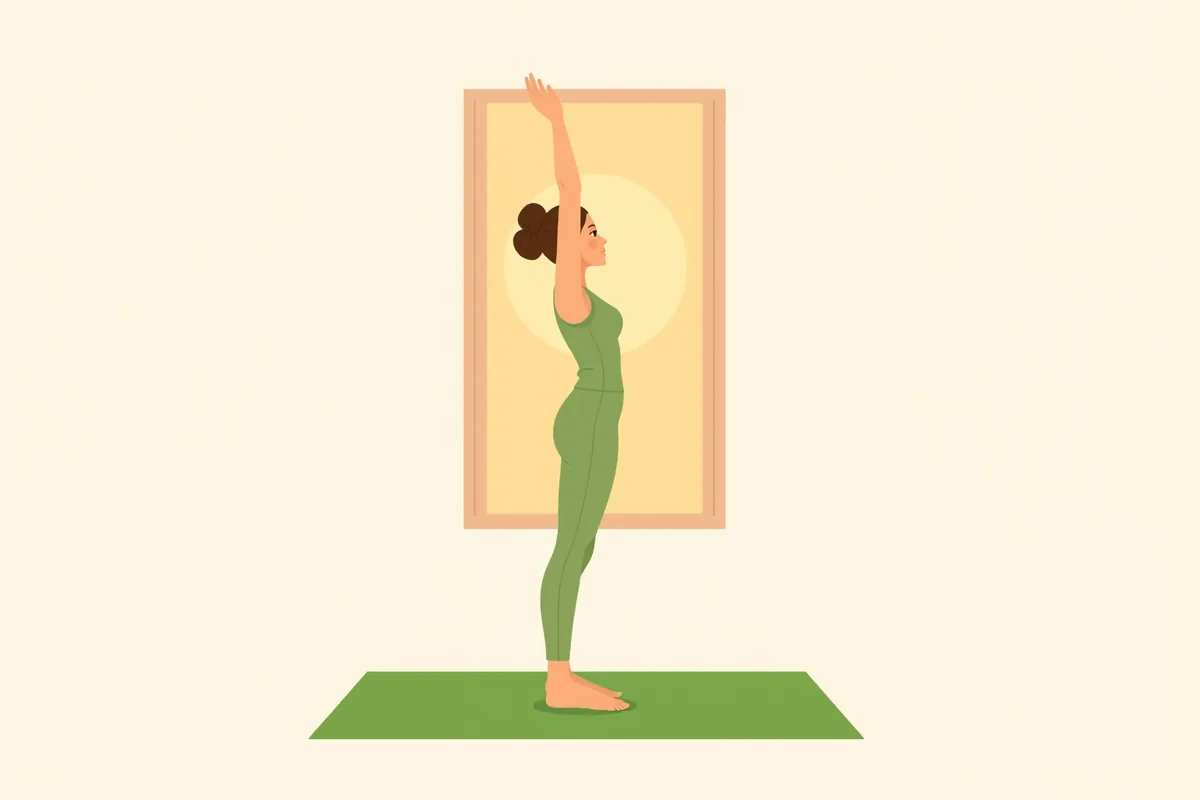
Ten minutes is enough time to move your spine, hips and shoulders before the day starts, and short enough to fit in before breakfast. This routine uses seven beginner poses in an order that suits a body that has just been lying down for hours: standing first, small movements before bigger ones, and a slow return to your feet at the end.
Every pose has its own step-by-step guide on this site, so the notes here stay short. You’ll also find a gentler version for stiff mornings, wrist-friendly swaps, a 15-minute option and answers to the usual morning questions. It is part of our Routines section. If you have never done yoga, read yoga for beginners first.
In this guide
- The 10-minute morning yoga routine at a glance
- Before you start
- How to do each step
- A gentler version for stiff mornings
- Make it easier (props)
- A 15-minute version
- Is it OK to do yoga right after waking up?
- Should you do morning yoga before or after breakfast?
- Why do you feel stiff in the morning?
- Is it better to do yoga in the morning or in the evening?
- Is 10 minutes of yoga a day enough?
- Who should skip it or ask a doctor first
- What the research says
- How do you make morning yoga a habit?
- Frequently asked questions
- Sources
The 10-minute morning yoga routine at a glance
The times include getting into each pose. If you slow your breathing to about 10 seconds for one breath in and out, a minute is roughly six breaths. Most people breathe faster than that, so treat the counts as a guide and don’t watch the clock too closely.
| Order | Pose | Time or breaths | What to notice |
|---|---|---|---|
| 1 | Mountain Pose with arm sweeps | 1 min (about 5 arm sweeps) | Weight even on both feet; shoulders stay low as your arms rise |
| 2 | Cat-Cow | 1 min 30 s (about 8 rounds) | Small movements first; breathe in for Cow, out for Cat |
| 3 | Downward-Facing Dog, knees bent | 1 min (two holds of 2 to 3 breaths) | A long back matters more than straight legs; any lightheadedness |
| 4 | Low Lunge, right foot forward | 1 min (about 5 breaths) | A mild pull at the front of the left hip; front knee over the ankle |
| 5 | Low Lunge, left foot forward | 1 min (about 5 breaths) | Whether one side feels tighter than the other |
| 6 | Cobra Pose, kept low | 1 min (4 slow lifts) | Hips and thighs stay on the mat; no pinching in the lower back |
| 7 | Child’s Pose | 1 min (about 5 breaths) | Your breath moving into the back of your ribs |
| 8 | Bridge Pose | 1 min 30 s (two lifts of 3 breaths) | Legs doing the work; head still, neck relaxed |
| 9 | Rest, then stand up in stages | 1 min | How you feel compared with 10 minutes ago |
That adds up to about 10 minutes. For a shorter session of about five minutes, do steps 1, 2, 4, 5 and 9; for step 9, sit back on your heels for three breaths instead of lying down, then stand up in stages.
Before you start
- Give yourself a few minutes after you wake. Sit on the edge of the bed for a moment, then stand up slowly. Use the bathroom and drink some water if you like.
- Set up your space. Roll out a mat, fold a blanket or towel for your knees, and keep a sturdy chair within reach. Our guide to starting yoga at home covers space and setup in detail.
- Dress for the room. Keep a layer on until you feel warm.
- Read the safety box below if you’re pregnant or have high blood pressure, glaucoma, osteoporosis, a back, knee or wrist problem, or you often get dizzy.
How to do each step
These are short reminders, not full instructions. Follow the link in each step the first few times.
1. Mountain Pose with arm sweeps (1 minute)
- Stand with your feet parallel and about hip-width apart. Spread your weight evenly over both feet.
- Straighten your legs without locking your knees, and let your arms hang by your sides.
- As you breathe in, sweep both arms out and up, palms turned toward each other. Keep your shoulders away from your ears.
- As you breathe out, lower your arms. Repeat about five times, then stand still for one breath.
If a shoulder is sore, lift your arms only as high as is comfortable. Full steps: Mountain Pose.
2. Cat-Cow (1 minute 30 seconds)
- Come down onto your hands and knees, one knee at a time. Hold the chair on the way down if that helps.
- Set your hands under your shoulders, or a little ahead of them, and your knees under your hips. Rest the tops of your feet on the mat.
- Breathe in, let your belly sink, and lift your chest and tailbone (Cow).
- Breathe out, press the floor away and round your back toward the ceiling, letting your head drop (Cat).
- Make the first two or three rounds very small. Do about eight rounds in all.
Full steps: Cat-Cow.
3. Downward-Facing Dog with bent knees (1 minute)
- From hands and knees, move your hands a little ahead of your shoulders, shoulder-width apart, and tuck your toes under.
- Breathe out, lift your knees and send your hips up and back. Keep your knees bent.
- Press through your whole hand and lengthen your back. Keep your head between your upper arms.
- Stay for two or three slow breaths, then lower your knees and look forward for one breath.
- Lift up once more for two or three breaths, then come back to hands and knees.
Watch out for: lightheadedness. Your head is below your heart here. If you feel dizzy, lower your knees, sit back on your heels with your head up, and skip the second hold. Full steps: Downward-Facing Dog.
4 and 5. Low Lunge, one minute on each side
- Put your folded blanket where your back knee will rest.
- From hands and knees, bring your right foot forward to land between your hands. Use a hand to help the foot forward if it stops short. Your right knee sits over your ankle.
- Slide your left knee back a few inches and lay the top of your left foot flat on the mat.
- Rest your hands on your front thigh or on two blocks, and lift your chest.
- Point your tailbone down, then let your hips move forward until you feel a mild stretch at the front of your left hip. Stay for about five breaths.
- Bring your hands down, step back to hands and knees and repeat with your left foot forward.
Full steps: Low Lunge.
6. Low Cobra (1 minute)
- From hands and knees, lower yourself onto your belly. Stretch your legs back, hip-width apart, with the tops of your feet on the mat.
- Place your palms under your shoulders and keep your elbows close to your ribs.
- Press your feet, thighs and pelvis gently into the floor.
- As you breathe in, lift your head and chest a few inches. Keep your elbows bent and look at the floor just ahead of you.
- As you breathe out, lower down. Repeat four times, slowly.
Come down right away if your lower back pinches. Full steps: Cobra Pose.
7. Child’s Pose (1 minute)
- Press back up to hands and knees and bring your big toes together.
- Keep your knees together or take them wider, then breathe out and sit your hips back toward your heels.
- Fold forward and rest your forehead on the mat, a block or your stacked fists.
- Reach your arms forward or lay them beside your shins. Stay for about five breaths.
- Walk your hands back toward your knees and roll up slowly to sit on your heels.
Full steps: Child’s Pose.
8. Bridge Pose (1 minute 30 seconds)
- From sitting on your heels, bring your legs around in front of you and lower yourself onto your back, using your hands. Bend your knees and place your feet flat, hip-width apart, a few inches from your buttocks.
- Rest your arms by your sides, palms down, and look straight up.
- Breathe out, press down through your feet and lift your hips. Stop before your lower back arches sharply.
- Keep your knees pointing forward and your head still. Stay for three breaths.
- Lower slowly, rest for a breath and lift once more.
Full steps: Bridge Pose.
9. Rest and stand up in stages (1 minute)
- Stay on your back with your knees bent for two slow breaths.
- Roll onto one side and push yourself up to sitting. Wait there for a breath or two.
- Stand up slowly, holding the chair if you like, and finish with two or three breaths in Mountain Pose.
Why get up in stages? See “Is it OK to do yoga right after waking up?” below.
A gentler version for stiff mornings
Swap any step for the option in the same row. The chair options take the weight off your knees and most of it off your wrists, and they suit mornings when getting down to the floor feels like too much.
| Step | Gentler option | Wrist-friendly option |
|---|---|---|
| Mountain Pose | Seated Mountain: sit tall near the front of a sturdy chair, feet flat, and lift your arms only as high as is comfortable | No change needed |
| Cat-Cow | Chair Cat-Cow: hands on your knees, lift your chest as you breathe in, round your back as you breathe out | Rest on soft fists, or on your forearms on two blocks at their lowest height |
| Downward-Facing Dog | Wall dog: hands on a wall at hip height, feet under your hips, back long | Wall dog, or forearms on the floor (Dolphin) |
| Low Lunge | A shorter lunge with thicker padding and hands on blocks, or a chair lunge: one foot on the seat of a chair pushed against a wall, both hands on the backrest | Start kneeling upright beside a chair instead of on hands and knees, and keep your hands on your front thigh |
| Cobra | Sphinx (forearms on the mat), or sit tall on a chair and lift your chest | Sphinx |
| Child’s Pose | A rolled blanket behind your knees and a block under your forehead, or rest sitting in a chair | Arms beside your shins instead of reaching forward |
| Bridge | Lift your hips only an inch or two | No change needed |
A few notes on these swaps:
- The all-chair version (seated Mountain, chair Cat-Cow, wall dog, chair lunge, seated chest lift, a quiet minute sitting) takes about six to eight minutes. The chair lunge has you standing on one leg, so keep both hands on the backrest.
- The edge of the bed works for seated Mountain and chair Cat-Cow only if the mattress is firm and your feet rest flat on the floor. A sturdy chair without wheels is steadier.
- Each pose guide has more options. The “Make it easier” section of every linked guide lists further versions and who should use them.
Make it easier (props)
You can do the whole routine with things you already own. These make it more comfortable:
- A folded blanket or towel. Under your knees in Cat-Cow, Low Lunge and Child’s Pose. Fold it thicker if your knees complain.
- Two blocks, or two thick books of the same size. Beside your front foot in Low Lunge, under your hands in Downward-Facing Dog, or under your forehead in Child’s Pose. See how to use yoga blocks.
- A sturdy chair without wheels. For getting down and up, for balance in Low Lunge and for every chair option above.
- A wall. For wall dog, and for a hand when you stand up.
- A non-slip mat. Hands and feet that slide make Downward-Facing Dog harder than it needs to be.
Helpful gear for this
 Manduka begin yoga mat, 5 mm
5 mm TPE mat, 68 x 24 in, light to carry, with a center alignment stripe (maker's spec).
See it on Amazon Gaiam foam yoga blocks, pair
Two light foam blocks, 9 x 6 x 4 in each, to raise the floor under your hands (maker's spec).
See it on Amazon Hugger Mugger cotton D-ring yoga strap, 10 ft
Cotton webbing 1.5 in wide with a metal D-ring buckle, 10 ft long (maker's spec).
See it on Amazon
As an Amazon Associate we earn from qualifying purchases. How we choose gear
A 15-minute version
When you have more time, keep the same order and add five minutes in three places:
| Add | Where | Extra time |
|---|---|---|
| Slow belly breathing, sitting on a chair or the edge of the bed | Before step 1 | 1 min |
| A second round of steps 3 to 5 (Downward-Facing Dog and both lunges) | After step 5 | 3 min |
| A longer rest with slow breathing | In step 9, before you roll to your side | 1 min |
For the breathing, see diaphragmatic breathing or, for a counted pattern, box breathing. If your hips or the backs of your legs are what feel tight in the morning, the timed routines in yoga for tight hips and yoga for tight hamstrings are a better use of the extra minutes.
Is it OK to do yoga right after waking up?
We found no health guidance that says you need to wait a set time after waking, and no study that tests yoga at that hour. The NCCIH describes yoga as generally safe for healthy people when it is done properly with a qualified instructor. So keep the session gentle and don’t rush the changes of position.
The thing to respect is the move from lying down to standing. Blood pressure can drop for a few seconds or minutes when you go from lying to standing, which is called orthostatic hypotension, and it can make you dizzy or lightheaded (MedlinePlus). For people who tend to get lightheaded on standing, MedlinePlus advises getting up from lying slowly, sitting for a few moments before standing, and having something to hold on to.
Head-down poses can also make you lightheaded, for a different reason. Cleveland Clinic notes that some people feel lightheaded or dizzy in a sun salutation, partly because of bending over and being upside down in poses like Downward-Facing Dog (Cleveland Clinic).
That is why this routine starts on your feet, puts Downward-Facing Dog third instead of first, keeps it to two short holds and ends with a staged return to standing. If you feel dizzy at any point, stop, sit down and wait until it passes. If it happens often, tell your doctor.
Should you do morning yoga before or after breakfast?
Either works for a short, gentle routine like this one. We found no official guidance that tells healthy adults to eat first, or not to. Poses that fold or press on the belly, such as Child’s Pose, Cobra and Downward-Facing Dog, may feel uncomfortable on a full stomach. So before breakfast, or a while after it, is the more comfortable choice.
Three groups should not practice on an empty stomach without thinking about it:
- If you’re pregnant. The NHS advises against exercising on an empty stomach in pregnancy, because it could make you faint. Eat something first.
- If you have diabetes and take insulin or other medicine that lowers blood sugar. Exercise can push blood sugar too low. MedlinePlus advises checking your blood sugar before exercise, keeping a fast-acting snack nearby and, if you use insulin, asking your provider when and what to eat beforehand.
- If you tend to feel faint or lightheaded in the morning. Drink some water, eat something small if that helps you, and talk to your doctor about it. Drinking more fluids is one of the steps a provider may recommend for low blood pressure (MedlinePlus).
Why do you feel stiff in the morning?
In one small study, people could not bend their lower backs as far early in the morning as later in the day: the 21 volunteers gained about 5 degrees of forward bending over the day (Adams et al., 1987).
The same researchers also loaded donated spines in the lab to imitate a day’s activity. Putting the two experiments together, they estimated that bending forward puts more bending stress on the discs and ligaments of the lower back early in the morning than later in the day, and concluded that these tissues are at greater risk of injury at that time. This is an estimate from one small, older lab study. It doesn’t show that gentle morning yoga injures anyone, and nobody has compared these poses at different times of day.
One trial points the same way for people who already have back trouble. In a trial that randomized 85 people with persistent or recurring low back pain, pain intensity fell within the group that was taught to limit forward bending in the early morning. It didn’t fall in the comparison group, which did sham exercises, until that group was given the same instruction six months later (Snook et al., 1998). If you have ongoing back pain, ask your doctor or physical therapist before doing forward-bending poses soon after you wake.
Here is how the routine takes this into account:
- No loaded forward folds. There is no standing forward bend, no seated forward fold and no sit-up. Cat and Child’s Pose do round your back, with your weight supported on your hands and knees or your thighs. Nobody has tested whether that matters, and a few minutes of movement doesn’t undo the time-of-day difference, which was measured between early morning and afternoon. If your back dislikes rounding in the morning, keep Cat small and rest sitting on a chair instead of in Child’s Pose.
- Small first. The first rounds of Cat-Cow are meant to be tiny. Let the range grow as you go, and never push to the end of it.
- Movement before holds. Harvard Health cautions against stretching muscles before they’re warmed up and suggests five to 10 minutes of light activity first. This routine doesn’t give you that much: Downward-Facing Dog comes after two and a half minutes and Low Lunge after three and a half. That is why both are kept short and mild. If you want deeper or longer stretches, walk around the house for five minutes first.
Some morning stiffness has a medical cause. With osteoarthritis, morning stiffness usually lasts less than 30 minutes (NIAMS). Stiff joints for more than 30 minutes after waking are one of the symptoms listed for rheumatoid arthritis (NIAMS). So if your morning stiffness lasts that long, or comes with joint pain or swelling, see your doctor instead of trying to stretch it away.
Is it better to do yoga in the morning or in the evening?
There is no clear winner. The research gives small, mixed differences, and the stronger finding is about keeping a regular time, whatever time that is.
- Yoga itself. We found one trial that compared the two. In India, 156 graduate students were assigned at random to an hour of online yoga at 6 a.m., the same class at 6 p.m., or a waiting list, five days a week for four weeks. Only 82 finished. The morning group did better than the evening group on sleep disturbances and a few other self-rated measures, and both yoga groups did better than the waiting list on quality of life, sleep and psychological health (Iyer et al., 2026). One small trial with hour-long classes, young students and nearly half the participants dropping out can’t settle the question, and it says little about a 10-minute routine.
- Sticking with it. In a survey of 375 people who had lost weight and kept it off, the 68% who exercised at a consistent time of day were active on more days a week (4.8 compared with 4.4). How active people were did not depend on which time of day they had chosen (Schumacher et al., 2019). A survey shows a link, not cause and effect. A 2024 review of 20 habit studies included one that compared times of day: in that study, a daily stretching habit became stronger when people did it in the morning than in the evening (Singh et al., 2024). One study of stretching, not yoga, is thin support.
In short, choose the time you can keep. Mornings have one practical advantage: the day hasn’t had a chance to get in the way yet. If evenings suit you better, a calmer sequence such as our bedtime yoga routine may fit.
Is 10 minutes of yoga a day enough?
It depends on what you want from it.
What it can reasonably do. It gets you moving through your spine, hips and shoulders, and the Physical Activity Guidelines for Americans are clear that some physical activity is better than none. A short session is also an easy way to practice the poses until they feel familiar.
What it can’t replace. The same guidelines ask adults for at least 150 minutes a week of moderate aerobic activity, plus muscle-strengthening activity on two or more days. They note that yoga ranges from light to moderate intensity depending on the style, and that time spent on flexibility activities alone doesn’t count toward those two targets. Nobody has measured this routine, but slow floor poses and short holds are likely to be at the light end, so keep your walks, rides or other exercise.
What nobody has shown. We found no research showing that a 10-minute morning routine speeds up your metabolism, “detoxes” your body, causes weight loss or gives you more energy for the rest of the day. The research box below describes the nearest studies.
Who should skip it or ask a doctor first
- Practicing on your own. The NCCIH advises learning yoga with a qualified instructor and notes that learning without supervision has been linked to higher risks. If you can, have a teacher check these poses once; see how to start yoga at home.
- Dizziness, fainting spells or low blood pressure. Get up slowly and in stages, and keep a chair within reach (MedlinePlus). Use wall dog instead of Downward-Facing Dog, and keep Child’s Pose short or rest sitting up. Cleveland Clinic advises talking to a health care provider before trying Downward-Facing Dog if you have dizziness, fainting spells, heart issues, high blood pressure or glaucoma.
- High blood pressure or a heart condition. The NCCIH lists severe high blood pressure among the conditions that may call for changes to a yoga practice. Ask your doctor whether head-down poses are OK for you. Until you know, use wall dog, rest sitting up instead of in Child’s Pose and leave out Bridge.
- Glaucoma. In a small study, eye pressure rose within a minute in head-down poses, most of all in Downward-Facing Dog (Jasien et al., 2015); the Downward-Facing Dog guide has the details. Ask your eye doctor first. Wall dog keeps your head higher, and a chair rest can replace Child’s Pose. Bridge also lifts your hips above your head, so ask about it too, although the study did not test Bridge.
- Osteoporosis, low bone density or a past spine fracture. Doctors who reviewed 89 patients with yoga-related injuries advise people with low bone density to avoid extreme forward rounding of the spine (Lee et al., 2019). The Cat half of Cat-Cow and Child’s Pose both round your back. Ask your doctor or physical therapist which movements suit you. Until then, keep a flat back instead of rounding in Cat-Cow, keep Cobra low, and rest sitting on a chair.
- Back pain or a diagnosed back condition. The NCCIH lists lumbar spine disease too. Keep every movement small, keep Cobra very low or leave it out, and ask your doctor or physical therapist before bending forward soon after waking (Snook et al., 1998).
- Neck or shoulder problems. Keep your head still and look straight up in Bridge, let your head hang only as far as is comfortable in Cat, raise your arms only as high as is comfortable, and use wall dog.
- Recent surgery, including a C-section or hernia repair. Skip Cobra and ask your surgeon when lying on your belly and floor work are OK.
- Wrist problems. Several steps put weight on your hands. Use the wrist-friendly column in the table above, and skip any pose that hurts.
- Knee problems or a knee replacement. Cat-Cow, Low Lunge and Child’s Pose are done on your knees, and Child’s Pose bends them fully. The NCCIH lists knee and hip injuries among the conditions that may call for changes. Pad your knees well or use the chair options. After a knee or hip replacement, skip the kneeling poses and the lunge, including the chair lunge, until your surgeon or physical therapist has told you which positions are safe.
- Pregnancy. Have your health care provider check that exercise is safe for you first, as the NCCIH advises. Leave out Cobra, which is done lying on your belly, and Bridge and the rest in step 9, which are done lying on your back: the NCCIH advises avoiding yoga poses that involve long periods on your back, and the NHS says that in later pregnancy you shouldn’t spend longer than a few minutes lying flat on your back. In their place, do a few more rounds of Cat-Cow with a gentle Cow, or sit tall on a chair and lift your chest, and rest sitting in a chair or lying on your side with pillows. Take Child’s Pose with your knees wide, keep the lunge short with a chair beside you, and come out of Downward-Facing Dog if you feel dizzy or queasy. Eat something first, and stop if you feel too hot or unwell (NHS).
- Age 65 or older, or balance problems. The NCCIH notes that people 65 and older are treated in emergency departments for yoga injuries at a higher rate than younger adults. Keep the chair close, take the chair versions if getting down to the floor is hard, and talk with your health care provider about what suits you.
- Pain. A mild stretch is fine. Sharp pain, pinching or pain in a joint means stop. Yoga is not a reason to delay getting a medical problem checked (NCCIH).
What the research says
Evidence: no good evidence
No study has tested this sequence, and we found no trial of any 10-minute morning yoga routine. That is why the label is “no good evidence”. The poses are widely taught, and the nearest research is about something else:
- Very short sessions and mood. In an online study in Germany during a COVID-19 lockdown, when stress levels were unusually high, 131 adults were assigned at random to one seven-minute guided session of endurance and strength exercise, yoga-based mobility exercises (45 people) or mindfulness meditation. Perceived stress, negative mood and anxiety were lower afterward than before in all three groups, with no clear difference between them (Marschin and Herbert, 2026). No group did nothing, so the study can’t show that the sessions caused the change, and it measured only the minutes right after.
- One longer session and stress markers. In a pilot study of 19 adults who were new to yoga, a single 24-minute session did not change stress markers in saliva (cortisol and alpha-amylase) compared with sitting quietly (Zhou et al., 2026).
- Stretching in general. A 2024 meta-analysis found that healthy people who stretched regularly over weeks gained range of motion, and how much, how hard or how often they stretched did not clearly change the result. Held (static) stretches gained more than moving ones, and this routine is mostly moving poses and short holds (Konrad et al., 2024). Those were stretching programs, not yoga routines.
For the broader picture, see benefits of yoga: what the research says and mobility vs flexibility.
How do you make morning yoga a habit?
Our guide to starting yoga at home covers habit building and the research behind it, so here are only the points that matter most in the morning:
- Attach it to something you already do, such as brushing your teeth or waiting for the coffee to brew.
- Set up the night before. Leave the mat, blanket and chair where you’ll practice, so the morning needs no decisions.
- Start with two or three mornings a week, with a day off in between, then add days if you feel good. That is the pace of our beginner plan.
- Keep the short version for bad days. Five minutes still counts as showing up.
Frequently asked questions
Can you do this routine every day?
Nothing in the guidance we read sets a limit for a short, gentle routine, and no study has tested doing one daily. If you are new to yoga, start with two or three mornings a week and build up. Take a day off if anything feels sore, and see a health care provider about pain that doesn’t settle.
Can you do morning yoga in bed?
Some of it. Slow breathing and, on a firm mattress with your feet on the floor, the seated versions of Mountain Pose and Cat-Cow work from the edge of the bed. The hands-and-knees poses need a firm surface, so move to the floor for those.
How long should you hold each pose in the morning?
In this routine, two to five breaths, and the moving poses aren’t held at all. We kept the holds short on purpose, for the reasons in the section on morning stiffness. For more on timing, see how long to hold a yoga pose.
Sources
- National Center for Complementary and Integrative Health (NCCIH). Yoga: Effectiveness and Safety. Last updated August 2023., checked Nov 11, 2026
- Adams MA, Dolan P, Hutton WC. Diurnal variations in the stresses on the lumbar spine. Spine (Phila Pa 1976). 1987;12(2):130-137., checked Nov 11, 2026
- Snook SH, Webster BS, McGorry RW, Fogleman MT, McCann KB. The reduction of chronic nonspecific low back pain through the control of early morning lumbar flexion. A randomized controlled trial. Spine (Phila Pa 1976). 1998;23(23):2601-2607., checked Nov 11, 2026
- Harvard Health Publishing. The importance of stretching. April 17, 2024., checked Nov 11, 2026
- MedlinePlus (U.S. National Library of Medicine). Dizziness. Reviewed April 1, 2025., checked Nov 11, 2026
- MedlinePlus (U.S. National Library of Medicine). Low blood pressure. Reviewed January 1, 2025., checked Nov 11, 2026
- Cleveland Clinic. How To Do Yoga Sun Salutation Sequences. Health Essentials. October 28, 2025., checked Nov 11, 2026
- Cleveland Clinic. Yoga Poses 101: How To Do a Downward Dog Pose. Health Essentials. July 21, 2025., checked Nov 11, 2026
- NHS. Exercise in pregnancy. Page last reviewed September 24, 2026., checked Nov 11, 2026
- MedlinePlus (U.S. National Library of Medicine). Diabetes and exercise. Reviewed May 18, 2026., checked Nov 11, 2026
- National Institute of Arthritis and Musculoskeletal and Skin Diseases (NIAMS). Osteoarthritis., checked Nov 11, 2026
- National Institute of Arthritis and Musculoskeletal and Skin Diseases (NIAMS). Rheumatoid arthritis., checked Nov 11, 2026
- Iyer S, Bhat R, Gulati K, Bhargav H. Dawn vs. Dusk: Yoga practice timing shapes sleep, mood and well-being in young adults – results of a randomized controlled trial. J Ayurveda Integr Med. 2026;17(2):101314., checked Nov 11, 2026
- Schumacher LM, Thomas JG, Raynor HA, et al. Relationship of consistency in timing of exercise performance and exercise levels among successful weight loss maintainers. Obesity (Silver Spring). 2019;27(8):1285-1291., checked Nov 11, 2026
- Singh B, Murphy A, Maher C, Smith AE. Time to Form a Habit: A Systematic Review and Meta-Analysis of Health Behaviour Habit Formation and Its Determinants. Healthcare (Basel). 2024;12(23):2488., checked Nov 11, 2026
- Marschin V, Herbert C. Acute effects of ultra-short aerobic and resistance, yoga-based mobility, and mindfulness meditation sessions on mental health: a randomized online study. Front Sports Act Living. 2026;8:1774292., checked Nov 11, 2026
- Zhou Y, Chen P, Morisaki Y, et al. Acute Physiological and Emotional Responses to a Brief 24-Minute Yoga Session: Randomized Exploratory Pilot Study With Waitlist Comparison. JMIR Form Res. 2026;10:e87077., checked Nov 11, 2026
- Konrad A, Alizadeh S, Daneshjoo A, et al. Chronic effects of stretching on range of motion with consideration of potential moderating variables: a systematic review with meta-analysis. J Sport Health Sci. 2024;13(2):186-194., checked Nov 11, 2026
- U.S. Department of Health and Human Services. Physical Activity Guidelines for Americans, 2nd edition. Washington, DC: HHS; 2018., checked Nov 11, 2026
- Jasien JV, Jonas JB, de Moraes CG, Ritch R. Intraocular pressure rise in subjects with and without glaucoma during four common yoga positions. PLoS One. 2015;10(12):e0144505., checked Nov 11, 2026
- Lee M, Huntoon EA, Sinaki M. Soft tissue and bony injuries attributed to the practice of yoga: a biomechanical analysis and implications for management. Mayo Clin Proc. 2019;94(3):424-431., checked Nov 11, 2026
Image credits: Illustration: AI-generated for YogaForFitness (FLUX.1 [schnell], run locally), checked for pose accuracy
