Box Breathing: Steps, Uses and Safety
Quick answer
Sit upright and breathe out fully. Then breathe in through your nose for a count of four, hold for four, breathe out for four and hold again for four. Repeat for three or four rounds, and shorten every count to three if four feels like a strain.
We may earn a commission when you buy through links on this page. It never changes what we recommend. As an Amazon Associate we earn from qualifying purchases.
Box breathing is a slow, counted breathing pattern with four equal parts: in, pause, out, pause. Picture tracing the four sides of a square, one side per part. It’s also called square, four-square or 4-4-4-4 breathing, and Cleveland Clinic links it to the yogic practice of *sama vritti* (equal breath).
If you’re new to breathing practice, learn diaphragmatic (belly) breathing first. It teaches relaxed, low breaths with no pauses, and box breathing simply adds two short holds and a steady count. You’ll find more techniques in our Breathing guides.
In this guide
- How to do box breathing
- How to shorten the counts if four feels too long
- How long and how often should you do it?
- When people use box breathing
- Common mistakes
- How box breathing compares with other slow-breathing methods
- Who should skip the holds or ask a doctor first
- What the research says
- Frequently asked questions
- Sources
How to do box breathing
Sitting is the easiest way to learn it, and it lets you practice almost anywhere.
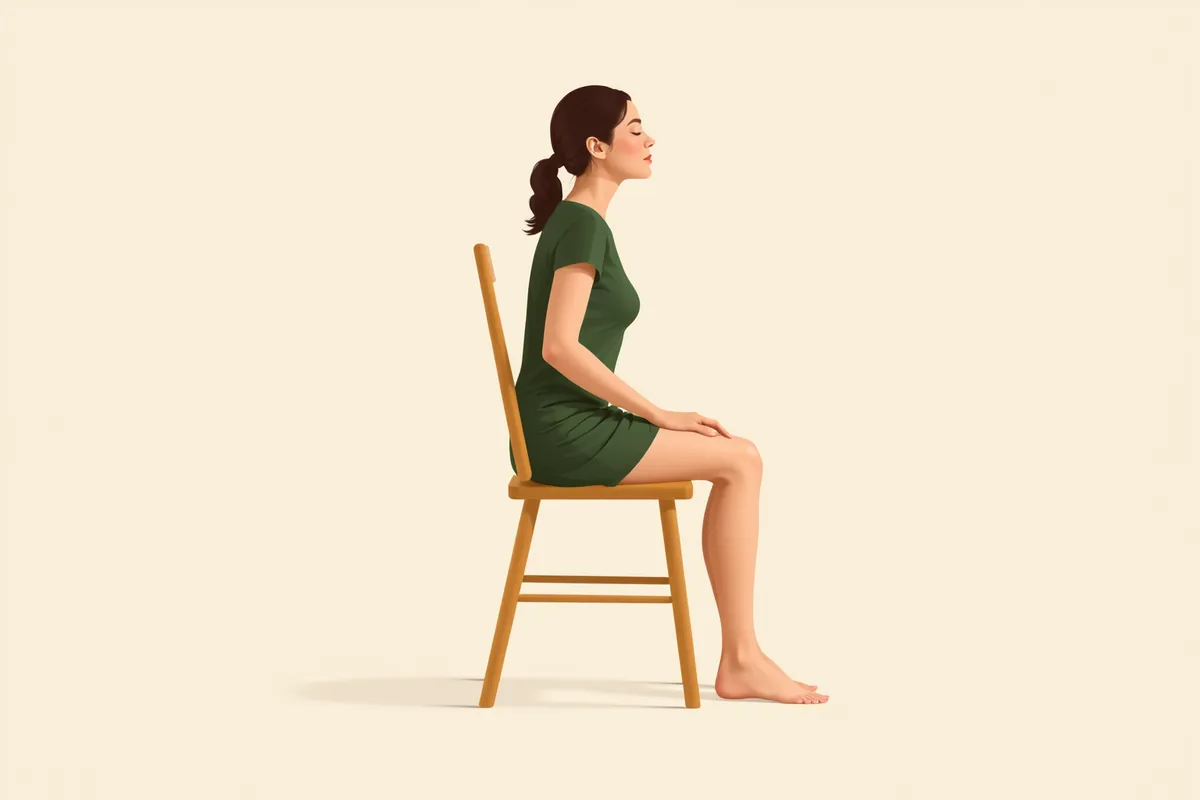
- Sit in a chair with your back supported and both feet flat on the floor. Rest your hands on your thighs and let your shoulders drop.
- Breathe out slowly through your mouth until your lungs feel comfortably empty. Don’t squeeze out the last bit.
- Breathe in gently through your nose while you count to four in your head. Let the breath reach low, so your belly widens.
- Pause with the air in and count to four. Keep your jaw, throat and shoulders soft: it’s a rest, not a clamp.
- Breathe out slowly for a count of four, through your nose or gently parted lips.
- Pause again with your lungs empty for a count of four. Then start the next breath in.
- That’s one round. Do three or four rounds, then breathe normally for a moment before you stand up.
These steps follow Cleveland Clinic’s method, which starts with a slow full exhale, then four counts each of breathing in, holding, breathing out and holding, for three to four rounds. Its specialist advises staying at your comfort level and breathing gently without straining (Cleveland Clinic). A video from Sunnybrook Health Sciences Centre teaches the same idea by having you picture moving around the sides of a box as you breathe. You can also trace a square with one finger on your leg.
How to shorten the counts if four feels too long
The count is a guide, not a test. If four makes you gasp, rush or tense up, make every side of the box shorter.
| Version | In | Hold | Out | Hold | One round takes about |
|---|---|---|---|---|---|
| Shorter | 3 | 3 | 3 | 3 | 12 seconds |
| Classic | 4 | 4 | 4 | 4 | 16 seconds |
| Longer (only once 4 is easy) | 5 | 5 | 5 | 5 | 20 seconds |
In a Stanford study, people were given box counts of 3 to 4, 5 to 6 or 8 to 10 seconds, based on a simple breathing test, and were told to shorten every count if they ever had to strain (Balban et al., 2023). Use the same rule: shorten first and lengthen later. Cleveland Clinic notes that holding a steady count can feel hard at first and gets easier with practice.
If the pauses are the hard part, keep them shorter than the other sides, for example 4-2-4-2. That isn’t a perfect square any more, but it’s a gentler start. Researchers have also tested softer variations, such as 4 seconds in, a 2-second pause and 4 seconds out (McAllister et al., 2026, summarizing earlier work).
How long and how often should you do it?
| Source | How long | How often |
|---|---|---|
| Cleveland Clinic (box breathing) | 3 to 4 rounds | Once or twice a day, however you feel |
| Cleveland Clinic (breathwork in general) | 5 to 10 minutes | Daily |
| Stanford study (Balban et al., 2023) | 5 minutes | Daily for about a month |
A few rounds take only a minute. If you’d like to build up, add a round at a time until you reach about 5 minutes, and stop sooner if you feel lightheaded. Cleveland Clinic suggests practicing in calm moments, such as first thing in the morning, so the pattern comes more easily when you’re stressed.
When people use box breathing
- Before a stressful task. People use a few rounds before a presentation, an exam, a hard conversation or a medical appointment. One study tested exactly this, 5 minutes before a lab stress test, with encouraging short-term results (see the research box below). That doesn’t promise it will work for you.
- During a busy day. Cleveland Clinic suggests it as an anytime practice, at your desk or while you wait in line. It also says not to do it while driving (Cleveland Clinic).
- Winding down in the evening. A few calm rounds can be part of how you settle before bed. Be realistic: NCCIH notes that relaxation techniques alone haven’t shown much promise for sleep (NCCIH), and in the Stanford study none of the breathing groups slept differently after a month. For a fuller evening wind-down, pair it with our bedtime yoga guide.
- Not between hard intervals. In 40 active students, box breathing during short rests between hard cycling efforts led to a higher heart rate than slow breathing at six breaths a minute, and higher perceived effort than either slow or normal breathing (Kasap and Aydin, 2025). During rests between hard efforts, breathe freely or slow your breathing without holds.
Common mistakes
- Straining during the holds. A hold should feel like a pause at the top or bottom of a swing. Don’t close your throat and push. Pushing air against a closed mouth and nose is the Valsalva maneuver, which briefly changes blood pressure and heart rate and is used on purpose only under medical guidance (Cleveland Clinic).
- Gulping air. Taking huge breaths, or breathing hard to “make up” for the pauses, can tip you into overbreathing. That can make you lightheaded or dizzy and cause tingling around your mouth or in your arms (MedlinePlus). Keep each breath comfortable rather than big.
- Forcing long counts. Counting to six or eight before you’re ready makes the holds tense. Go back to four or three.
- Breathing into your chest and shoulders. If your shoulders rise on every breath, practice belly breathing on its own first.
- Counting too fast. Rushing the count to “get through” a round defeats the point. Aim for roughly one count a second, the pace used in studies (McAllister et al., 2026).
- Waiting for a crisis. A new skill is hard to use for the first time when you’re upset. Practice when you’re calm.
How box breathing compares with other slow-breathing methods
| Method | Pattern | Breath holds? |
|---|---|---|
| Box breathing | In 4, hold 4, out 4, hold 4 | Two equal holds each round |
| Diaphragmatic breathing | Slow, comfortable breaths that move the belly | None |
| 4-7-8 breathing | In 4 through the nose, hold 7, out 8 through the mouth | One long hold; the out-breath is the longest part |
| Alternate nostril breathing | Breathe in through one nostril and out through the other, then switch sides | Short pauses of a beat or two in Cleveland Clinic’s version |
| Cyclic sighing | Two breaths in, one long, slow breath out | None |
The 4-7-8 pattern comes from Cleveland Clinic, which suggests it for bedtime, while box breathing is the one it calls easy to do on the go (Cleveland Clinic). Cyclic sighing is the exhale-focused pattern from the Stanford study (Balban et al., 2023), and the alternate nostril steps follow Cleveland Clinic. If breath holds don’t suit you, the methods without holds are the easier choice.
Who should skip the holds or ask a doctor first
- Never while driving. Practice only where it’s safe to feel briefly lightheaded; Cleveland Clinic says not to do it while driving (Cleveland Clinic).
- Dizziness, tingling or lightheadedness: stop, breathe normally and sit until it passes. These are signs of overbreathing (MedlinePlus).
- Chest pain, or breathlessness or fast breathing that is new to you: this is not a moment for breathing drills. MedlinePlus warns that fast breathing you’ve never had before can be an emergency, so call for help or go to the ER.
- Heart disease, a heart rhythm problem or uncontrolled high blood pressure: ask your doctor before practicing breath holds, and never bear down during a hold. Cleveland Clinic advises care with straining-type breath holds in heart valve, coronary artery or congenital heart disease (Cleveland Clinic). Keep taking your prescribed medicine; a breathing exercise is an add-on, never a swap.
- Lung conditions such as COPD or asthma: we found no good-quality studies of box breathing in these conditions. Ask your doctor or respiratory therapist which breathing exercises suit you.
- Pregnancy: the Stanford study left out pregnant people, along with people with heart disease, glaucoma or a history of seizures (Balban et al., 2023), so there’s no data for you there. Ask your midwife or doctor before adding breath holds, or use slow breathing without pauses. Practice sitting up, since the NHS advises limiting time spent flat on your back in later pregnancy.
- Glaucoma or other eye conditions: ask your eye doctor first, and keep any hold light. Straining with your breath held raises pressure in the eyes, and Cleveland Clinic says people with retinopathy or lens implants shouldn’t do the Valsalva maneuver (Cleveland Clinic).
- Panic attacks, or if the holds make you anxious: drop the holds and breathe slowly in and out. NCCIH notes that relaxation techniques occasionally bring on more anxiety, and that a few reports link them to worse symptoms in epilepsy, some psychiatric conditions, or after abuse or trauma (NCCIH). Talk to your doctor or therapist first.
- Ongoing anxiety, stress or low mood: box breathing can’t stand in for care for an anxiety disorder. Talk to your doctor, a therapist or another mental health professional.
What the research says
Evidence: limited
Few studies have tested box breathing itself, and most are small and short. A 2026 systematic review found only a small number of randomized trials of the equal four-part pattern (its abstract gives both 8 and 29, so treat the exact count with caution), in healthy adults and a few clinical groups such as new mothers. The trials were too different to combine; the authors describe the evidence as limited and fragmented, with some short-term benefits for stress, anxiety and mood and mixed effects on body measures such as heart rate and breathing rate (Dujawara et al., 2026).
The best-known trial randomly assigned 108 adults to 5 minutes a day of box breathing (21 people), cyclic sighing, another breathing method or mindfulness meditation for a month. On average, mood and anxiety were better after a session than before it within the box breathing group, but the meditation group improved by about the same amount. Box breathing did not beat meditation by a statistically significant margin on any measure; only cyclic sighing did, for positive mood and breathing rate (Balban et al., 2023). Most participants were Stanford undergraduates; the study ran remotely, was registered only after it started, and one author advises the company that made the study’s wristband.
In a 2026 trial, 66 healthy young adults were randomly assigned to 5 minutes of 4-4-4-4 box breathing, a long-exhale breath or normal breathing before a virtual stress test (a speech and mental math). Both breathing groups had smaller rises in heart rate, anxiety and a saliva stress marker than the normal-breathing group. Heart rate variability, cortisol and test performance didn’t differ (McAllister et al., 2026). In a small pilot study, 47 students did one minute of box breathing, cyclic sighing or nothing at moments when they felt anxious; both exercises were followed by a bigger drop in anxiety than doing nothing, though reaction times were a little slower afterward. The paper doesn’t say whether the groups were assigned at random (Riedl et al., 2026). Among 43 resident physicians who chose box breathing and tried it for four weeks, it made almost no difference to daily stress on average; seven of them clearly benefited, while some others felt slightly more stressed on box-breathing days (Vetter et al., 2026).
Wider reviews of slow breathing, such as a 2018 review of 15 studies in healthy people breathing under 10 times a minute, describe higher heart rate variability and more relaxed moods (Zaccaro et al., 2018), but they didn’t test box breathing specifically.
A few studies of the pattern itself, all small, short and mostly in young healthy adults, with mixed results: that’s why we rate the evidence as limited.
Frequently asked questions
Does box breathing work for anxiety?
It may ease anxious feelings in the moment. In the small trials above, people felt less anxious right after box breathing, and in one trial it softened the rise in anxiety and heart rate during a stressful task. But it didn’t outperform mindfulness meditation in the Stanford study, and no study shows it works as a long-term fix. Box breathing is not a treatment for anxiety disorders. If anxiety gets in the way of daily life, talk to your doctor.
Is box breathing the same as 4-7-8 breathing?
No. Box breathing keeps all four parts the same length and holds the breath twice. The 4-7-8 method holds once, for longer, and makes the out-breath the longest part (Cleveland Clinic). Cleveland Clinic calls 4-7-8 a bit more complex than box breathing (Cleveland Clinic).
Why do Navy SEALs use box breathing?
Box breathing is widely linked to the military. Cleveland Clinic says it is used by U.S. Navy SEALs, and a Stanford research team writes that soldiers have used it to manage stress (Balban et al., 2023). We found no official Navy source describing how it’s taught. Military psychologists who studied a related “tactical breathing” method called the evidence for it limited. In their own small lab test with 30 healthy adults, tactical breathing calmed the body slightly more than a long-exhale method, but people performed a task better with the long exhale (Röttger et al., 2021). Its popularity is real; it doesn’t prove the method works better than other slow breathing.
Is box breathing a form of meditation?
Partly. Cleveland Clinic’s specialist describes the silent counting as a kind of mantra meditation that helps you stay in the present moment. You don’t need any meditation experience to try it.
Why does box breathing make me dizzy or more anxious?
Dizziness usually means you’re breathing too deeply or too hard between the holds. Make the counts shorter and the breaths smaller. Some people feel uneasy when they hold their breath. If that’s you, skip the holds and simply breathe in and out slowly, or try diaphragmatic breathing. If dizziness keeps coming back, stop and talk to your doctor.
Can you do box breathing lying down?
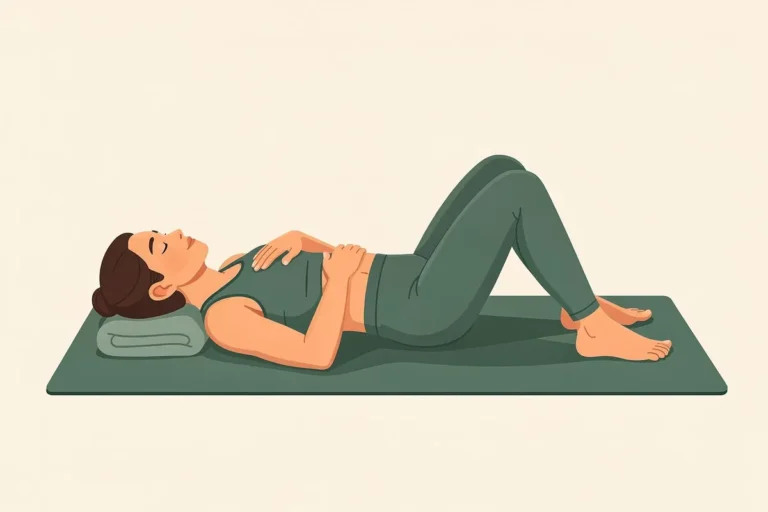
Yes. Participants in the Stanford study could sit in a chair or lie down. Sitting upright makes it easier to stay alert and keep the count, and it’s the safer choice in later pregnancy. If you’re new to yoga as well, our guides to yoga for beginners and starting yoga at home show you where to begin.
Helpful gear for this
 Hugger Mugger zafu meditation cushion
Round cushion, 15 x 15 x 5 in, buckwheat-hull fill, removable cotton cover you can hand-wash (maker's spec).
See it on Amazon Gaiam zafu meditation cushion
15 in round and 5 in high, buckwheat fill you can add or remove, machine-washable cover (maker's spec).
See it on Amazon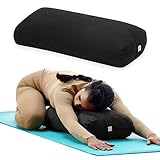 Gaiam rectangular yoga bolster
25 x 12 x 5 in bolster to lie back on or put under your knees, machine-washable cover (maker's spec).
See it on Amazon
As an Amazon Associate we earn from qualifying purchases. How we choose gear
Sources
- Cleveland Clinic. How box breathing can help you destress. Health Essentials. August 17, 2021., checked Nov 10, 2026
- Cleveland Clinic. Breathwork for beginners: what to know and how to get started. Health Essentials. May 19, 2023., checked Nov 10, 2026
- Cleveland Clinic. How to do the 4-7-8 breathing exercise. Health Essentials. September 6, 2022., checked Nov 10, 2026
- Cleveland Clinic. How and why to try alternate nostril breathing. Health Essentials. September 7, 2022., checked Nov 10, 2026
- Cleveland Clinic. Valsalva maneuver. Last updated June 9, 2022., checked Nov 10, 2026
- Sunnybrook Health Sciences Centre. Box breathing relaxation technique: how to calm feelings of stress or anxiety. October 1, 2020., checked Nov 10, 2026
- National Center for Complementary and Integrative Health (NCCIH). Relaxation techniques: what you need to know. Updated June 2021., checked Nov 10, 2026
- MedlinePlus (U.S. National Library of Medicine). Hyperventilation. Reviewed July 22, 2026., checked Nov 10, 2026
- NHS. Exercise in pregnancy. Reviewed September 24, 2026., checked Nov 10, 2026
- Balban MY, Neri E, Kogon MM, et al. Brief structured respiration practices enhance mood and reduce physiological arousal. Cell Rep Med. 2023;4(1):100895., checked Nov 10, 2026
- McAllister MJ, Martaindale MH, Sutton N, Andersen JP. Box breathing and prolonged exhalation reduces markers of physiological stress reactivity in response to a virtual Trier social stress test. Compr Psychoneuroendocrinol. 2026;27:100360., checked Nov 10, 2026
- Riedl EM, Bracklo T, Wimmer K, et al. Simply breathing anxiety away? A pilot, just-in-time ecological momentary intervention study of one-minute cyclic sighing versus box breathing as tools for acute anxiety reduction and attention promotion in real life. Anxiety Stress Coping. 2026;39(5):608-622., checked Nov 10, 2026
- Vetter VM, Kurth T, Konigorski S. Evaluation of two easy-to-implement digital breathing interventions in the context of daily stress levels in a series of N-of-1 trials: results from the ASIP study. NPJ Digit Med. 2026;9(1):135., checked Nov 10, 2026
- Kasap M, Aydin GR. Box breathing or six breaths per minute: which strategy improves athletes post-HIIT cardiovascular recovery? PLoS One. 2025;20(11):e0336615., checked Nov 10, 2026
- Dujawara A, Ali K, Kumari S. Systematic review of randomised controlled trials evaluating box breathing for stress, autonomic, and clinical outcomes. Appl Psychophysiol Biofeedback. 2026 (online ahead of print)., checked Nov 10, 2026
- Röttger S, Theobald DA, Abendroth J, Jacobsen T. The effectiveness of combat tactical breathing as compared with prolonged exhalation. Appl Psychophysiol Biofeedback. 2021;46(1):19-28., checked Nov 10, 2026
- Zaccaro A, Piarulli A, Laurino M, et al. How breath-control can change your life: a systematic review on psycho-physiological correlates of slow breathing. Front Hum Neurosci. 2018;12:353., checked Nov 10, 2026
Image credits: Illustration: AI-generated for YogaForFitness (FLUX.1 [schnell], run locally), checked for accuracy