Yoga for Kids: 10 Simple Poses and How to Keep It Safe
Quick answer
Start with a few easy shapes such as Mountain, Tree, Cat-Cow and Child's Pose, do them alongside your child for a few slow breaths each, and stop if anything hurts. Leave out headstands, shoulder stands, the lotus position, forceful breathing and hot yoga. Studies in children show some promise, but they are mostly small and mixed.
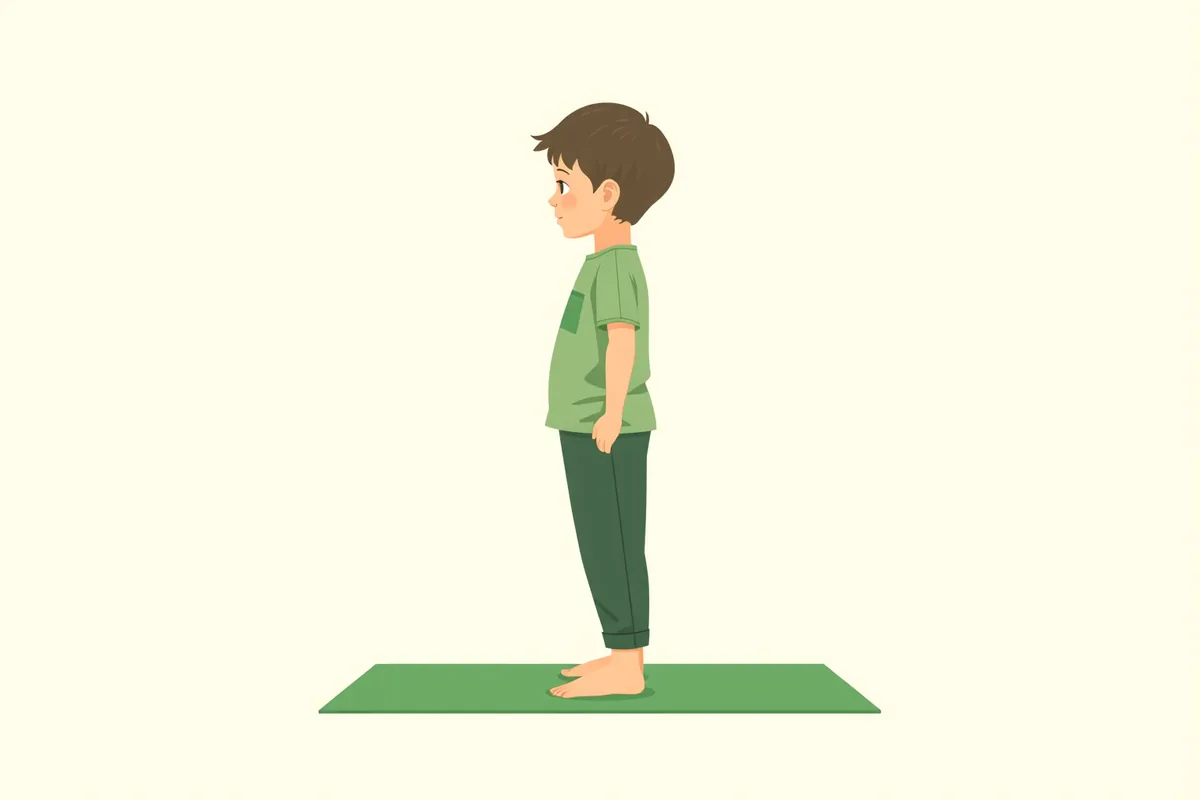
To try yoga for kids today, clear a patch of floor, pick three or four poses and do them together. Show each shape yourself, let your child copy it for a few slow breaths, and count wobbles and giggles as part of the game. Nothing should hurt.
Below are ten poses with words to say out loud, a cue to watch in each, a short card and what studies in children show, for parents, caregivers and teachers. It’s part of our Yoga For guides.
In this guide
- Is yoga safe for children?
- What should children avoid in yoga?
- Kids yoga poses on one read-aloud card
- 10 yoga poses for kids, step by step
- How do you keep yoga playful?
- How long and how often should a child do yoga?
- Who should skip it or ask a doctor first
- What the research says
- Frequently asked questions
- Sources
Is yoga safe for children?
The National Center for Complementary and Integrative Health (NCCIH) lists yoga among the low-risk mind and body practices with the best evidence for children. It also notes that little is known about the effects and safety of complementary approaches in children, and that many haven’t been tested for safety in them.
For healthy people in general, the NCCIH calls yoga mostly safe when it’s done properly under a qualified instructor. Sprains and strains can happen, the knee and lower leg are hurt most often, serious injuries are rare, and unsupervised self-learning has been linked to more risk. A few easy shapes at home are a fine first taste. To go further, find a teacher and ask about that person’s training and experience with children.
If your child has a health condition, a disability that affects movement, or a recent injury or operation, speak with their health care provider first.
What should children avoid in yoga?
| Leave out | Why |
|---|---|
| Headstands, shoulder stands and the lotus position | The NCCIH advises people new to yoga to avoid them. |
| Forceful breathing | It is on the same NCCIH list. |
| Breath holding | Our choice for this page: keep every breath easy and flowing. |
| Hot yoga | The NCCIH warns of special risks of overheating and dehydration. |
| Anything that hurts | A Cleveland Clinic article on children’s yoga says poses should never hurt: a bit of stretch is enough. |
The lotus position is the cross-legged seat with each foot up on the opposite thigh. A case report describes a 15-year-old girl who injured the growth plate at the lower end of her shin bone, a fracture, during a yoga posture. A 2021 review of harms in children’s mind and body studies says she was getting into the lotus position in a school physical education class. One case can’t tell you how often that happens, but never fold a child’s legs into place.
Children’s growth plates, the areas near the ends of long bones that shape the adult bone, are weaker than nearby ligaments and tendons, according to the National Institute of Arthritis and Musculoskeletal and Skin Diseases. Have a provider check pain that lingers after a knock, a fall or overuse; the end of a bone that looks misshapen or swollen or feels warm; a new way of bending an arm or leg; or a limb your child can’t move or lean on because it hurts.
Kids yoga poses on one read-aloud card
Read the middle column to your child and watch for the point in the last one. Three slow breaths is our suggested count for a first try; Cleveland Clinic suggests holding for several seconds while breathing deeply. Do both sides of Tree and Warrior. For a paper copy, use your browser’s print command, check the preview and select only the pages that show the card.
| Pose | Say to your child | Adult watches |
|---|---|---|
| 1. Mountain | “Feet on the ground, head up to the sky.” | Knees not locked (YogaEasy) |
| 2. Tree | “Stand on one leg and grow branches.” | Foot off the knee joint (YogaEasy) |
| 3. Warrior II | “Wide feet, long arms, look over one hand.” | Front knee over the ankle (YogaEasy) |
| 4. Cat-Cow | “Moo and sink. Meow and round.” | Long neck, no crunching (Cleveland Clinic) |
| 5. Downward Dog | “Bottom up high. Pedal your paws.” | Heels may stay up (YogaEasy) |
| 6. Cobra | “Lift your head like a snake and hiss softly.” | Hips down, no pain (Cleveland Clinic) |
| 7. Child’s Pose | “Curl up small like a sleeping mouse.” | Knees may move wider (YogaEasy) |
| 8. Butterfly | “Feet together, sit tall, quiet wings.” | No bouncing (ACE) |
| 9. Bridge | “Lift your middle so a toy car fits under.” | Neck stays still (YogaEasy) |
| 10. Starfish rest | “Lie like a starfish and feel your tummy move.” | Eyes may stay open |
10 yoga poses for kids, step by step
You don’t need all ten. Ages shown come from Cleveland Clinic’s article featuring a yoga instructor, not from trials. Our linked pose guides are written for adults: read them for yourself and keep the child’s version this simple.
1. Mountain Pose
Say:
- Stand with a little space between your feet.
- Spread your toes wide, then let them rest.
- Make your legs strong and your neck long.
- Let your arms hang and take three slow breaths.
Adult’s cue: knees straight but not locked, and no stiff soldier posture, as YogaEasy teaches. Yoga International allows feet together or hip-width apart. Adult guide: Mountain Pose.
2. Tree Pose
Age: elementary school and older.
Say:
- Stand tall and find something still to look at.
- Lean your weight into one foot.
- Rest your other heel against your ankle, with those toes still touching down.
- Feeling steady? Slide that foot onto your lower leg.
- Put your palms together, or reach up like branches.
- Come down and try the other side.
Adult’s cue: offer a wall or your hand, and keep the lifted foot below or above the knee, not on the joint, as Yoga International and YogaEasy teach. Adult guide: Tree Pose.
3. Warrior II
Age: elementary school and older.
Say:
- Take a big step so your feet are far apart.
- Point one foot out to the side. Turn the other in just a little.
- Stretch your arms out like airplane wings.
- Bend the knee above your pointing foot.
- Peek over that front hand like a lookout.
- Stand up straight, then face the other way.
Adult’s cue: a shallow bend is enough. Keep the front knee aimed with the toes and stacked over the heel or ankle, the placement taught by Yoga International and YogaEasy. Adult guide: Warrior II.
4. Cat-Cow
Say:
- Make a table on your hands and knees.
- Breathe in, let your tummy sink and look ahead. That’s the cow, so try a “moo.”
- Breathe out, push your back up round and tuck your chin. That’s the cat: “meow.”
- Swap slowly from cow to cat a few times.
The sounds come from ACE’s sequence for kids.
Adult’s cue: use a mat, carpet or other soft surface, with the neck and lower back long instead of crunched, as Cleveland Clinic’s Cat-Cow guide advises. Adult guide: Cat-Cow.
5. Downward Dog
Age: toddlers and older.
Say:
- Start on hands and knees and spread your fingers like paws.
- Curl your toes under.
- Push the floor away and send your bottom up high.
- Pedal your feet, one knee bending and then the other.
- Put your knees down gently when you’re done.
Adult’s cue: bent knees and lifted heels are fine; YogaEasy says heels don’t need to reach the floor. Keep it brief: Cleveland Clinic’s article warns, in its note on a standing fold, that long spells upside down can cause dizziness. Adult guide: Downward-Facing Dog.
6. Cobra
Age: toddlers and older.
Say:
- Lie on your tummy with long legs.
- Put your hands flat under your shoulders and tuck your elbows in.
- Push a little and lift your head and chest.
- Hiss gently as you breathe out.
- Slide back down and rest your cheek.
Adult’s cue: hips stay on the floor, and the arms straighten only as far as feels fine, in line with Cleveland Clinic’s version. The soft lift and the hiss also appear in ACE’s sequence for kids. Adult guide: Cobra Pose.
7. Child’s Pose
Age: toddlers and older.
Say:
- Kneel with your big toes touching.
- Sit back toward your heels.
- Tip forward until your head rests on the floor or on your hands.
- Stretch your arms ahead or lay them by your sides.
- Stay small and quiet, and breathe into your back.
Adult’s cue: if the tummy feels squashed, let the knees move apart. Cushion sore spots, and sit up if knees or ankles hurt. YogaEasy suggests wider knees and padding, and a different resting pose for knee or ankle injuries. Adult guide: Child’s Pose.
8. Butterfly
Say:
- Sit on the floor and put the bottoms of your feet together.
- Hold your ankles or feet.
- Sit up as tall as you can and let your knees drop out to the sides.
- Keep your wings quiet while you breathe.
If your child wants to flap, let the arms be the wings and keep the knees still.
Adult’s cue: no bouncing, and don’t press the knees down for your child. The American Council on Exercise (ACE) says to go only to a feeling of tension, never bouncing or forcing into pain, and YogaEasy puts a long back ahead of low knees.
9. Bridge
Say:
- Lie on your back, bend your knees and set your feet flat near your bottom.
- Rest your arms beside you.
- Push into your feet and raise your hips to build a bridge.
- Keep your eyes on the ceiling.
- Come down slowly.
Adult’s cue: a low bridge counts. YogaEasy says not to turn the neck during the pose, and ACE warns that pushing the hips too high tends to over-arch the lower back. Adult guide: Bridge Pose.
10. Starfish rest
Adult classes call this resting pose Savasana.
Say:
- Lie on your back with your legs a little apart.
- Put your arms by your sides, palms up.
- Close your eyes if you like, or watch one spot above you.
- Feel your tummy rise and fall.
- When you’re done, sit up slowly.
Adult’s cue: stay close and finish whenever your child has had enough. Grown-up versions from Harvard Health and Yoga International also have you lie on your back with palms up and legs apart. Harvard’s lasts several minutes; don’t expect that from a young child.
How do you keep yoga playful?
A Cleveland Clinic pediatrician advises parents to lead by example and to help their child find something enjoyable. Ideas to try:
- Tell a story walk. Wake up on a mountain, pass a tree, stand guard like a warrior, meet a cat, a cow, a dog and a
snake, spot a sleeping mouse and a butterfly, cross a bridge and flop on the beach as a starfish. That is the card from top to bottom.
- Let your child pick. Draw pose names from a cup, or let your child play teacher while you watch the cues.
- Play five senses at the end. Cleveland Clinic suggests asking
a child to name what they can see, hear, feel, taste and smell.
- Skip the counting rules for breath. Try “smell the soup, then cool it gently.” Cleveland Clinic’s article suggests
breathing in through the nose and taking longer to breathe out through the mouth. Add no pauses or force.
How long and how often should a child do yoga?
We found no official guideline that sets yoga minutes or sessions for children of any age. U.S. guidelines set total activity instead:
| Age | Physical Activity Guidelines for Americans |
|---|---|
| 3 to 5 | Active play through the day, aiming for at least 3 hours |
| 6 to 17 | An hour or more of moderate-to-vigorous activity daily, with some that builds muscles and bones |
A Cleveland Clinic pediatrician says yoga can help children six and up work toward their daily hour. For quiet time, the instructor in Cleveland Clinic’s article notes that most children won’t meditate for half an hour, but a minute spent pausing to notice their breath can help.
These schedules show what researchers did, not what your child needs:
| Children | Schedule tested | Study |
|---|---|---|
| 54 kindergartners, about age 5, in three groups | 30 minutes, twice a week, 12 weeks | Jarraya 2022 |
| 232 children aged 6 to 11, in three groups | 30 minutes, 5 times a week, 6 months | Kasture 2024 |
| 98 children aged 8 to 13, in two groups | 45 minutes, 5 days a week, 3 months | Telles 2013 |
| 51 high school students, assigned by class | 2 to 3 times a week, 10 weeks | Noggle 2012 |
At home, start with three poses, stop while it’s still fun and add more when your child asks. For your own practice, see yoga for beginners, easy yoga poses and diaphragmatic breathing, all written for adults.
Who should skip it or ask a doctor first
- Any health condition. The NHS says children and young people with one should get medical advice about exercise. It also advises exercise suited to a child’s age, ability and experience, started slowly and built up bit by bit. The NCCIH urges families to discuss any complementary approach with the child’s health care provider.
- Joints, spine, blood pressure, balance or eyes. Some people may need to change or skip poses, the NCCIH says: for instance with glaucoma, severe high blood pressure, trouble with balance, disease of the lower spine or an old knee or hip injury.
- Epilepsy, certain psychiatric conditions, or past abuse or trauma. There are rare reports of some relaxation techniques bringing on or worsening symptoms in these groups, the NCCIH notes. Check before the resting pose or breathing games, and stop if your child gets upset.
- Asthma or another ongoing illness. Keep to the care plan. The NCCIH says not to replace or delay conventional care or prescribed medicines for something unproven.
- Pain or dizziness. Stop the pose. The growth plate warning signs above need a health care provider.
- You’re pregnant and joining in. Get checked by your health care provider first. The NCCIH advises avoiding hot yoga and long spells of stillness or lying on your back, so sit beside your child for Bridge and the starfish rest. Read each adult pose guide’s pregnancy note before joining that pose.
- Weak bones (you or your child). Cat and Child’s Pose round the spine; Cobra and Bridge arch it. Mayo Clinic authors who studied 89 people with yoga-related injuries urge care with extreme forward bending and backbends, and say people with osteopenia or osteoporosis would benefit from avoiding extreme forward bending of the spine. Ask first.
- Glaucoma (you or your child). In 20 adults, half with glaucoma, eye pressure climbed quickly in head-down yoga poses, Downward Dog most of all. Child’s Pose and Bridge also put the head low, though they weren’t tested. Ask an eye doctor.
What the research says
Evidence: limited
Reviews lean positive, with weak spots. A 2020 review of 27 studies in young people found that 70% showed some improvement in anxiety or depression symptoms; study quality ranged from weak to moderate. A 2023 review of 21 research papers on school yoga and mental health called the evidence encouraging but pointed to small samples and thin program descriptions. For ages 3 to 5, 13 of 16 studies of yoga and mindfulness programs reported better self-regulation or related skills, with widely varying risk of bias.
Several randomized trials found little or no advantage.
- In 30 middle schoolers, 12 weeks of yoga did no better than physical education (PE) on positive mood, self-worth, aggression or parent-reported behavior. Negative feelings rose with yoga and fell with PE.
- In 98 children, the one difference between yoga and physical exercise after three months was in social self-esteem, which favored exercise.
- In 211 seventh graders, right after the program only willingness to try cigarettes differed from regular PE (lower with yoga); stress, mood, self-regulation, impulsivity and actual substance use did not. Later follow-ups were mixed by sex.
- In 86 students aged 11 to 14, anxiety and depression scores fell within the school yoga and mindfulness group, but not by a statistically significant margin; anxiety also fell in the comparison group.
Some found gains. In 54 kindergartners, motor skills and self-esteem came out higher with yoga than with PE or no program. In 232 children in rural India, grip strength and maximum muscle force rose more with yoga than with no added exercise, about the same as with PE; muscle power showed no clear effect, and every group got a daily protein snack. Among high school students, some mood scores held up better with yoga than with PE in a trial of 51, and emotion regulation improved more in a trial of 37.
The biggest trial we found needs confirming. A study of 2,000 Indian adolescents in 24 schools reported less stress after 17 weekly yoga classes than after health talks. Stress was self-reported, the yoga group was younger and lighter than the comparison group at the start, and the schools were in only two cities.
Asthma. A 2026 meta-analysis looked at yoga-based programs used alongside standard asthma medicines. In 4 trials with 377 children and teens, a main lung function test (FEV1) was about 3 points of the predicted value better with yoga at 6 weeks. Asthma control and quality of life showed no significant difference.
Harms are poorly recorded. A 2009 review of 34 controlled yoga studies up to age 21 found no adverse events reported, nor statements that none had occurred, so its authors warned of possible under-reporting. A 2021 review of all kinds of mind and body studies in children found that 85.5% of 441 didn’t clearly report on harms or safety.
Why “limited”: the trials are mostly small, programs differ widely and results are mixed. Many took place in schools. We found no study of this list of ten poses or of a parent leading it at home.
Frequently asked questions
What age can a child start yoga?
We found no official starting age. Cleveland Clinic’s article says yoga can be adapted to any age, and the instructor it quotes says even toddlers can learn simple ideas, such as feeling a stretch when they reach up. With little ones, plan on copy-me games and close supervision.
Can yoga help my child calm down or focus?
It might, but don’t count on it. The reviews lean positive, while several trials found no clear advantage over PE. Yoga also isn’t a substitute for care. If you’re worried about your child’s mood, sleep, attention or behavior, talk with their health care provider.
Can teachers use these poses in class?
Yes, as a starting point. Check your school’s rules, find out which children have health needs, let anyone sit out and leave space between children. Studied school programs ran for weeks, so don’t expect their results from a short break using this page.
Sources
- National Center for Complementary and Integrative Health (NCCIH). Yoga: Effectiveness and Safety. Last updated August 2023., checked Nov 28, 2026
- National Center for Complementary and Integrative Health (NCCIH). 7 Things To Know About Mind and Body Practices for Children and Teens., checked Nov 28, 2026
- National Center for Complementary and Integrative Health (NCCIH). Children and the Use of Complementary Health Approaches., checked Nov 28, 2026
- NHS. Physical activity guidelines for children and young people. Reviewed October 23, 2024., checked Nov 28, 2026
- Office of Disease Prevention and Health Promotion. Top 10 Things to Know About the Second Edition of the Physical Activity Guidelines for Americans., checked Nov 28, 2026
- National Institute of Arthritis and Musculoskeletal and Skin Diseases (NIAMS). Growth Plate Injuries. Last reviewed December 2023., checked Nov 28, 2026
- Cleveland Clinic. Yoga for Kids: Benefits and 17 Poses and Exercises To Get Started. Health Essentials. February 13, 2024., checked Nov 28, 2026
- Cleveland Clinic Newsroom. Health Benefits of Yoga for Kids. September 24, 2024., checked Nov 28, 2026
- Cleveland Clinic. Cat-Cow Stretch: A Gentle Move With Big Benefits. Health Essentials. November 19, 2025., checked Nov 28, 2026
- American Council on Exercise (ACE). Yoga for Kids: 6 Animal-inspired Poses., checked Nov 28, 2026
- American Council on Exercise (ACE). Exercise Library: Seated Butterfly Stretch., checked Nov 28, 2026
- American Council on Exercise (ACE). Exercise Library: Glute Bridge., checked Nov 28, 2026
- Yoga International. Mountain Pose., checked Nov 28, 2026
- Yoga International. Tree Pose., checked Nov 28, 2026
- Yoga International. Warrior II., checked Nov 28, 2026
- Yoga International. 2 Guided Relaxations in Savasana (Corpse Pose)., checked Nov 28, 2026
- YogaEasy. Mountain Pose (Tadasana)., checked Nov 28, 2026
- YogaEasy. Tree Pose (Vrksasana)., checked Nov 28, 2026
- YogaEasy. Warrior 2 Pose., checked Nov 28, 2026
- YogaEasy. Downward Dog Pose., checked Nov 28, 2026
- YogaEasy. Child’s Pose (Balasana)., checked Nov 28, 2026
- YogaEasy. Bound Angle Pose., checked Nov 28, 2026
- YogaEasy. Bridge Pose., checked Nov 28, 2026
- Harvard Health Publishing. Try this: Play dead., checked Nov 28, 2026
- James-Palmer A, Anderson EZ, Zucker L, Kofman Y, Daneault JF. Yoga as an intervention for the reduction of symptoms of anxiety and depression in children and adolescents: a systematic review. Front Pediatr. 2020;8:78., checked Nov 28, 2026
- Khunti K, Boniface S, Norris E, De Oliveira CM, Shelton N. The effects of yoga on mental health in school-aged children: a systematic review and narrative synthesis of randomised control trials. Clin Child Psychol Psychiatry. 2023;28(3):1217-1238., checked Nov 28, 2026
- Sun Y, Lamoreau R, O’Connell S, Horlick R, Bazzano AN. Yoga and mindfulness interventions for preschool-aged children in educational settings: a systematic review. Int J Environ Res Public Health. 2021;18(11):6091., checked Nov 28, 2026
- Yadav R, Kabra SK, Jat KR, Upadhyay AD, Lodha R. Effect of yoga in children and adolescents with asthma: a systematic review and meta-analysis. J Asthma. 2026;63(3):294-304., checked Nov 28, 2026
- Haden SC, Daly L, Hagins M. A randomised controlled trial comparing the impact of yoga and physical education on the emotional and behavioural functioning of middle school children. Focus Altern Complement Ther. 2014;19(3):148-155., checked Nov 28, 2026
- Telles S, Singh N, Bhardwaj AK, Kumar A, Balkrishna A. Effect of yoga or physical exercise on physical, cognitive and emotional measures in children: a randomized controlled trial. Child Adolesc Psychiatry Ment Health. 2013;7(1):37., checked Nov 28, 2026
- Butzer B, LoRusso A, Shin SH, Khalsa SB. Evaluation of yoga for preventing adolescent substance use risk factors in a middle school setting: a preliminary group-randomized controlled trial. J Youth Adolesc. 2017;46(3):603-632., checked Nov 28, 2026
- Bazzano AN, Sun Y, Chavez-Gray V, et al. Effect of yoga and mindfulness intervention on symptoms of anxiety and depression in young adolescents attending middle school: a pragmatic community-based cluster randomized controlled trial. Int J Environ Res Public Health. 2022;19(19):12076., checked Nov 28, 2026
- Kasture S, Khadilkar A, Padidela R, Gondhalekar K, Patil R, Khadilkar V. Effect of yoga or physical exercise on muscle function in rural Indian children: a randomized controlled trial. J Phys Act Health. 2024;21(1):85-93., checked Nov 28, 2026
- Jarraya S, Jarraya M, Nouira S. Effect of yoga on motor skills and self-esteem in kindergarten children: a randomized controlled trial. Int J Yoga Therap. 2022;32:Article 10., checked Nov 28, 2026
- Daly LA, Haden SC, Hagins M, Papouchis N, Ramirez PM. Yoga and emotion regulation in high school students: a randomized controlled trial. Evid Based Complement Alternat Med. 2015;2015:794928., checked Nov 28, 2026
- Noggle JJ, Steiner NJ, Minami T, Khalsa SB. Benefits of yoga for psychosocial well-being in a US high school curriculum: a preliminary randomized controlled trial. J Dev Behav Pediatr. 2012;33(3):193-201., checked Nov 28, 2026
- Ranjani H, Jagannathan N, Rawal T, et al. The impact of yoga on stress, metabolic parameters, and cognition of Indian adolescents: cluster randomized controlled trial. Integr Med Res. 2023;12(3):100979., checked Nov 28, 2026
- Bianchi G, Cavenago C, Marchese M. Can the practice of yoga be dangerous? Considerations over a case of epiphyseal separation of the distal tibia in a teenager. J Orthop Traumatol. 2004;5:188-190., checked Nov 28, 2026
- Birdee GS, Yeh GY, Wayne PM, Phillips RS, Davis RB, Gardiner P. Clinical applications of yoga for the pediatric population: a systematic review. Acad Pediatr. 2009;9(4):212-220., checked Nov 28, 2026
- Lyszczyk M, Karkhaneh M, Gladwin KK, Funabashi M, Zorzela L, Vohra S. Adverse events of mind-body interventions in children: a systematic review. Children (Basel). 2021;8(5):358., checked Nov 28, 2026
- Lee M, Huntoon EA, Sinaki M. Soft tissue and bony injuries attributed to the practice of yoga: a biomechanical analysis and implications for management. Mayo Clin Proc. 2019;94(3):424-431., checked Nov 28, 2026
- Jasien JV, Jonas JB, de Moraes CG, Ritch R. Intraocular pressure rise in subjects with and without glaucoma during four common yoga positions. PLoS One. 2015;10(12):e0144505., checked Nov 28, 2026
Image credits: Illustration: AI-generated for YogaForFitness (FLUX.1-schnell), checked for pose accuracy