Core Exercises for Seniors: 8 Gentle Moves, Chair to Floor
Quick answer
Start in a chair with a gentle belly brace, a pelvic tilt, a seated march and a supported lean-back, then add two standing moves, and use the two floor moves only if you can get down and up safely. We suggest 2 or 3 non-consecutive days a week, with steady breathing and no sit-ups. Check with a doctor first after surgery or a hip replacement, or if you have osteoporosis, a hernia, high blood pressure or balance problems.
We may earn a commission when you buy through links on this page. It never changes what we recommend. As an Amazon Associate we earn from qualifying purchases.
These core exercises for seniors begin on a firm chair and finish, only if you want, on the floor. The core is more than the belly: it takes in your sides, back, hips and buttocks, and Harvard Health links it to everyday jobs such as rising from a seat, lifting and staying balanced. The eight moves run from gentlest to most demanding (our ranking, not a tested one). It belongs to our Yoga For category.
Move 7 is the yoga pose Bridge, move 6 is a wall plank and move 1 borrows chair yoga’s tall seat; the others are ordinary strength and posture exercises. Nothing here is medical advice.
In this guide
- Check these before your first session
- The routine at a glance
- How to breathe while you brace
- Seated core exercises: moves 1 to 4
- Standing core moves: 5 and 6
- Floor core moves: 7 and 8
- When to move up
- How often should you do core exercises?
- Why are sit-ups and crunches left out?
- Make it easier (props)
- Who should skip it or ask a doctor first
- What the research says
- Frequently asked questions
- Sources
Check these before your first session
Our safety box explains each point.
- Hip replacement: leave this routine alone unless your surgeon clears it.
- Hernia or recent surgery: get your doctor’s or surgeon’s answer before any core work.
- Osteoporosis: no sit-ups or crunches, and ask about moves that bend your spine.
- High blood pressure, heart disease, balance problems or a long break from activity: talk with your doctor first. The NHS advises that for medical conditions and for people who haven’t exercised in a while.
The routine at a glance
Begin with a few minutes of easy marching, seated or standing, since Harvard Health suggests marching as a warm-up for core work. We estimate one round at 10 to 15 minutes.
| # | Move | Where | Start with | Build toward |
|---|---|---|---|---|
| 1 | Seated belly brace | Chair | 3 holds of 3 to 5 seconds | 5 holds of 10 seconds |
| 2 | Seated pelvic tilt | Chair | 5 | 10 |
| 3 | Braced seated march | Chair | 5 lifts each leg | 10 each leg |
| 4 | Supported lean-back | Chair by a wall | 5 | 8 to 12 |
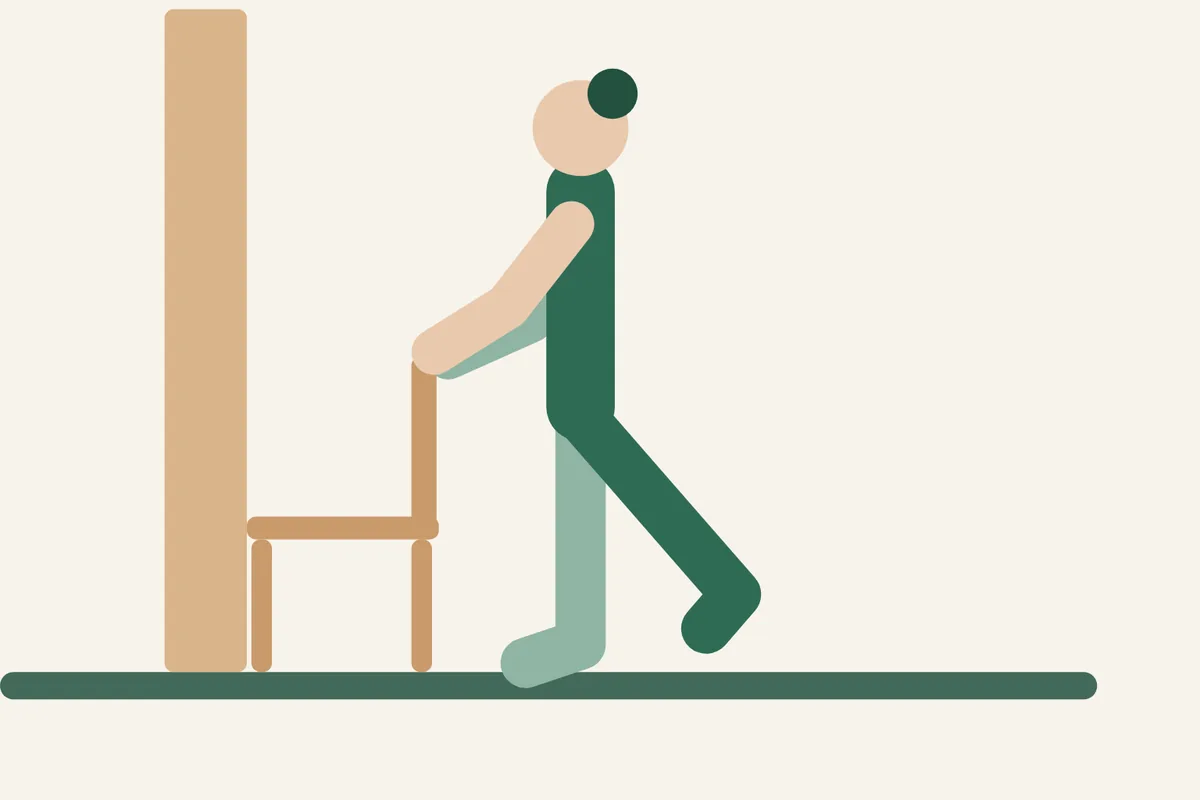
| 5 | Standing back leg lift | Holding a chair | 5 each leg | 5 each leg, holding 5 seconds |
| 6 | Wall plank | Wall | 2 holds of 10 seconds | 3 holds of 30 seconds |
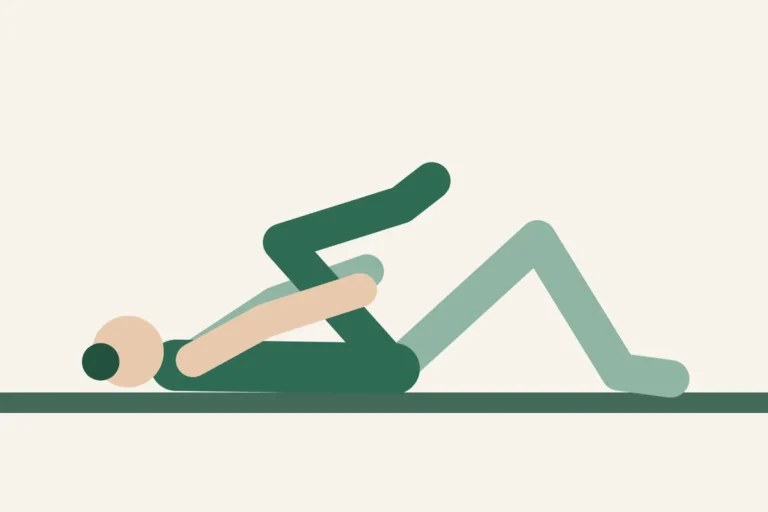
| 7 | Bridge | Floor | 3 to 5 | 10 |
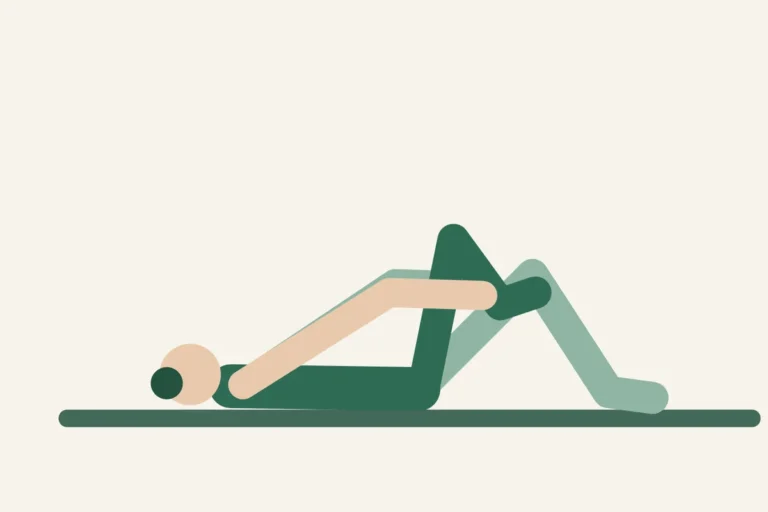
| 8 | Opposite arm and leg raise | Floor | 3 each side | 10 each side |
No floor? Stop after move 6. Six moves make a full session. Starting numbers and the count of brace and plank holds are our cautious plan. Upper repetitions and times come from Cleveland Clinic (moves 2 and 3), its desk plank (move 6), the NHS (move 5) and Harvard Health (moves 1, 4, 7 and 8; its figure for move 4 covers a full chair stand). For paper, use your browser’s print command (Ctrl+P or Cmd+P); we have no PDF.
How to breathe while you brace
Bracing means firming your belly gently, as if drawing your navel toward your spine. Harvard Health suggests doing it before each core exercise and practicing 10-second holds with ordinary breathing.
- Keep air moving. The NIA says not to hold your breath in strength work: exhale on the effort and inhale as you relax.
- Keep holds short. One ACE chair article advises avoiding static isometric (hold-still) exercises with older clients, while Harvard Health teaches 10-second braced holds with normal breathing and Cleveland Clinic a 30-second desk plank. We keep the holds modest, and never with the breath held.
- Count aloud. Our tip: talking makes breath-holding hard.
- Ease off if your face feels tight or you can’t speak (our rule of thumb).
- Stuck? Practice diaphragmatic breathing on its own first.
Seated core exercises: moves 1 to 4
Choose a solid chair without wheels that won’t slide, and sit so your feet rest flat with your knees at a right angle. The NHS prefers no arms for its seated routines. After a hip replacement that changes; see the safety box.
1. Seated belly brace
Works: the muscles wrapping your middle. It sets up every move that follows.
- Move forward on the seat, feet hip-width apart, and lengthen your spine as in a seated Mountain Pose.
- Rest one hand on your belly and the other on your thigh.
- As you breathe out, tighten your lower belly and pull it lightly back.
- Hold that mild effort while you carry on breathing, then let go completely.
Easier: hold for one slow exhale. Harder: keep the same light brace during move 3.
2. Seated pelvic tilt
Works: abdominals and back. The motion is small but rounds your lower back a little. With osteoporosis, keep it very small or leave it out, and ask your doctor or physical therapist (our precaution; Cleveland Clinic says a straight spine is generally safer than bending forward).
- Sit right back against the chair, feet about shoulder-width apart.
- With your chest and shoulders quiet, use your belly and buttocks to roll your pelvis until your lower back presses the backrest.
- Stay a few seconds, breathing, then return to your usual upright sit.
Easier: make the roll tiny. Harder: stay for one or two slow breaths.
Cleveland Clinic teaches this tilt; it is also one of our chair exercises for seniors.
3. Braced seated march
Works: hips and thighs, while your trunk practices staying still. The march is also in our chair exercise guide; here the point is the quiet middle.
- Sit upright, clear of the backrest, holding the sides of the seat.
- Brace lightly, then raise one bent knee only as far as is comfortable.
- Set the foot down softly without tipping back or sideways.
- Alternate legs and keep breathing.
Easier: lift each foot barely off the floor. Harder: rest your hands on your thighs. Hold the seat again if you start to sway.
The steps follow the NHS hip march, which begins with 5 lifts a leg.
4. Supported lean-back
Works: the hip flexors and the front of your trunk as you come upright (our description). This is our seated version of the first part of Harvard Health‘s chair stand, a strength move for getting up from a seat rather than a dedicated core drill; here you finish seated.
- Put the chair’s back against a wall and set a small pillow against the backrest.
- Perch near the front of the seat with both feet planted a little apart and your knees bent.
- Cross your arms, hands on shoulders, and recline onto the pillow about halfway.
- Brace, breathe out and bring your upper body up to a tall sit with your back and shoulders straight, not curled.
- Ease back again as you breathe in.
Easier: push a little with your hands on the seat, or use a plumper pillow to shorten the trip (both our adaptations). Harder: return more slowly, keeping the pillow in place.
If you can only get up by rounding your back or jerking your head forward, stay with moves 1 to 3.
Standing core moves: 5 and 6
Wear stable shoes, or go barefoot on a floor that grips, and keep a sturdy chair, wall or helper close, as the NIA advises for balance work. On days when standing is a bad idea, try chair yoga for seniors.
5. Standing back leg lift
Works: the buttocks, part of the core in Harvard Health’s description, and the back of the thigh.
- Set the front of a chair seat against a wall so it can’t skate away (our setup). Stand behind it and hold its back with both hands.
- Stand tall and brace.
- Breathe out and take one straight leg back a short way, without tipping forward or arching your lower back.
- Hold for up to 5 seconds, lower, and do the other leg.
Easier: slide your toes back along the floor and leave them touching (our version). Harder: lengthen the hold before you add height.
This follows the NHS leg extension. Harvard Health lists a similar chair-supported lift among its osteoporosis exercises.
6. Wall plank
Works: core, arms and shoulders together.
- Face a clear wall at about arm’s length and put your palms on it at chest height, shoulder-width apart.
- Walk your feet back a little so your hands take more weight, arms straight but elbows unlocked.
- Firm your belly and buttocks to make one line from shoulders to feet, hips not sagging toward the wall.
- Breathe through the hold, then walk your feet in before lifting your hands.
Easier: stand closer to the wall. Harder: Cleveland Clinic describes the same plank on a desk edge, with the wall for beginners. Use only a heavy surface that can’t move. Later, if the floor suits you, Harvard’s modified plank goes onto knees and forearms, elbows under shoulders, feet raised behind you, back straight.
Floor core moves: 7 and 8
Try these only if reaching the floor and rising again is no trouble. A physical therapist can show you how, and stretching exercises for seniors says more about getting to a mat. Afterward, sit a moment before standing.
7. Bridge
Works: the buttocks and the whole area between ribs and pelvis.
- Lie on your back with bent knees, both soles down and as wide as your hips, arms alongside you.
- Brace, and keep your back straight.
- Breathe out, push through your heels and lift your hips toward a straight line from shoulders to knees, stopping lower if that is plenty.
- Pause while breathing, then lower slowly on an inhale.
Easier: raise your hips just clear of the floor. Harder: add a few seconds to the pause at the top.
ACE warns that lifting too high tends to arch the lower back. Our Bridge Pose page covers foot placement, a block for support and neck cautions.
8. Opposite arm and leg raise (bird dog)
Works: abdominals, back and buttocks, which work to keep your trunk level.
- Come to hands and knees on a mat, a folded blanket under your knees if you like, with hands below shoulders and knees below hips.
- Gaze at the floor just ahead and brace so your back neither sags nor arches.
- Slowly reach one arm forward and the opposite leg back, only as far as hips and shoulders stay square.
- Pause for a breath, return, and change sides.
Easier: raise both limbs just a little. Harder: work toward limbs level with your trunk and hold a few breaths.
These cues follow ACE’s bird-dog and the Harvard Health version for older adults.
When to move up
Harvard Health puts form before numbers: add repetitions or seconds once a move is easy and tidy, then a set or a harder version. If it’s too much, cut the count or take the easier option.
How often should you do core exercises?
We suggest 2 or 3 days a week with a rest day between. The sources differ a little:
- CDC: adults 65 and older need muscle strengthening on 2 or more days, balance activities, and 150 minutes of moderate aerobic activity each week.
- NHS: work on strength, balance and flexibility, 2 days a week or more.
- NIA: strength work on 2 or more days for the major muscle groups, abdomen and back included, never the same group on back-to-back days.
- Harvard Health: a physical therapist it quotes says the core can be trained daily, while its core-workout tips suggest three times a week for the best gains.
Core work is one slice of the week. Add seated strength work for legs and arms, and give steadiness its own time with balance exercises for seniors. Yoga for seniors shows how our pages fit together.
Why are sit-ups and crunches left out?
A physical therapist quoted by Harvard Health calls them risky for older adults: you pull on your neck, and the effort goes to the hip flexors instead of the core. The NHS does name sit-ups as a general example of body-weight strength work, so advice isn’t unanimous.
Bone health weighs more with us, so we leave them out. Cleveland Clinic says a straight or slightly arched spine is generally safer than forward bending in osteoporosis, because most spine fractures happen bent forward. In a small 1984 study of women aged 49 to 60 with spinal osteoporosis and back pain, further wedge or compression fractures showed up in 89% of 9 who did flexion (forward-bending) exercises, 16% of 25 who did extension (back-arching) exercises, 53% of 19 who did both and 67% of 6 who did no therapeutic exercise (Sinaki and Mikkelsen). Groups were small, and its abstract doesn’t mention random assignment.
Make it easier (props)
- Chair without wheels: park it against a wall for moves 4 and 5.
- Small, firm pillow: for move 4.
- Bare stretch of wall: for move 6, over flooring that grips.
- Mat and folded blanket: only for moves 7 and 8.
Helpful gear for this
 Manduka begin yoga mat, 5 mm
5 mm TPE mat, 68 x 24 in, light to carry, with a center alignment stripe (maker's spec).
See it on Amazon Gaiam foam yoga blocks, pair
Two light foam blocks, 9 x 6 x 4 in each, to raise the floor under your hands (maker's spec).
See it on Amazon Hugger Mugger cotton D-ring yoga strap, 10 ft
Cotton webbing 1.5 in wide with a metal D-ring buckle, 10 ft long (maker's spec).
See it on Amazon
As an Amazon Associate we earn from qualifying purchases. How we choose gear
Who should skip it or ask a doctor first
- Unsure? Any health condition, inactivity or doubt about a move is a reason to ask your doctor first.
- Hip replacement: skip the routine unless your surgeon clears it (our precaution), and follow your physical therapist’s exercises. NHS recovery advice says not to bend the hip more than 90 degrees, not to sit with your legs crossed, and not to do exercises with jumping, sudden turns or a high risk of falling while the hip is recovering. It also rules out low chairs and chairs without arms, so if you are cleared for seated moves, use a chair with arms that isn’t low. Sitting already bends your hip close to a right angle, so lifting a knee in move 3 can take it past 90 degrees, and the floor moves bend the hip too. Even once you are cleared for exercise, leave out moves 3, 7 and 8 until your surgeon or physical therapist says they suit you.
- Hernia: if you have one, ask your provider before any of this. A Cleveland Clinic surgeon advises people with a hernia against strenuous activity or heavy straining, and says providers will likely advise against exercises meant to target or stretch the abdominal muscles. After hernia repair, wait until you are cleared.
- Recent surgery, especially on the belly, back, hips or shoulders: ask your surgeon when and how to start.
- Osteoporosis or low bone density: no sit-ups or crunches, and no added weights without advice. Ask your provider about moves 2 and 4 first, keep move 2 very small or leave it out (our precaution), and keep your back straight in the others. A Mayo Clinic-led review of 89 people hurt doing yoga advised those with weak bones to avoid extreme spinal flexion (deep rounding). After any fracture from osteoporosis, check every move first; Cleveland Clinic says to avoid forward bending, side bending and trunk rotation then. The NIA says to ask your provider which activity is safe.
- High blood pressure or heart disease: ask your doctor before you start. The NIA advises involving your provider as you do more with high blood pressure, and the NCCIH says severe high blood pressure may call for changes to yoga. Moves 1 and 6 are still holds, and moves 5 and 7 can include them. With high blood pressure, ask your doctor whether holds suit you, keep them short and keep breathing.
- Balance problems: stay with the seated moves until your doctor or physical therapist says standing work suits you, and never lean on anything that rolls or folds (our precaution). The NCCIH lists balance problems among reasons to change a yoga practice.
- Back conditions: with lumbar spine disease, ask your doctor or physical therapist first. The NCCIH lists it among conditions that may call for changes to yoga, and notes that yoga injuries treated in emergency departments are more common in people 65 and older.
- Knee, hip, shoulder or wrist trouble: the NCCIH says knee and hip injuries may call for changes. Shorten or skip any move that loads the sore joint.
- Glaucoma: Bridge puts your head lower than your hips. It wasn’t among four inverted-head poses that raised eye pressure in a small study, but check with your eye specialist.
- Pain: stop, particularly for the lower back. If it persists, see a doctor or physical therapist before repeating the move (Harvard Health). Joint pain also means back off (Cleveland Clinic).
- Call 911 for chest pain or heaviness, shortness of breath at rest or with little effort, sudden dizziness or other signs of a possible heart attack, even if you are not sure.
What the research says
Evidence: no good evidence
No study has tested these eight moves as a set, so the label is “No good evidence” for this routine. The findings below belong to other programs.
Trunk strength and function. A trial randomized 64 adults aged 60 and over to 12 weeks of walking and balance exercise, with or without added trunk strengthening and control work (32 per group). Against walking and balance alone, the trunk group gained more trunk strength, did about 6 more chair stands in 30 seconds, reached farther and was 0.76 seconds faster on a timed up-and-go test. Some gains slipped during 6 later weeks of walking only, though results stayed better than at the start (Shahtahmassebi et al., 2019). A second analysis of the same people found no significant difference between groups in physical activity, fear of falling, or anxiety or depression symptoms (Shahtahmassebi et al., 2022).
Balance tests. A 2025 review included 11 studies with 442 healthy older adults (average age 60 or more); some used Pilates and some had no control group. Pooled results favored core training for functional reach (4 studies, 127 people) and standing on one leg, by about 3 seconds (3 studies, 157 people). The timed up-and-go result (3 studies, 141 people) was borderline and varied widely, and walking speed was significant in one of the paper’s analyses but not another. The authors asked for more rigorous trials. The review does not report side effects (Zhong et al., 2025).
A weaker result. In a pilot study of 23 older adults with at least one fall risk factor, the authors concluded that adding core stability training to balance exercises did not improve sit-to-stand counts, although a difference appeared among those who completed it (Arnold et al., 2015).
Yoga and a curl-up test. In a controlled trial without random assignment, 173 Hong Kong adults aged 31 to 71 (average 52) either took 12 weeks of Hatha yoga or went on a waiting list. Curl-up scores improved more with yoga overall. Among those aged 53 and over (47 in yoga, 41 waiting), the difference was not significant. No serious adverse events were reported (Lau et al., 2015).
What is missing. The exercise studies above didn’t count falls, and our PubMed searches found no yoga trial of core strength made up only of older adults.
Frequently asked questions
Can you do core exercises with osteoporosis?
Often yes, with changes agreed with your provider. Harvard Health encourages people with osteoporosis to stay active, while advising those who have broken spine bones to avoid forward bending, reaching down, twisting and heavy lifting. Skip sit-ups and crunches.
Will core work improve my balance?
A review of other core programs found better scores on some balance tests, but nobody has shown that for this routine. To work on it directly, use balance exercises for older adults.
What if my lower back hurts?
Stop the move that hurts, and have it checked if the pain stays. Our yoga for lower back pain guide lists the warning signs that need medical care.
Sources
- Centers for Disease Control and Prevention (CDC). Older Adult Activity: An Overview. Page dated December 4, 2025., checked Nov 27, 2026
- NHS. Physical activity guidelines for older adults. Page last reviewed August 15, 2024., checked Nov 27, 2026
- National Institute on Aging (NIA). Three Types of Exercise Can Improve Your Health and Physical Ability. Content reviewed January 14, 2025., checked Nov 27, 2026
- National Institute on Aging (NIA). Exercising With Chronic Conditions. Content reviewed January 14, 2025., checked Nov 27, 2026
- NHS. Strength exercises. Page last reviewed February 28, 2024., checked Nov 27, 2026
- NHS. Sitting exercises. Page last reviewed January 18, 2024., checked Nov 27, 2026
- NHS. Recovering from a hip replacement. Page last reviewed March 6, 2024., checked Nov 27, 2026
- National Center for Complementary and Integrative Health (NCCIH). Yoga: Effectiveness and Safety. Last updated August 2023., checked Nov 27, 2026
- Harvard Health Publishing. The best core exercises for older adults. April 1, 2021., checked Nov 27, 2026
- Harvard Health Publishing. Core exercise workout: 12 tips for exercising safely and effectively. July 20, 2016., checked Nov 27, 2026
- Harvard Health Publishing (Klein S; reviewed by Shmerling RH). Chair exercises for seniors: boosting strength, flexibility, and stamina. January 9, 2025., checked Nov 27, 2026
- Harvard Health Publishing. Effective exercises for osteoporosis. April 11, 2021., checked Nov 27, 2026
- Cleveland Clinic (Jevnikar T, PT). 11 chair exercises for seniors, older adults and people with limited mobility. April 18, 2024., checked Nov 27, 2026
- Cleveland Clinic. 6 desk exercises that help you get stronger while working. January 19, 2023., checked Nov 27, 2026
- Cleveland Clinic. The best workouts for osteoporosis. January 12, 2021., checked Nov 27, 2026
- Cleveland Clinic. Can heavy lifting and exercise cause a hernia? October 20, 2023., checked Nov 27, 2026
- American Council on Exercise (ACE). Exercise Library: Glute Bridge Exercise., checked Nov 27, 2026
- American Council on Exercise (ACE). Exercise Library: Bird-dog., checked Nov 27, 2026
- Antoian F. Chair exercises for older adults: 5 for strength, flexibility and balance. ACE Fitness. Last updated October 22, 2026., checked Nov 27, 2026
- Shahtahmassebi B, Hebert JJ, Hecimovich M, Fairchild TJ. Trunk exercise training improves muscle size, strength, and function in older adults: a randomized controlled trial. Scand J Med Sci Sports. 2019;29(7):980-991., checked Nov 27, 2026
- Shahtahmassebi B, Hatton J, Hebert JJ, et al. The effect of the inclusion of trunk-strengthening exercises to a multimodal exercise program on physical activity levels and psychological functioning in older adults: secondary data analysis of a randomized controlled trial. BMC Geriatr. 2022;22(1):738., checked Nov 27, 2026
- Zhong Y, Guo W, Chen P, Wang Y. Effects of core training on balance performance in older adults: a systematic review and meta-analysis. Front Public Health. 2025;13:1661460., checked Nov 27, 2026
- Arnold C, Lanovaz J, Oates A, Craven B, Butcher S. The effect of adding core stability training to a standard balance exercise program on sit to stand performance in older adults: a pilot study. J Aging Phys Act. 2015;23(1):95-102., checked Nov 27, 2026
- Lau C, Yu R, Woo J. Effects of a 12-week hatha yoga intervention on cardiorespiratory endurance, muscular strength and endurance, and flexibility in Hong Kong Chinese adults: a controlled clinical trial. Evid Based Complement Alternat Med. 2015;2015:958727., checked Nov 27, 2026
- Lee M, Huntoon EA, Sinaki M. Soft tissue and bony injuries attributed to the practice of yoga: a biomechanical analysis and implications for management. Mayo Clin Proc. 2019;94(3):424-431., checked Nov 27, 2026
- Sinaki M, Mikkelsen BA. Postmenopausal spinal osteoporosis: flexion versus extension exercises. Arch Phys Med Rehabil. 1984;65(10):593-596., checked Nov 27, 2026
- Jasien JV, Jonas JB, de Moraes CG, Ritch R. Intraocular pressure rise in subjects with and without glaucoma during four common yoga positions. PLoS One. 2015;10(12):e0144505., checked Nov 27, 2026
- National Heart, Lung, and Blood Institute (NHLBI). Heart attack: symptoms. Last updated March 24, 2022., checked Nov 27, 2026
Image credits: Illustration: YogaForFitness (vector figure), drawn from the steps above