Best Yoga Mats for Beginners: How to Choose by Thickness, Grip and Size
Quick answer
For a first yoga mat, look for roughly 4 to 6 mm of cushioning, a surface your hands and feet don't slide on, and a length at least equal to your height. Go thicker only if kneeling on a standard mat is uncomfortable, and thinner only for travel. We have not tested any mat by hand, so the four picks in this guide are matched to needs from the makers' own specifications, not ranked.
We may earn a commission when you buy through links on this page. It never changes what we recommend. As an Amazon Associate we earn from qualifying purchases.
A yoga mat has two jobs. It stops your hands and feet from sliding, and it puts a little padding between you and the floor. Everything else on a product page is a trade-off between those two jobs, plus how much mat you are willing to carry and clean.
First, what this guide is and what it is not. We have not tested any of these mats by hand, so you won’t find a ranking or a single winner here. We wrote down the criteria first, then matched four mats to four common needs using the makers’ own published specifications. No company paid to be included. The method is explained on How we choose gear, and this guide belongs to our gear section.
In this guide
- Do you need a yoga mat to start?
- How thick should a beginner’s yoga mat be?
- Which yoga mat material is right for a beginner?
- Why do hands slip on a yoga mat?
- Latex sensitivity and slipping
- What size yoga mat do you need?
- How do you clean and care for a yoga mat?
- What should beginners skip?
- Picks by need: four mats matched to four situations
- Frequently asked questions
- Sources
Do you need a yoga mat to start?
Not for floor poses in your very first sessions. Our first-month guide, yoga for beginners, covers what you can do without one, and how to start yoga at home has a table of what works on wood, tile and carpet.
A mat starts to earn its place once you add standing poses and poses where your hands and feet push away from each other, such as Downward-Facing Dog. So the first thing to buy a mat for is grip. Padding comes second.
How thick should a beginner’s yoga mat be?
There is no research-backed number. What we can say is what the makers sell: most everyday yoga mats from the two makers in this guide are 4 to 6 mm, so that is a sensible place to start. On Gaiam’s yoga mat page, the thickness filter listed 2, 3, 4, 5, 6 and 10 mm when we checked, and 26 of the 42 mats counted in that filter were 6 mm (the filter also counts kids’ and fitness mats). Manduka’s menu lists its everyday yoga mats at 4, 4.7, 5 and 6 mm and its travel mats at 1.5 and 2 mm (Manduka).
| Thickness | In inches | What you gain | What you give up |
|---|---|---|---|
| 1.5–2 mm | Under 0.1 in | A mat that folds into a bag and weighs little | Padding: there is very little material between you and the floor |
| 4–6 mm | About 0.16–0.24 in | Some padding, at a thickness most everyday mats are sold in | A heavier roll as thickness goes up |
| 10 mm | About 0.4 in | The most cushion under knees, hips and spine in floor work | Possibly some firmness underfoot in standing and balance poses (not measured; see below); a bulkier roll |
Thickness is only half of it. Density matters as well. Manduka calls its 6 mm PRO high-density and says it gives “floor-like stability” (Manduka), while the 10 mm mat in this guide is NBR foam that its maker sells as a fitness mat for ab work, toning and stretching (Gaiam). Gaiam’s page gives no density or firmness figure. Manduka’s president, writing for beginners, argues that a mat with too much softness can make balancing harder (Manduka Mag). That is a maker’s view, not a trial result.
Is there research behind it? Only indirectly. In one balance study, 30 healthy adults standing still with their feet together tended to sway more as layers of medium-density foam were added under them (Kong et al., 2007). The foam was described as 4.7 cm high, though, many times thicker than a yoga mat, and we found no study that compared yoga mats of different thickness in people. So treat “thick and soft means wobbly” as a reasonable expectation, not a measured fact about any mat here.
What if kneeling hurts on a standard mat?
A thicker mat puts more cushion under your knees. You can also add cushion only where you need it: fold the edge of your mat double, or slide a folded blanket under your knees in Cat-Cow and Low Lunge. That keeps the rest of the mat firm for standing poses. A mat is padding, not a treatment. If your knees hurt in daily life or keep hurting in practice, ask a doctor or physical therapist before you look for a fix in gear.
Which yoga mat material is right for a beginner?
The table gives what the makers of the four mats in this guide state on their own pages. We have not lab-tested any material, and we use makers’ pages for specifications only, never as health evidence.
| Material | Example (maker’s page) | What the maker states | Keep in mind |
|---|---|---|---|
| PVC (polyvinyl chloride) | Manduka PRO | Closed-cell surface that keeps sweat out and wipes clean; latex-free; dense and firm | The same page says it may feel slick if you sweat a lot |
| TPE (thermoplastic elastomer) | Manduka begin | Lightweight (2.5 lb at 5 mm); closed-cell; latex-free | Wipe only: no soaking, no machine washing |
| Natural rubber | Manduka eKO SuperLite | Textured surface for traction; closed-cell | Not for people with latex sensitivity; keep out of sun and heat |
| NBR foam (Gaiam’s term) | Gaiam Essentials 10 mm | Extra-thick foam with ridges for traction | The page gives no weight and no statement on latex or on closed-cell construction; care steps are in a PDF linked from the page |
You will also see mats with a polyurethane (PU) top layer. Manduka explains that an open-cell PU surface soaks up moisture the way a sponge does. The cost is care: such a mat has to dry fully before you roll it, and skin oils and lotions can leave marks that cleaning may not remove (Manduka care guide). Cork-topped mats exist too, but none of the maker pages we read covers cork, so we make no claims about it.
What do independent bodies say about mat materials?
Very little that is specific to yoga mats, so we won’t guess. What a buyer can look for is a third-party label. Manduka states that its PRO series is certified to STANDARD 100 by OEKO-TEX (Manduka). OEKO-TEX is a testing and labeling organization separate from the maker, and it says every item that carries this label has passed its tests for harmful substances (OEKO-TEX). We did not look up the certificate ourselves. The pages for the other three mats name no outside certification, which is not evidence of a problem.
Why do hands slip on a yoga mat?
Mostly because of moisture, and what the mat’s surface does with it. Manduka’s grip guide splits mats into two kinds:
- Closed-cell mats don’t let moisture in. They are easy to wipe clean, but sweat stays on top. The three Manduka mats in this guide are closed-cell, according to their pages. Gaiam’s page doesn’t say either way.
- Open-cell mats take moisture in. Manduka says many people prefer them for hot, sweaty classes. They need more drying and care.
Which kind suits you depends on whether your hands are usually dry or damp when you practice.
- Mostly dry hands, gentle classes at home: a closed-cell mat is the simple choice.
- Sweaty hands, or heated classes: plan on a yoga towel over a closed-cell mat, or look at an open-cell mat. The makers’ pages for both the PRO and the eKO SuperLite say those mats may feel slick if you are prone to sweat, and suggest a towel.
- Either way: the same grip guide advises skipping hand lotion right before practice and cleaning the mat regularly, because oils and residue build up on the surface.
Manduka says a new PRO may feel a little different for the first few practices, and its advice is plain practice, with no salt scrub or other treatment (Manduka). Its guarantee doesn’t cover slipping.
Latex sensitivity and slipping
- Natural rubber and latex. Natural rubber is made from rubber-tree sap, and people with a latex allergy react to proteins in it. Symptoms can include hives, itching, a stuffy or runny nose and asthma symptoms, and in rare cases a severe reaction called anaphylaxis (ACAAI; MedlinePlus). Both sources say avoiding latex is the best approach. Manduka labels the eKO SuperLite “99% latex-free” and still says it is not recommended for people with latex sensitivities (Manduka). If you have a latex allergy, or think you might, choose a mat whose maker states it is latex-free, and ask an allergist about anything you are unsure of.
- Slipping. If your hands or feet start to slide, come out of the pose, dry your hands and the mat, and start again. Do balance poses such as Tree Pose within reach of a wall. A mat that slides on the floor itself needs a different surface under it, not more effort from you.
What size yoga mat do you need?
Long enough to lie on with your head and heels both on the mat. That makes your own height the number to beat.
The three Manduka mats here are 68 in (5 ft 8 in), 71 in (5 ft 11 in) and, for the long PRO, 85 in (7 ft 1 in). For the Gaiam mat, the maker’s page says 72 in (6 ft), but the title of the Amazon listing we link to gave a different length when we checked, so read the size on the listing.
Manduka’s own rule of thumb is to look for an extra-long mat if you are taller than 1.80 m, which is about 5 ft 11 in (Manduka Mag). Width varies less. The begin mat and the eKO SuperLite are 24 in wide, Gaiam’s page gives 23.6 in, and the PRO is 26 in. Sizes can differ between sellers’ listings of what looks like the same mat, so read the dimensions on the listing itself before you order.
Weight matters if you walk or ride to class. The makers list 2.2 lb for the eKO SuperLite, 2.5 lb for the begin mat, and 9.5 lb for the PRO in its long size (7.5 lb in the standard 71 in size). Gaiam’s page gives no weight for the Essentials mat.
How do you clean and care for a yoga mat?
Follow the maker’s instructions for your mat, because the right method depends on the material. Manduka’s care guide and product pages give these basics for the three Manduka mats in this guide:
- After practice: wipe the surface with a clean cloth, and let the mat dry completely before you roll it.
- Closed-cell PVC (PRO): the maker’s mat wash or plain warm water, then wipe dry. Manduka says it has not tested other cleaners. Roll it with the top side facing out.
- TPE (begin): warm water and a cloth. No harsh chemicals, hard scrubbing or washing machine.
- Natural rubber (eKO SuperLite): a damp cloth and the maker’s rubber cleaner, then air dry flat or hanging. Store it away from direct sun, hot cars and heaters.
- All three: never soak or submerge the mat.
For the NBR foam mat, Gaiam’s care sheet for its fitness mat says to dry it with a towel after use, wipe it with a damp cloth, let it air dry, keep it away from heat and strong sun, and store it somewhere cool and dry.
Cleaning is not the same as disinfecting. Manduka’s guide points out that a routine wipe removes sweat and dirt but does not disinfect the surface, and says to check a mat’s care instructions before using a household disinfectant.
What should beginners skip?
- Buying for looks first. Check thickness, length, material and care before color.
- A very thick mat as your only mat, if you plan to do standing and balance poses.
- A travel mat as your only mat. At 1.5 mm it is a thin layer for grip, not padding.
- Natural rubber, if you have or suspect a latex allergy.
- Any mat whose listing doesn’t state the material and the size.
- A full set of accessories on day one. Our beginner guides use two blocks and a strap at most; see how to use yoga blocks and how to use a yoga strap.
Picks by need: four mats matched to four situations
These are matches, not rankings. Each mat is here because its published specifications fit one need, and every number comes from the maker’s own page, read on November 13, 2026. A seller’s listing can differ from the maker’s page, so confirm the size on the listing before you order. Return rules depend on the seller you buy from, so read them on the listing too.
| Need | Mat | Thickness | Size | Weight | Material |
|---|---|---|---|---|---|
| A light everyday first mat | Manduka begin | 5 mm | 68 x 24 in | 2.5 lb | TPE |
| More cushion for floor work | Gaiam Essentials | 10 mm | Check the listing (see below) | Not stated | NBR foam |
| Tall people | Manduka PRO, long | 6 mm | 85 x 26 in | 9.5 lb | PVC |
| Travel | Manduka eKO SuperLite | 1.5 mm | 71 x 24 in | 2.2 lb | Natural rubber |
A light everyday first mat: Manduka begin, 5 mm
Best for: home practice and carrying to a class now and then, if you are 5 ft 8 in or shorter.
The begin mat sits in the middle of the everyday thickness range. Manduka describes its 5 mm cushion as soft and suited to gentle movement, and publishes no density figure. It describes the mat as lightweight and portable, with a closed-cell surface, a stripe down the center as a visual guide for placing your hands and feet, and two usable sides. It is labeled latex-free, and care is a cloth and warm water. It comes in one length only. Manduka’s lifetime guarantee names its PRO mats only, and the begin page mentions no guarantee (specs).
 See the Manduka begin mat on Amazon
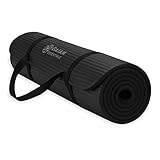
More cushion for floor work: Gaiam Essentials, 10 mm
Best for: kneeling, seated and lying-down work when a standard mat feels too hard, and for stretching and core exercises.
At 10 mm this is the thickest mat here, twice the begin mat. Gaiam describes it as extra-thick foam with ridges for traction and includes a nylon carry strap. Gaiam calls it a fitness mat, and the uses it names are ab work, toning and stretching. It names no standing or balance use and says nothing about firmness, so we can’t tell you how steady it feels in standing poses; see the thickness section above. The page doesn’t say whether the foam is latex-free. The product page says it comes with Gaiam’s lifetime guarantee, whose terms are written for Gaiam yoga mats and cover manufacturing defects only, for the original buyer, for US residents. An older Gaiam care sheet for its fitness mat says the product is sold without a guarantee, so ask Gaiam before you count on it (specs; guarantee; care sheet).
Watch out for: the size. Gaiam’s own page gives 72 x 23.6 in. The title of the Amazon listing we link to said 68 x 24 in when we checked on November 13, 2026. We can’t tell you which is right, so if length matters to you, read the dimensions on the listing itself before you order.
 See the Gaiam Essentials 10 mm mat on Amazon
Tall people: Manduka PRO, long size
Best for: anyone who runs out of mat on a standard length, and people who want a firm, dense mat that stays at home.
The long PRO is over a foot longer than a 71 in standard mat and about 2 in wider than the other three. It is dense, closed-cell PVC, made in Germany and labeled latex-free. At 9.5 lb it is not a mat to carry far. Manduka warns that the surface may feel slick if you sweat a lot and suggests a towel. The PRO series carries Manduka’s lifetime guarantee. The terms describe a mat’s lifetime as about 10 years of regular use, allow one replacement, and apply to mats bought from Manduka or an authorized seller in the United States. We could not confirm which Amazon sellers Manduka counts as authorized, so check who the seller is and keep your receipt; Manduka asks for proof of purchase. Confirm the 85 in length on the listing before you order (specs; guarantee).
 See the Manduka PRO long mat on Amazon
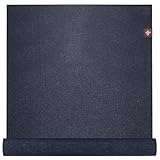
Travel: Manduka eKO SuperLite, 1.5 mm
Best for: a suitcase or backpack, or as a personal layer over a studio’s mat.
The eKO SuperLite is a thin sheet of natural tree rubber that can be folded for packing. The surface is closed-cell with a texture for traction, and Manduka notes it can be laid over a studio mat. At 1.5 mm there is very little material between you and the floor, so it suits travel better than daily practice. Because it is natural rubber, Manduka does not recommend it for people with latex sensitivities, and it needs to be kept out of sun and heat (specs).
 See the Manduka eKO SuperLite travel mat on Amazon
Frequently asked questions
Is a thick yoga mat better?
Not automatically. More thickness means more cushion under your knees in floor poses, and it may mean less firm footing in standing ones. The makers’ everyday yoga mats sit around 4 to 6 mm.
How long does a yoga mat last?
It depends on the material, how often you use it and how you care for it. The one figure we found is in Manduka’s guarantee terms, which put the lifetime of a PRO mat at about 10 years of regular use when it is cared for properly (Manduka).
Sources
- Manduka. begin yoga mat 5mm (product page: specs, use and care)., checked Nov 13, 2026
- Manduka. Manduka PRO yoga mat 6mm (product page: specs, use and care, product FAQ)., checked Nov 13, 2026
- Manduka. eKO Travel Superlite yoga mat 1.5mm (product page: specs, use and care)., checked Nov 13, 2026
- Gaiam. Gaiam Essentials Fitness Mat & Sling (10mm) (product page)., checked Nov 13, 2026
- Gaiam. Yoga mats (collection page with thickness filter)., checked Nov 13, 2026
- Manduka. How to Clean a Yoga Mat: Care Guide by Mat Type. Manduka Mag. November 2, 2026; updated November 10, 2026., checked Nov 13, 2026
- Manduka. A Guide to Stronger Grip and More Confidence on the Mat. Manduka Mag. September 8, 2026; updated October 7, 2026., checked Nov 13, 2026
- Appleby J. How to Choose Your First Yoga Mat: A Guide for Beginners. Manduka Mag. February 5, 2026; updated August 19, 2026., checked Nov 13, 2026
- Manduka. A Few Things To Consider Before Buying A Mat. Manduka Mag. October 26, 2023; updated August 19, 2026., checked Nov 13, 2026
- Manduka. Manduka PRO Lifetime Guarantee (limited warranty)., checked Nov 13, 2026
- Gaiam. Gaiam Yoga Mat Lifetime Guarantee (terms and conditions)., checked Nov 13, 2026
- American College of Allergy, Asthma and Immunology (ACAAI). Latex Allergy., checked Nov 13, 2026
- MedlinePlus (U.S. National Library of Medicine). Latex Allergy., checked Nov 13, 2026
- OEKO-TEX. OEKO-TEX STANDARD 100., checked Nov 13, 2026
- Kong WJ, Liu B, Wu Q, Wu YY. [Postural characteristics of healthy subjects under different thickness of foam]. Zhonghua Er Bi Yan Hou Tou Jing Wai Ke Za Zhi. 2007;42(10):721-5. Article in Chinese; English abstract., checked Nov 13, 2026
- Gaiam. Fitness Mat: Setup, Workout Tips and Care & Safety Guide (PDF, 2016), linked from the Essentials Fitness Mat product page., checked Nov 13, 2026
Image credits: Illustration: AI-generated for YogaForFitness (FLUX.1-schnell)