Yoga Nidra: What It Is and How to Practice It
Quick answer
Yoga nidra is a guided practice you do lying down or in another supported resting position, following a voice that leads your attention through your body and breath. To try it, get comfortable somewhere safe, play or read a short session, stay awake if you can (dozing off is common) and take your time getting up.
We may earn a commission when you buy through links on this page. It never changes what we recommend. As an Amazon Associate we earn from qualifying purchases.
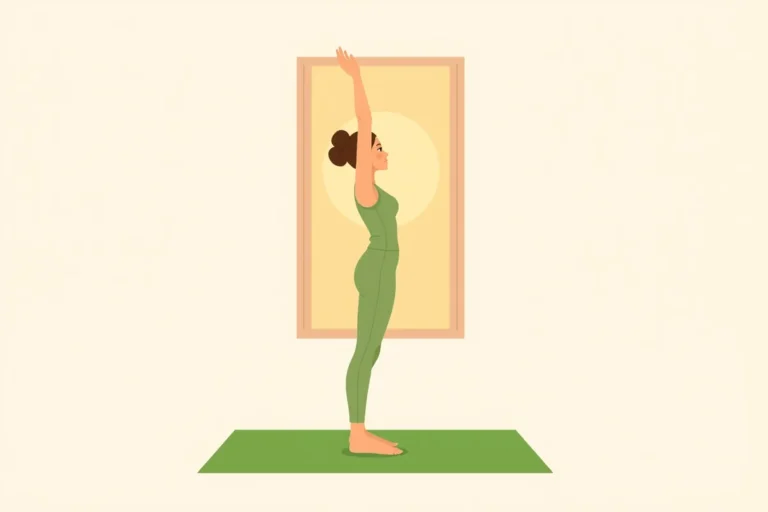
Yoga nidra is a guided rest practice. You settle into a comfortable position, stay still and listen as a teacher or a recording leads your attention around your body, to your breath and sometimes into simple imagery. The aim is to feel deeply relaxed while some awareness stays switched on. You don’t need flexibility or any experience with poses.
The name is often translated as “yogic sleep,” which causes some confusion and some big promises. Below you’ll find how it differs from sleep, a beginner method, a short script, safety advice and an honest look at the research. For more practice plans, browse our Routines guides.
In this guide
- What is yoga nidra?
- Is it sleep, a nap or meditation?
- How to do yoga nidra, step by step
- Make it easier (props and positions)
- How long should a session be?
- A short yoga nidra script to record or read
- Who should take care or ask a doctor first
- What the research says about the benefits
- Frequently asked questions
- Sources
What is yoga nidra?
It’s a meditation practice with a set path, usually done lying down. A 2026 research review credits the Indian teacher Swami Satyananda Saraswati with standardizing the practice in 1976 and describes a typical seven-part format:
- Getting ready.
- Setting an intention, called a sankalpa in Sanskrit.
- Rotating attention through the parts of the body.
- Watching the breath.
- Noticing feelings and emotions.
- Visualizing.
- Ending the session.
Not every teacher follows that outline. Cleveland Clinic presents a ten-step version from the teacher Richard Miller, and an 11-minute research recording used fewer stages. The review also names adapted forms, including iRest and “non-sleep deep rest” (NSDR), that leave out religious or mystical elements. If a study tested one recording or program, its results don’t automatically carry over to another.
Is it sleep, a nap or meditation?
It overlaps with all three, but the goal is different from sleep: you try to keep following the guide.
| Practice | What you do | The aim |
|---|---|---|
| Yoga nidra | Rest still and follow spoken cues | Deep relaxation with some awareness |
| Nap | Close your eyes and let go | Sleep |
| Seated meditation | Sit and focus your mind | Awake, steady attention |
| Savasana | Rest lying down, often to end a yoga class | Quiet relaxation |
Compared with sleep. In a lab study, 26 healthy adults who had practiced for two weeks were wired up to record brain waves, eye movements and muscle activity. By standard sleep scoring, they were awake for the whole practice, although a central area of the brain showed more of the slow-wave activity associated with sleep. The authors concluded that the practice can’t be equated with natural sleep. That was a small, morning study of beginners with no comparison group, and it doesn’t mean you won’t doze off. A teacher writing for Yoga International points out how easily people drift off in this practice.
Compared with a nap. One yoga teacher draws the line at conscious attention, which you keep in the practice and lose when you sleep (Yoga International). We found no study on PubMed that tested yoga nidra head to head against a nap. We also found nothing showing that a session can replace a night’s sleep, whatever you may read elsewhere.
Compared with meditation. It counts as a form of guided meditation. The yoga therapist quoted by Cleveland Clinic contrasts it with seated, waking meditation: here you lie down, follow a highly structured guide and move toward a deeper state of rest.
How to do yoga nidra, step by step
A recording or a teacher is the easiest way to begin, because you don’t have to remember what comes next. If you guide yourself, go slowly. The stages below loosely follow the seven-part outline described above, with tips from Yoga International’s teaching articles, in our own words.
- Choose a safe time and place. You should be free to close your eyes and even fall asleep, so never practice while driving or operating machinery.
- Get into position. Choose a setup from the table below, cover yourself and let your arms and legs rest where they need no effort. If you’re pregnant, ask your provider first and don’t lie on your back (see the caution box). You can move later if something hurts.
- Arrive. Listen to the sounds around you. Feel where the floor, bed or chair holds your weight. Let your eyes close, or keep them softly open.
- Set an intention, if you want one. Pick one short, kind sentence about why you’re here, such as “I’m giving myself time to rest.” Say it silently.
- Travel through your body. Name one place at a time, in an order you can remember: head, face, each arm, trunk, each leg. Notice what’s there, or that you feel nothing in particular. You don’t need to move or relax anything on command.
- Watch your breath. Feel it at your nose, ribs or belly without changing its pace. Counting each out-breath can give a wandering mind something to hold. If you’d rather practice changing your breath, that’s a separate skill: see diaphragmatic breathing or box breathing.
- Explore a sensation or image (optional). Some guides invite you to imagine heaviness and then lightness, or to picture a calm place. Skip this stage if it stirs up anything unpleasant.
- Return to your intention. Repeat your sentence once, then let it go.
- Come out gradually. Notice the room, take a fuller breath and move your fingers and toes. If you’re on your back, roll to one side. Push up to sit and stay there for a moment before standing. If you get dizzy when you stand, the NHS advises moving slowly from lying to sitting to standing.
If you fall asleep or can’t settle
Dozing off isn’t a failure. To stay more alert, Yoga International suggests a shorter session, a time of day when you have energy, or a seated or side-lying position. If you’re on your back, you can also keep your upper arm on the floor with your forearm raised, so that it drops if you nod off. A busy mind is normal too; Cleveland Clinic advises giving the practice a few tries.
Make it easier (props and positions)
Comfort comes first. You can use any of these setups.
| Position | How to set it up |
|---|---|
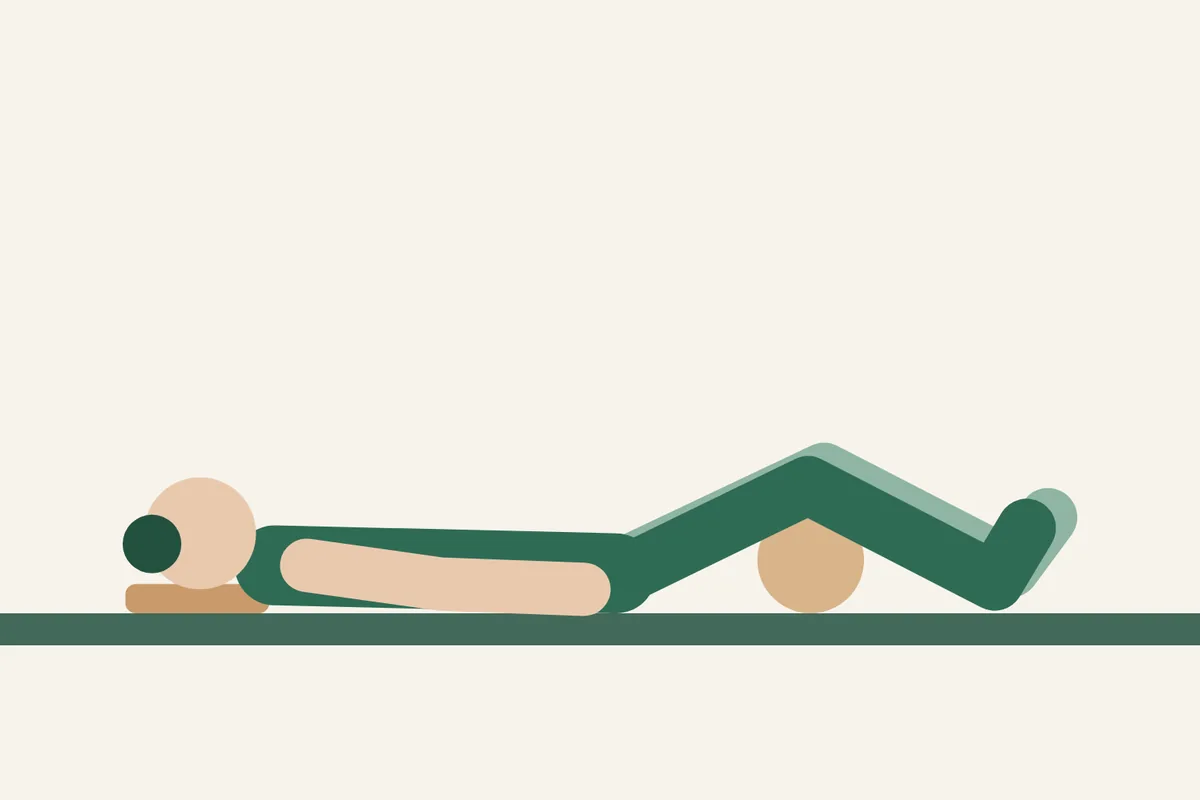
| On your back | Support your head with a pillow and put a bolster or folded blanket under your knees. Cleveland Clinic also suggests support under your lower back and spine. Not for pregnancy. |
| On your side | Bend your knees a little. Rest your head on a folded blanket, put a pillow or bolster between your thighs and, if you like, another behind your back (Yoga International). |
| In a chair | Sit tall with your hands in your lap and your feet flat on the floor, or on blocks if they don’t reach (Yoga International). |
| Bed or recliner | A fine option if lying on the floor isn’t comfortable (Cleveland Clinic). |
A dim, quiet room helps. Cleveland Clinic suggests a blanket, since your body tends to cool as you rest, and an eye mask if light bothers you. Silence your phone’s alerts. If you set a timer, choose a soft sound so you aren’t startled.
Helpful gear for this
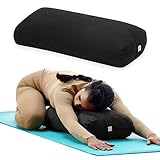 Gaiam rectangular yoga bolster
Rectangular bolster, 25 x 12 x 5 in, with a removable, machine-washable cover (maker's spec).
See it on Amazon Hugger Mugger cotton yoga blanket
Woven cotton blanket to fold, roll or stack under your hips or knees (maker's description).
See it on Amazon Gaiam foam yoga blocks, pair
Two light foam blocks, 9 x 6 x 4 in each, to prop a bolster or rest under your forehead (maker's spec).
See it on Amazon
As an Amazon Associate we earn from qualifying purchases. How we choose gear
How long should a session be?
There’s no single standard. These are starting points from teaching sources and studies, not a prescription.
| Source | Session length |
|---|---|
| Yoga International, if you keep dozing | 5 to 10 minutes at first, building toward 40 or more |
| Cleveland Clinic, for beginners | 15 or 20 minutes at first |
| A YogaEasy teacher, describing iRest-style classes | Usually around 35 minutes |
| An online trial | 11 or 30 minutes, ideally daily |
| A heart-patient trial | 35 minutes, 27 sessions over 12 weeks, plus recordings |
Pick a length you can finish without feeling restless.
A short yoga nidra script to record or read
This original script takes roughly 10 minutes with its pauses. Record it in your own voice, or have someone read it slowly. Pause where the parentheses say, and lengthen the pauses if you want more time. It doesn’t assume any particular position.
Arriving. This time is for resting. There’s nothing to get right. Close your eyes, or let them rest on one spot. You can move, open your eyes or stop whenever you like. If you fall asleep, that’s all right. (Pause 15 seconds.)
Notice what is holding you up, and let it take your weight. (Pause 15 seconds.) Hear the farthest sound you can. Now a nearer one. Now the quiet between them. (Pause 20 seconds.)
Intention. If you’d like one, bring a short sentence to mind, perhaps “I can rest for a few minutes.” Say it silently. (Pause 10 seconds.)
Body. As I name each place, notice it, then move on. Leave out any place you prefer to skip.
The top of your head. Forehead. Eyes. Cheeks. Jaw. Throat. Back of the neck. (Pause 10 seconds.)
Left shoulder. Upper arm. Elbow. Forearm. Wrist. Palm. Thumb and each finger. (Pause 10 seconds.)
Right shoulder. Upper arm. Elbow. Forearm. Wrist. Palm. Thumb and each finger. (Pause 10 seconds.)
Chest. Upper back. Ribs. Belly. Lower back. Hips. (Pause 10 seconds.)
Left thigh. Knee. Shin and calf. Ankle. Heel. Sole. Toes. (Pause 10 seconds.)
Right thigh. Knee. Shin and calf. Ankle. Heel. Sole. Toes. (Pause 10 seconds.)
Now sense your whole body at once. (Pause 30 seconds.)
Breath. Find the place where breathing is easiest to feel. Let it come and go at its own speed. (Pause 30 seconds.) Silently count each breath out, from ten down to one. If you lose your place, begin again or simply feel the breath. (Pause 90 seconds.)
Sensation. Imagine your hands growing heavy. (Pause 20 seconds.) Now imagine them light. (Pause 20 seconds.) Whatever you feel, or don’t, is fine.
Place. Picture an ordinary spot where you feel at ease, such as a porch, a garden or a favorite chair. Notice one color there, and one sound. If no picture comes, or it isn’t comfortable, listen to the room instead. (Pause 60 seconds.)
Closing. Bring back your sentence, once. (Pause 10 seconds.) Feel what is holding you up. Hear the sounds around you. Take a fuller breath. Wiggle your fingers and toes, and stretch if that feels good. Open your eyes when you’re ready. If you’re lying on your back, roll to one side. Rest there, then sit up slowly. Stay seated for a few breaths before you stand.
Who should take care or ask a doctor first
- While driving or operating machinery: don’t listen to relaxation recordings (Torbay and South Devon NHS). That includes a recording of the script above.
- Epilepsy, certain psychiatric conditions, or a history of abuse or trauma: NCCIH says rare reports suggest some relaxation techniques might cause or worsen symptoms. Talk with your doctor or therapist before you try this.
- Flashbacks, distress or feeling detached: these reactions have been reported with yoga nidra in particular, according to a paper on trauma-informed practice. It stresses choice and consent, a safer, comfortable setting, careful use of imagery and flexibility in the body and breath stages. A qualified teacher or clinician with trauma experience can help you decide whether and how to practice.
- If you feel worse: people occasionally report more anxiety, intrusive thoughts or a fear of losing control with relaxation techniques (NCCIH). You can stop at any point. If it leaves you more distressed or caught in worrying thoughts, stop and talk with a health professional before you try again (Torbay and South Devon NHS). For meditation in general, a review of 83 studies concluded that about 8% of participants had a negative effect, most commonly anxiety or depression (NCCIH).
- Pregnancy: the NCCIH advises pregnant people to avoid activities, including yoga poses, that involve lying on the back or staying still for long periods. Yoga nidra is built on staying still, so ask your health care provider before you try it. If your provider agrees, never lie on your back: rest on your side or sit in a supported chair, and ask how long to stay.
- After a hip replacement: follow your surgeon’s rules before choosing a position or getting down to the floor. The NHS advises that while you recover you shouldn’t cross your legs, bend the hip past a right angle or use a low chair or one without arms, and that you should try not to sit still for long periods.
- Severe or lasting symptoms, including ongoing insomnia, anxiety or low mood: see a health care provider (NCCIH). Don’t let yoga postpone that visit, and don’t change any medicine without your doctor.
What the research says about the benefits
Evidence: limited
Researchers have tested the practice itself, but many studies are small, run in particular groups and open to bias. Recordings and schedules also differ.
Sleep
- Pooled results are very uncertain. A 2026 review of adults with poor sleep or insomnia combined two randomized trials on a sleep quality score (181 people) and two on insomnia severity (99 people), with one trial in both. Scores leaned in favor of yoga nidra, but neither difference was statistically significant. Two studies without random assignment (45 people) did show improvement. The authors rated the certainty very low and noted that the research came largely from India.
- A second review sounded more hopeful. It included six randomized trials (244 people) in groups such as people with insomnia or high blood pressure, health care workers and athletes. Most reported better sleep, but most had a moderate or high risk of bias, and harms were poorly reported (Dutta et al., 2026).
- Heart disease and poor sleep. In a trial of 144 adults in India, 12 weeks of yoga nidra added to usual care and sleep advice led to better sleep on wrist monitors than usual care and advice alone: a median 82% of time in bed asleep, compared with 64%. Participants knew their group, the comparison group got no matching activity, 89% were men, and the trial was registered only after recruitment had ended.
- Chronic insomnia. In a 41-person trial, both yoga nidra and cognitive behavioral therapy for insomnia (CBT-I) groups improved on several sleep measures within the group. Only 30 people handed in complete sleep diaries and 26 repeated the sleep-lab test, and the results don’t show that yoga nidra matches or beats CBT-I.
- One lab session. In a sleep-lab pilot of 22 adults who reported insomnia, half of them did 30 minutes of yoga nidra at the second visit. It did not change how quickly people fell asleep, compared with lying quietly. Breathing slowed more with yoga nidra.
Relaxation techniques in general, used alone, don’t seem especially promising for sleep, and a 2016 American College of Physicians guideline recommends CBT-I as the first treatment for chronic insomnia (NCCIH).
Stress, anxiety and low mood
A 2026 meta-analysis gathered 73 studies (5,201 people), mostly not randomized. Each pooled comparison below favored yoga nidra by a moderate to large amount.
| Outcome | Compared with no intervention | Compared with another activity or treatment |
|---|---|---|
| Stress | 10 studies (7 randomized) | 8 studies (5 randomized) |
| Anxiety | 10 studies (5 randomized) | 17 studies (12 randomized) |
| Depression | 6 studies (3 randomized) | 11 studies (9 randomized) |
Don’t take the size of those effects at face value. Of 22 randomized trials assessed for bias, 17 were at high risk and five raised some concerns. When the review tallied nine stress studies with active comparisons one by one, six found no significant difference. Its authors say the pooled effects are likely inflated.
Larger online trials in Germany found much smaller effects, based mainly on questionnaires:
- With 771 people analyzed, an 11-minute recording used over 30 days beat a waiting list slightly on stress, sleep quality and well-being (Moszeik et al., 2022).
- In a later trial (362 analyzed), two months of 11- or 30-minute recordings gave small gains over a waiting list in stress, anxiety and depression; only the 30-minute group clearly gained on sleep. Compared with listening to music, differences were fewer and very small: lower depression with the short recording, and borderline results for stress and depression with the long one. Neither showed a sleep advantage over music. The trial wasn’t preregistered (Moszeik et al., 2025).
- In the heart-disease trial, stress and depression scores favored yoga nidra, but anxiety didn’t differ.
Other claims and null results
- Pain: a meta-analysis found a large reduction compared with no intervention (5 studies), but no significant difference from active comparisons (6 studies). Study quality was low, and the five no-intervention comparisons were largely about short-term pain, such as period pain, pain after a cesarean birth and colonoscopy.
- Blood pressure: a review of 8 trials (482 people with raised or high blood pressure), not all randomized, found top-number readings about 12 mmHg lower than in control groups. Its bias ratings ran from moderate to serious or high, and the paper gives conflicting counts of randomized trials. If you have high blood pressure, keep to your provider’s treatment plan (NCCIH). The 144-person heart trial found no blood pressure difference in people whose readings started near normal.
- Dissociative seizures: in a pilot trial of 50 people, adding yoga nidra to patient education worked no better than adding a sham version. Both groups improved.
- Depression symptoms in older adults: a 30-person pilot of iRest reported less sleep impairment at six weeks than a vacation comparison. At 6 and 12 months (25 responded), depression didn’t differ, while stress and negative mood favored the vacation group.
Why “limited”: there are real trials, including some randomized ones, but many are small or weakly controlled, most rely on self-ratings and they don’t all agree. The practice may be a pleasant way to rest. It isn’t proven to fix sleep, stress or any health condition. For physical yoga’s evidence, see benefits of yoga.
Frequently asked questions
Can you do it in bed before sleep?
Yes. Cleveland Clinic lists the bed as an option and mentions nighttime practice. If your goal is staying aware, try an earlier, more alert time.
How often should you practice?
We found no settled best amount. Some trials asked for daily listening, while the heart-disease trial scheduled about two guided sessions a week. Start with what fits your life and notice how you feel. If you’re building a wider routine, how to start yoga at home can help.
Is NSDR the same thing?
A 2026 review describes non-sleep deep rest as an adaptation of yoga nidra (Ghai et al., 2026). Recordings carrying either label can differ, so check the length and content before you press play.
Do you need a teacher?
Several trials used recordings for home practice. Live guidance is worth seeking if you’re unsure, if imagery or stillness feels hard, or if you have a trauma history.
Sources
- Cleveland Clinic. What is yoga nidra? Health Essentials. September 14, 2020., checked Nov 25, 2026
- Quirt J. Yoga nidra for chronic pain. Yoga International., checked Nov 25, 2026
- Jeraci AR. How to practice yoga nidra without falling asleep. Yoga International., checked Nov 25, 2026
- Jeraci AR. 3 corpse pose (savasana) variations to try. Yoga International., checked Nov 25, 2026
- Reeves J. What is yoga nidra? YogaEasy., checked Nov 25, 2026
- Ghai S, Odyniec P, Ghai I. Effects of yoga nidra on stress, anxiety, and depression: a systematic review and meta-analysis. Ann N Y Acad Sci. 2026;1556(1):e70149., checked Nov 25, 2026
- Datta K, Mallick HN, Tripathi M, Ahuja N, Deepak KK. Electrophysiological evidence of local sleep during yoga nidra practice. Front Neurol. 2022;13:910794., checked Nov 25, 2026
- Singh S, Dhanlika D, Singh U, Haldar P, Sharma G. Effect of yoga nidra (yogic sleep) in sleep disturbances and insomnia: systematic review and metanalysis. Sleep Breath. 2026;30(2):144., checked Nov 25, 2026
- Dutta A, Mooventhan A, Nivethitha L, Dharani E. Efficacy of yoga nidra in managing sleep disorders: a systematic review of randomized controlled trials. J Integr Complement Med. 2026;32(3):235-241., checked Nov 25, 2026
- Sharma G, Murugesan P, Gupta A, et al. Effectiveness of yoga-based guided meditation in improving the quality of sleep in patients with coronary artery disease: the Yoga Nidra Trial. Am J Prev Cardiol. 2026;31:101738., checked Nov 25, 2026
- Datta K, Tripathi M, Verma M, Masiwal D, Mallick HN. Yoga nidra practice shows improvement in sleep in patients with chronic insomnia: a randomized controlled trial. Natl Med J India. 2021;34(3):143-150., checked Nov 25, 2026
- Sharpe E, Butler MP, Clark-Stone J, et al. A closer look at yoga nidra: early randomized sleep lab investigations. J Psychosom Res. 2023;166:111169., checked Nov 25, 2026
- Moszeik EN, von Oertzen T, Renner KH. Effectiveness of a short yoga nidra meditation on stress, sleep, and well-being in a large and diverse sample. Curr Psychol. 2022;41(8):5272-5286., checked Nov 25, 2026
- Moszeik EN, Rohleder N, Renner KH. The effects of an online yoga nidra meditation on subjective well-being and diurnal salivary cortisol: a randomised controlled trial. Stress Health. 2025;41(3):e70049., checked Nov 25, 2026
- Ghai S, Ghai I. Yoga nidra and pain: a between-, within-group meta-analysis and dose response meta-regression. Complement Med Res. 2025;32(6):495-521. (A 2026 erratum corrects the article’s license.), checked Nov 25, 2026
- Ahuja N, Bhardwaj P, Pathania M, et al. Yoga nidra for hypertension: a systematic review and meta-analysis. J Ayurveda Integr Med. 2024;15(2):100882., checked Nov 25, 2026
- Gomathy SB, Sharma S, Sharma G, et al. Efficacy of adjunctive yoga nidra in patients with functional dissociative seizures receiving structured psychoeducation (YOGA-FDS): a pilot randomised controlled trial. Epilepsy Behav. 2026;183:111180., checked Nov 25, 2026
- Wahbeh H, Nelson M. iRest meditation for older adults with depression symptoms: a pilot study. Int J Yoga Therap. 2019;29(1):9-17., checked Nov 25, 2026
- Wahbeh H, Fry N. iRest meditation for older adults with depression symptoms: 6-month and 1-year follow-up. Int J Yoga Therap. 2019;29(1):51-56., checked Nov 25, 2026
- Luu K. Key components of trauma-informed yoga nidra. Int J Yoga Therap. 2024;34(2024):Article 20., checked Nov 25, 2026
- National Center for Complementary and Integrative Health (NCCIH). Relaxation techniques: what you need to know. Updated June 2021., checked Nov 25, 2026
- National Center for Complementary and Integrative Health (NCCIH). Yoga: Effectiveness and Safety. Last updated August 2023., checked Nov 25, 2026
- National Center for Complementary and Integrative Health (NCCIH). Meditation and mindfulness: effectiveness and safety. Last updated June 2022., checked Nov 25, 2026
- Torbay and South Devon NHS Foundation Trust. Deep relaxation skills., checked Nov 25, 2026
- NHS. Low blood pressure (hypotension)., checked Nov 25, 2026
- NHS. Recovering from a hip replacement. Page last reviewed 6 March 2024., checked Nov 25, 2026
Image credits: Illustration: YogaForFitness (vector figure), drawn from the steps above