Yoga for Beginners: A Complete First-Month Guide
Quick answer
Start with two or three short sessions a week, 10 to 20 minutes each, using a few simple poses and slow, steady breathing, and build up gradually over the month. You need little more than comfortable clothes and a non-slip surface. Learn from a qualified teacher if you can, and talk to your doctor first if you're pregnant, 65 or older, or have a health condition.
We may earn a commission when you buy through links on this page. It never changes what we recommend. As an Amazon Associate we earn from qualifying purchases.
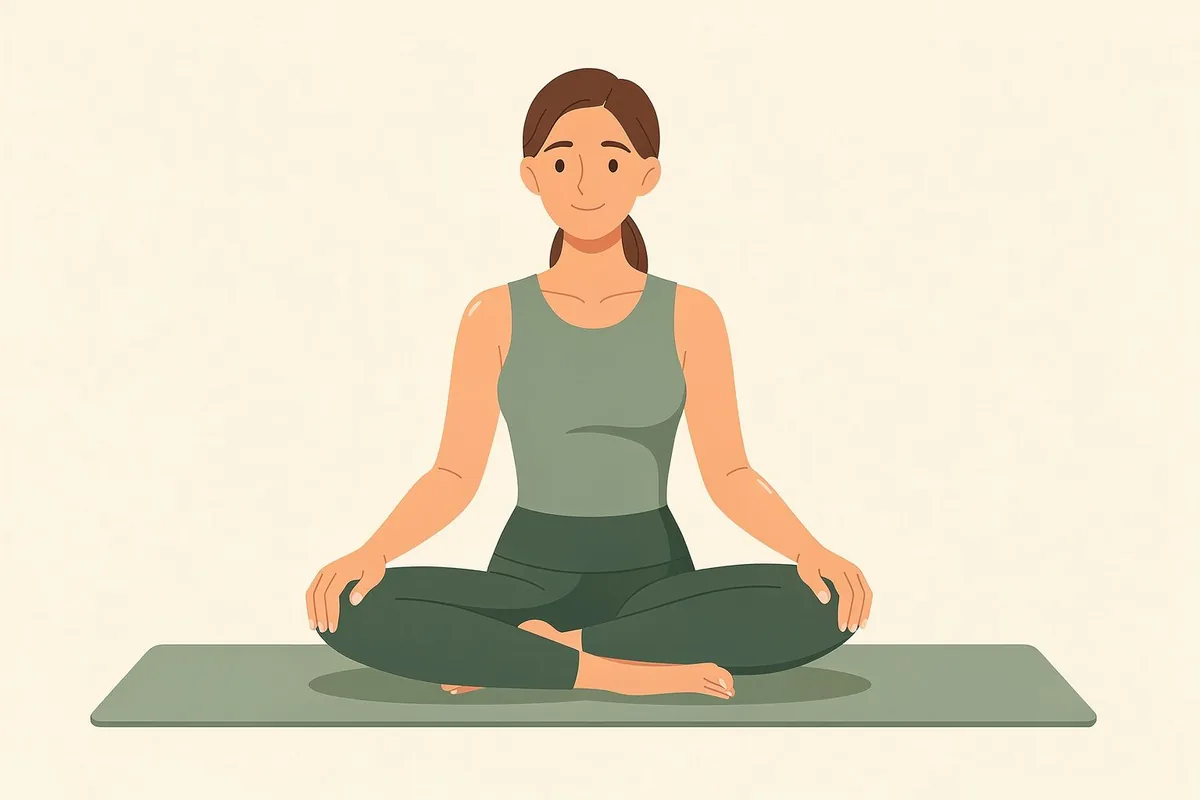
Yoga is easy to start. You need no special skills, very little gear and a clear patch of floor a little bigger than a mat. The share of US adults who practice it grew from 5.0 percent in 2002 to 15.8 percent in 2022, according to the National Center for Complementary and Integrative Health (NCCIH).
This guide takes you through your first month, step by step. It’s the core guide of our Start Here section.
In this guide
- What is yoga, from a fitness point of view?
- What do you need to start yoga?
- What type of yoga is good for beginners?
- How often should beginners do yoga?
- Your 4-week starter plan
- 10 foundation poses for beginners
- Make it easier: props and simple swaps
- How should you breathe during yoga?
- Is yoga safe for beginners?
- Talk to your doctor before you start if…
- Common beginner mistakes
- What the research says
- Frequently asked questions
- Sources
What is yoga, from a fitness point of view?
Yoga grew out of Indian philosophy as a spiritual practice. Today many people use it to support body and mind (NCCIH). In the United States, a yoga class usually combines three things: physical poses (asanas), breathing techniques (pranayama) and meditation.
This guide sticks to the physical side: poses, breathing and a little stillness.
How hard is it? That depends on the style, and styles range from gentle to physically demanding (NCCIH). The Physical Activity Guidelines for Americans say yoga can be light- or moderate-intensity activity, and can count as aerobic or muscle-strengthening exercise, depending on the type and the poses. A review of 17 studies that measured the energy cost of yoga found most poses and full sessions were light intensity. A few sequences, such as sun salutations, reached moderate to vigorous intensity. So yoga can be a workout, but a gentle beginner class is usually light exercise.
What do you need to start yoga?
Almost nothing. Here is the short list:
- Space: enough room to lie down with your arms stretched overhead and out to the sides.
- A non-slip surface: a yoga mat keeps your hands and feet from sliding. A rug works for floor poses in your first sessions, but skip standing poses on anything that slides.
- Clothes you can move in: stretchy pants or shorts and a top that stays put when you fold forward. Most people practice barefoot. Keep a sweater nearby for the rest at the end.
- Optional props: two yoga blocks (or two thick, sturdy books), a strap (a belt or towel works) and a folded blanket to pad your knees.
Props aren’t a sign you’re doing it wrong. They bring the floor closer, so you can do a pose well before you have the flexibility for the full version. Our guide to what you need to start yoga goes through each item.
What type of yoga is good for beginners?
Class names aren’t standardized, so read the description. Words like “beginner,” “basics,” “gentle” or “slow” are good signs. Cleveland Clinic suggests starting with a beginner hatha, slow flow or restorative class. Here’s how the common styles compare:
| Style | What a class is like | In your first month? |
|---|---|---|
| Hatha | A general class of standing and seated poses, each held for several breaths | Yes. Cleveland Clinic calls it excellent for beginners |
| Slow flow | Poses linked with your breath, at a relaxed pace | Yes |
| Restorative | A few poses held for a long time, your body supported by props | Yes, especially to wind down |
| Yin | Floor stretches held for about 3 to nearly 10 minutes each | Yes, if you like slow and quiet |
| Iyengar | Detailed alignment, with chairs, blocks and straps | Yes |
| Vinyasa (flow) | Continuous movement from pose to pose, often at a quick pace | After you know the basic poses |
| Power and Ashtanga | Athletic, demanding sequences | Later. Even Ashtanga’s entry level is challenging |
| Hot and Bikram | A heated room; Bikram classes run 90 minutes at 104°F (40°C) | Not yet |
Style details come from Cleveland Clinic’s guides to yoga types and yoga for beginners. Hot yoga can wait because heat adds risks of overheating and dehydration (NCCIH).
Class or video: where should you learn?
NCCIH advises learning yoga under a qualified instructor and notes that learning on your own without supervision has been linked to higher risks (NCCIH). So if you can, take a few beginner classes in your first month. Ask about the teacher’s training and experience, and mention any injuries or health conditions before class starts.
If classes aren’t an option, you can start at home with videos. These rules keep the risk down:
- Pick videos labeled “beginner” or “gentle,” and stick to the foundation poses below.
- Skip headstands, shoulder stands, the lotus position and forceful breathing for now, as NCCIH advises.
- Go slower than the video when you need to. Pause it, or hold a pose for fewer breaths.
- See a teacher before you try anything upside down, or if a pose keeps bothering you.
For setting up a space and a routine, see how to start yoga at home.
How often should beginners do yoga?
Start with two or three sessions a week of 10 to 20 minutes each, and build up from there. There’s no official dose for yoga, but exercise guidelines give a useful frame:
- Flexibility: The American College of Sports Medicine (ACSM) recommends flexibility exercises for each major muscle-tendon group on at least 2 days a week, with about 60 seconds in total per exercise.
- Balance: ACSM also recommends exercise for balance, agility and coordination on 2 to 3 days a week.
- Start low and go slow: The Physical Activity Guidelines advise inactive people to begin with lower-intensity activity, then gradually increase how often and how long they’re active. ACSM adds that gradual progression may reduce the risks of exercise.
- One teacher’s tip: a yoga therapist quoted by Cleveland Clinic says a little yoga every day, even 10 minutes, beats one session every few weeks.
Where yoga fits in your weekly exercise
The guidelines ask adults for 150 to 300 minutes of moderate aerobic activity a week (or 75 to 150 minutes of vigorous activity), plus muscle-strengthening activity on 2 or more days. Active styles such as vinyasa or power yoga count as moderate-intensity aerobic activity. Time spent only stretching doesn’t count toward either target (Physical Activity Guidelines). Gentle yoga is mostly light activity, so keep walking, cycling or whatever else you enjoy, and treat yoga as one part of your week. If you can’t reach these numbers yet, that’s fine: some activity is better than none.
Your 4-week starter plan
This plan is our suggestion, built on the guidelines above, not a program tested in a study. Each week adds a little time or a few poses. If a week feels like too much, repeat it. In weeks 1 and 2, leave a rest day between sessions so you can see how your body responds. From week 3, short daily sessions are fine if you feel good.
| Week | Days | Minutes | Focus | Poses |
|---|---|---|---|---|
| Week 1 | 2–3 | 10–15 | Learn the basic shapes and slow breathing | Mountain Pose, Cat-Cow, Child’s Pose, Downward-Facing Dog with bent knees |
| Week 2 | 3 | 15–20 | Add floor poses | Week 1, plus Low Lunge, Cobra Pose, Bridge Pose |
| Week 3 | 3 | 20 | Standing strength and balance | Week 2, plus Warrior II, Tree Pose near a wall, Seated Forward Fold |
| Week 4 | 3–4 | 20–30 | Link the poses into one smooth session; try a beginner class | All 10 poses |
What one session looks like
- Settle (1–2 minutes). Sit or lie down. Breathe slowly, through your nose if that’s comfortable.
- Warm up (2–4 minutes). Do five to ten slow rounds of Cat-Cow.
- Standing poses (3–8 minutes). Start in Mountain Pose, then do Warrior II and Tree Pose on each side.
- Floor poses (3–8 minutes). Move through Downward-Facing Dog, Low Lunge, Cobra Pose, Bridge Pose and Seated Forward Fold.
- Rest (2–5 minutes). Rest in Child’s Pose, then lie on your back and let your breath settle.
Stretch or shorten each part to fit your week’s total time.
In weeks 1 and 2, use only the poses you’ve learned so far. Hold each pose for 3 to 5 slow breaths. Cleveland Clinic suggests starting with a few breaths per pose and holding longer as you get comfortable. Our guide on how long to hold a yoga pose explains more.
10 foundation poses for beginners
Each of these poses links to its own step-by-step guide. Bend your knees, use props and keep every pose easy enough to breathe smoothly.
1. Mountain Pose
Mountain Pose is standing, done with attention. Stand with your feet hip-width apart and your weight spread evenly over both feet. Let your arms hang by your sides. Lengthen up through the crown of your head, and keep your knees soft, not locked.
2. Cat-Cow
Come onto your hands and knees for Cat-Cow, wrists under shoulders and knees under hips. As you breathe in, let your belly sink and lift your chest and gaze (Cow). As you breathe out, round your back and let your head hang (Cat). Move slowly. A small range of motion is fine.
3. Child’s Pose
Child’s Pose is your rest position. Kneel, sit your hips back toward your heels and fold forward until your forehead rests on the floor or a block. Reach your arms forward or rest them by your sides. Widen your knees if your belly feels squashed. Come here whenever you need a break.
4. Downward-Facing Dog
From hands and knees, tuck your toes and lift your hips up and back into an upside-down V for Downward-Facing Dog. Bend your knees as much as you need to keep your back long. Your heels don’t have to touch the floor.
5. Low Lunge
For Low Lunge, step one foot forward between your hands and lower your back knee to the floor. Keep your front knee over your ankle. Rest your hands on blocks or your front thigh. Let your hips ease forward until you feel a stretch at the front of the back hip, then switch sides.
6. Cobra Pose
For Cobra Pose, lie on your belly with your hands under your shoulders and your elbows close to your sides. Press the tops of your feet into the floor and lift your chest a few inches. Keep your elbows bent and your neck long. Stay low; if your lower back pinches, lower down or rest on your forearms instead.
7. Bridge Pose
For Bridge Pose, lie face up with your knees bent and your feet flat on the floor, hip-width apart and close to your hips. Rest your arms by your sides. Press through your feet to lift your hips, with your knees pointing forward. Keep your head still while your hips are up. Lower slowly.
8. Warrior II
Step your feet wide apart for Warrior II, front toes pointing forward and back foot turned almost parallel to the back edge of your mat. Bend your front knee over your ankle, in line with your middle toes. Reach your arms out at shoulder height and look past your front hand. A shorter stance and a smaller knee bend make it easier.
9. Tree Pose
Shift your weight onto one foot for Tree Pose. Place the sole of your other foot on your inner ankle (toes on the floor), your calf or your inner thigh, but not against the side of your knee. Rest your hands on your hips or at your chest. Stand next to a wall or chair and touch it whenever you need to. Switch sides.
10. Seated Forward Fold
Sit with your legs out in front of you for Seated Forward Fold. Bend your knees as much as you need, then lean forward from your hips with a long back. Rest your hands on your legs, or loop a strap around your feet. Don’t pull yourself down; a small fold is enough.
Make it easier: props and simple swaps
Props help poses fit your body. Iyengar yoga, for example, uses props to help people reach poses while keeping good alignment (Cleveland Clinic). Simple swaps for your first month:
- The floor feels far away: put your hands on yoga blocks or thick books in Downward-Facing Dog, Low Lunge and forward folds.
- You can’t reach your feet: loop a yoga strap, belt or towel around them in Seated Forward Fold.
- Your knees are sore on the floor: fold a blanket under them in Cat-Cow, Child’s Pose and Low Lunge.
- Your hips don’t reach your heels in Child’s Pose, or your back rounds when you sit: use a cushion or folded blanket under your hips.
- Your balance wobbles: do Tree Pose and Warrior II next to a wall or a sturdy chair.
- Getting down to the floor is hard: try a chair yoga routine first.
- Your hands or feet slip: a grippy mat usually helps. See our guide to yoga mats for beginners.
How should you breathe during yoga?
Breathing is part of every pose, and it’s easy to hold your breath when a pose gets hard. A few basics:
- Breathe slowly and steadily, through your nose if that’s comfortable.
- Keep breathing in every pose. If you can’t breathe smoothly, ease off a little.
- A common pattern: breathe in as you lengthen or lift, breathe out as you fold or lower.
- If you get out of breath, pause and come back to your breathing before you go on (Cleveland Clinic).
- Skip forceful breathing techniques, such as rapid “breath of fire,” for now. NCCIH lists forceful breathing among the practices new students should avoid (NCCIH).
To learn slow belly breathing, follow our guide to diaphragmatic breathing. A few minutes of it fits well at the start and end of each session.
Is yoga safe for beginners?
For most healthy people, yes. NCCIH calls yoga generally safe for healthy people when it’s done properly, under the guidance of a qualified instructor. Serious injuries are rare, and the risk is lower than in higher-impact activities (NCCIH). A review of 94 randomized trials with 8,430 participants found side effects were no more common with yoga than with usual care or other exercise.
Injuries still happen. Here’s what the data shows:
- Sprains and strains are the most common injuries, and the knee or lower leg is hurt most often (NCCIH). In emergency-room data, though, the trunk topped the list (below).
- Most problems are mild and short-lived. In a review of nine observational studies, about 1 in 20 people who did yoga (4.6%) reported an injury or other problem in the past year, mostly mild. Their risk of falls was similar to that of people who don’t do yoga, but meniscus (knee cartilage) injuries were more common among them.
- Emergency room visits: US emergency departments saw an estimated 29,590 yoga-related injuries from 2001 to 2014. The trunk was hurt most often (46.6%), and sprains or strains made up 45.0% of diagnoses.
- Risk rises with age: in 2014, the yoga injury rate for people 65 and older was 57.9 per 100,000 people who do yoga, compared with 11.9 for ages 18 to 44 and 17.7 for ages 45 to 64 (Swain and McGwin).
What does pain mean in yoga?
Some discomfort is normal when you’re new: a stretch you can feel, muscles that work hard, a pose that’s tough to hold. Pain is different. Cleveland Clinic advises that you should never feel pain in yoga, and that if you do, you should stop and reassess. It also notes that most yoga injuries happen when people push themselves too hard (Cleveland Clinic).
A simple rule: come out of a pose if you feel sharp or pinching pain, pain in a joint, or anything that makes you hold your breath. The common mistakes further down list more ways to stay safe.
Talk to your doctor before you start if…
- You’re pregnant. Get checked by your health care provider first. Avoid hot yoga, and avoid poses that keep you lying on your back or still for long periods (NCCIH).
- You’re 65 or older. Yoga injuries treated in emergency rooms happen at a higher rate at this age (NCCIH). Start with light activity, such as a gentle or chair class, and build up as you’re able (Physical Activity Guidelines).
- You have an injury or condition that may call for changes to poses, such as a knee or hip injury, lower-back (lumbar) spine disease, severe high blood pressure, balance problems or glaucoma (NCCIH). Head-down poses such as Downward-Facing Dog briefly raise eye pressure (Jasien 2015).
- You have osteoporosis or low bone density. Poses that strongly round or arch the spine have been linked to spine fractures in people with weak bones. Ask your doctor or physical therapist which poses to skip or change, such as Seated Forward Fold (Lee 2019).
- You have a chronic condition, such as diabetes, heart disease or osteoarthritis, or symptoms such as chest pain or pressure, dizziness or joint pain (Physical Activity Guidelines).
- You have long-term back pain. In trials, yoga gave only small improvements compared with no exercise, too small to matter to most people. It was also linked to more side effects, mostly more back pain (about 4 in 100 people with yoga against about 1 in 100 without; low-certainty evidence) (Cochrane review). Ask which movements are right for you.
- New symptoms appear as you become more active. See your provider (Physical Activity Guidelines).
Yoga doesn’t replace medical care. Don’t use it to put off seeing a provider about a health problem (NCCIH).
Common beginner mistakes
- Chasing the picture-perfect pose. Bent knees and a long back are a fine version of most poses.
- Pushing through pain. Most yoga injuries happen when people push too hard (Cleveland Clinic).
- Holding your breath. If you can’t breathe smoothly, back off.
- Doing too much, too soon. Increase how often and how long you practice step by step (Physical Activity Guidelines).
- Jumping to advanced poses. Headstands, shoulder stands and lotus can wait (NCCIH).
- Starting with hot yoga. The heat adds risks of overheating and dehydration (NCCIH).
- Locking your knees and elbows. Keep a slight bend in standing poses and in Downward-Facing Dog.
- Forcing your knees. Pad them, keep your front knee over your ankle in lunges and Warrior II, and never force a cross-legged or lotus position. Observational studies found more meniscus (knee cartilage) injuries among people who do yoga (Cramer 2018).
- Making yoga your only exercise. Gentle yoga is mostly light intensity, so add aerobic activity such as brisk walking (Larson-Meyer; Physical Activity Guidelines).
- Keeping an injury to yourself. Tell your teacher before class so they can suggest changes (NCCIH).
What the research says
Evidence: moderate
What systematic reviews show (most studied specific groups, noted below):
- Safety: in 94 randomized trials (8,430 participants), side effects were no more common with yoga than with usual care or other exercise (Cramer 2015).
- Balance, flexibility and strength: in a review of 22 trials in adults with an average age of 60 or older (17 measured physical function), yoga improved balance, lower-body flexibility and leg strength compared with no exercise, and leg strength and lower-body flexibility compared with other activities (Sivaramakrishnan 2019). Another review, of 6 trials (307 people aged 60 and over), found small gains in balance and medium gains in mobility; whether they prevent falls isn’t known yet (Youkhana 2016).
- Stress: a 2020 review of 12 studies (672 participants) in healthy adults found less perceived stress with yoga in every study (NCCIH).
- Back pain: in a Cochrane review of 21 trials (2,223 participants) with chronic low back pain, yoga gave small, clinically unimportant improvements in pain and function compared with no exercise. Compared with other back exercise, function was about the same at 3 months; for pain, the evidence was too uncertain to say (Wieland 2022).
- Intensity: most yoga poses and sessions measured were light-intensity activity (Larson-Meyer 2016).
Why “moderate”: the reviews point the same way, but trials are often small (one balance review pooled 6 trials and 307 people) and unblinded (Youkhana 2016; Wieland 2022), most of the fitness evidence comes from adults 60 and older (Sivaramakrishnan 2019), and the styles of yoga studied vary a lot, which makes results hard to compare (NCCIH). The label covers safety and balance, flexibility and strength. For back pain, the benefit over no exercise was too small to matter, so that outcome on its own would not earn “moderate”. For the full picture, see benefits of yoga: what the research says.
Frequently asked questions
How long should a beginner yoga session be?
10 to 20 minutes is enough at first. By week 4, 20 to 30 minutes is a reasonable goal. If you join a longer class, rest in Child’s Pose whenever you need to.
Is it OK to do yoga every day?
For most healthy people, yes. A yoga therapist quoted by Cleveland Clinic recommends a little every day, even 10 minutes. In your first two weeks, leave a rest day between sessions; after that, keep most days gentle and take a day off if you’re sore or tired.
Can I do yoga if I’m not flexible?
Yes. Flexibility is something yoga works on, not something you need first, though in a small survey of US Hispanic adults with low incomes, worry about needing to be flexible was one reason people gave for not doing yoga (NCCIH). Bend your knees, use blocks and a strap, and keep poses small. In trials with older adults, yoga improved lower-body flexibility (Sivaramakrishnan 2019).
Is yoga a good workout?
It depends on the style. Most yoga that researchers have measured is light activity (Larson-Meyer 2016), while active styles such as vinyasa or power yoga count as moderate-intensity aerobic activity (Physical Activity Guidelines). If your yoga is gentle, add walking or cycling to reach the weekly aerobic target.
Do I need a yoga mat?
Not on day one. A rug works for floor poses, but standing poses need a surface that doesn’t slide, and a grippy mat is the easiest fix.
What should I wear to my first yoga class?
Stretchy clothes that stay in place when you bend forward. Most people go barefoot. Bring water and a layer for the final rest, and tell the teacher you’re new.
How hard is yoga for beginners?
A beginner or gentle class should feel manageable. You’ll work, but it shouldn’t hurt. A good teacher helps you modify poses to suit your body (Cleveland Clinic).
Can yoga help me lose weight?
It may help. A 2022 review of 22 studies (1,178 participants) in people with overweight or obesity found reductions in body weight, BMI, body fat and waist size. An older review of 17 yoga-based weight-control programs found that most led to gradual, moderate weight loss. The programs with the best results included at least some of these features: longer, more frequent sessions (at least 75 to 90 minutes, at least 3 times a week), a program lasting 3 months or more, a yoga-based diet component and home practice (NCCIH). Treat yoga as one part of a weight plan, not the whole of it.
Sources
- National Center for Complementary and Integrative Health (NCCIH). Yoga: Effectiveness and Safety. National Institutes of Health. Last updated August 2023., checked Nov 4, 2026
- U.S. Department of Health and Human Services. Physical Activity Guidelines for Americans, 2nd edition. Washington, DC: HHS; 2018., checked Nov 4, 2026
- Garber CE, Blissmer B, Deschenes MR, et al.; American College of Sports Medicine. American College of Sports Medicine position stand. Quantity and quality of exercise for developing and maintaining cardiorespiratory, musculoskeletal, and neuromotor fitness in apparently healthy adults: guidance for prescribing exercise. Med Sci Sports Exerc. 2011;43(7):1334-59.
- Larson-Meyer DE. A systematic review of the energy cost and metabolic intensity of yoga. Med Sci Sports Exerc. 2016;48(8):1558-69.
- Cramer H, Ward L, Saper R, Fishbein D, Dobos G, Lauche R. The safety of yoga: a systematic review and meta-analysis of randomized controlled trials. Am J Epidemiol. 2015;182(4):281-93.
- Cramer H, Ostermann T, Dobos G. Injuries and other adverse events associated with yoga practice: a systematic review of epidemiological studies. J Sci Med Sport. 2018;21(2):147-154.
- Swain TA, McGwin G. Yoga-related injuries in the United States from 2001 to 2014. Orthop J Sports Med. 2016;4(11):2325967116671703.
- Sivaramakrishnan D, Fitzsimons C, Kelly P, et al. The effects of yoga compared to active and inactive controls on physical function and health related quality of life in older adults: systematic review and meta-analysis of randomised controlled trials. Int J Behav Nutr Phys Act. 2019;16(1):33.
- Youkhana S, Dean CM, Wolff M, Sherrington C, Tiedemann A. Yoga-based exercise improves balance and mobility in people aged 60 and over: a systematic review and meta-analysis. Age Ageing. 2016;45(1):21-9.
- Wieland LS, Skoetz N, Pilkington K, Harbin S, Vempati R, Berman BM. Yoga for chronic non-specific low back pain. Cochrane Database Syst Rev. 2022;11(11):CD010671.
- Lee M, Huntoon EA, Sinaki M. Soft tissue and bony injuries attributed to the practice of yoga: a biomechanical analysis and implications for management. Mayo Clin Proc. 2019;94(3):424-431.
- Jasien JV, Jonas JB, de Moraes CG, Ritch R. Intraocular pressure rise in subjects with and without glaucoma during four common yoga positions. PLoS One. 2015;10(12):e0144505.
- Cleveland Clinic. 7 Different Kinds of Yoga and How To Find the Right Practice. Health Essentials. June 2, 2022., checked Nov 4, 2026
- Cleveland Clinic. Yoga for Beginners: Get Started Today! Health Essentials. May 18, 2026., checked Nov 4, 2026
Image credits: Illustration: AI-generated for YogaForFitness (FLUX.2 [pro]), checked for pose accuracy
