Diaphragmatic (Belly) Breathing: How to Do It
Quick answer
Lie on your back with your knees bent, one hand on your chest and one on your belly. Breathe in slowly through your nose so the belly hand rises while the chest hand stays almost still, then breathe out slowly and let the belly fall. Start with 5 to 10 minutes, once or a few times a day.
We may earn a commission when you buy through links on this page. It never changes what we recommend. As an Amazon Associate we earn from qualifying purchases.
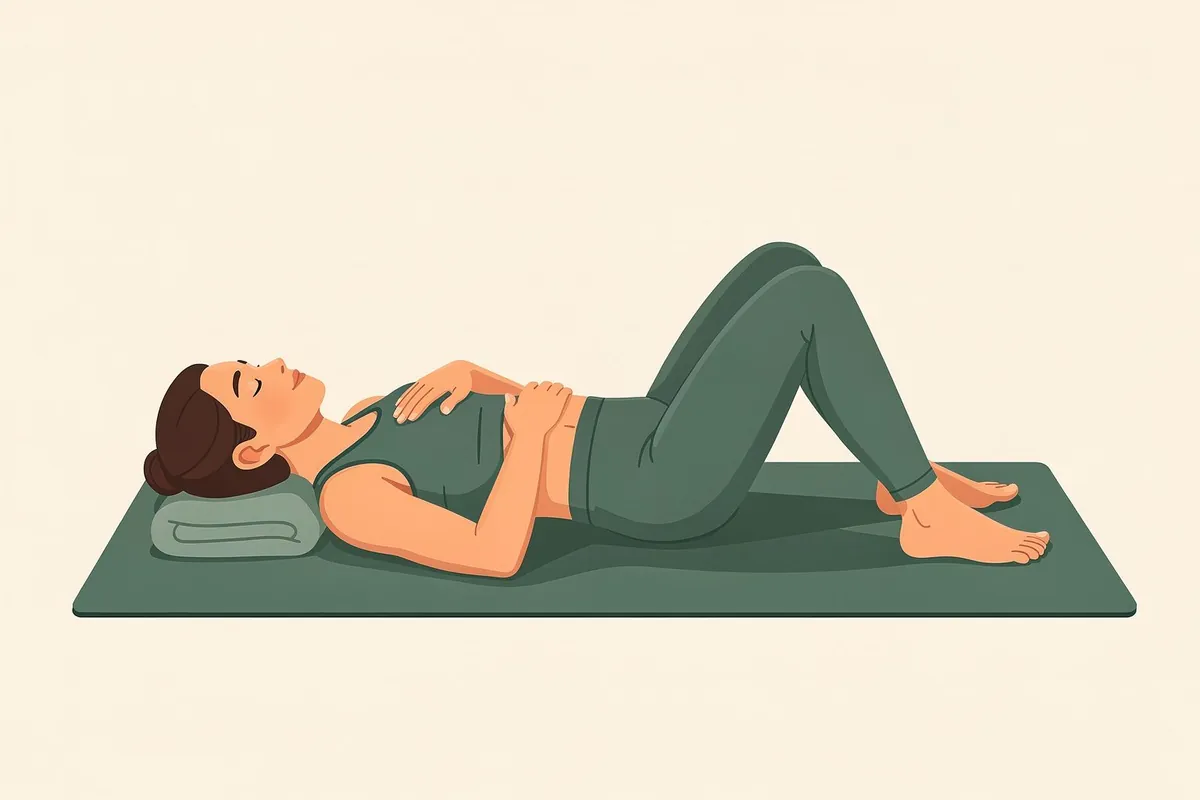
Diaphragmatic breathing is slow, relaxed breathing that moves your belly instead of your chest and shoulders. It’s the simplest breathing practice we cover in our Breathing guides and a good base for the others. This guide shows you how to do it lying down and sitting, how long to practice, and what the research does and doesn’t show.
In this guide
- What is diaphragmatic breathing?
- How to do diaphragmatic breathing lying down
- How to do it sitting in a chair
- How long and how often should you practice?
- Common mistakes
- Make it easier (props)
- When to use belly breathing
- When to stop, and who should ask a doctor first
- What the research says
- Frequently asked questions
- Sources
What is diaphragmatic breathing?
Your diaphragm is a thin dome of muscle under your lungs and heart that divides your chest from your belly. Each in-breath pulls it flat and down toward your belly; as you breathe out, it lets go and domes back up, according to Cleveland Clinic.
Diaphragmatic breathing means using that muscle on purpose to take slow, full breaths that stay comfortable. Because the diaphragm moves down as you breathe in, your belly gently rises; that’s why it’s also called abdominal or belly breathing (Cleveland Clinic, Harvard Health).
How to do diaphragmatic breathing lying down
Lying down is a good way to learn, because you can feel your belly move under your hand.
- Lie on your back on a bed or mat with your knees bent and your feet flat. Rest your head on a pillow.
- Rest one palm on your breastbone and the other on your belly, just under your ribs.
- Breathe in slowly through your nose. Let your belly rise into your lower hand while the hand on your chest stays almost still.
- Breathe out slowly through gently pursed lips, as if cooling a spoonful of soup. Let your belly sink, drawing it in a little if that helps.
- Keep each breath comfortable rather than big. If counting helps, breathe in for a count of up to five and out for the same.
- Keep going for a few minutes, then let your breathing return to normal before you sit up.
These steps follow the method described by Cleveland Clinic and Harvard Health. The NHS version is similar: breathe into your belly only as far as is comfortable, in through the nose and out through the mouth, counting from one to five if that helps (NHS).
How to do it sitting in a chair
Once the lying version feels natural, practice sitting, so you can use it at a desk or on a bus.
- Sit in a chair that supports your back, with your feet flat on the floor about hip-width apart.
- Relax your shoulders, neck and jaw.
- Place one hand on your upper chest and the other on your belly.
- Breathe in through your nose so your belly pushes gently out against your hand, chest hand still.
- Breathe out slowly and let your belly move back in.
You can also do it standing, the NHS notes. Loosen any tight clothing at the waist first.
How long and how often should you practice?
| Source | How long | How often |
|---|---|---|
| Cleveland Clinic | 5 to 10 minutes at first, then longer | About 3 to 4 times a day |
| Harvard Health | 5 to 10 minutes | Several times a day if possible |
| NHS | At least 5 minutes | Regularly, as part of your daily routine |
If 5 minutes feels long, start with a few breaths and build up. Cleveland Clinic notes that you’ll probably feel tired at first; the technique takes practice.
Common mistakes
- Breathing into the chest and shoulders. Watch your hands: the lower one should move most.
- Forcing a huge breath. The NHS advises breathing as deep into the belly as is comfortable, without forcing it.
- Breathing too fast or too hard. Overbreathing can make you feel lightheaded or dizzy and cause numbness or tingling around the mouth or in the arms (MedlinePlus). Slow down.
- Forcing your belly out. Don’t push it out on purpose; let it rise on its own as your diaphragm draws the breath in.
- Holding your breath. This technique has no pauses. Breath holds belong to other methods, such as box breathing.
- Giving up after one try. It feels like work at first; Cleveland Clinic notes that it takes practice. Even a couple of minutes a day keeps you going until you can manage the times in the table.
Make it easier (props)
- A pillow or folded blanket under your head, as in Cleveland Clinic’s steps.
- A bolster or a couple of pillows under your knees. Harvard Health suggests pillows under your head and knees if that is more comfortable.
- A chair with a firm back for the sitting version, as the NHS suggests.
- A cushion or folded blanket to sit on if you’d rather practice on the floor.
When to use belly breathing
- As a daily habit. The NHS says regular, daily practice gives the most benefit.
- In stressful moments. The NHS presents this kind of breathing as a calming technique for stress, anxiety and panic. Research suggests it may help lower stress, though the evidence is still early (see below).
- Before sleep. Some people use a few minutes of slow breathing to wind down. Be realistic: NCCIH notes that relaxation techniques alone haven’t shown much promise for sleep. If you have ongoing insomnia, talk to your doctor. A gentle bedtime yoga routine is another way to wind down.
- Alongside treatment for a lung condition. Cleveland Clinic and Harvard Health describe diaphragmatic breathing as a technique for people with COPD, but Cleveland Clinic says it shouldn’t be the only treatment. Use it only as your care team advises.
When to stop, and who should ask a doctor first
- Dizziness or tingling: stop, sit up slowly and breathe normally. They can be signs of breathing too fast or too deeply (MedlinePlus).
- New or unexplained shortness of breath, rapid breathing or chest pain: don’t try to breathe through it. MedlinePlus says rapid breathing for the first time may be a medical emergency. Get medical help right away.
- COPD, asthma or anxiety: Cleveland Clinic advises talking to your provider about whether this technique is right for you, and using it alongside, not instead of, your treatment. In a small study of people with severe COPD, belly breathing made breathing less efficient (Gosselink et al., 1995), so learn it from your respiratory therapist or pulmonary rehab team rather than on your own.
- Epilepsy, some mental health conditions, or a history of trauma or abuse: NCCIH notes rare reports that relaxation techniques may cause or worsen symptoms in these groups. Anyone can occasionally feel more anxious or have unwanted thoughts. Talk to your doctor or therapist first, and stop if it makes you feel worse.
- High blood pressure: slow breathing is not a replacement for your treatment. Don’t change any medicine without your doctor.
- Stress, anxiety or low mood that doesn’t ease: see your doctor or a mental health professional. Breathing exercises shouldn’t delay getting help (NCCIH).
- Later pregnancy: the NHS advises avoiding lying flat on your back for more than a few minutes. Practice sitting up instead.
What the research says
Evidence: limited
The research on diaphragmatic breathing on its own is small. A 2019 systematic review found only three studies that tested it alone: one randomized trial and two studies without random assignment. All three reported less stress, measured by things like cortisol, blood pressure or a stress questionnaire, but the studies were too different to combine (Hopper et al., 2019). NCCIH calls this preliminary evidence.
One small trial in 40 healthy adults found lower cortisol and better sustained attention than in a no-training group after 20 sessions over eight weeks, using a feedback device to slow breathing to about four breaths a minute. Negative mood fell in the breathing group, but the difference from the control group wasn’t statistically clear (Ma et al., 2017).
Wider research on breathwork in general points the same way. A 2023 meta-analysis of 12 randomized trials with 785 adults found lower self-reported stress than in control groups, a small-to-medium effect, with similar results for anxiety (20 trials) and depressive symptoms (18 trials). Most studies had a moderate risk of bias, and the authors urged caution (Fincham et al., 2023). Slow breathing at 10 breaths a minute or fewer, often guided by a device, lowered blood pressure modestly (about 6/3 mmHg) in people with high or borderline-high blood pressure. That review covered slow-paced breathing in general, not belly breathing specifically, and its trials were short, varied widely and often had a high risk of bias (Chaddha et al., 2019; NCCIH).
For COPD, a 2012 Cochrane review found that breathing exercises improved walking distance but had no consistent effect on breathlessness; diaphragmatic breathing was tested in a single study of 30 people (Holland et al., 2012).
Small, early and mixed studies are why we rate the evidence as limited: promising, but not settled.
Frequently asked questions
Is diaphragmatic breathing the same as belly breathing?
Yes. Diaphragmatic, abdominal and belly breathing are different names for the same technique.
Should I breathe through my nose or my mouth?
Breathe in through your nose. To breathe out, Cleveland Clinic and Harvard Health describe pursed lips, and the NHS simply says through the mouth. Either way, keep the out-breath slow and gentle.
Does belly breathing help with anxiety?
It may help. The NHS describes this kind of breathing as a calming technique for anxiety and panic. The 2023 meta-analysis above found slightly lower self-reported anxiety than in control groups (20 trials), but it pooled many breathing techniques, so it doesn’t show how much belly breathing on its own helps. On its overbreathing page, MedlinePlus advises people diagnosed with anxiety or panic to see a mental health professional and to learn to breathe from the diaphragm and belly. It is not a treatment for an anxiety disorder on its own.
Can diaphragmatic breathing help acid reflux?
Researchers are studying it. A 2023 systematic review says training the diaphragm has potential for selected people with reflux (GERD), but the studies are small and long-term benefit still needs research (Zdrhova et al., 2023). If you have reflux, ask your doctor before relying on it.
Why do I feel dizzy when I do it?
You’re probably breathing too fast or too deeply. Slow down, make each breath smaller and let your breathing return to normal. If dizziness keeps happening, stop and talk to your doctor. When you’re ready for another technique, try alternate nostril breathing.
Sources
- Cleveland Clinic. Diaphragmatic breathing. Medically reviewed March 30, 2022., checked Nov 4, 2026
- Cleveland Clinic. Diaphragm. Medically reviewed June 11, 2021., checked Nov 4, 2026
- Harvard Health Publishing. Learning diaphragmatic breathing. February 8, 2020., checked Nov 4, 2026
- NHS. Breathing exercises for stress. Reviewed June 12, 2026., checked Nov 4, 2026
- National Center for Complementary and Integrative Health (NCCIH). Relaxation techniques: what you need to know. Updated June 2021., checked Nov 4, 2026
- MedlinePlus (U.S. National Library of Medicine). Hyperventilation. Reviewed July 23, 2024., checked Nov 4, 2026
- NHS. Exercise in pregnancy. Reviewed September 24, 2026., checked Nov 4, 2026
- Hopper SI, Murray SL, Ferrara LR, Singleton JK. Effectiveness of diaphragmatic breathing for reducing physiological and psychological stress in adults: a quantitative systematic review. JBI Database System Rev Implement Rep. 2019;17(9):1855-1876., checked Nov 4, 2026
- Ma X, Yue ZQ, Gong ZQ, et al. The effect of diaphragmatic breathing on attention, negative affect and stress in healthy adults. Front Psychol. 2017;8:874., checked Nov 4, 2026
- Fincham GW, Strauss C, Montero-Marin J, Cavanagh K. Effect of breathwork on stress and mental health: a meta-analysis of randomised-controlled trials. Sci Rep. 2023;13:432., checked Nov 4, 2026
- Chaddha A, Modaff D, Hooper-Lane C, Feldstein DA. Device and non-device-guided slow breathing to reduce blood pressure: a systematic review and meta-analysis. Complement Ther Med. 2019;45:179-184., checked Nov 4, 2026
- Holland AE, Hill CJ, Jones AY, McDonald CF. Breathing exercises for chronic obstructive pulmonary disease. Cochrane Database Syst Rev. 2012;10:CD008250., checked Nov 4, 2026
- Zdrhova L, Bitnar P, Balihar K, et al. Breathing exercises in gastroesophageal reflux disease: a systematic review. Dysphagia. 2023;38(2):609-621., checked Nov 4, 2026
- Gosselink RA, Wagenaar RC, Rijswijk H, Sargeant AJ, Decramer ML. Diaphragmatic breathing reduces efficiency of breathing in patients with chronic obstructive pulmonary disease. Am J Respir Crit Care Med. 1995;151(4):1136-42., checked Nov 4, 2026
Image credits: Illustration: AI-generated for YogaForFitness (FLUX.2 [pro]), checked for pose accuracy
