- Level: Beginner
- Pose type: Kneeling · Restorative · Forward fold
- Body area: Hips · Lower back · Ankles
- Props: blanket, bolster, block
Child’s Pose (Balasana)
Pronounced bah-LAHS-ah-nah
Quick answer
Kneel with your big toes together, sit your hips back toward your heels and fold forward until your forehead rests on the floor or a block. Keep your knees together or wide, and let your arms reach forward or rest by your sides.
We may earn a commission when you buy through links on this page. It never changes what we recommend. As an Amazon Associate we earn from qualifying purchases.
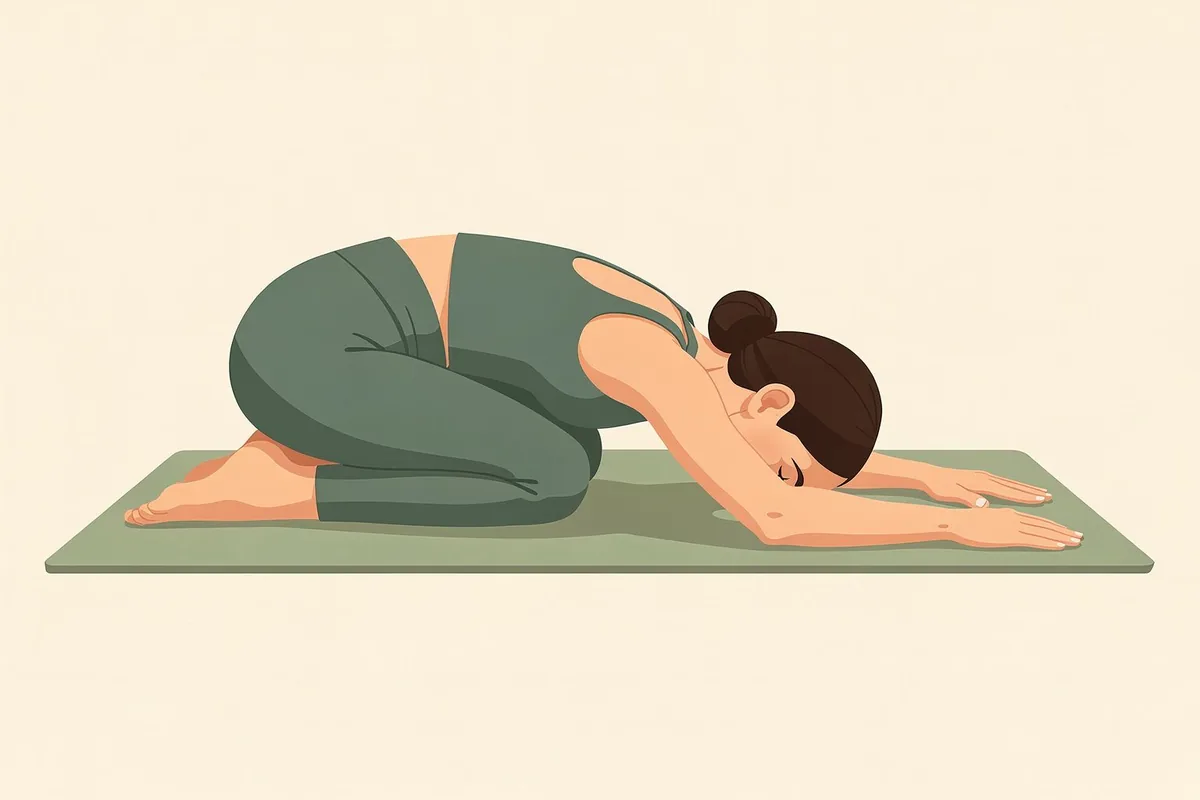
Child’s Pose is a kneeling rest. You kneel, fold forward and let the floor take your weight. In a class, it is the place to go whenever you need a break, and you never need permission to take it. It also works on its own, for a few quiet minutes at the end of the day.
There are two common shapes: knees together, or knees wide with your big toes touching. Both are correct. Choose the one that lets you breathe easily without strain in your knees, hips or ankles. A blanket, a block or a bolster can make the pose far more comfortable. Find more poses in our pose library, or start with yoga for beginners.
In this guide
How to do Child’s Pose
- Start on your hands and knees, wrists under your shoulders and knees under your hips.
- Bring your big toes together so they touch. Rest the tops of your feet on the mat.
- Keep your knees together, hip-width apart, or wider, up to the width of your mat.
- Breathe out and sit your hips back toward your heels.
- Fold forward and lower your chest onto or between your thighs.
- Let your forehead settle on the mat. If there’s a gap, slide a block under it or rest it on your fists, one on top of the other.
- Choose an arm position: reach both arms ahead with your hands flat, or lay them alongside your shins with your hands turned up.
- Release any effort in your face, neck and shoulders, and breathe slowly.
- Stay for a few breaths or a few minutes. To come out, walk your hands back toward your knees and slowly roll up to sit on your heels.
Alignment cues
- Hips: they move toward your heels, but they don’t have to land there. If they hover, support them with a blanket (see the props below).
- Knees: with your knees together, your torso rests on your thighs and your back rounds more. With your knees wide, your chest drops between your thighs and your belly and ribs get more room.
- Spine: let it lengthen forward from your hips toward your head. You don’t need to flatten it or round it on purpose.
- Head: let the floor or a prop carry its full weight, so your neck can relax.
- Arms: reaching forward gives your shoulders and the sides of your body a gentle stretch. Resting them back lets your shoulders drop toward the floor. If a shoulder is injured or sore, rest your arms back beside your legs.
- Feet: big toes touch, tops of the feet flat, soles facing up.
- Breath: slow and easy. As you breathe in, notice your back widen and rise a little. As you breathe out, notice it settle. To practice this kind of breathing, see diaphragmatic breathing.
Common mistakes
- Forcing your hips down. Pushing your hips onto your heels puts more load on your knees. Fill the gap with a blanket instead.
- Leaving your head hanging. If your forehead floats above the floor, your neck has to hold it up. Bring the floor closer with a block or your fists.
- Squeezing your knees together when you feel cramped. If your belly or chest feels squashed, or your breath feels tight, widen your knees.
- Gripping with your shoulders. If your arms are forward and your shoulders creep toward your ears, soften your elbows or bring your arms back.
- Turning a rest into a workout. If you’re straining anywhere, change the setup. Child’s Pose should feel easy.
- Ignoring your ankles. If the tops of your feet or your ankles ache, pad them (see below).
Watch out for: sharp pain in your knees, hips or ankles. Come out of the pose and rest on your back instead.
Make it easier (props)
- Blanket behind your knees. Fold or roll a blanket and place it between the backs of your thighs and your calves. Your knees bend less, and your hips have something to sit on.
- Padding under your knees. A folded blanket under your knees and shins softens a hard floor.
- Rolled blanket under your ankles. Slide a thin roll under the fronts of your ankles if the tops of your feet feel strained.
- Block under your forehead. A yoga block lets your head rest fully when the floor feels far away.
- Bolster under your torso. For a fully supported version, place a bolster or two firm pillows lengthwise between your knees. Widen your knees around it and rest your chest and one cheek on top. Turn your head the other way halfway through.
- No kneeling at all. If kneeling isn’t possible, rest on your back instead, with your knees bent or your legs long. Or try Reclined Butterfly: lie on your back with the soles of your feet together and your knees falling open. If you’re pregnant, rest on your side instead.
Variations
- Wide-knee Child’s Pose. Big toes together, knees wide toward the edges of the mat. This gives your belly and ribs more room and opens your hips more.
- Side reach. From the arms-forward version, walk both hands toward the right side of your mat. Keep your left hip heavy toward your heel and feel the stretch along your left side. Stay for 3 to 5 breaths, come back to the center and switch sides.
- Arms back. Rest your arms along your legs, palms up, and let your shoulders drop toward the floor.
- Supported Child’s Pose. The bolster version above, held for a few minutes as a restorative pose.
Poses to do before and after
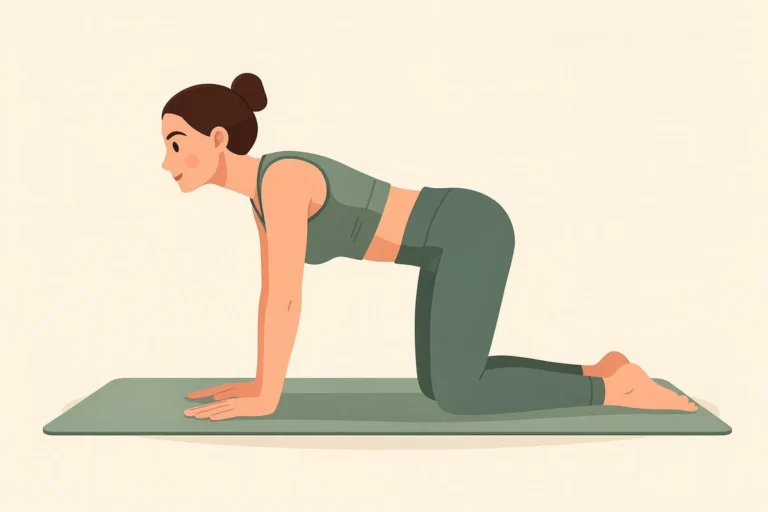
- Before: Cat-Cow starts from the same hands-and-knees position and moves your spine gently before you rest.
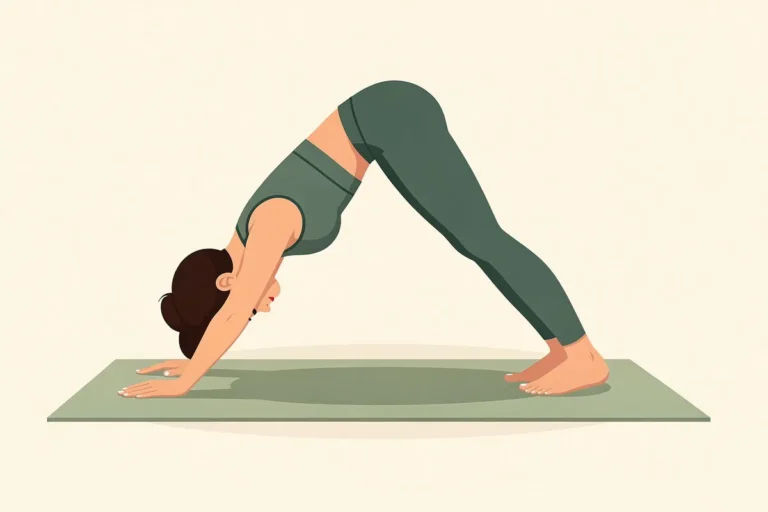
- During a class: from Downward-Facing Dog, lower your knees and sit back into Child’s Pose whenever you need a break.
- After a backbend: after a pose like Cobra Pose, press back into Child’s Pose so your back can rest in the opposite shape.
- At night: Child’s Pose fits easily into a bedtime yoga routine.
Who should skip it or ask a doctor first
- Knee injuries or knee pain. Child’s Pose bends your knees as far as they go. The NCCIH lists earlier injuries, including knee and hip injuries, among the conditions that may call for changes to your yoga practice. Use a blanket behind your knees, or rest on your back instead, and ask your doctor or physical therapist.
- Ankle injuries. The tops of your feet and your ankles take part of your weight. Pad them well, or choose a resting pose on your back.
- Hip replacement. Folding forward over your thighs bends your hips more than a right angle, the kind of bending MedlinePlus tells people to avoid after a hip replacement, especially in the first months. Ask your surgeon or physical therapist before you try this pose.
- Osteoporosis, low bone density or a past spine fracture. Doctors at Mayo Clinic have reported spine fractures, mostly in people with low bone mass, after yoga poses that bend the spine forward (Sfeir et al., 2018; Sinaki, 2013). They advise people with low bone density to avoid extreme forward bending of the spine (Lee et al., 2019). Child’s Pose rounds your back. Ask your doctor or physical therapist which positions are right for you.
- Lower-back conditions. The NCCIH lists lumbar spine disease among the conditions that may call for changes. Check with your doctor if you have a diagnosed back problem.
- Glaucoma. Your head rests lower than your hips. The NCCIH lists glaucoma among the conditions that may call for changes, and in a small study eye pressure rose in four other head-down yoga poses (Jasien et al., 2015). Ask your eye doctor. A bolster under your chest keeps your head higher.
- Pregnancy. Get checked by your health care provider first, as the NCCIH advises. Widen your knees to make room for your belly and rest your forehead on a block. The NCCIH also advises avoiding poses that keep you still for long periods or have you lying on your back, so keep your holds short. If you need a break from kneeling, rest on your side, propped with pillows, instead of on your back.
What the research says
Evidence: no good evidence
We found no study that tested Child’s Pose on its own for a health benefit, so there is no good evidence for the pose by itself. It was one of the poses in a 12-week yoga class program (study protocol) that a trial compared with physical therapy in 320 adults, most of them on low incomes, with chronic low back pain. The yoga group did about as well as the physical therapy group, but not clearly better than a group that got an education book (Saper et al., 2017). Looking across many studies, the NCCIH sums up the evidence for yoga and low back pain as “a slight benefit.” None of this shows what Child’s Pose does by itself.
Frequently asked questions
How long should you hold Child’s Pose?
As long as it feels restful: a few breaths as a break between poses, or several minutes at the end of a session. Come out sooner if your knees, hips or ankles start to complain. For more on timing, see how long to hold a yoga pose.
Why does Child’s Pose hurt my knees or hips?
The pose bends your knees fully and folds your hips deeply, and not every body is comfortable there. For your knees, put a blanket between your thighs and calves and pad the floor. If your hips feel pinched, widen your knees or rest on your back. If a knee or hip still hurts with props, skip the pose and ask a doctor or physical therapist.
What does Child’s Pose stretch?
You may feel a gentle stretch across your back, around your hips and over the tops of your feet and ankles. With your arms forward, you may also feel it in your shoulders and along your sides. If you feel more rest than stretch, that’s fine. Rest is the point of this pose.
Is Child’s Pose good for lower back pain?
We found no study that tested Child’s Pose on its own for back pain. It has been part of yoga programs for back pain, which helped a little (see the research box above). If your back hurts, don’t use yoga to put off seeing a health care provider.
Is Child’s Pose safe during pregnancy?
Ask your doctor or midwife first. If you get the OK, widen your knees so your belly has room and rest your head on a block. Keep your holds short, since the NCCIH advises avoiding poses that keep you still for long periods during pregnancy.
Is Child’s Pose safe if you have osteoporosis?
Check with your doctor or physical therapist first. Child’s Pose rounds your back, and doctors have reported spine fractures after forward-bending yoga poses, mostly in people with low bone mass. Your care team can tell you which positions suit your bones.
Sources
- National Center for Complementary and Integrative Health (NCCIH). Yoga: Effectiveness and Safety. Last updated August 2023., checked Nov 4, 2026
- MedlinePlus (U.S. National Library of Medicine). Taking care of your new hip joint. Reviewed November 7, 2024., checked Nov 4, 2026
- Sfeir JG, Drake MT, Sonawane VJ, Sinaki M. Vertebral compression fractures associated with yoga: a case series. Eur J Phys Rehabil Med. 2018;54(6):947-951., checked Nov 4, 2026
- Sinaki M. Yoga spinal flexion positions and vertebral compression fracture in osteopenia or osteoporosis of spine: case series. Pain Pract. 2013;13(1):68-75., checked Nov 4, 2026
- Jasien JV, Jonas JB, de Moraes CG, Ritch R. Intraocular Pressure Rise in Subjects with and without Glaucoma during Four Common Yoga Positions. PLoS One. 2015;10(12):e0144505., checked Nov 4, 2026
- Saper RB, Lemaster C, Delitto A, et al. Yoga, Physical Therapy, or Education for Chronic Low Back Pain: A Randomized Noninferiority Trial. Ann Intern Med. 2017;167(2):85-94., checked Nov 4, 2026
- Saper RB, Sherman KJ, Delitto A, et al. Yoga vs. physical therapy vs. education for chronic low back pain in predominantly minority populations: study protocol for a randomized controlled trial. Trials. 2014;15:67., checked Nov 4, 2026
- Lee M, Huntoon EA, Sinaki M. Soft tissue and bony injuries attributed to the practice of yoga: a biomechanical analysis and implications for management. Mayo Clin Proc. 2019;94(3):424-431., checked Nov 4, 2026
Image credits: Illustration: AI-generated for YogaForFitness (FLUX.2 [pro]), checked for pose accuracy